
“Scrolling Culture Prepares Us for Loss”: Two Filipino Poets on Grief in the “Instapocalypse”


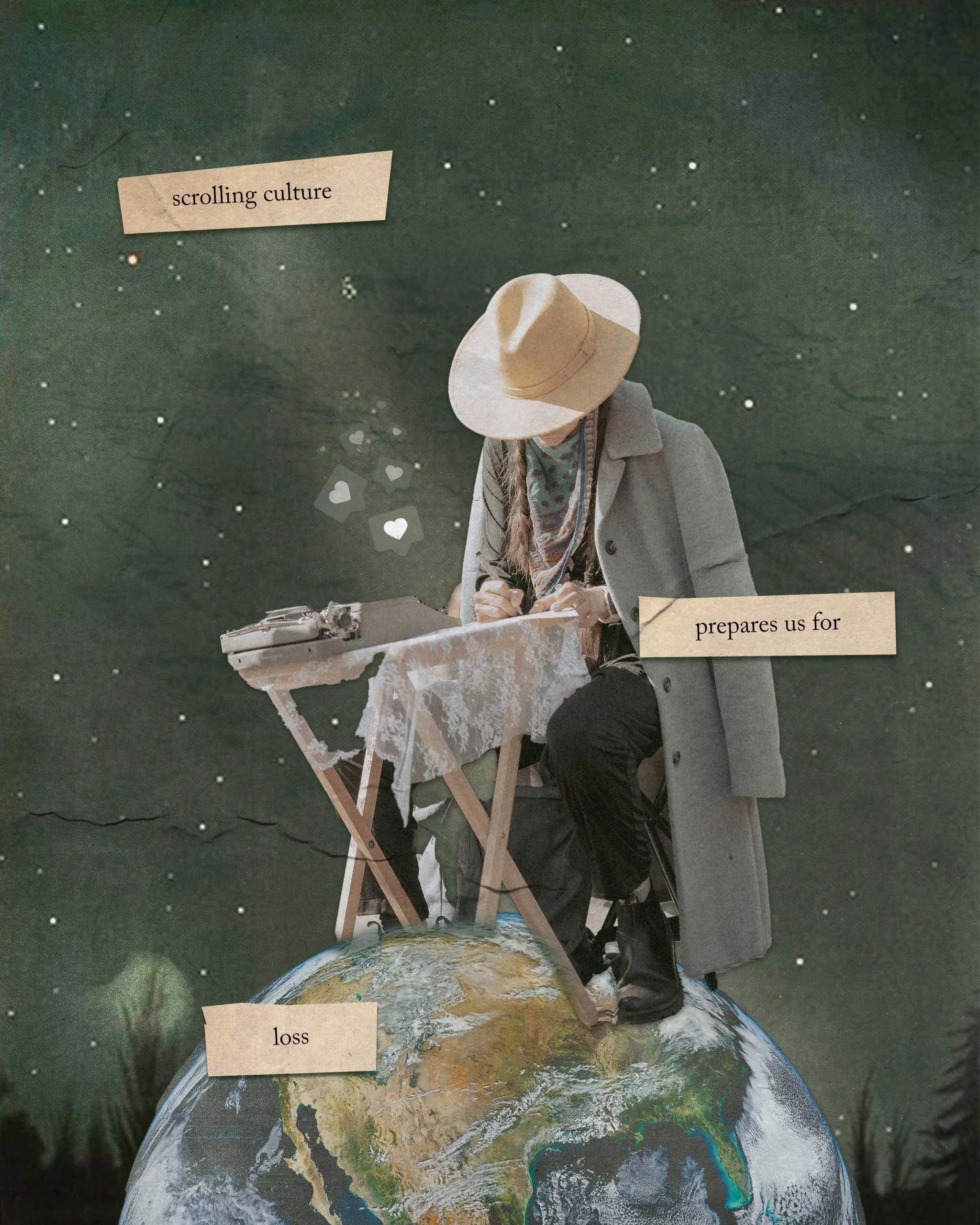
Artwork by Bea Lu
Deirdre Camba and Alfonso Manalastas turn to poetry to make sense of a world shaped by climate crisis, political upheaval, and technology.
Early this year, singer-songwriter Mitski released the anxiety-ridden anthem “Where’s My Phone?” where she intones, “I just want my mind to be a clear glass, clear glass with nothing in my head.” Bristling with dread, the song is a fever dream pitched to the extremity of a collective nightmare: that eerie panic when you’ve gone out, realizing your phone is left behind at home. What to do without it, these things that structure, make possible, so much of our lives?
Daily life has increasingly shrunk to the four corners of our screens. The ease, speed, and seamlessness that connect the digital and physical worlds can make our minds feel like clear glass: transparent, numb, soulless. More than ever, art, in its capacity to slow down our hyperactive attention spans, can offer a viable architecture for meeting this moment with a level-headed mind.
Poetry offers one vocabulary for understanding how this current moment has changed the way we think and the way we speak to one another. In the past year, two poets released debut volumes that propose, in their own characteristic ways, tactics to remain present and resist numbness, to sit with the uneasy and the ugly, and to possibly move forward into a shared space of solidarity.
In the 2025 collection A chain is a house to sleep in, published by indie press Everything’s Fine, Filipina writer and teacher Deirdre Camba constructs a poetry that’s self-conscious and bursting with humor, reckoning in the process with motifs of grief, pop culture, and the subconscious ways our minds have changed at a time when “brainrot culture” coexists, one scroll away, alongside international warfare and the climate crisis.
A Deirdre Camba poem often acts like a velvet-lined trap, mesmeric as it ensnares you into its thicket of hyperspecific references, sharp diction, and tragicomic emotional resonance. A poem called “mr. pogi 1996” typifies this funhouse mirror approach to poetry in which the titular character, Jericho Rosales, “proud son of Marikina,” momentarily offers the speaker solace in the midst of a torrential flood:
Meanwhile, our street is a riptide, and yes, the WiFi, in this Instapocalypse, is very good. We’ve made it with the fried rice and the hotdogs to the roof and so did YouTube where Jericho finds us in 4k: delirium between the top ten things to do in a disaster, he and his fast-acting Advil and cans of tuna and powdered milk which must be how the future tastes.
Instapocalypse: it’s a hodgepodge of a word that strangely rolls off the tongue with ease. It entwines these ideas of the digital and real, connectivity and catastrophe, somehow approximating the pervading mood of doomscrolling and mindless consumption that have shaped our relations: to the Internet, to the planet, and to each other.
Camba describes the word as a bit of a double-portmanteau: “I wanted to combine the idea of an ‘instant apocalypse’ and an ‘Instagram apocalypse.’” The word itself arrived to her viscerally: “I thought of the term ‘Instapocalypse’ while I was on the roof of my house, fleeing another flood in Marikina,” she says. “It was surreal because everyone was on their phones, acting normally, except we were all on the roof.”
Encapsulating these ideas into a single word, Camba sought “to capture the feeling of a doomsday that is much more immediate and faster-acting than we ever imagined.” On the flipside, the word also “highlights the absurdity of wanting to, or having the ability to, post about the end of the world on social media.”
The flood-prone city of Marikina is one of the threads that tie together Camba’s collection, and it is a prime setting to explore what it means to live through an Instapocalypse. “I was born into a flood, and I experienced it again as a teenager during Typhoon Ondoy,” Camba recalls. “When you survive something like Ondoy, you lose everything, and it feels like your memories are erased.”
For Camba, writing arrived like a force against loss, a form of keeping memory alive. “The compulsion to write was about investigating what was left of a place after it had been erased so many times.
“When you live through a crisis where you leave everything behind, you develop a mindset of: ‘I have to be okay if I lose everything the next second,’” Camba says. “If you want to survive an Instapocalypse, you have to be ready to lose things. It’s a violent way to live and perceive the future, and that gruffness is absolutely in the book.”
The barbed edges of Chain are part and parcel a response to this compulsion, but also to our digital lives today as we scroll restlessly through feeds and servers and move across internet tabs. “Scrolling gives us access to a fantasy we can’t have in real life, like imagining an ideal society in a K-drama while in the middle of a pandemic,” Camba says. “But the more sinister side is that scrolling culture prepares us for loss.”
Across Chain, Camba forges humor and grief, love and nostalgia, ferocity and fandom into a kind of armor against erasure and detachment. “You have something one second, and it’s gone the next; there are no consequences.” This conditioning, she posits, mimics what is happening on a larger scale with ecological tragedies: “It’s a toxic connection, but it helps you cope when you need a short memory to survive the real world.”
Loss, too, informs the Swedish practice of döstädning or “death cleaning,” a decluttering practice that reflects on material possessions, prioritizing the objects we pass down to our inheritors upon death, and letting go of the rest. In a poem titled “Swedish Death Cleaning,” the Butuan native poet Alfonso Manalastas reflects on death and the things we leave behind in the aftermath of catastrophe: “books / I have read from cover to cover, or // have not opened at all, / shoes I have inherited—each one / just a hollow space / to fill”.
In a conversation with Manalastas, who won the grand prize at the 2021 Maningning Miclat Award Poetry Awards for English, the poet discusses his 2025 poetry collection Factory of Alleged Virtues. Issued by Ateneo de Manila University Press, the book touches on grief and catastrophe, filtered through a perspective informed equally by lyricism and criticism. In a blurb, poet and professor Conchitina Cruz describes Manalastas’ poems as “clear-eyed studies for living the end times.”
Döstädning is one way to cope with end times, and across Factory, Manalastas searches for different forms of coping to make sense of a world hurtling towards doom, and finding solace in the struggle for solidarity. The city is one such form and so are travel, mythology, history. Like Camba, Manalastas invokes a speaker intellectualizing and parsing through a crisis that actively eludes itself, an apocalypse on the verge of short-circuiting our memory.
Manalastas grounds them in the experience of the self, with each chapter of the poem marked as a self-portrait. “I call each section of my collection a self-portrait of something because I hope it will hold up a mirror not only to how I experience and make sense of the world, but also to how the reader may find their own truths reflected back to them.”
Reflecting on the necessity of poetry as a catalyst for change, particularly in opposition to the growing use of artificial intelligence cutting through daily and professional life, Manalastas describes poetry’s potential for allowing us to look beyond the goals of productivity and output: “I think the magic of poetry is its ability to evoke feelings that are raw, primal, and arbitrary,” he says.
For Manalastas, writing poetry is to partake in the shared human condition: “When poetry is treated as mere data being synthesized by a machine, it makes it inherently incompatible not only with what poetry hopes to achieve for the reader, but also the process of writing poetry itself, which, to me, always begins with the lived experiences of the writer.”
During such a polarizing time when consensus on any political, ecological, or social issue seems nearly impossible, poetry can offer one way to cut through the noise and build community without settling on easy binaries. Manalastas channels this ambiguity by leaning into the various possibilities that crisis and emergency can offer, by asking: where do we find the yes in each no, the us in them?
Speaking about the collection’s title, Factory of Alleged Virtues, Manalastas describes that he sought to “build a larger collection on this imaginary factory that alchemizes different pejorative feelings like anger and grief and turns them into virtuous, palatable versions.”
One such interrogation appears in “A Study of Anger,” in which the speaker, caught in a “gunfire backdrop” with “wailing sirens” from Metro Manila traffic, refuses to sanitize his anger, rejects its more legible, socially accepted forms.
The Bisaya word for anger is sukô
I live in a city whose language
desecrates my native tongue
softens my anger inside a petri dish
and calls it surrender
There is no god in this city,
no benevolent one, at least,
only a bone-tired blue-collar worker of a god:
limping, aging, on the brink of losing his job
To stay with our anger is not to succumb to it, the poem suggests. The vital tension coursing through Manalastas’ poems has to do with the “the constant tug-of-war between surrendering to these so-called ugly feelings reared by the ugly injustices of the world, and being told that any resistance or reaction toward these injustices is unacceptable in any civilized world,” he says.
As both collections embody, reckoning with these hard feelings allow us the chance to imagine a life worth living and remembering. Despite the constant threat of erasure, violence, and destruction, Camba’s and Manalastas’ works persist as reminders of the grace that language offers.
Though the Instapocalypse rages on, these works provide a framework for understanding the injustices of the world we live in. They direct our anger and grief into something unlike clear glass: tangible, that which can withstand loss, something approaching community.
Frequently Asked Questions
Deirdre Camba calls “Instapocalypse” a word that combines “instant apocalypse” and “Instagram apocalypse.” It aims to capture the prevalent sense of dread and disconnection today, where the effects of war and climate change are felt immediately both on and offline.
Deirdre Camba is an instructional designer from Marikina City. She is the author of a chain is a house to sleep in (Everything’s Fine 2025) and the recipient of a Loyola Schools Award for the Arts in 2013. Her poems have appeared in Cordite Poetry Review, Ilahás, Voice & Verse Poetry Magazine, TLDTD, and more.
Alfonso Manalastas is a poet and the author of Factory of Alleged Virtues (ADMU Press 2025). His poem “Strange, Black Silhouettes” earned a Carlos Palanca Memorial Award for Literature in 2025, and his collection Country Underwater won the grand prize at the 2021 Maningning Miclat Poetry Awards. His poems have appeared in Busilak (UP Press 2020) and in various journals.
A chain is a house to sleep in is a debut poetry collection by Filipina author Deirdre Z. Camba. The books encompass pop culture, womanhood, and religious iconography, as well as themes of climate anxiety, class awareness, and the realities of living in Metro Manila.
Everything’s Fine is an independent, small-press bookstore located in the Philippines at 14 Tordesillas, Salcedo Village, Makati.