
Through Community and Soft Sculpture, Alma Quinto Creates Art for Healing


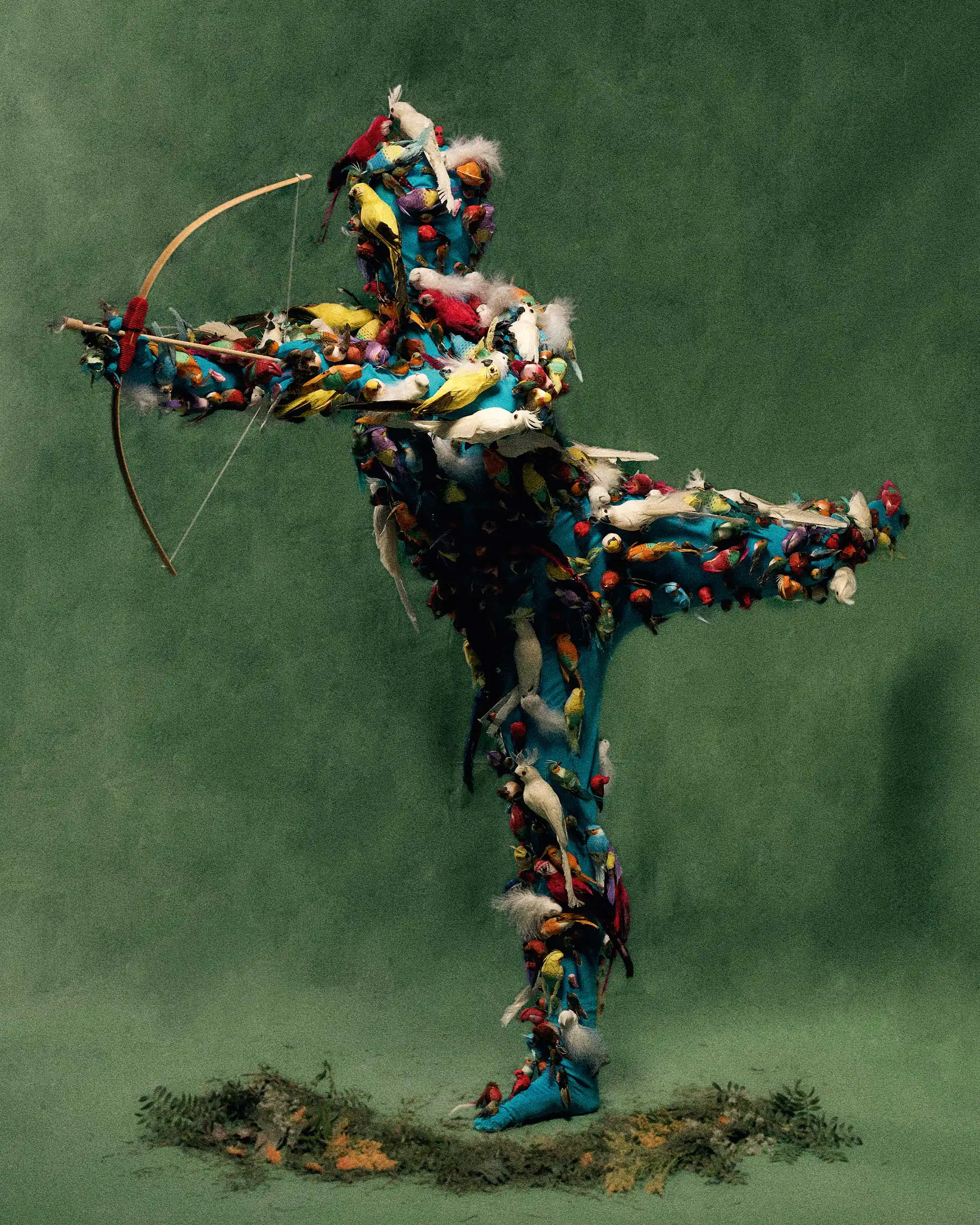
Photographed by Victoria Ruiz for the May 2026 Issue of Vogue Philippines
Alma Quinto’s art of care, memory, and the body.
There is something deceptively gentle about Alma Quinto’s work. At first glance, it invites you in: soft sculptures in bright, almost playful colors, textiles that feel familiar, even comforting. They resemble objects of care: beds, cushions, garments, things meant to be touched. But to stop there is to miss what they carry. Beneath the softness is something far more deliberate. A language shaped by memory, trauma, and the radical act of repair.
For Quinto, softness is not aesthetic alone, but method. “I chose to do it differently,” she says. “Using art as method… it’s always service through art.”
Born in Urdaneta, Pangasinan, and now back being based there after years in Manila, Quinto has spent decades working with disaster-affected communities, women, and survivors of violence, often far from the visibility of traditional art spaces. Her practice, sometimes described as social artistry, resists easy categorization. It does not neatly align with the commercial circuits of contemporary art, nor does it attempt to.
“It doesn’t bring in a lot of money,” she says. “It’s not art market but it’s something that’s good for your psyche.”
That refusal is not incidental. It allows her work to unfold on its own terms: slowly, relationally, and often outside the structures that define artistic value. In Quinto’s practice, art is not produced in isolation. It is built through time, the trust of a community, and through the careful negotiation of other people’s stories.
It also exists without the conventions many artists rely on. “I create anywhere,” she says. “In my kitchen, in my room, outside.” The absence of a fixed studio is not a limitation, but a reflection of how her work operates. It moves with her: into communities, into shared spaces, into environments where art is not something separate from life, but embedded within it.
Quinto’s turn toward textiles and soft sculpture marked a shift not just in medium, but in intention.
Initially trained in painting, she gravitated toward materials that could be touched, held, and manipulated. Fabric, foam, scraps often discarded or overlooked. These were not neutral choices. They carried histories of labor, of domesticity, of care. In her hands, they became tools for something more complex.
Her work with young survivors of sexual violence deepened this direction. “They had very difficult experiences,” she says. “And the very tactile soft sculpture can be a very good connection.”
The body, in her practice, is not an abstract subject. It is an archive, one that holds memory beyond language. For those who have experienced violence, touch itself becomes fraught. Reintroducing it requires precision, sensitivity, and time.
“Touch is actually very central to their experience,” she explains. “They were badly touched… and to be able to reconnect with their bodies, you have to do something that they can trust again.” Softness, here, becomes a strategy. It offers a way back, toward the body, toward sensation, toward trust.
This relationship between body, labor, and restoration extends beyond the Philippines. During her residency in Hong Kong, Quinto worked closely with migrant domestic workers, centering on the idea of rest, both as a necessity and as something often denied. On their single day off, many gathered in public spaces, carving out moments of reprieve within a city structured around their labor. “Rest is very important,” she says. “Otherwise they will get sick… they cannot work.”
Through collaborative workshops, Quinto invited the women to create soft sculptures and a collective book, visualizing what an uninterrupted day of rest could look like. The process was as important as the outcome. Some participants stayed through the night, working, talking, building, and finding a form of release in the act of making.
In this context, softness becomes more than healing from trauma; it becomes a reclaiming of time, of the body, and of selfhood within systems that often reduce both to function.
Her installations often appear visually inviting, their colors vivid, their forms almost playful. But this accessibility is deliberate. It creates an entry point before the weight of the work reveals itself. Viewers are drawn in, then asked to stay. In Quinto’s work, beauty is not merely decorative. It is structural.
To understand Quinto’s practice is to understand her resistance to authorship as a fixed idea.
Her work is collaborative by design, shaped through long-term engagement with communities affected by disaster, displacement, and systemic inequality. In these spaces, the artist is not the sole creator, but part of an ongoing exchange. “You’re like a medium,” she says. “It’s not something that you control.”
This approach challenges traditional hierarchies in art-making. It requires relinquishing control over outcome, allowing the work to evolve through collective input rather than singular vision.
In one community, children drew scenes of helicopters, burning homes, and displacement. Images drawn not from instruction, but from their lived experience. The results were immediate, unfiltered, and formally striking. “They learn from us, and we learn from them,” she recalls. “It’s a dialogue.”
This reciprocity extends beyond the act of making. It shapes how the work is exhibited, credited, and understood. Quinto has long insisted on naming collaborators, whether weavers, participants, or entire communities, pushing back against institutional tendencies to center only the artist. It is also what grounds her practice ethically. “You don’t see yourself as an authority when you go to communities,” she says. “You have to listen.”
Listening, in this context, is active. It involves restraint: Knowing when not to ask, when not to probe further into trauma. “If it’s so hard to open a wound, and you don’t know how to close it… they will suffer more,” she says.
Quinto’s work occupies an unusual position within the art world. Visible in international exhibitions, yet largely operating outside commercial frameworks. She has participated in major biennales and worked with institutions across Asia, Europe, and Latin America. Yet many of her most significant works, particularly those created collaboratively, are not for sale. “They are priceless,” she says.
This is not rhetoric. It reflects a fundamentally different understanding of value. The outcomes she prioritizes: Confidence, connection, healing. Things that cannot be easily quantified or commodified. Instead, they exist as lived transformations.
In a field where visibility often translates to market demand, Quinto’s refusal to reduce her work to objects for sale becomes a form of resistance. It preserves the integrity of the process and protects the communities involved from becoming subjects of extraction. “You don’t rush,” she asserts. “You respect the creators… and you don’t leave them behind.”
Back in Pangasinan, Quinto is building a space that reflects the evolution of her practice. A site for workshops, exhibitions, and organic gardening, where art intersects with learning and sustainability. More than a studio, she sees it as an ecosystem.
Her decision to leave Manila and return to her hometown was not framed as a retreat. Rather, Quinto sees it as recalibration. Away from the density and pace of the city, she has found a different rhythm. One that allows her to work with intention.
And yet, the work continues to travel. Curators still find her. Institutions still invite her. The visibility she once stepped away from returns, on its own terms. “If you believe in your art,” she says, “it will happen.”
In a world that often rewards the tough, the swift, and those who revel in spectacle, Alma Quinto’s work insists on something else. Something slower. Something deliberate. Something that refuses to be forgotten.
Frequently Asked Questions
Alma Quinto is a contemporary Filipino visual artist, educator, and cultural worker born in Urdaneta, Pangasinan. Since the mid-1990s, she has dedicated her practice to socially engaged art, working with marginalized communities, survivors of natural disasters, and victims of violence to empower them through creative expression.
Quinto’s approach is process-based and collaborative rather than expert-led. She acts as a facilitator, creating a safe space for participants to externalize their experiences through mediums like soft sculpture, embroidery, sewing, and even cooking. By prioritizing the act of making and sharing over the final product, she helps communities process trauma, reclaim their agency, and build social bonds.
Quinto transitioned to textiles and soft sculptures because these materials are tactile, familiar, and comforting. For survivors of violence or disaster, the ability to touch and manipulate materials can be a powerful tool for reconnecting with the body and sensation in a safe, controlled manner, helping to bridge the gap between internal trauma and external expression.
Her impactful projects include Soft Dreams and Bed Stories (2003), a collaboration with girl survivors of violence; House of Comfort (2007), which addressed trauma in disaster-affected areas; and the Floating Wombs Project (2013), which focused on disaster preparedness. She also led the Day Off Mo? project in Hong Kong, centering on the necessity of rest for migrant domestic workers.
For Quinto, art in disaster recovery is not about decoration; it is structural. She believes that creative workshops allow survivors to liberate themselves from negative experiences by turning their lived realities into stories. These workshops often encourage participants to share their creations with one another, fostering a sense of unity, validation, and collective strength that helps the community move forward together.
- Fashion by Bottega Veneta, Jude Macasinag, and More Find a Fitting Sense of Place in Venice
- How Indigenous Women in Bolivia Are Reclaiming Their History With Their Clothes
- Ahead of the 2026 Met Gala, We Assembled a Stellar Lineup of Creatives in Fashion Worthy of a Museum
- From Horse Barbie to Dolls, Geena Rocero Has Lived Life as a Storyteller