
Watch: In The Studio with Ambeth Ocampo


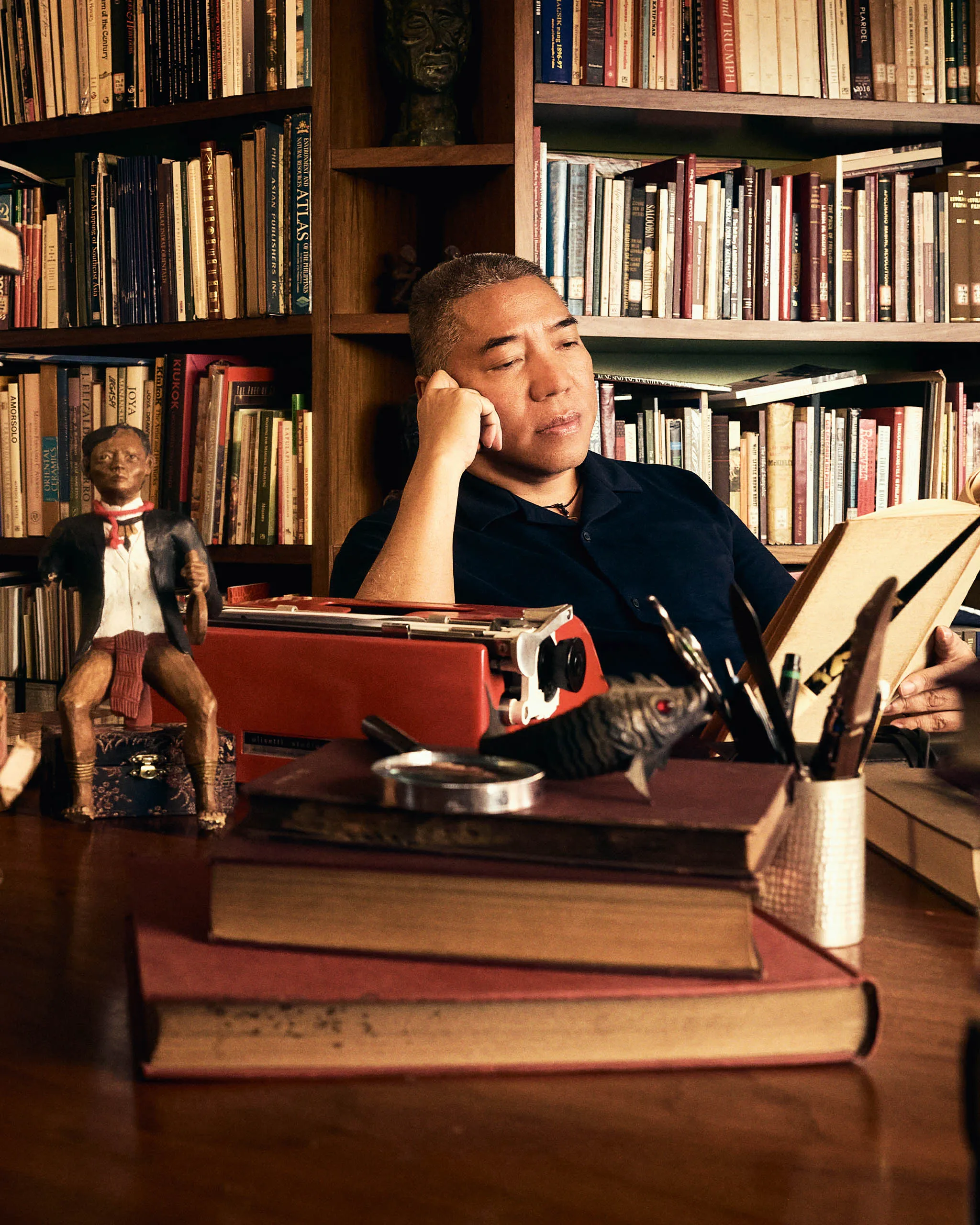
Photographed by Gabriel Nivera for the February 2026 Issue of Vogue Philippines
For In The Studio, Filipino historian Ambeth Ocampo opens his home study, where he speaks on his approach to humanizing national heroes, his digital archiving efforts, and using humor as a bridge to the next generation.
In the center of his library, Ambeth Ocampo sits between a cluttered work table and a line of floor-to-ceiling bookshelves, where volumes sit next to carved wooden busts and plush toys collected from years of travel. There’s a gleam in his eyes as he swivels on an ergonomic dentist stool, a piece of furniture that seems out of place, but nonetheless captures his personality: practical and playful at the same time.
“I always tell people that I enjoy the research process. So you can leave me in a library, and I can stay there for days,” he says. “Just getting the material, that’s the fun for me.”
In this episode of In The Studio, a series that follows artists in their creative spaces, Ocampo opens his home study to Vogue Philippines and speaks on the path to becoming a public historian, the legacy projects he’s currently working on, as well as the objects in his space that connect him to his studies: various keepsakes from national artists, a foto-oleo of his mother, a lock of Apolinario Mabini’s hair (a man whose biography he hopes to write one day), and more.
The discussion takes him back to the start of his journey. As a journalist for Weekend Magazine in the ‘80s, Ocampo saw how stories moved from draft to publication through literal cuts and pastes. He recalls observing the details that made information entertaining, the anecdotes that made personalities familiar and relatable. “It was chismis (gossip),” he says of the writing style, “but that was how you engaged the public.”
It’s a skill that has become instinct for the practicing historian, who has built an over four-decade career in publishing, teaching, curation, and cultural administration. In that time, his goal has remained constant: to offer people an engaging entry-point into the minds of our nation’s past: “Going to our heroes and not writing about them as monuments or fossils in stone and marble, but I wanted to see what they were like in person.”
As he tours the team around his study, conversation moves seamlessly between past and future. Among his ongoing plans, Ocampo shares that he’s working on a new book about unusual characters in Philippine history, as well as a digital archive for future José Rizal scholars. He also recounts memories of starting his long-running newspaper column “Looking Back,” now in its 36th year, and teaching at Ateneo de Manila University, where students remember lessons through his “funny stories.”
“It is humor actually that is my main weapon,” he admits. “I’ve always learned, whether it’s a reader or it’s a bored freshman, when you make people laugh, the defenses are down and you are able to get your message across.”
Watch the full episode of “In The Studio with Ambeth Ocampo” below.
Videographers: Ken Tan and Geralde Bustamante of Chapters PH. Video editors: Dhezirhae Viclar-Nazal of Chapters PH and Aija Lonica. Media Channels Editor: Anz Hizon. Media Channels Producer: Angelo Tantuico. Media Channels Video Lead: Wainah Joson. Chapters PH Team: Liah Barra, Patrick Juarez, and Roger Valenzuela. Interview and introduction by Aylli Cortez.
Frequently Asked Questions
Born in Manila in 1961, Dr. Ambeth Ocampo is a public historian, author, and academic whose work covers national heroes and political leaders in Philippine history, namely José Rizal, Apolinario Mabini, and Antonio Luna, as well as a broad range of cultural topics in modern history.
Ambeth Ocampo is best known for his approach to humanizing historical figures through his writing and teaching styles. Across his publications, lectures, and social media, he offers the public a glimpse into the thoughts, feelings, and everyday lives of past figures, supported by primary evidence.
Ambeth Ocampo’s influential works include his regular newspaper columns, which were compiled into the best-selling books, Looking Back and Rizal Without the Overcoat, of which the latter won a National Book Award for essay in 1990.
Ocampo considers humor his “main weapon.” He believes that by using humor to make people laugh, he can lower their defenses, making them more receptive to historical lessons—whether they are readers of his columns or bored students in a university classroom.
Beyond his ongoing teaching and writing, Ocampo is currently developing a new book about unusual characters in Philippine history and is dedicated to creating a digital archive for future José Rizal scholars, ensuring his extensive research remains accessible.