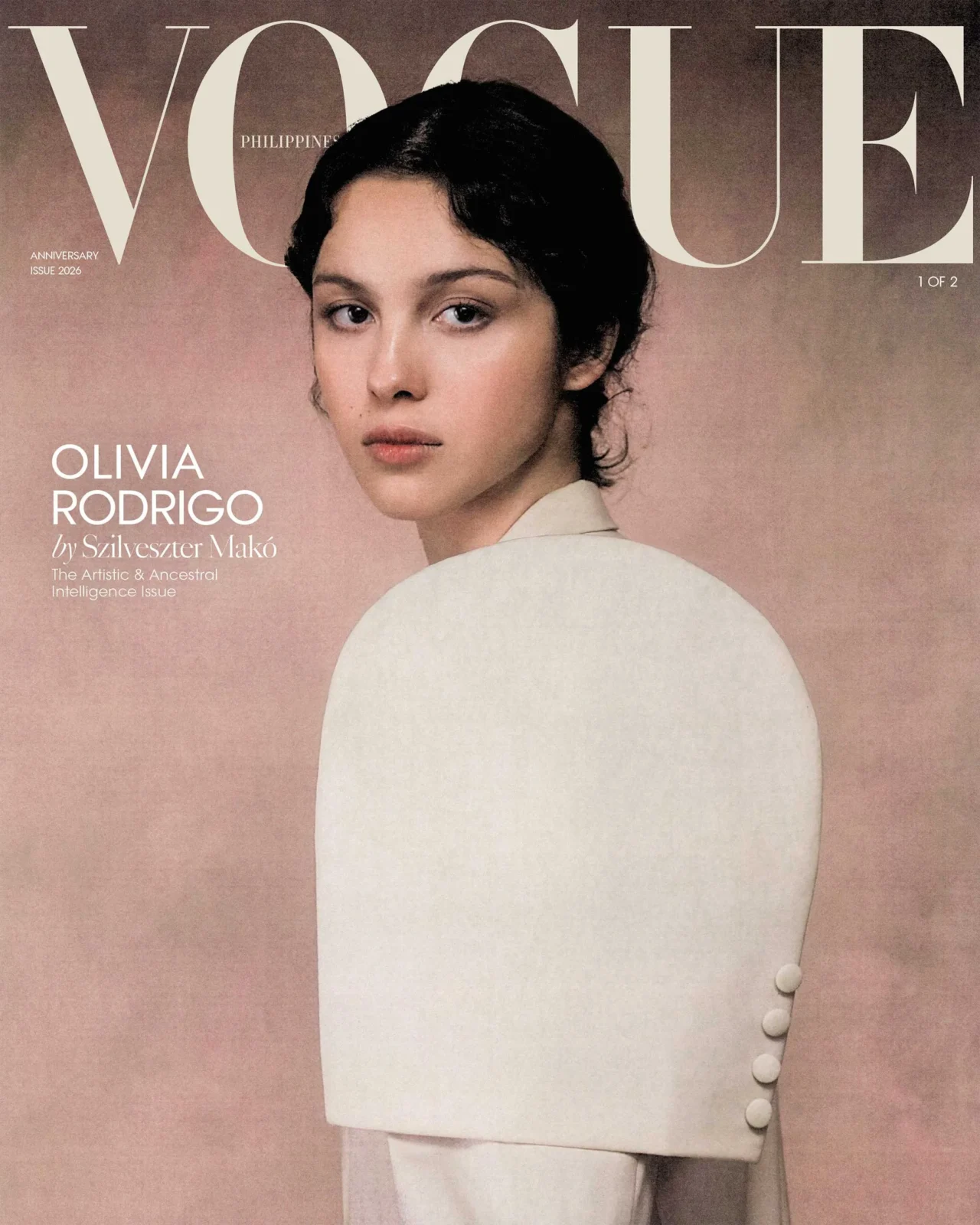
Olivia Rodrigo Is Vogue Philippines’ September/October 2026 Cover Star


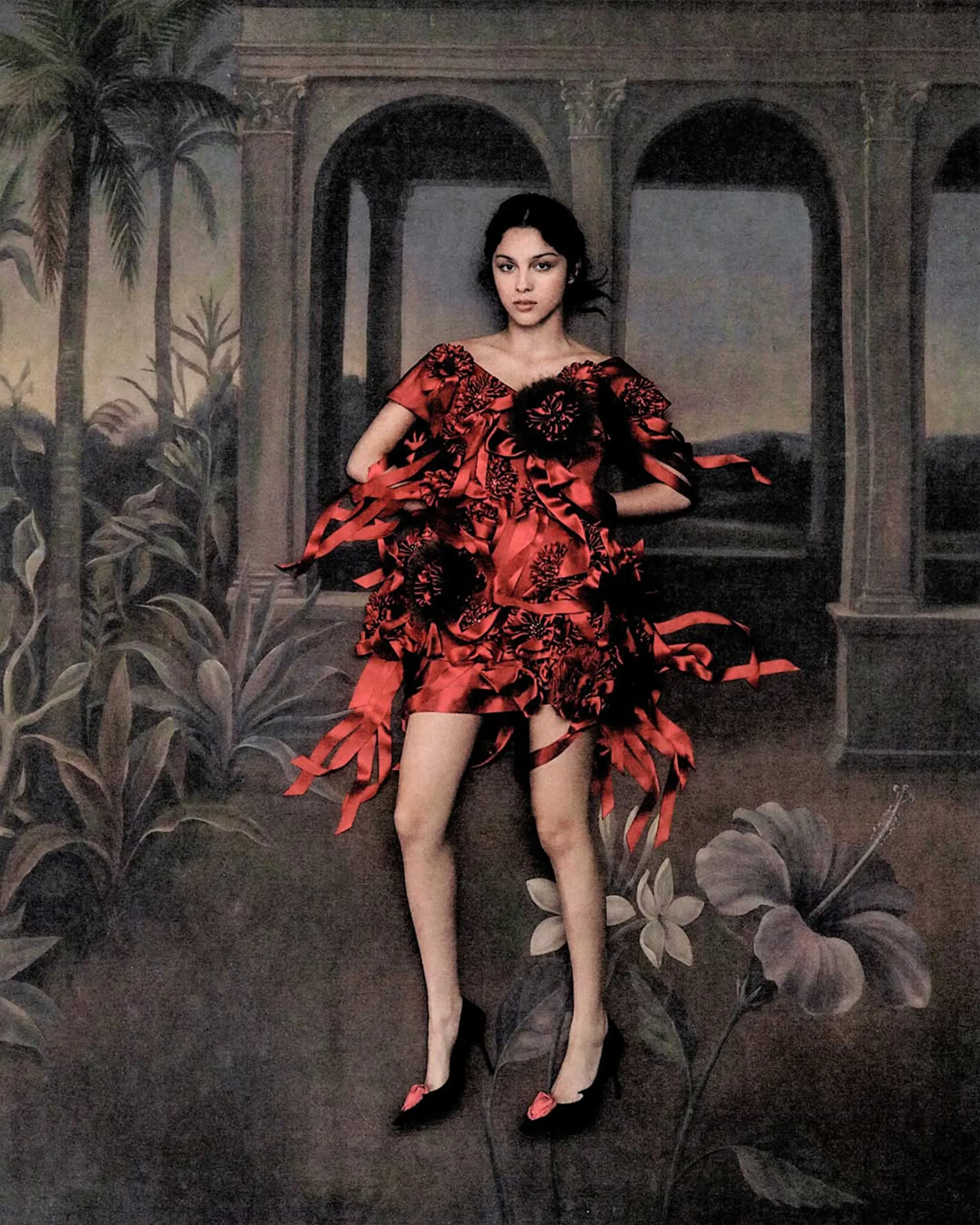
Olivia Rodrigo wears a SIMONE ROCHA dress and ROGER VIVIER shoes. Photographed by Szilveszter Makó for the September/October 2026 Issue of Vogue Philippines
On a scorching July day, forecasted as the hottest of the week, a group of editors of Vogue Philippines found ourselves in a freezing studio warehouse in Brooklyn. We set out from Midtown Manhattan at 7 A.M., our call time four hours before we expected Olivia Rodrigo to arrive.
For the editorial team, this day marked the culmination of three years of conversations and proposals to feature the superstar singer in our pages.
In the course of the morning, the four-hour lead time started to make sense. We had looked forward to working with photographer Szilveszter Makó. In today’s highly digital world, he creates his sets the old-fashioned way. Through research, and paint, and canvas, and a production crew on standby to retouch and render his bond-paper sized paintings into blown-up larger-than-life versions, all under his watchful eye, all to his exacting specifications.
The work for this shoot began in earnest two months earlier. After a year of back-and-forth messaging with Pam Quiñones, our deputy editor, Szilveszter finally found a project he wanted to undertake with Vogue Philippines.
A week before our shoot, Szilveszter spoke to us from Shanghai, where he had traveled from Italy. He had just spent time at the Uffizi Gallery. He spoke to us about Dürer. We sent him a deck, a bit of a primer on Philippine culture. He used these as starting points. He then proceeded to create a world entirely his own, a fictional landscape to situate Olivia Rodrigo for Vogue Philippines.
As the day progressed, we witnessed Olivia lying on Szilveszter’s painted surfaces, his imaginary hills, and he shot her from above.
At approximately the same time that we started preparing for the shoot, the team asked ourselves what the premise of our September issue would be. Always an important month in the fashion calendar, September also marks the magazine’s anniversary. This year, we celebrate our fourth.
We asked ourselves where would we go next? We asked ourselves, in today’s world, what exactly does AI mean to us?
We began to think beyond the most obvious answer. In an age increasingly defined by artificial intelligence, we wanted to consider other forms of intelligence. AI as artistic intelligence, born of imagination, intuition, and the impulse to create. AI as ancestral intelligence, knowledge accumulated over generations, brought forth by memory and tradition.
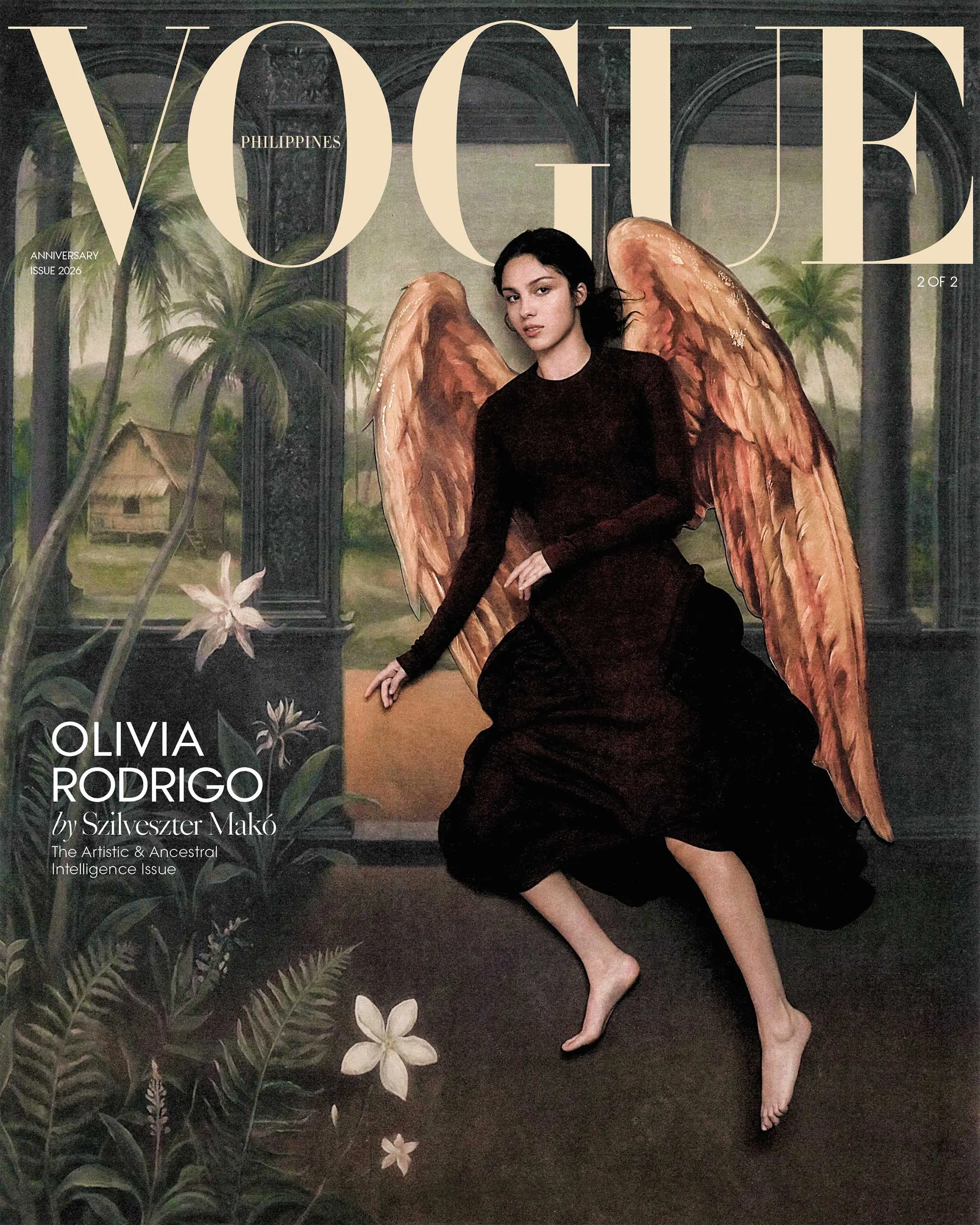
These ideas came together in the stories we gathered for September 2026. In some instances, illustrating exactly the juxtaposition of the high tech and the traditional that has defined our present.
Rug designer Iñigo Elizalde tells us, for instance, how a computer glitch led to a pattern for a carpet painstakingly hand-knotted in Nepal. The concept for another collection came from collected photographs of laser lights at raves and music festivals. “Every square inch is a hundred knots made by human hands. So that in itself is a thing of wonder.”
After a decade away, artist Michelline Syjuco returns to her line of wearable sculpture. She welds and hammers metal, allowing materials and accidents to lead and surprise her. She discovered the Bungisngis, apparently the mythical Filipino cyclops. “At a certain point, the art starts making itself,” she says. “The challenge is to make something that AI has no access to because it hasn’t yet been made.”
In an age obsessed with generating more, we celebrate the slower, older, embodied ways in which human beings create and discover meaning.
This includes the ability to question the information we’ve been given, as Maia Cruz Palileo does, when they perused and gathered their family archive.
In the essay, “The First AI,” features editor Audrey Carpio asks us to consider ancestral intelligence not simply as information to be accessed, but as something lived, something we acquire over time, passed from one generation to another. Communities hold this knowledge collectively, and keep this alive through practice. Arnis, the age-old Filipino martial art we also explore in this issue, offers perhaps its most literal expression. This is a sport whose knowledge is carried by the body, learned through repetition, and transmitted from master to student.
Olivia Rodrigo embodies much of what we are trying to impart. She touches countless lives through the music she makes, music that harks back to the songs she grew up with, what her parents listened to. She finds kinship with Robert Smith of The Cure, an outsider and original, far from mainstream in the 1980s when Michael Jackson and Madonna ruled the airwaves. She draws from her “inner well of inspiration” and searches for the best way to sing about love.
That search for love has preoccupied poets and minstrels, musicians, and thinkers for centuries, from Homer to Shakespeare, to Biag ni Lam-ang and Florante at Laura, to the Eraserheads and Olivia. Artificial intelligence may keep transforming the world around us, but what we long for remains constant.
In this story: Photography and Art Direction by Szilveszter Makó. Styling by Lisa Jarvis. Deputy Editor: Pam Quiñones. Casting Director: Jill Demling.