
Tad Ermitaño Constructs a Panoptic Reality in Somatodelic


Courtesy of Ateneo Art Gallery
Courtesy of Ateneo Art Gallery
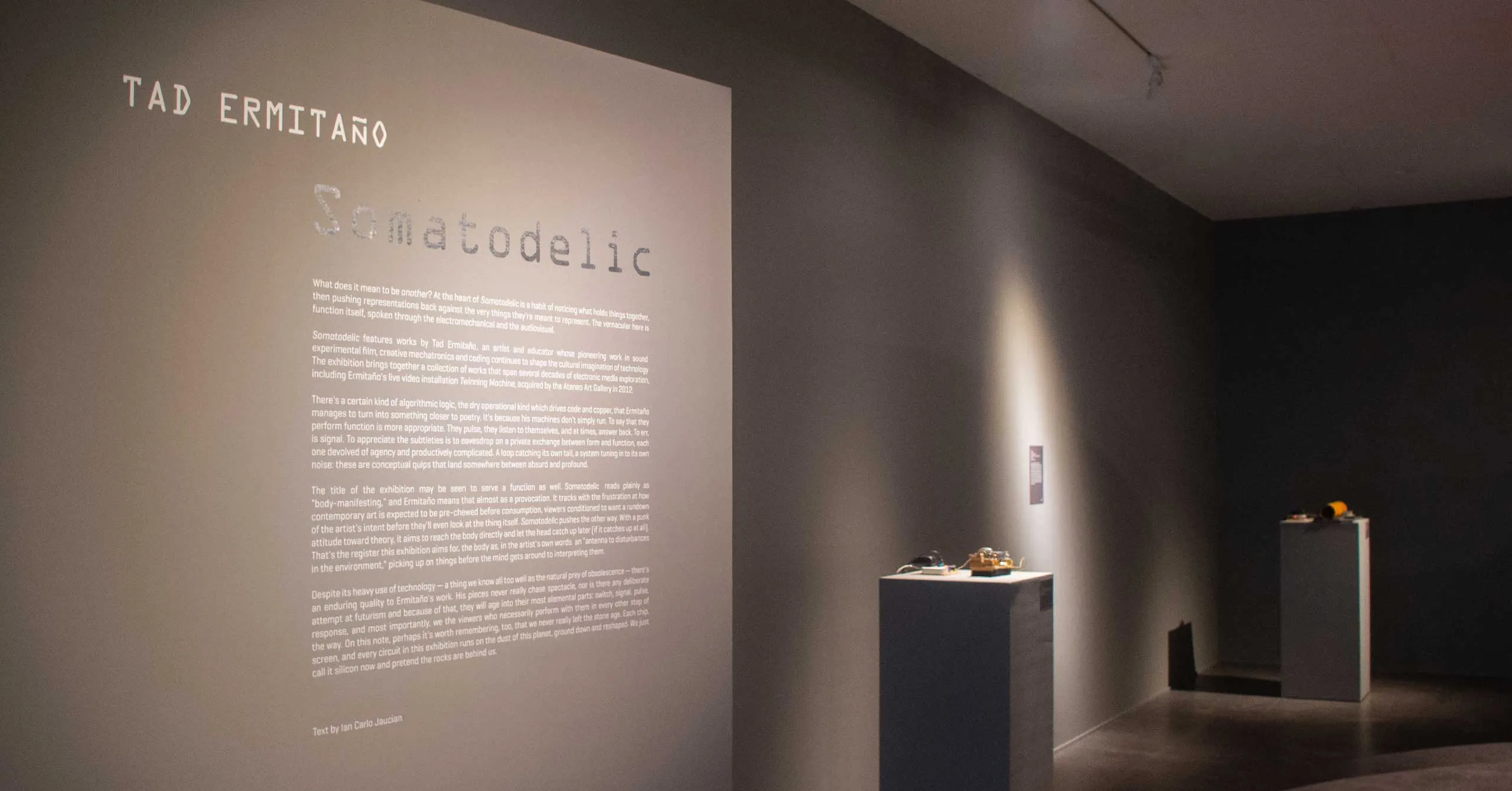
Tad Ermitaño overwhelms the senses in Somatodelic, an unnerving exploration between machine and body.
Before one can even set foot into the exhibit, a loud, droning hum emanates throughout a dimly lit room. What hangs at the center is a cylindrical metal sheet, titled Bell. Hooked to an electromagnet, it transforms surrounding vibrations into a low, eerie groan that reverberates across the floor. As these all-consuming sounds occupy the ear, Ermitaño uses technology as a site that instills the senses both with anxiety and uneasy curiosity.
Departing from popular depictions of technology as mystically distant and futuristic, his work exemplifies that the panopticon of the digital world is now held together by cameras, switches, and algorithms.
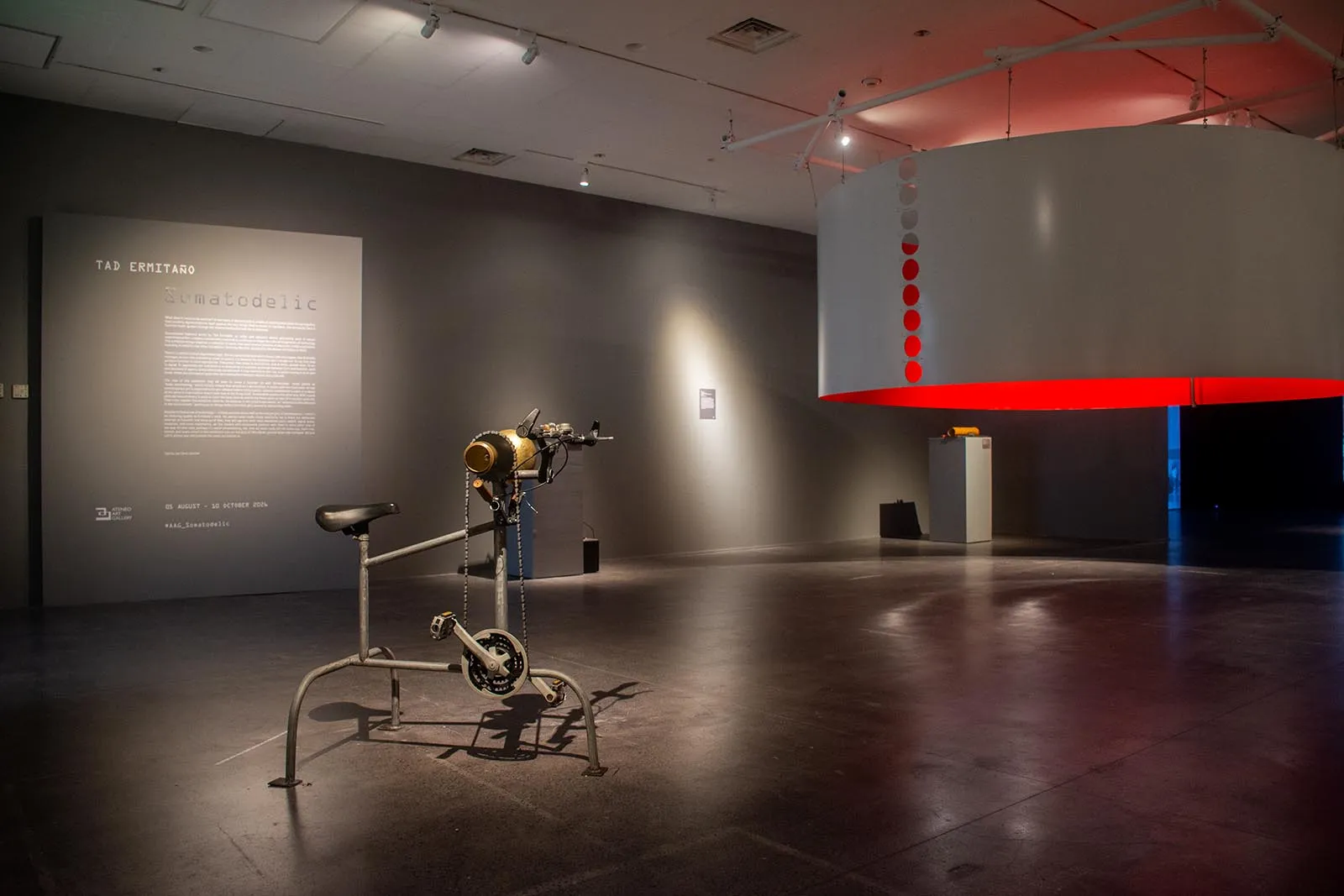
As a recognized pioneer in sound art and media art, Ermitaño has always been fascinated with the structures and semiotics that create the dynamic between machines and humans. His latest exhibit, Somatodeclic, which translates to “body-manifesting,” invites viewers not to interpret each piece based on an ascribed meaning but what feelings stir upon each interaction. Leading with the idea that the body acts as an “antenna to disturbances in the environment,” his creations elicit a reaction before the mind can rationalize a response, making for an embodied experience.
Drawing an intimate connection between the body and machine, Ermitaño urges visitors to interact directly with his apparatuses. As visitors hold and tinker with the objects, he establishes Somatodelic’s fundamental logic: that technology will always be tethered to the physical world, reliant on how people choose to engage with it.
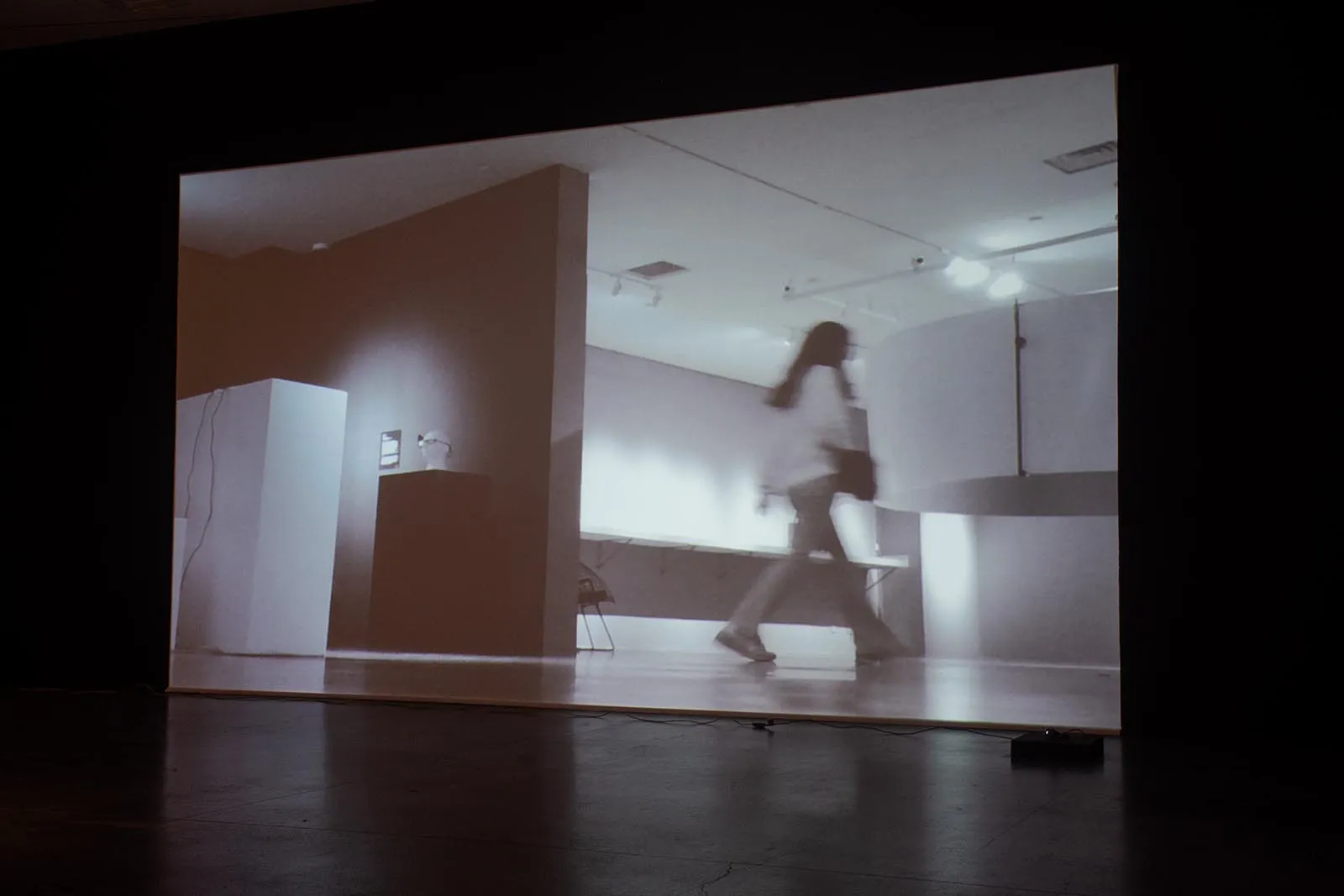
Still, the perceived control and understanding over the algorithmic logic of his pieces stutters as people roam deeper into the exhibit. Upon entering the archway that divides the room in half, a camera records the entryway. Displayed on a projector screen is distorted footage that plays in a disorienting loop, glitching and warping into what he calls an anti-mirror. Existing at a time where technology plays an increasingly invasive role in enveloping private life, Twinning Machine Ed. 1 of 25, makes clear how easily wayward a camera’s lens can become.
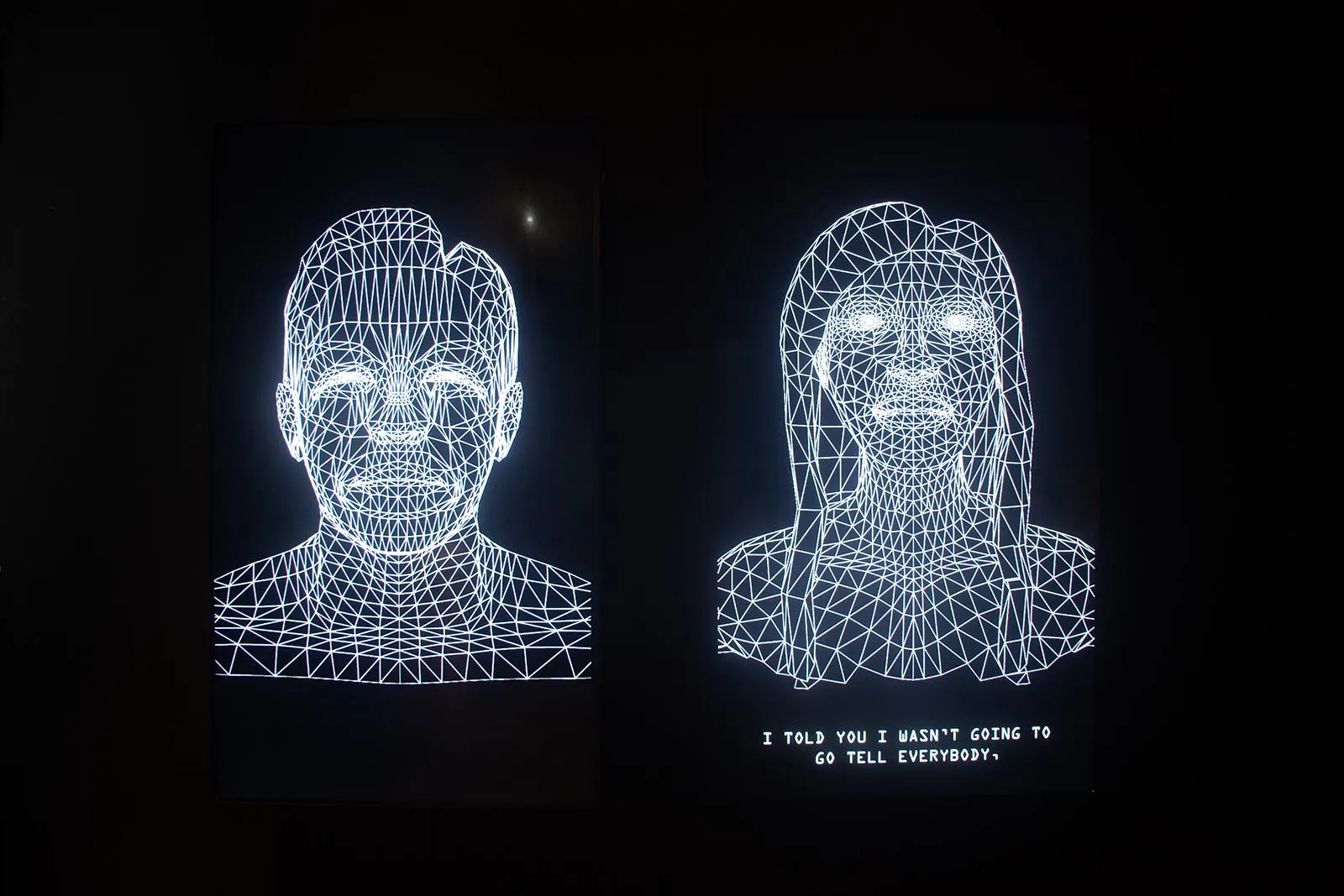
Even more encroaching is a recording device’s capacity to archive moments meant to be kept personal. In 1983, journalist Hermie Rotea published a transcript of President Ferdinand Marcos’ torrid affair with American actress Dovie Beams in her book Marcos’ Lovey Dovie. Imagining their bedtime conversations as a forensic reconstruction processed through text-to-speech, Sex to Speech provides a robotic reenactment of the two lovers, their faces represented by facial imaging. By computerizing the uninhibited exchanges between the two, the recording outlines a worrying implication for people. While surveillance software can expose two public figures, who’s to say such tools can pull back the curtain of our own private lives?
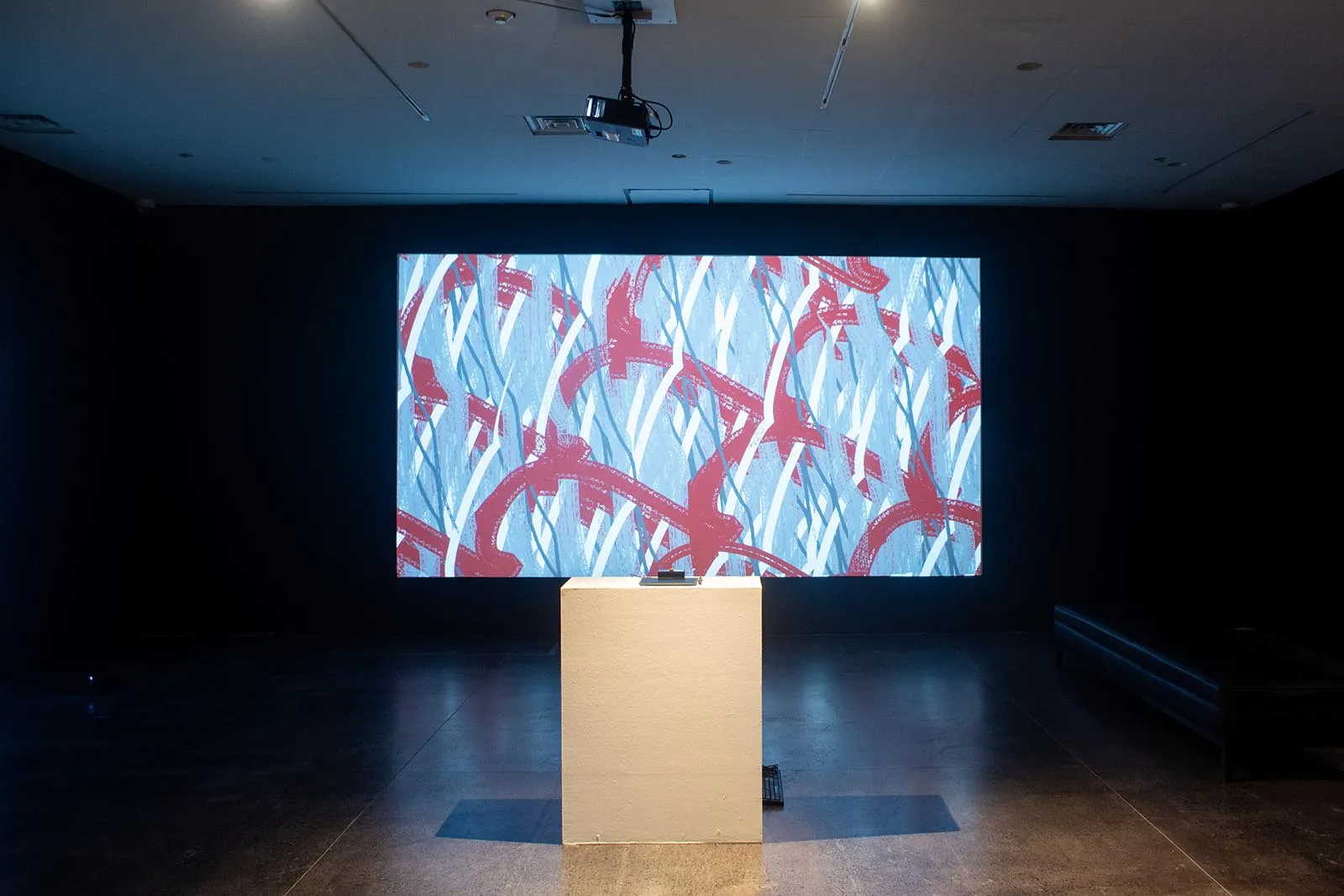
This fundamental skepticism of technology continues in his other works, namely Sammy and the Sandworms, where participants are free to make brushstrokes using a drawing pad. Each line and swirl takes a life of its own, emitting its own sound and multiplying at random. While the strokes themselves are predictable, the program is not. As the interactive takes on a life of its own, it examines who leads the creation-making process: the person who draws the first line, or the computer that metamorphosed it?
Prolonging Sammy and the Sandworms’ program run eventually creates an unbearable sound that overpowers the ambient noises of the other pieces. However, a simple switch at the top of the drawing pad resets the interactive, serving as an immediate reprieve from the dizzying noise. In this interactive, Somatodelic provides visitors with a kill switch, both literally and figuratively.
As people continue to question the role technology plays within our lives, Ermitaño’s collection touches upon the inevitable surveillance culture that emerges alongside innovation. While each work shows an impressive, albeit worrying, display of engineering, his machines are ultimately held together with circuits and switches, all of which can be taken apart at any moment.
Tad Ermitaño’s Somatodelic is currently on view at the Wilson L Sy Prints & Drawings Gallery, 2F Ateneo Art Gallery (AAG) from 5 August to 10 October 2026.
Frequently Asked Questions
Tad Ermitaño is a Filipino artist that specializes in experimenting with sound and media art. As a prominent figure in new media art, he is considered a pioneer in creative mechatronics, film, and coding.
Somatodelic is an immersive art exhibit that aims to explore how the humans engage and make sense of modern technology through their senses.
Somatodelic will be availble at the 2nd Floor of the Ateneo Art Gallery (AAG) from August 5 to October 10, 2026.
Tad Ermitaño has had multiple exhibits prior to Somatodelic including PROTOTYPE, an exhibition that ran from May to June, 2025 at the PABLO galleries in Bonifacio Global City (BGC).
Visitors can expect to hear a series of ambient noises from the actual pieces, and are encouraged to directly interact with selected pieces from the collection depending on the artist’s intstructions.