
Meet Corazon Garcia, the BBC’s First Filipino Weather Presenter


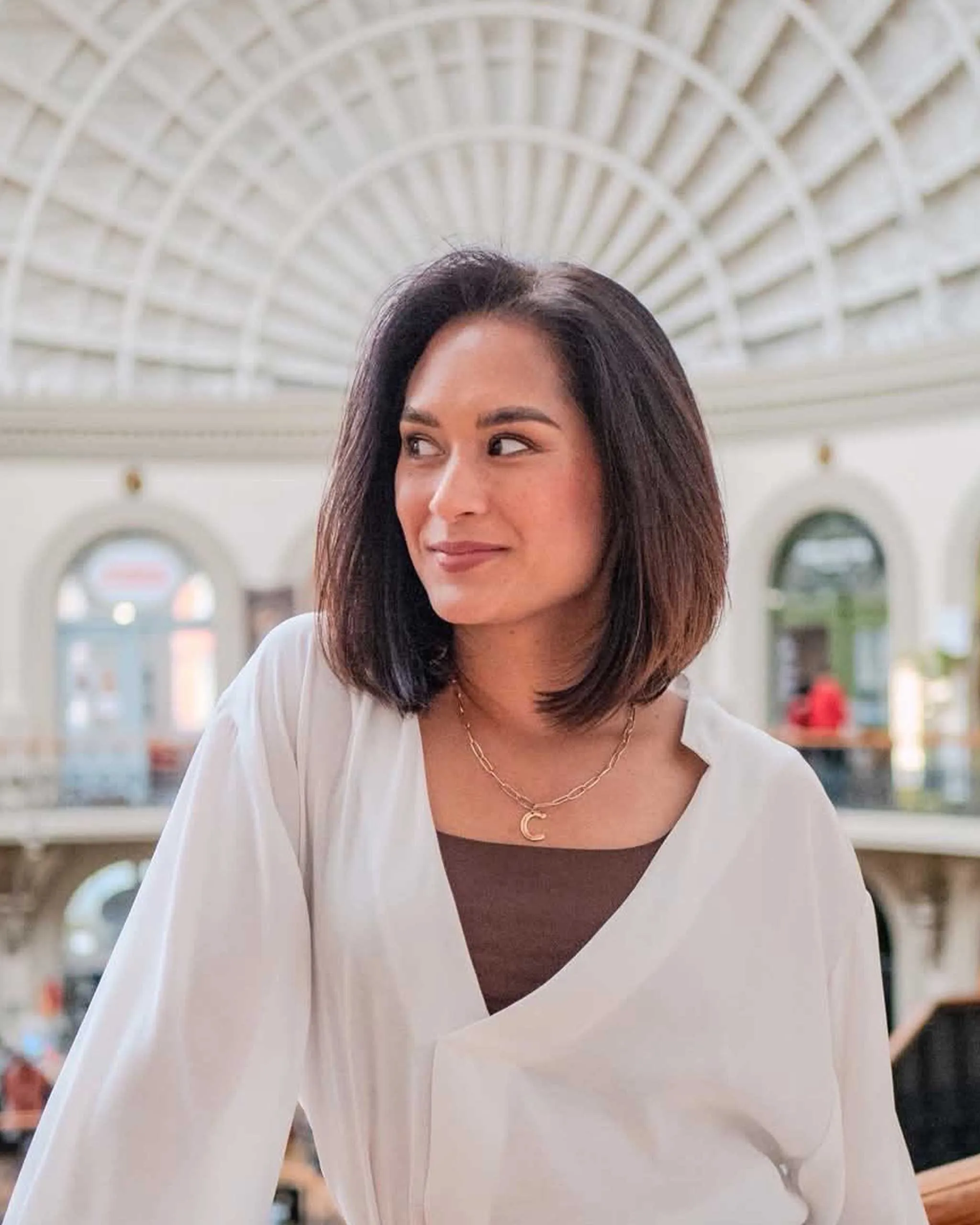
“We’re all about cheerleading other nations… and we’re always in other countries serving people, but actually, I think it’s about time to serve ourselves.” Photographed by Cameron Davidson, courtesy of Corazon Garcia
From growing up in a Filipino family in East London to building a career in British broadcasting, the journalist reflects on family, identity, and what it means to see yourself represented.
Around 4 AM, while getting ready for her shift in hair and makeup, Corazon Garcia would watch fellow Filipino broadcaster Rico Hizon present the news live on television.
“He was great. He had such a big personality. Really quite jolly, quite happy disposition,” says Garcia over a video call during her lunch break at The Markets in Leeds. Hizon was the first Filipino anchor for BBC World News, and for years, Garcia had never seen another Filipino face on screen. “I would have jumped out of my skin!” she says.
Today, she is the BBC’s first Filipino weather presenter, a distinction she never set out to achieve, but one that carries a badge of honor after two decades in the elite industry. More than half of British journalists are privately educated, despite private-school pupils making up just 7% of the UK population, placing Garcia among the minority. She grew up in preregeneration Stratford, raised by Filipino parents who had arrived in Britain in their early 20s, long before the Olympic Park, V&A East Museum and Sadler’s Wells East transformed the area.
Her mother grew up in Santa Ana, Pampanga, before taking on domestic work as a nanny and later studying nursing. Her father, from Pangasinan, arrived in Britain with few formal qualifications, taking his first job as a pot washer in a London restaurant. A colleague encouraged him to train as a cook, launching a culinary career that took him to the ritzy kitchens at Harvey Nichols, The Savoy, Café Rouge, the Hilton, and the Oxo Tower.
“When they came over to England, obviously, it was their prerogative to work hard, study hard, earn money, and send the money home,” Garcia says, describing the universal responsibility shared by millions of OFWs around the world. Her maternal grandfather was a rice farmer, while her grandmother raised 14 children. Her father was one of 13 siblings, and as the eldest children, both of Garcia’s parents learned from an early age what it meant to contribute financially to their families.
It was a childhood shaped by tight-knit family ties and the gritty realities of London’s East End. Garcia remembers being aware of crime in the area, though her parents shielded her as best they could. “When you’re a kid, you have no fear,” she says. “Even though I was living in it, my parents did really well to protect me from it.” She also describes herself as “dead nosy.” While her father envisioned her becoming a lawyer, Garcia was drawn to creative expression from an early age.
She began dancing at four, studying ballet, tap, modern jazz, and contemporary dance, even auditioning for West End productions like The King and I and Miss Saigon. But performance was only one outlet for her curiosity. She loved reading and was fascinated by global current events. “I’d ask all the questions all the time,” she says. “But why is that happening in that country? Why are they doing that? Why are they at war?”
That instinct to probe and inquire eventually led her toward journalism. “I didn’t go down the lawyer route,” she says. “But I was also creative, and I was really interested in the world, so I guess that’s why I landed in journalism.” She spent years in commercial radio, working for stations like Heart, Kiss FM, Magic, and Trent FM, before transitioning to the BBC across Nottingham, Derby, and Lincoln.
The shift to public broadcasting was a cultural adjustment. “I came from a commercial background,” Garcia says. “When I made the crossover to the BBC and walked into that newsroom, it felt very corporate for me. Very businesslike.” Rather than changing herself to fit in, she doubled down on her origins. “I fully embraced being from the East End of London, and I speak the way that I speak,” she says.
After developing her transferable skills in radio news, production, and presentation, Garcia found a natural home in weather. She had always gravitated toward the subject alongside her media pedigree. “As well as being creative, I really love sciences and geography. So it kind of was calling me.”
Garcia trained in meteorology with senior weather presenter Darren Betts and in broadcast graphics with Simon Hunt. These days, her early mornings are spent studying pressure charts and forecasting models, translating complex meteorological data into an engaging story for viewers. “It’s my job to piece together a story about what the weather’s doing,” she explains.
As a mother, the nature of her occupation makes her hyper-aware of climate change and the weather her children will experience as they grow up. In her bid to do her bit for the environment, and because the BBC does not provide her clothes, she sources her on-screen wardrobe herself, with one obvious restriction: she cannot wear green because of the green screen.
Instead, she sources her entire wardrobe through Vinted, the European equivalent of Carousell. “I love the thrift shop,” she says. “There’s something quite exciting about finding something, whether that’s a vintageVintageClothing and accessories from an earlier era, generally at least twenty years old, that reflect the style and craftsmanship of their time. Vintage pieces offer unique character and often superiorGo to Vintage Glossary piece or, you know, hasn’t gone to landfill, and you’re rescuing it.” She applies the same approach at home, where her sons’ clothes are often bought secondhand or passed from one child to the other.
Even 6,750 miles away, staying connected to the Philippines remains just as important. She visited regularly as a child, and she’s eager to give her sons that same sense of grounding. She speaks Tagalog at home, takes them to the annual Barrio Fiesta, and introduces them to comfort foods like arroz caldo, sinigang, and lumpia. Above all, she encourages them to embrace their dual heritage: “I say to [my kids], ‘You are not half of anything… You are mixed, Filipino and white, but you are not half anything. You are a full person.'”
Growing up in Britain, Garcia saw Filipinos represented through professions like nursing, hospitality, domestic work, and seafaring. Artists like Bruno Mars, Apl.de.ap, and Lea Salonga, her childhood idol and a “living national treasure,” offered a powerful alternative, proving Filipino talent could command global stages, inspiring Garcia so much that she later personally lobbied her BBC newsroom to cover her. Right now, that creative lineage continues with stars like Olivia Rodrigo, whom Garcia admires for proudly claiming her heritage “from the jump off.” “We’re so much more than that,” Garcia says. “We’re a very creative type.”
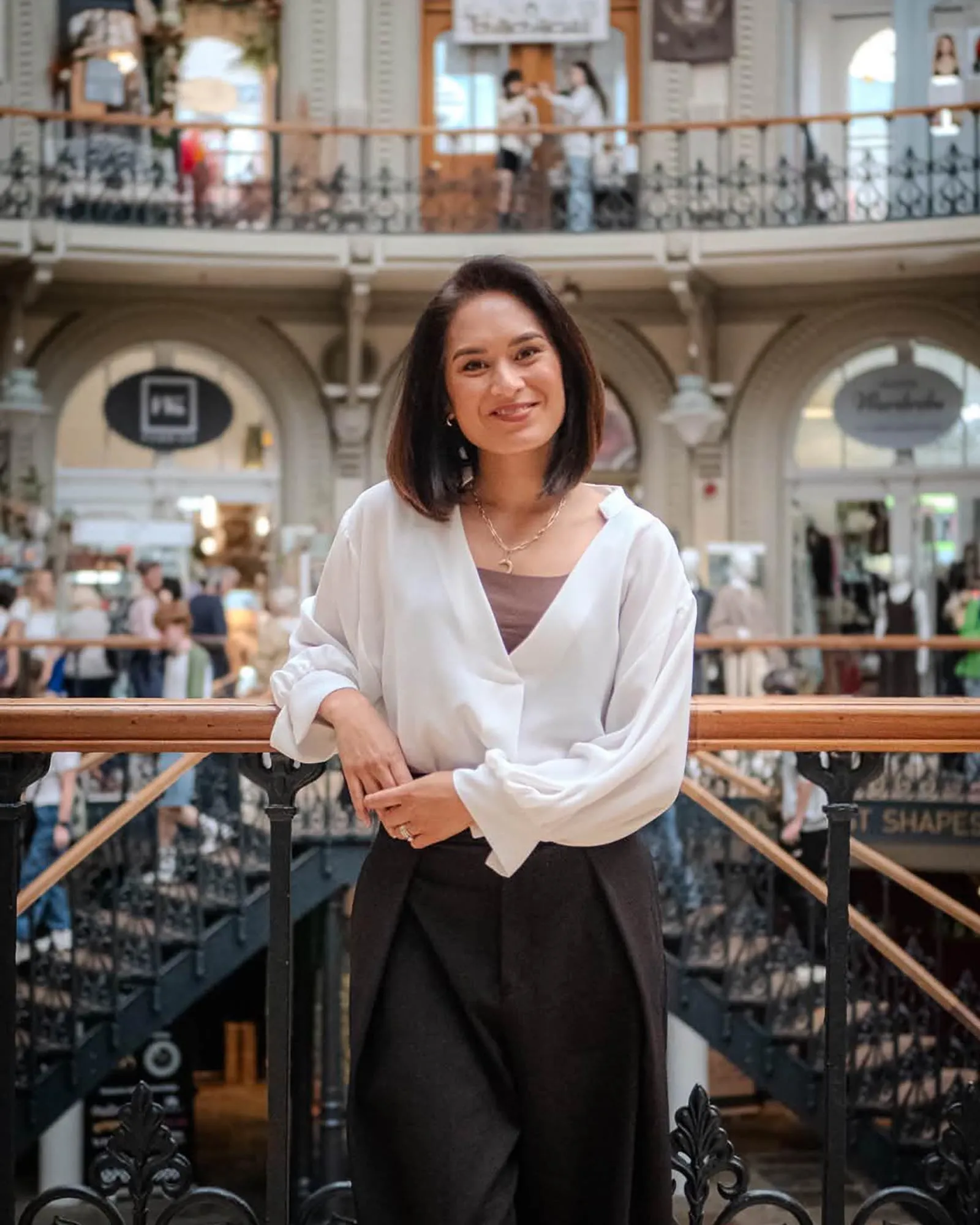
From the beginning of her career, authentic representation has remained central to what she hopes to see in journalism. “For the longest time, I always felt like the other in the newsroom,” she says, recalling how rare it was to see diverse talent in leadership positions within corporate structures.
She also acknowledges how her upbringing shaped the way she saw herself professionally. Garcia is proud of the humility and gratitude associated with her Filipino sensibilities, but says those qualities can sometimes make people less inclined to advocate for themselves. “So much of the Filipino culture is always about being humble, appreciative… But let’s shed some of the things that may have not allowed us to flower or flourish to our absolute capacity.”
Before interviewing for her current position, she played music in her car and talked herself into believing she deserved it. “I had to tell myself, I am deserving of this job,” she recalls.
It’s this homegrown confidence has become part of how she thinks about identity. “I am grateful, but I deserve to be here,” she says. “My voice, our voice needs to be better represented, is deserving of a platform.” For Garcia, pride does not have to mean abandoning humility. “I think it’s about time to serve ourselves better,” she says. “Be proud of who we are.”
Her approach to broadcasting has been shaped by the veteran journalists she encountered throughout her career. She admired Jon Snow for his integrity and professionalism, while Kate Adie showed her what confidence could look like for a woman reporting from difficult environments. Years later, Garcia met Adie at BBC Radio Nottingham and was struck not by the encounter itself, but by how much time Adie gave her. “She was just so interested in you,” Garcia recalls. “She gave me time.”
It’s a quality Garcia now tries to bring to her own work. “The job’s never safe,” she says. “My job has changed. A number of times, the goalposts have changed.” But she has also become less concerned with constantly moving forward. “Success isn’t linear,” she says. “There’s no end goal.”
Motherhood has reinforced that shift. Garcia has two young sons and chose, at points in her career, to put her ambitions aside to be present for them. “When I was 30, work was everything,” she says. “Since having my children, that’s completely changed.” Now, she says, success is being able to do work she enjoys without allowing it to take over her life. “I get to talk about the weather. I love it,” she says. “And I get to leave it on the doorstep and actually have a life with my children outside of work. It doesn’t consume me.”
Ultimately, for Garcia, that balance sits alongside another ambition: making British broadcasting a place where fewer people feel like “the other.” As the BBC’s first Filipino weather presenter, she knows that simply being visible matters, but she wants that visibility to lead to something broader.
“I don’t want it to just be lip service, a tick in the box, a checklist,” she says. “I want to see more of it.”
Frequently Asked Questions
Corazon Garcia is a Filipino-British journalist and weather presenter at the BBC. Having worked in commercial radio and regional broadcasting, she has built a career spanning journalism, news reporting, and weather forecasting.
She is Filipino-British, with her parents originating from the Philippines. Her mother is from Santa Ana, Pampanga, while her father is from Pangasinan.
Corazon Garcia is the first Filipino weather presenter at the BBC, marking a milestone for Filipino representation in British broadcasting.
She grew up in Stratford, East London, in a Filipino household. Her upbringing was shaped by her parents’ experiences as Filipino migrants, their dedication to their family, and the cultural connections they maintained with the Philippines.
Garcia’s journey into journalism began with her natural curiosity about the world. Describing herself as “dead nosy” growing up, she was drawn to asking questions and finding out about people. She initially worked in commercial radio before progressing to the BBC, including regional broadcasting in Nottingham, Derby, and Lincoln.
- How Filipino Creatives in Berlin Are Shaping Its Contemporary Scene
- “We Have So Many Filipino Stories to Share”: Inside the 4th Annual Filipino Forces Feast and Fiesta in Los Angeles
- Who Is Ari Reid? Meet the Scottish Filipino Property Influencer
- Myleene Klass on Motherhood, Music, and the Strength of Filipino Pride