
Maia Cruz Palileo Paints Their Different Way of Seeing


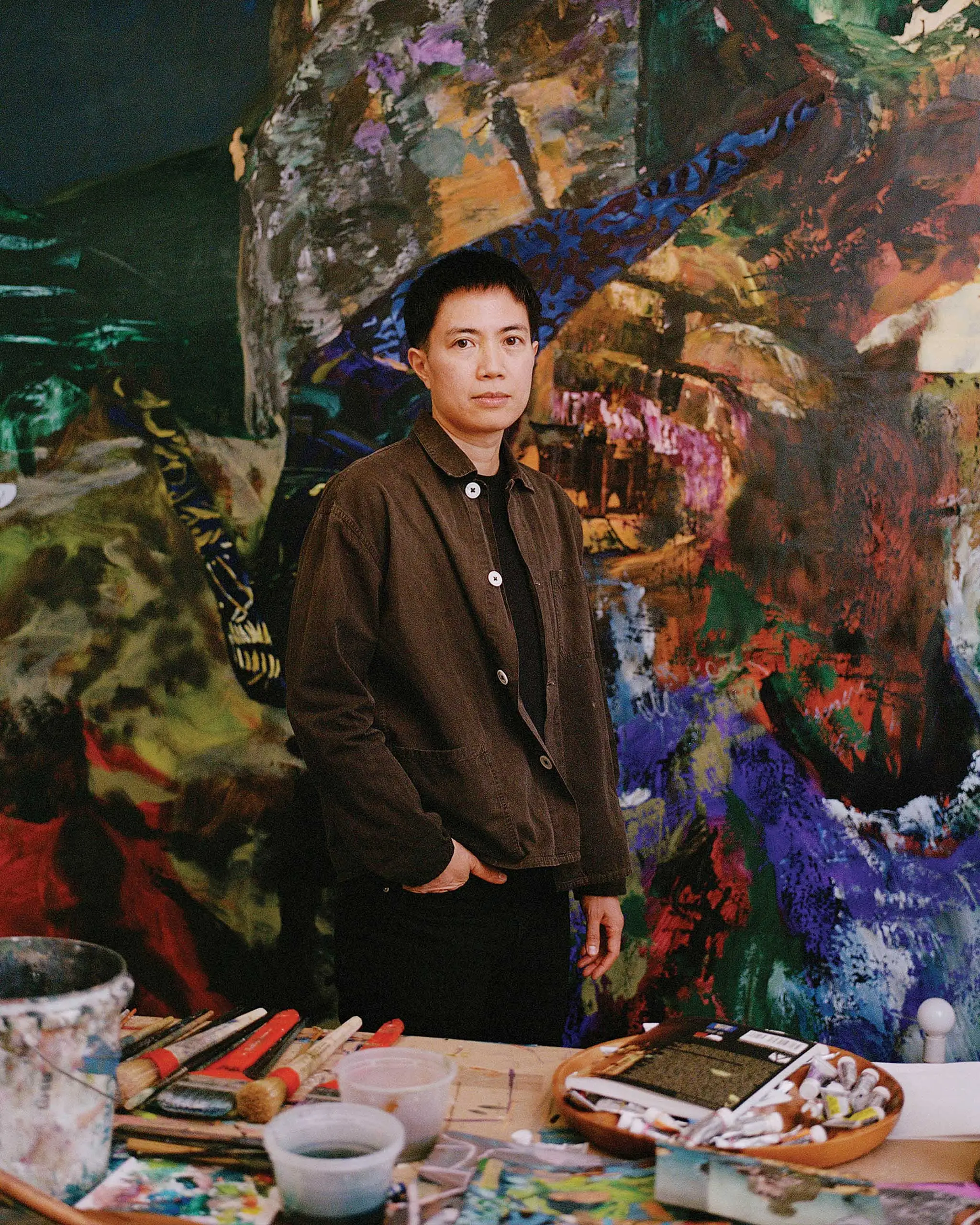
A portrait of the Filipino American painter Maia Cruz Palileo. Photographed by Mary Inhea Kang, courtesy of the artist and David Kordansky Gallery
Ahead of their upcoming solo show at the David Kordansky Gallery in New York City in September, Maia Cruz Palileo talks to Vogue Philippines about the expanse of stories a canvas can hold.
“Have you ever looked through these?” Maia Cruz Palileo hands me an object that curiously resembles an elongated View-Master, a toy I remember for viewing animated movie stills. I peer in and see a black-and-white scene that I infer as from the Philippine-American War.
“Is it in 3D?” Maia asks. “Isn’t that wild?”
The stereoscope, a 19th-century device, transforms two nearly identical photographs into a single three-dimensional image.
“I’m just obsessed with the way we perceive images.”
We are standing to one side of Maia’s studio, the whole space flooded with the bright glare of early July. The studio is in Kingston, a two-hour car ride north of New York City.
The Hudson Valley has always drawn artists. In the 1800s, painters of the Hudson River School immortalized its mountains and rivers. Today, another painter has made the valley home.
Born and raised in Chicago to parents who immigrated from the Philippines, Maia has lived in New York since 2000. The move upstate from a Brooklyn base came recently, the current studio is a temporary one, until they complete the conversion of a barn into a permanent workspace. Large-scale, nearly completed canvases stand around the expansive room. This month, Maia opens the fall art season with The World Tangled in You, a solo exhibition at David Kordansky Gallery’s Chelsea space, in Manhattan.
![Two horses and a person in a wide-brimmed hat stand on a rocky, sunlit hillside in a bold, impressionistic landscape art style.],](https://assets.vogue.ph/wp-content/uploads/2026/09/VPH_DIGITAL_2026_SEPT-OCT-MAIA_3.webp)
Maia’s process begins with photographs. In the early days, they limited themselves to just family photographs.
“My mom died when I was 19. Part of the reason why I got so interested in the family archive was because I missed her. I wanted to know more about her.”
But curiosity soon expanded beyond their mother. Maia began wondering about their parents’ lives before migration, their grandparents’ histories, and the political circumstances that remained outside the familiar versions of family stories.
“What’s the stuff that they don’t tell you? What’s the larger context?”
Ten years ago, the search led Maia back to Chicago, to the Field Museum’s collection of photographs by Dean Worcester, one of the principal figures of the American colonial occupation in the Philippines. As Secretary of the Interior, Worcester amassed thousands of photographs of indigenous Filipinos. He used these photographs to reinforce the idea that Filipinos remained “primitive,” in need of American rule and modernization.
“I wanted to see the photographs in person,” Maia says. “It’s such a different experience to be holding the material and seeing the actual photographs.”
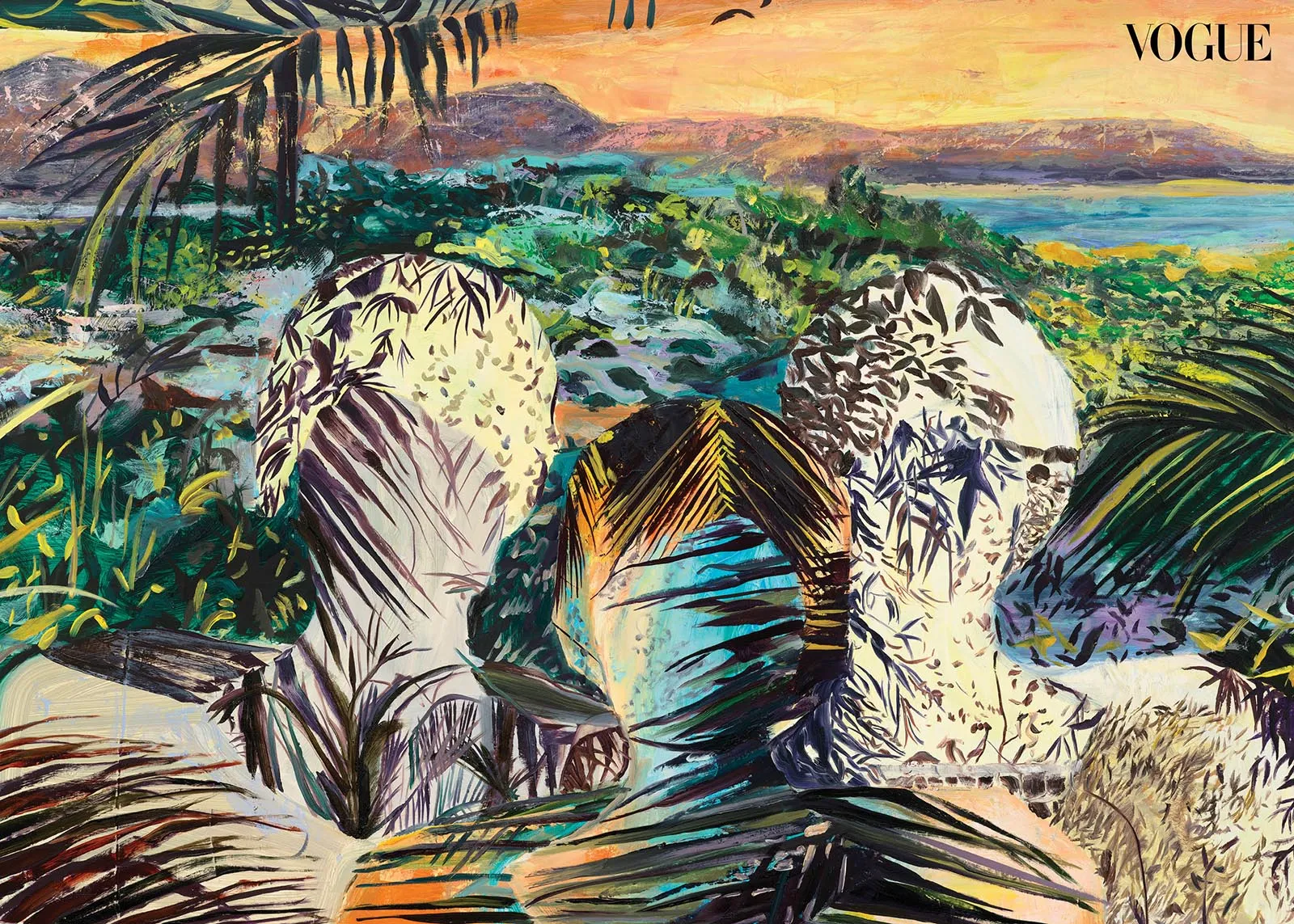
Further research at the Newberry Library, also in Chicago, introduced Maia to Damian Domingo’s complete set of Tipos Del Pais, a remarkable rendering of Filipino dress at the end of Spanish rule. Another trip brought them to the University of Michigan. The school’s vast Philippine collections hold more than 25,000 objects, from photographs, to textiles, to ceramics, botanical specimens, and even human remains. What once passed as scientific research is now increasingly understood as part of a larger colonial project, classifying and defining people under imperial rule.
“That experience for me was very… cellular,” they recall. “After that experience, I kind of started working really large, because everything kind of felt really constricted and sort of deadened in that space. And I wanted to bring in, the life that I think it was sort of missing.”
The encounter changed the scale of their work. Maia began painting larger, as if to liberate and animate the contents of the archive. They collected copies of the photographs, cut them apart, and recombined them into collages. These collages served as studies, starting points for paintings that draw freely from family pictures, colonial records, folklore, and imagined landscapes.
Last year, Maia traveled to the Philippines, to Pagsanjan where their father’s family is from. The journey transformed their work in the same way the research had. Maia reflects, “I think there was a sort of shift after that trip that feels more embodied, as opposed to imagined. I got to go to a lot of places that I was learning about in my archival research. And it became, like, in living color.”
“Painting is a framework that can kind of hold all of that… I’ve no answers, but it can take it. It can take it and maybe reveal something.”
Vivid and intense, hues of greens, oranges, and purples give Maia’s paintings a singular quality, one that allows them to be easily identified as theirs. “I’m a bit of a paint nerd,” they laugh. Having worked as an assistant to the late painter Denyse Thomasos, they learned to think of color not simply as surface but as structure. Rather than relying on conventional perspective, Maia uses shifts in hue and saturation to make forms advance, recede, or flatten. “She taught me how to create space with color.”
“A lot of the colors that I use, you can’t buy in the store,” they explain. Maia works with a friend to manufacture custom-made pigments. Sometimes a painting begins not with an image, but with an unexpected combination of colors waiting to be explored. “Gouache is sort of my first love,” Maia says. “I really try to make the oil paint feel like it.”
That revelation comes as a surprise because in the course of our conversation, Maia describes themselves as a reluctant painter. They studied sculpture, and painting held little appeal. “I hated painting!” Surrounded by classmates devoted to painting, Maia became “a secret painter,” experimenting in private.
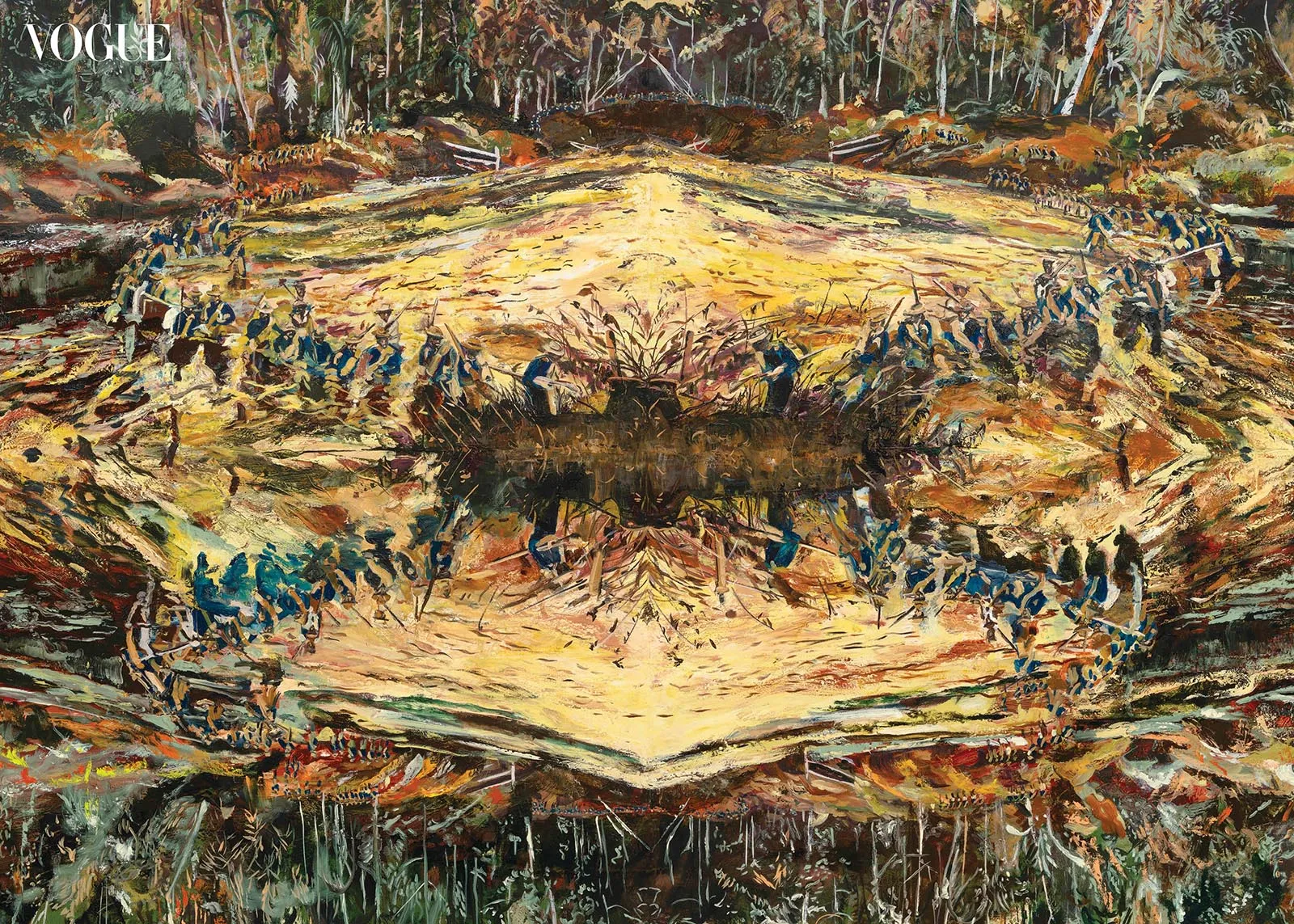
And then something shifted. “I got possessed by painting,” they describe the journey. “I got a voice that just told me to paint.” The first attempts proved disastrous, producing “really ugly paintings.” But gradually, Maia discovered that canvases could contain much more of their stories, that the expanse of fabric could hold a multitude of layers.
Critical and commercial recognition first arrived by way of another artist. After an exhibition in Chicago, Rashid Johnson acquired one of their paintings. “Artists talk about other artists,” Maia shares. They believe it was this that brought them to the attention of David Kordansky, who now represents Maia.
Toward the end of my visit, I looked around the studio: at the archival material taped on the walls, at the family photographs, at the collages assembled to test compositions, and at the paintings themselves. They all came together, as if through a stereoscope. In Maia’s practice, personal images and colonial archives, an imagined Philippines and a remembered one, memory and history, they fuse and overlap.
“Painting is a framework that can kind of hold all of that… I have no answers, but it can take it. It can take it and maybe reveal something.”
Maia Cruz Palileo’s The World Tangled in You is on view in New York at 520 W. 20th St. from September 10 through October 24, 2026.
- Szilveszter Makó, the Photographer Behind Vogue Philippines’ Olivia Rodrigo Cover, Makes Exhibition Debut With Bauhaus Ballet
- Rug Designer Iñigo Elizalde Finds Inspiration Everywhere
- Lyra Garcellano Reframes the Labor of Filipino Women Through “Heavy Lifting”
- Meet the Filipino Comic Artist Featured in Spider-Man: Brand New Day’s Special Credits