
Courtesy of Domu Mia Villa
Domu Mia Villa founder Nicolas Mattmuller reflects on its beginnings, how it taught him oneness with nature, and how it’s evolving with Siargao.
While Swiss-Filipino Nicolas Mattmuller put in hours of work in luxury hospitality properties like Park Hyatt, Wynn, and Mandarin for about 10 to 12 years, he began to feel the slow, persistent pull of Siargao. First while on holiday with some friends, and then, he recalls, “I realized I couldn’t work with anybody,” he tells Vogue Philippines. “I’ve lived in Sydney, Dubai, Manila. When I wanted to go back to the Philippines in 2017, I didn’t want to live in the city, so what brought me here was nature and the raw beauty of the island.”
Those were just extended stays and seasonal. He was away on another one, actually stuck in Thailand when travel halted for the world during the pandemic, when the opportunity to actually move to Siargao came, and this was by way of Domu Mia Villa, domu mia meaning my home in Sardinian.
It required quite a “glow-up” to bring it back to life as it was meant to be, but it’s got a charm of its own, and to date, feedback on the place has been positive. That serene private villa.
What was once a simple structure built by a friend evolved into a personal project of renewal. During the lockdowns, the villa stayed alive thanks to a local family who managed it, even housing a guest throughout that uncertain time. Then typhoon Odette came, and the upstairs was totally destroyed. “I’ve had to rebuild, totally, because of the damage. I put in a pool, but the rest just happened.”
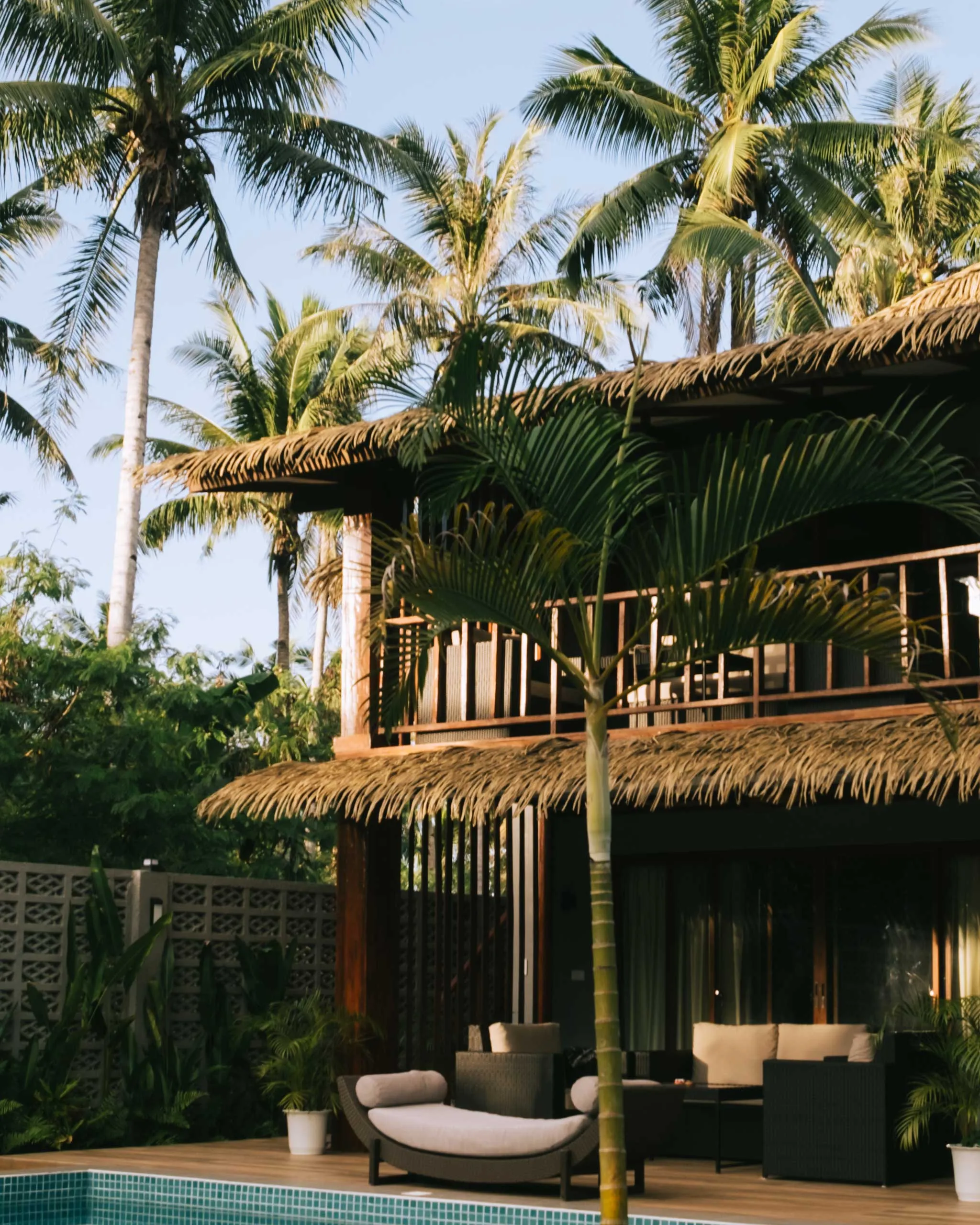
That ‘rest’ is what Domu Mia Villa is today. In the words of a guest: very spacious and quite homey, with character in terms of the interiors. It’s also exclusive; there are only three rooms in the entire villa, great for a small family. It’s a little remote from the tourist crowd, yet not that far from Siargao’s must-see landmarks.
“I don’t want to over-capitalize. I want to keep things authentic, and see how it grows.”
By homey, it means one gets a sense of a place that is devoid of cold uniformity and neutrality. Mattmuller designed the rooms, each 37 square meters, himself with the help of his mother. He elaborates, “Thai silk cushions from Jim Thomson, furniture and beds are custom-made mahogany from Manila mixed with repurposed pieces with hardwood, things handed down, with sentimental value from my grandparents … and a few basic modern stuff, creating a charming mix of old and new, global classics with sleek functional modern pieces.”
But at Domu Mia Villa, its expansive, 300-square-meter garden takes center stage. “Things grow quick here,” he says. A garden creates a sense of place. “People were saying after the typhoon, it’ll take ten years [to recover] because it was like a nuclear bomb had gone off here. It was all brown! But within six months, it all turned green. Nature healed itself.”
Looking around, Mattmuller reflects, “It’s amazing what you can do with a small space. You could actually do a lot with the space you have.”
Despite its easy calm, the villa’s soul lies in its service. “If you pay attention to the details of this place, it’s definitely not luxury,” he adds. “And that’s intentional. It’s not just the product, it’s also the service that comes with it. I want it to be simple.”
Looking back to how the place has evolved through all the huge surprises of the past years, he insists, “There’s always gonna be challenges with construction, rebuilding, people coming to work, showing up for work, but it’s all worth it. It’s very rewarding, despite the fact that there are headaches you go through.”
The call of nature and beauty of the island, which brought him to Siargao the first time, is a constant reminder. “Life here is simple. It humbles me. I love the raw beauty of the place and people live simple lives.” And then there’s the community. “The residents that live here, as well as the locals, we’re all close-knit.”
On the island, business is booming. Siargao, in the past few years, has grown to be the place to be. August is when most tourists come, then then surf season in September until around May. There’s also Easter in April, then you’ve got June and July when it’s really quiet. “[General Luna] changed a lot over the past five or six years, for the better or worse, depending on who you ask.”
But people still come to General Luna, where everything is happening. In his opinion, though, the true beauty of the island is in north of the island, where he’s setting his sights next. Now that Domu Mia Villa is beginning to flourish even more, that is Mattmuller’s new plan: two villas with the same reverence for land, space, and sustainability. “It’s gonna be a stressful one and a half years for sure,” he chuckles.
“I don’t want to over-capitalize,” he adds. “I want to keep things raw, authentic, and see how it grows.” Mattmuller’s number one goal for all these builds is to embrace local materials: wood, capiz shells in unexpected, cool ways, and handwoven textiles from Caridad in Pilar, for that homegrown touch. And if there is space for a garden, that’s always important; people do come here to get away from urban areas, as he once did, too.
“I’m gonna have to stay here for a while,” Mattmuller says, trailing off with a laugh.


