
Alex Eala Is the Tennis Player Creating a Sensation With Every Match


Photographed by Martin Romero
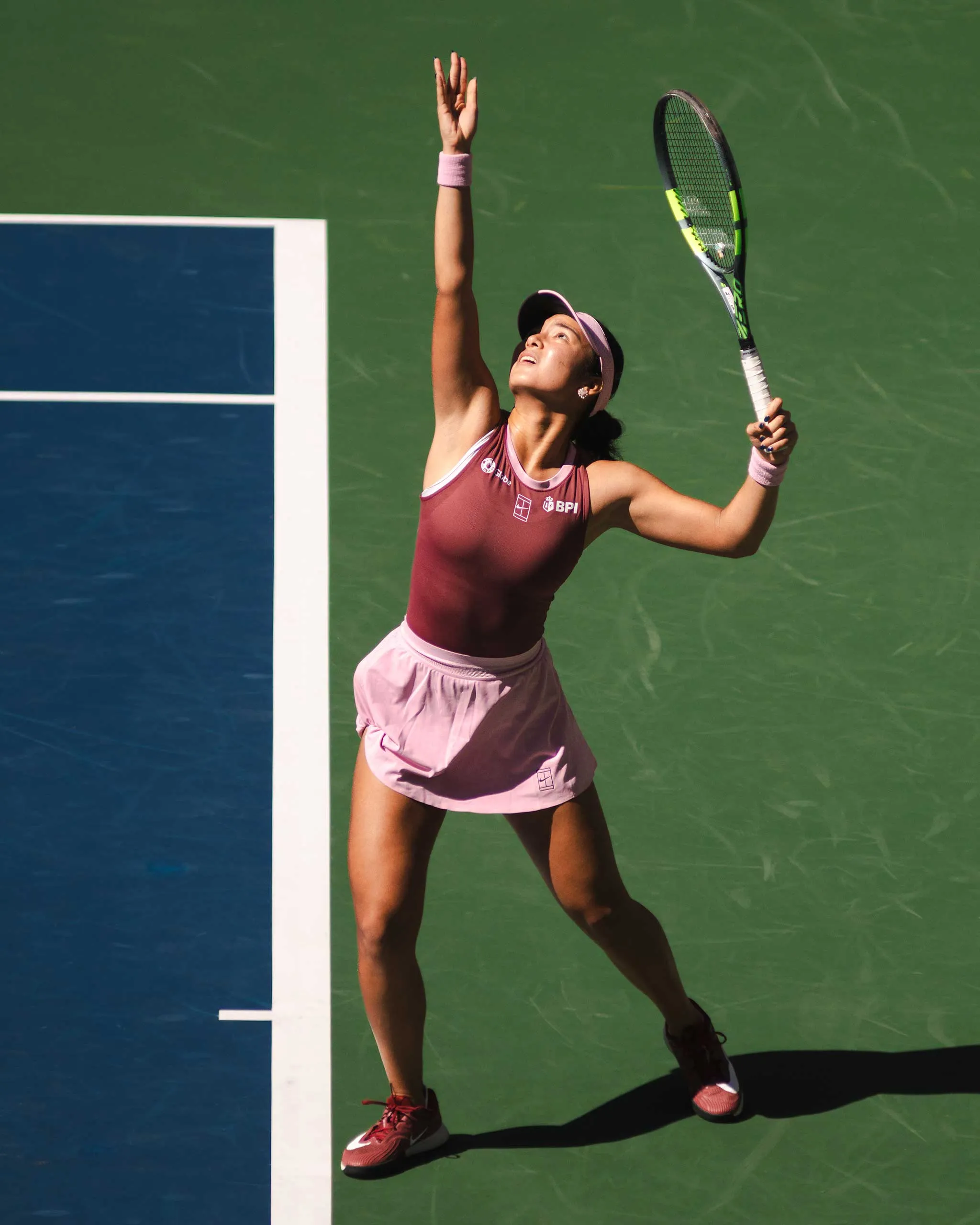
Earlier this month at the Canadian Open in Toronto—home to the largest Filipino diaspora in Canada, with more than 270,000 residents—the 21-year-old tennis star Alex Eala, ranked 18th in the world, drew sold-out crowds of more than 10,000 for each of her night matches, including a high-profile doubles appearance alongside Venus Williams. Long before Eala stepped onto the court, though, the venue buzzed with energy: Philippine flags and colors dotted the grounds at every turn, fans shouted encouragement in both English and Tagalog, and a local food vendor even rushed chicken adobo and lumpia onto the menu. To the untrained eye, the atmosphere felt more like a basketball game than a tennis match.
Eala—who plays her first match at the 2026 US Open tonight at Armstrong Stadium, the venue’s marquee court—has embraced this wave of growing fanfare ever since her breakthrough at the 2022 US Open, where she won the girls’ singles title to become her nation’s first Grand Slam champion. In the year and a half since her breakout semifinal run at last year’s Miami Open—where she stunned three Grand Slam champions along the way—Eala’s unprecedented success has not only crowned a new sporting iconIconA figure whose personal style is influential, memorable, and enduring, shaping how generations dress and think about beauty. Style icons range from actors and musicians to designers and models, andGo to Icon Glossary for the Philippines; it’s sparked a nationwide embrace of tennis.
“At first, it took me quite aback because I couldn’t understand how [Filipinos] could feel so deeply or so passionately towards the work that I do,” Eala admits over coffee after a late-night win in Toronto. “It was hard for me to wrap my head around the fact that I was famous.” Over time, though, she has come to realize and accept that she now occupies the same position for her young fans as Eala’s own childhood idols, Maria Sharapova and Li Na, did for her.
Born and raised in Quezon City, just outside Manila, Eala grew up in an elite sporting family. Her mother, Rizza, was a Southeast Asian Games bronze medalist in swimming before becoming the CFO of a major telecommunications firm, while her uncle Noli is a former high-ranking official in Philippine basketball. Yet it was Eala’s late grandfather Roberto—a club player with no formal coaching background—who introduced her to tennis at age three and guided her development over the next decade. Roberto’s original vision was simply to help Eala and her older brother, Miko, secure US college scholarships. (Miko went on to play for Penn State.)
Every day after school, Eala trained on courts made of crushed shell—a clay-like surface unique to the area (her local club also had a single hard court that doubled as a basketball court)—with Roberto creating an intense, disciplined training environment that she believes transformed her self-described “sassy” nature into gritty resilience. “The impact he had on my life is huge, so every major milestone I achieve, he comes to mind,” says Eala. “He and my parents built a great foundation for both me and my brother in how we approach not just tennis, but high-pressure moments in life.”
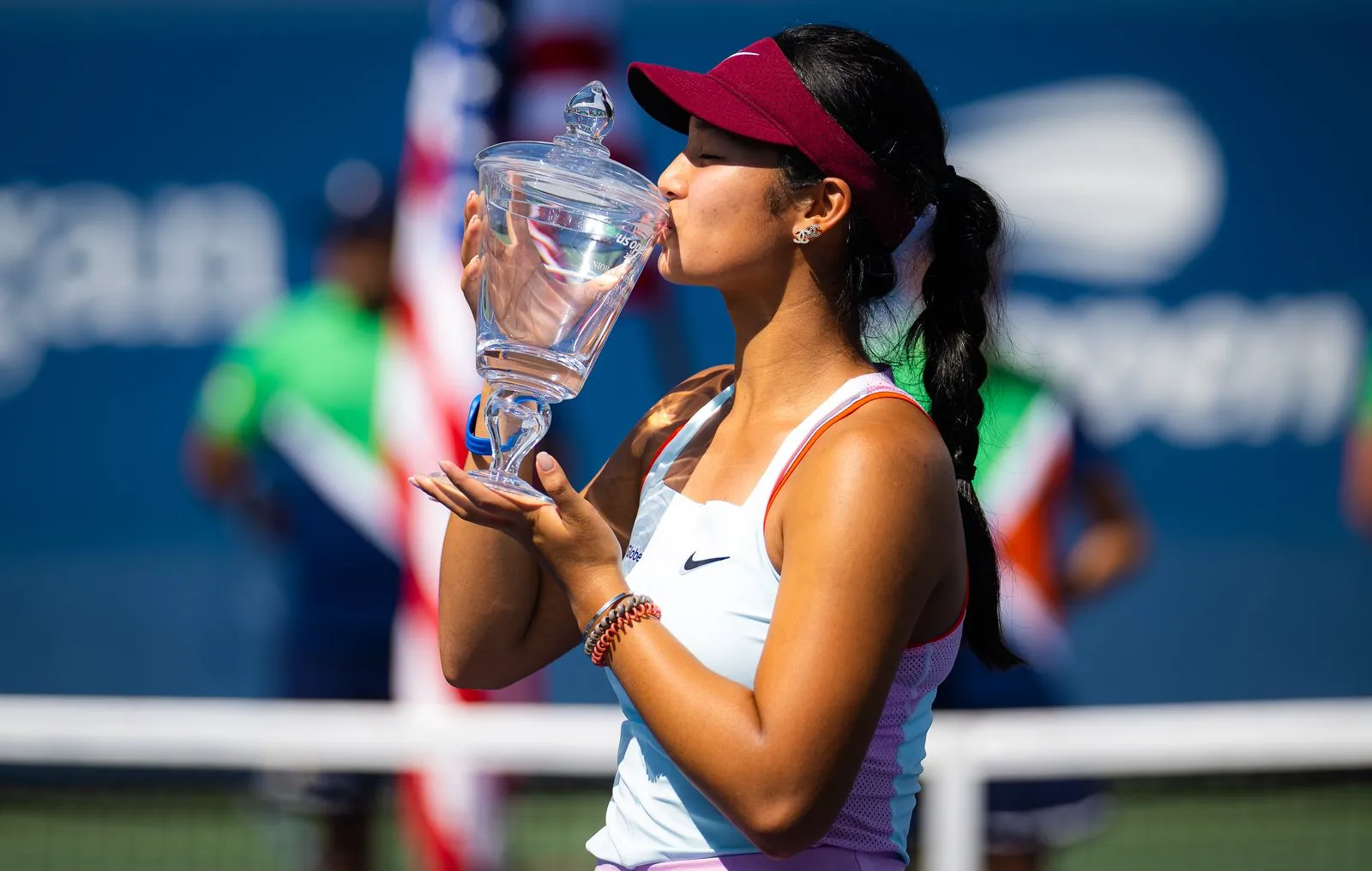
After defeating future Wimbledon champion Linda Noskova to win Les Petits As—a premier international junior tournament in France for players aged between 12 and 14—in 2018, Eala was offered a scholarship to the Rafael Nadal Academy in Mallorca, Spain. Moving halfway across the world as a young teenager might have daunted others, but Eala jumped at the opportunity, encouraged by her older brother joining her for the first couple of years—and, yes, regular visits from their parents.
“For a 13-year-old, I’d already been pretty well-traveled and exposed to a lot of different cultures,” Eala says. “My friends were also international, so it wasn’t as hard as people would imagine for me to adjust—it’s just the environment that I’m used to. Of course it was difficult to be away from home, to be away from family, but I was just so excited to be there that it took over everything else.”
With her crafty lefty serve and flat, relentless groundstrokes honed at the academy, Eala has emerged as a giant-killer in the women’s game. In her first two years on the main tour, she has notched wins over a slew of Grand Slam champions—including Iga Swiatek, Naomi Osaka, Elena Rybakina, Madison Keys, and Jelena Ostapenko—as well as top-10 mainstays like Jessica Pegula, Elina Svitolina, and Jasmine Paolini. (The day before she arrived in Toronto, Eala became the first Filipina to win a tour-level title at the WTA 500 event in Washington.)
The rest of the players have taken notice. In Toronto, Venus Williams hailed Eala as “a world star,” while Coco Gauff added that everyone in professional tennis should embrace the new Filipino demographic she brings to the game, “because we’re all benefiting from it.” Pegula’s podcast, co-hosted with three American players, including Keys, saw a sudden spike in subscribers after Pegula faced Eala in the Washington final. ”
The rest of the players have taken notice. In Toronto, Venus Williams hailed Eala as “a world star,” while Coco Gauff added that everyone in professional tennis should embrace the new Filipino demographic she brings to the game, “because we’re all benefiting from it.” Pegula’s podcast, co-hosted with three American players, including Keys, saw a sudden spike in subscribers after Pegula faced Eala in the Washington final. ”
Eala herself has seen a noticeable shift in the Philippines, where more people are picking up racquets, fighting for court time, and still learning the proper rules. “You have the hardcore sports fans, the girlies who like to dress up, the kids who are super excited to play with their friends—they’re realizing it’s a sport for everyone,” she says.
Following her historic run to the round of 16 at Wimbledon this summer, Eala received a hero’s welcome back home in Manila, with President Ferdinand Marcos Jr. even hosting a formal reception for her at Malacañang Palace—something that Eala said she’d never even imagined when she was dreaming big tennis dreams as a kid. “Just being at the presidential palace—or seeing the people who came to greet me at the airport!” she says, incredulous, before adding with a laugh: “I had a meet-and-greet at the mall! I feel like the meet-and-greet at the mall is a very canonical Filipino celebrity experience.”
The attention has meant that she’s had to rethink how she moves around Manila—“especially if I come home straight after these kinds of milestones. It’s quite uncharted territory for me,” she adds. “It’s a learning process.” During her last visit, she relied on a security detail to escort her to work obligations. Otherwise, “I literally just stayed at home,” she says. “Even going to the coffee shop with my dad was a wild experience—people were just all over [us].”
At the end of the day, Eala insists that she’s just like any other young girl figuring out her own sense of style and identity. Like most Gen-Zers, she’s pretty chronically online, spending a bit too much free time going down YouTube rabbit holes, while her everyday playlist features an eclectic mix of Olivia Rodrigo, Olivia Dean, Bad Bunny, Raye, Royal Otis, The 1975, Young Miko, Sombr, Sienna Spiro, Doja Cat, Daniel Caesar, and Rosalía.
Over the past year, though, Eala has made a concerted effort to build a fuller life off the court. She’s been very intentional about forming friendships on the tour and now counts fellow players Eva Lys, Iva Jovic, Vicky Mboko, and Zeynep Sonmez among her closest confidantes.
Having a life away from the sport has also allowed Eala to get better at handling all of the noise surrounding her ascent. “I know what it takes to stay where I am,” she says, matter-of-factly. “I know I can tell myself the hard truth: If you don’t meet the standard, you’re not going to be here. So all this love and all this support that I’m getting doesn’t blind me from that.”
And while she is gradually adjusting her position in the sport from hunter to hunted, Eala actually feels hungrier than ever to continue breaking the ceiling above her. “I don’t think you stop hunting even when you’re number-one in the world,” she says, and then adds, with a laugh: “If I actually get to number one, I can tell you. But I don’t think the hunt ever stops.”
Unsurprisingly, Eala also has her sights set on winning Grand Slams and taking home Olympic gold. “Everything’s on the table,” she says, with an easy grin. But—not unlike her mentor, Rafael Nadal—Eala is most focused on maximizing her potential: “I hope that after my career,” she says, “I can look back and be like: Okay—that is the best that I could have ever been.”
This article was originally published on Vogue.com.