Anthony Vaccarello Bows Out of Saint Laurent


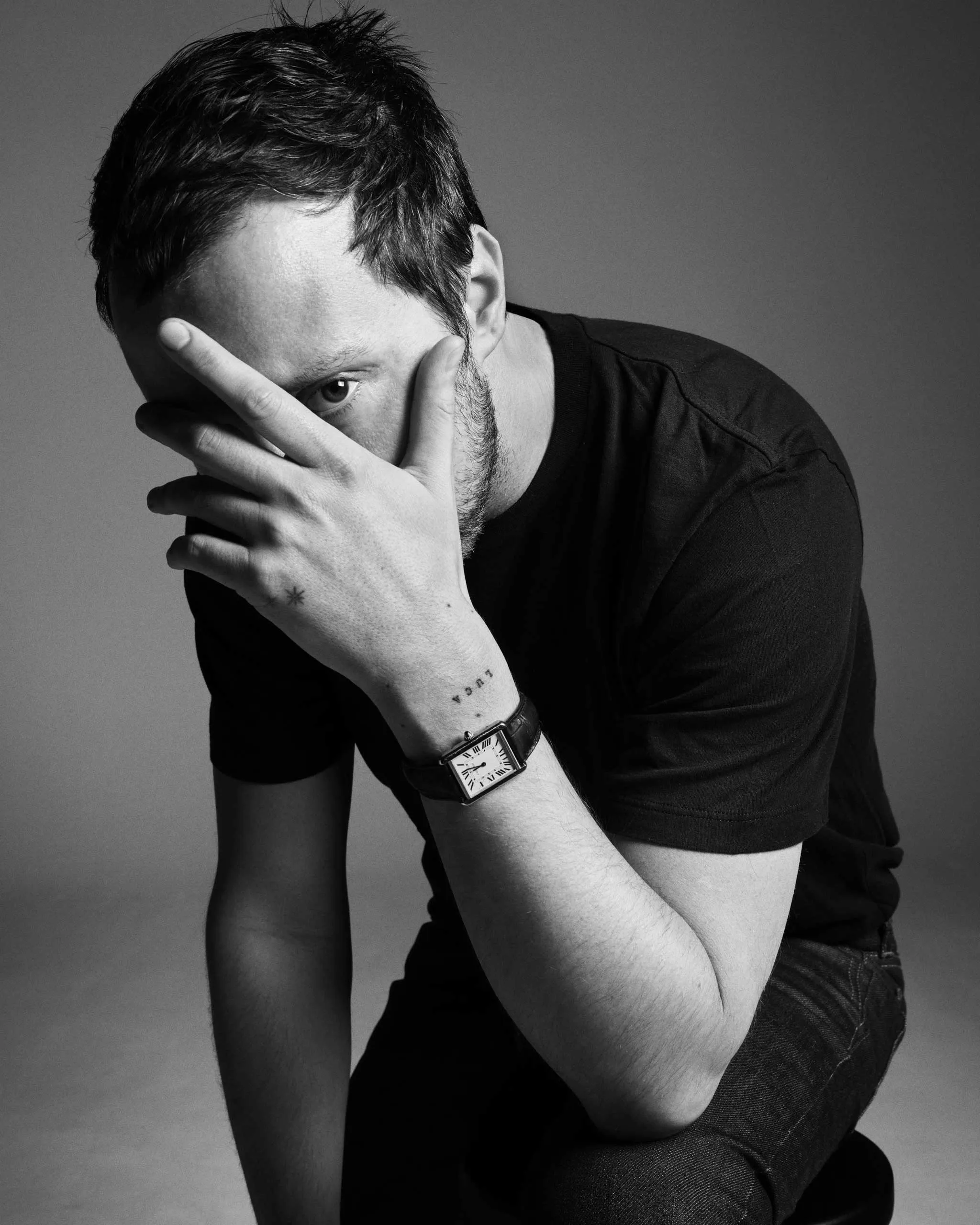
Photo: Gray Sorrenti/Courtesy of Saint Laurent
That golden goodbye has been made official: Anthony Vaccarello is stepping down as creative directorCreative DirectorThe person who sets the overall visual vision of a fashion house, publication, or campaign and guides designers, photographers, and stylists toward it. A creative director's influence shapes collections, imagery,Go to Creative Director Glossary of Saint LaurentAnt Saint Laurent will announce its new creative leadership soon.
Luca de Meo, CEO of Kering, said: “I would like to express my sincere gratitude to Anthony for his contribution to Saint Laurent over the past 10 years. Through his creative vision and exacting standards, he has contributed to strengthening the enduring influence of one of France’s greatest couture houses, as we embark on a new chapter in its history.”
In her review of what was today confirmed as the designer’s final show at the house last week in Paris, Nicole Phelps wrote that Vaccarello “is as strong-willed as he is soft-spoken, a designer resolutely unwilling to bend to trends, and just as firm in his disregard for the democratization of fashion that is one of the dominant storylines of the season.” She concluded it, presciently, with the Robert Frost line: “Nothing gold can stay.”
Cedric Charbit, president and CEO of Saint Laurent, said: “I would like to warmly thank Anthony for his ten years of dedication to the house. During his tenure, Anthony took Saint Laurent on a remarkable trajectory, elevating the house to the forefront of desirability and image, while accomplishing exceptional work both creatively and through his cultural impact.”
Today’s announcement ends a tenure whose timescale and success few would have bet on when it began in April 2016. Vaccarello was 36 when then-Saint Laurent CEO Francesca Bellettini appointed him as creative director just four days after Hedi Slimane’s departure.
At the time, Vaccarello was well regarded in the industry, following his sensually powerful output as creative directorCreative DirectorThe person who sets the overall visual vision of a fashion house, publication, or campaign and guides designers, photographers, and stylists toward it. A creative director's influence shapes collections, imagery,Go to Creative Director Glossary of Versace’s second line, Versus, which he had overseen since 2015 and collaborated with since 2013. From 2009, he also led his small but growing eponymous label, which he closed after taking the YSL job. Another feather in his cap was his win at the 2011 edition of the Andam Fashion Award, then under the presidency of Yves Saint Laurent co-founder Pierre Bergé.
Under Slimane’s four-year tenure as creative directorCreative DirectorThe person who sets the overall visual vision of a fashion house, publication, or campaign and guides designers, photographers, and stylists toward it. A creative director's influence shapes collections, imagery,Go to Creative Director Glossary, YSL brand revenue rose from €354 million in 2011 to €974 million in 2015: in business terms alone, Slimane’s seemed like huge Chelsea boots for Vaccarello to fill.
In extremely short order, the Belgian designer filled them and more, cresting the wave of growth that swelled across luxury between 2016 and 2023 (via the Covid slump). On his watch, Saint Laurent revenues more than tripled to €3.3 billion in 2022. Covid slump). Of that revenue, a sliver more than 30%, or €1.019 billion, was recurring operating income. Kering’s full-year 2025 figures place Saint Laurent’s value at €2.6 billion.
Vaccarello carved that path to success partly through a mix of progressive creativity drawn from his upbringing in Brussels and education at La Cambre, and an instinct for the provocatively propulsive that he inherited from his Sicilian parents. As he told Vogue Australia in 2015: “I have the Belgian way to construct clothes, to be more into construction and deconstruction of clothes, and maybe my Italian side is the sexy side.”
Another key factor was his image-making, whose aperture widened YSL’s scope beyond Slimane’s brilliant signature subcultural documentarianism to reinstate Yves Saint Laurent as the most quintessentially Parisian modern fashion house of all. His first Trocadéro show with the Eiffel Tower as its backdrop was Vogue RunwayRunwayThe platform or catwalk on which models present a designer's collection to an audience of editors, buyers, and guests. Runway shows establish the creative statement of a season, and Vogue'sGo to Runway Glossary’s most-viewed of the season. From Fall 2019, Vaccarello’s collections began not only to recall Saint Laurent’s gestures, but to expand upon and modernize them — testing the extremes of the founder’s silhouettes and codes to generate almost unbearable visual tension.
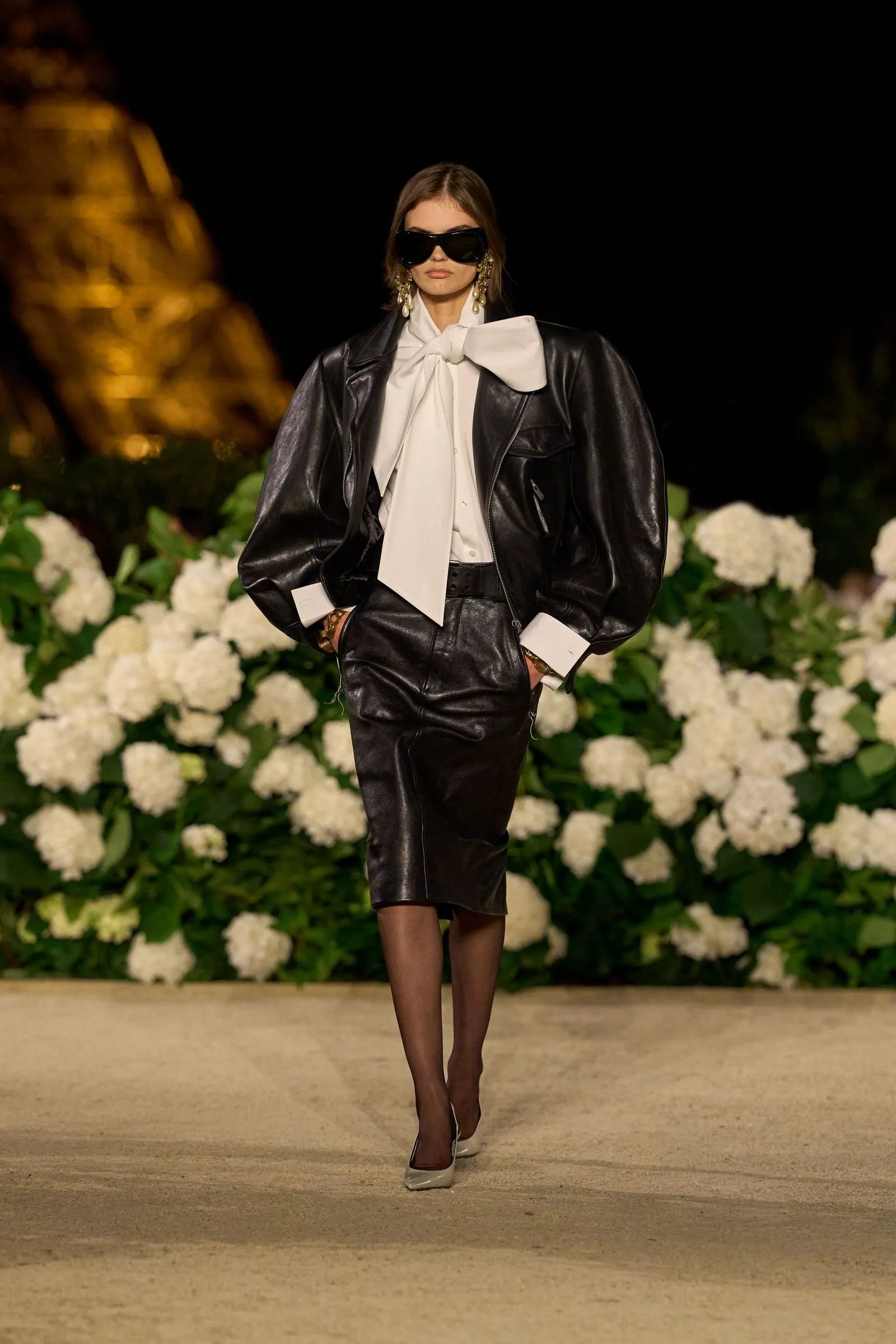
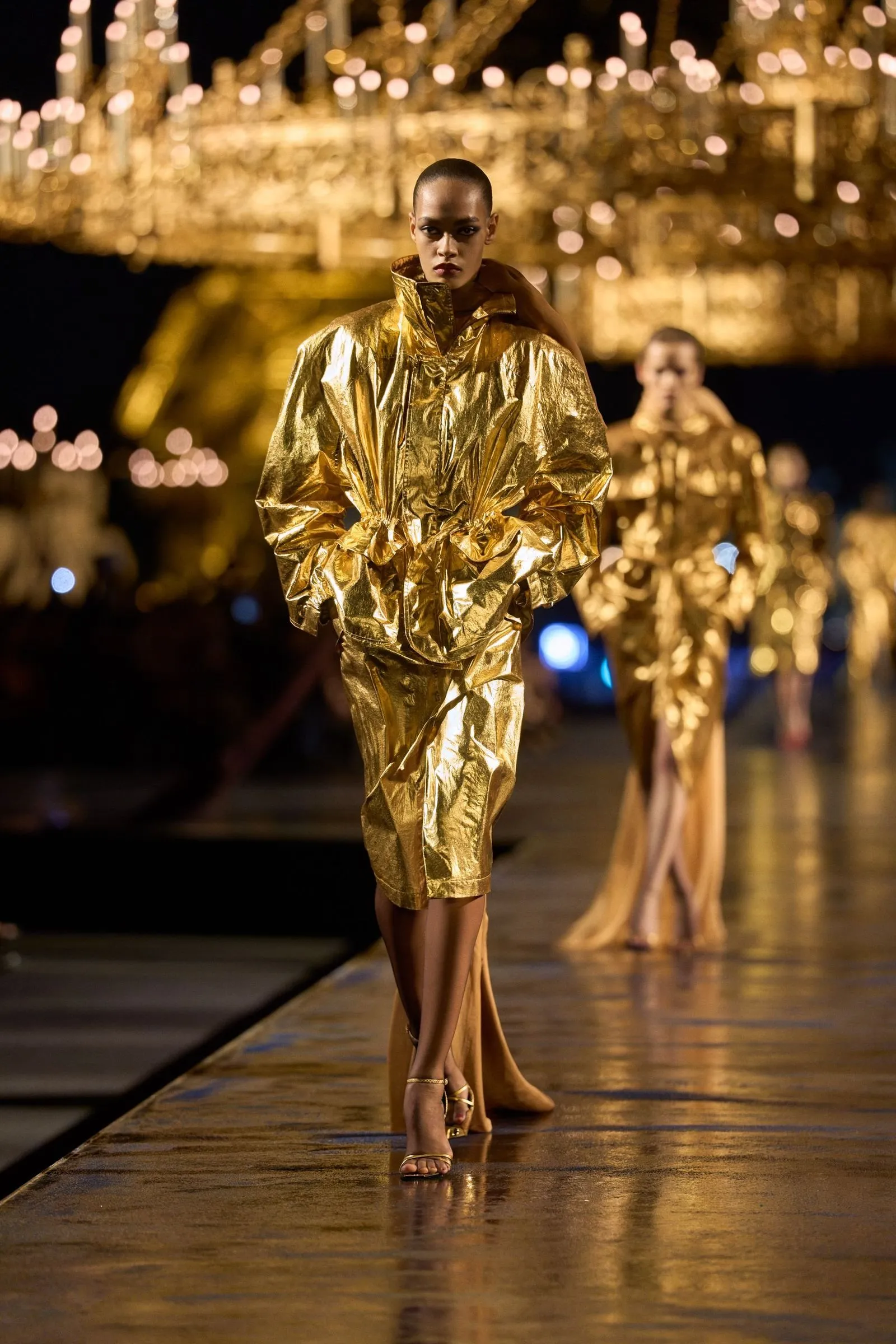
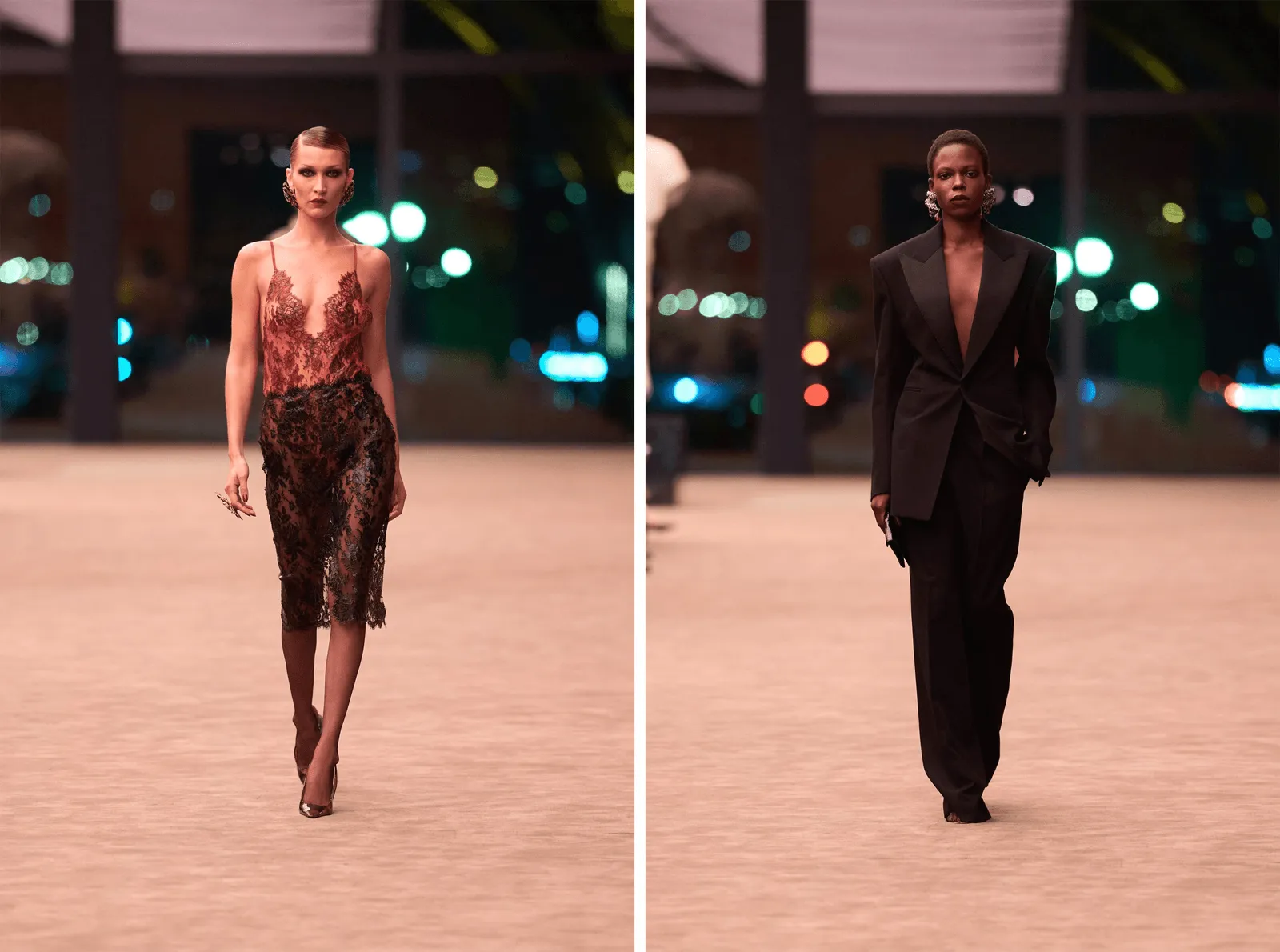
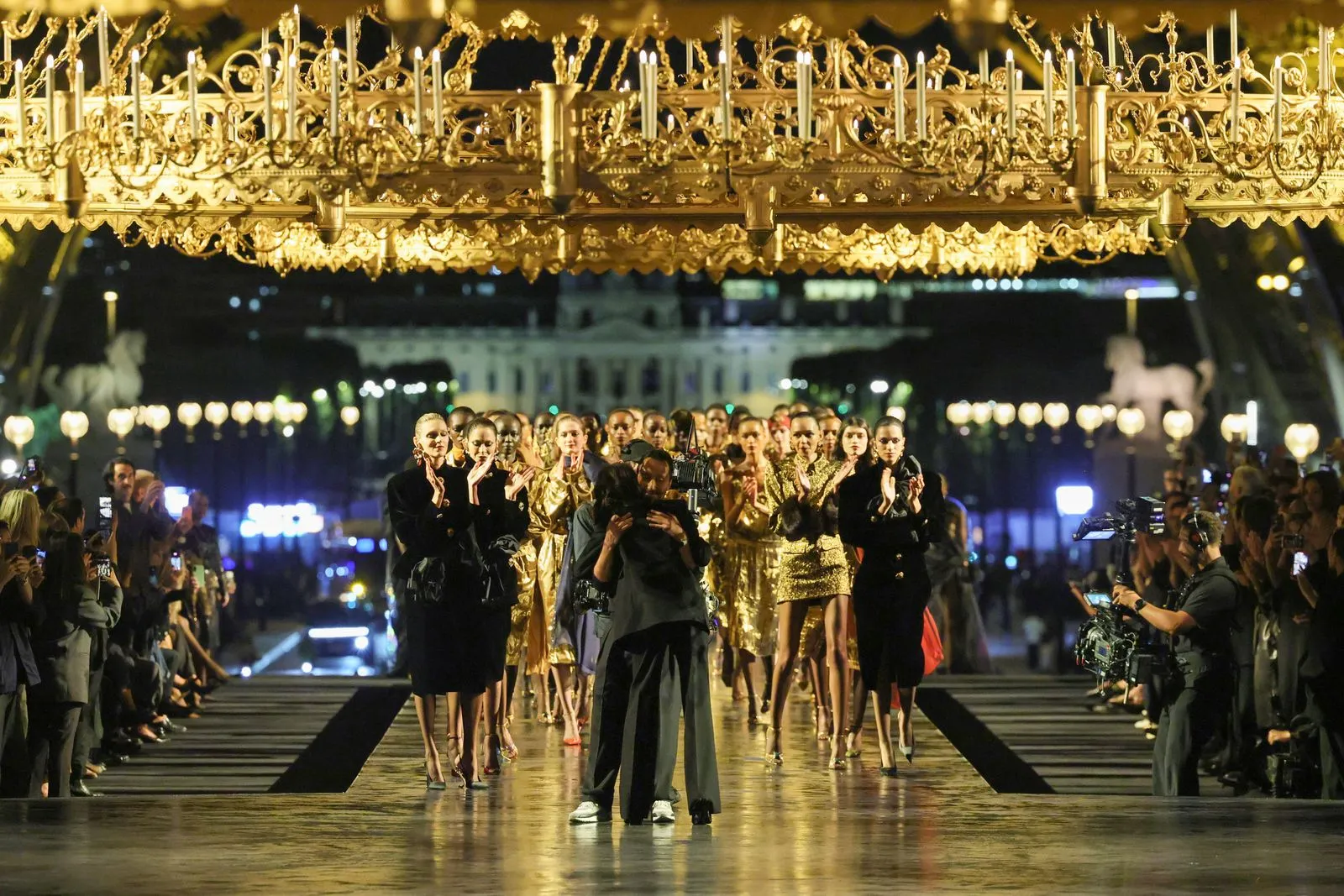
That trajectory reached its conclusion with Vaccarello’s Spring 2027 show on September 29, staged 10 years and two days after his Saint Laurent debut. Beneath the Eiffel Tower and three towering candlelit chandeliers, he presented 49 looks in shades of gold before closing with 10 in black. Sahariennes, trenches, pencil skirts, brocades and evening dresses revisited the house vocabulary with the amplified rigor that had become Vaccarello’s signature. The color sequence inverted the finale of Yves Saint Laurent’s Fall 1991 Rive Gauche collection, which had ended in gold: it was a fade to black.
Even before the show began, it had the atmosphere of a valedictory: his departure has been rumored since the summer. Vaccarello unusually declined preview interviews, instead offering black calla lilies with a note describing the collection as personal and emotional. Miles Davis’s soundtrack to Louis Malle’s Elevator to the Gallows played before; at the finale, Charlotte Gainsbourg appeared for a surprise performance. Vaccarello came out surrounded by his models, then crossed the catwalk to hand something to his son: many (mis)interpreted the gesture as handing over the keys of the house. Whatever the detail signified, this was his final bow for Saint Laurent.
During his decade at the house, Vaccarello’s conduct both reflected and amplified some of the patterns first sketched by the house’s great founding designer. Where Yves Saint Laurent had designed the costumes for Catherine Deneuve in Belle de Jour, Vaccarello conceived the house’s launch of Saint Laurent Productions in 2023: its output has included double Oscar winner Emilia Pérez and Paolo Sorrentino’s Parthenope. And just as Saint Laurent both supported and was supported by a close coterie of women including Deneuve, Loulou de La Falaise and Betty Catroux, Vaccarello’s 21st-century generation of Saint Laurent women includes Anja Rubik and Charlotte Gainsbourg.
In 2018, Vaccarello told Vogue: “Everyone has a vision of what they think Saint Laurent should be, and that’s something I knew when I started. I knew that whatever I did, some people would love it and some would hate it. It was the same with Hedi, and Stefano [Pilati] before him. I’m fine with it. In fact, I kind of love it.”
That observation also applied to Tom Ford, who had designed Yves Saint Laurent’s ready-to-wear between 2000 and 2004, following Gucci Group’s acquisition of the house in 1999 for a reported $1 billion. By the time Vaccarello arrived, Yves Saint Laurent had been under the operational control of CEO Francesca Bellettini since 2013 — the same year Gucci Group, later PPR, was rechristened Kering.
Following Yves Saint Laurent’s peak financial performance in 2022, it endured three years of declining revenues, to €2.64 billion in 2025, and a contraction in operating margin from 30.9% to 20%. Much of this, however, was attributable to both the wider decline across luxury and to YSL’s aggressive 2023 repositioning away from wholesale. Vaccarello’s collections, meanwhile, became ever more uncompromisingly distinct in their interpretation of Yves Saint Laurent’s revolutionary template.
Bellettini, now president and CEO of Gucci, was succeeded at Yves Saint Laurent by Cédric Charbit in early 2025. Charbit, like Bellettini, is a star of Kering’s C-suite, having surfed that same wave of luxury growth alongside Demna as CEO of Balenciaga from 2016. Before then, he was executive vice president in charge of product, retail merchandising and communication at Yves Saint Laurent, where he overlapped with Vaccarello for the first few months after the designer’s arrival.
This May, speaking to the Financial Times, Charbit observed of luxury’s stuttered boom: “The industry’s growth has been extraordinary but not sustainable.” Despite this, under Group CEO Luca de Meo, Kering is applying intense pressure to itself in order to reassert an upward trend in performance and value: in April, de Meo stated that by 2030, YSL is targeting a more than doubling of its menswear sales, a tripling of its jewelry sales, a doubling of its VIC sales and a minimum of €500 million of sales in its entry-price categories. Meeting these targets will now fall in part to whoever is appointed Vaccarello’s successor.
Vaccarello, meanwhile, has already hinted that his any moves might take him beyond fashion. While speaking with Pamela Golbin for the entertainment title The Wrap in 2024, he was asked what could follow his time at Yves Saint Laurent. He replied: “It’s complicated because just being here is already a dream. Saint Laurent, for me, is the most beautiful house, the Holy Grail of houses. What can top that? The only thing you can do is to start something completely different… We need to aspire to new dreams that I don’t necessarily have yet.”
Now aged 46, Vaccarello has plenty of time to formulate those dreams — and to savor his achievements during his decade-long service as custodian of Parisian fashion’s “Holy Grail”.
This article was originally published on Vogue.com.