
How Filipino-American Comedian Michael Cruz Kayne Is Teaching People to Laugh Amidst Grief and Loss


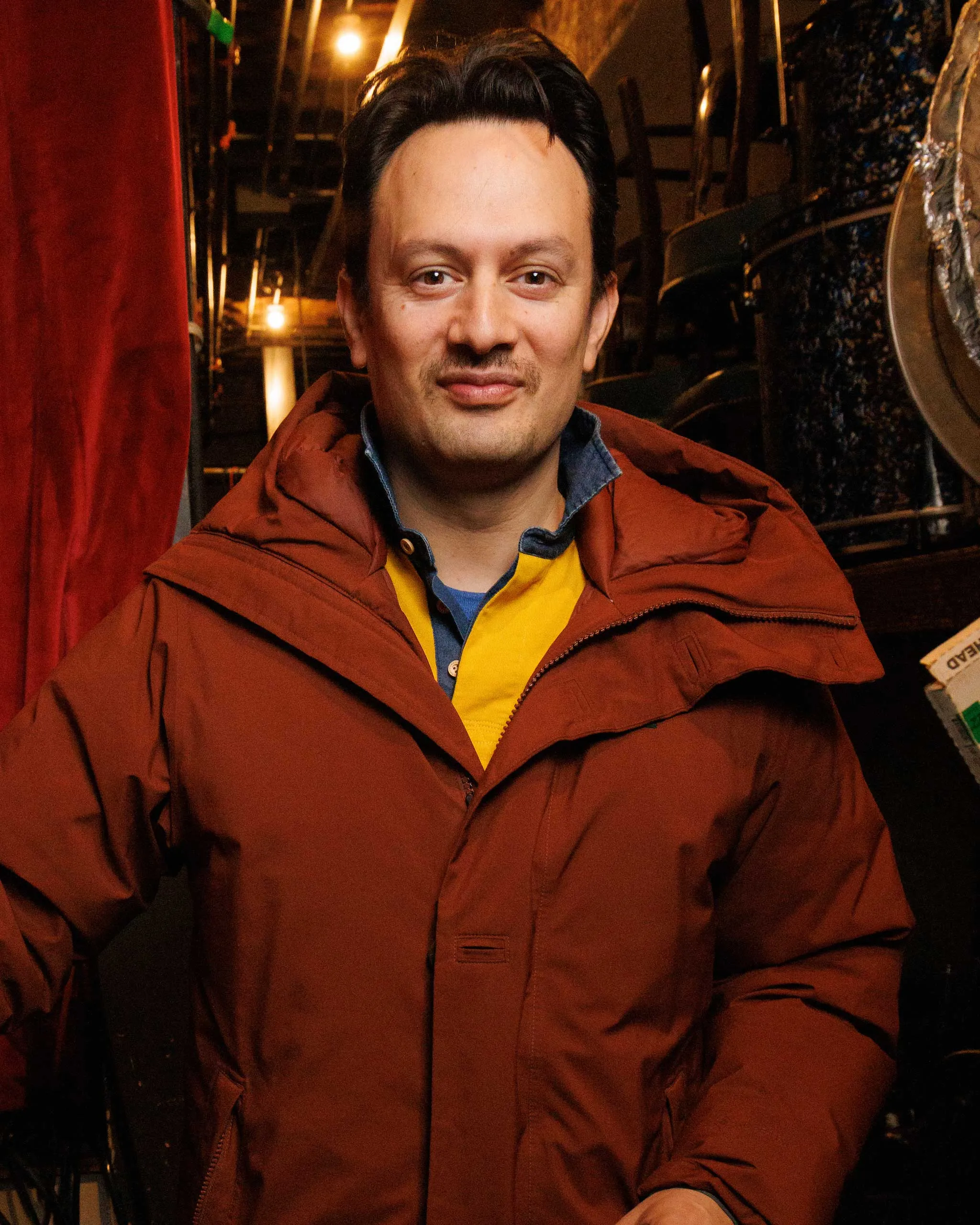
Photographed by Mindy Tucker
As Sorry For Your Loss makes its premiere on Dropout Presents, Michael Cruz Kayne talks about grief, humor, and his Filipino roots with Vogue Philippines.
When Filipino-American comedian Michael Cruz Kayne lost his son, he hesitated to describe the situation as traumatic. “My therapist was like, ‘Uh, that’s literally exactly what trauma is,’” he shares. Men, he says, learn to stuff down feelings of grief, shame, or recovering from trauma. “So-called toxic masculinity is largely a manifestation of all these unprocessed, complicated feelings,” he says. But bit by bit, he processed his grief, and through humor, opened up about the experience in a new stand-up special, Sorry For Your Loss.
In Sorry For Your Loss, Cruz Kayne’s punchline-driven comedy takes a backseat, giving way to a show that he describes as “crushingly sad.” Some people might be uncomfortable with the subject of laughing at loss, but for him, it is just another facet of processing grief. “The show alternates between joy, humor, bleakness, all of it, just like a person naturally would,” he says. “Grief is a galaxy of emotions, not just annihilating depression, though annihilating depression is definitely a feature. I try to summon all aspects of the loss, because all aspects were present for me.”
Comedy is often a vehicle for joy, but just as any craft or performance, can allow people to explore other emotions. “I tried to make space for people to feel super f******* sad, so people felt permission to do that, in between laughing at my jokes and being transfixed by my model-level good looks (Just let me believe it!),” he says, joking.
As Sorry For Your Loss makes its premiere on Dropout Presents, the Emmy-nominated and Peabody Award-winning writer and comedian chats with Vogue Philippines. This interview is edited for brevity and clarity.
The special feels like it sits between storytelling and stand-up. Did you always envision it in this hybrid form, or did it evolve as you processed your grief?
I had watched Mike Birbiglia’s one-man shows with awe and always felt intimidated by the idea of creating one. Over the years I spent working on Sorry For Your Loss, I distinctly remember watching Hannah Gadsby’s Nanette and Kate Berlant’s Kate and Jacqueline Novak’s Get On Your Knees (three times!).
It took all of that to help me realize something that should have been obvious: a necessary component of a good one-person show is that it be unique to its creator. I tried to keep it as true to myself as possible, at all times, whatever that meant. I wanted to say what I believed, how I would say it, rather than to perform to meet someone else’s expectations of what either grief or standup should look like.
Did sharing your grief so openly change your understanding of connection, both with audiences and within your own personal life?
Yes, completely. People want to talk about grief (I know, I know, not everyone, please no angry comments!). I was moved and surprised by how many strangers would message me stories about people who’ve died, and even more by close friends who revealed stories I had never heard. Once Fisher died, I found out about miscarriages, accidental deaths, and other tragedies that people I knew well had never shared with me. It is the worst club in the world to join, but if you live long enough, almost everyone is in it.
At a time when comedy is being asked to do more than entertain, what responsibility, if any, do you feel as a comedian working with deeply personal material?
I feel like there are two tiers to this answer. The first part is Hippocratic: First, do no harm. In other words, don’t make someone’s tough situation worse. Could I come up with 20 jokes insulting trans people? Or stepping on poor people? Yes! Any moron could! In fact, many morons have! But what is the purpose, the value?
Second: what am I trying to convince the listener of? Make sure to point every joke in that direction. N.B. this all sounds very high-minded, but let’s be real: I am also currently hard at work on a parody version of It’s Raining Men called It’s Raining Fish, so I’m not exactly Euripedes.
How does being Filipino figure into your identity and you comedy?
So glad you asked this! Being Filipino is so important to me. As a kid, I traveled to Quezon City almost every year and thanks to an incredible family I have only excellent memories. Furthermore, for a long while I went by Michael Kayne, but once I started to get a bit of traction, I added my mother’s maiden name, Cruz, which was already my middle name. My mom is one of six, but because her male siblings have no children, the Cruz name in our family will cease to be.
I put it into my name as a testimony of my love for my heritage and for my mom. My dad is a beautiful Jewish dude from New Jersey, so there were a lot of cultural dissimilarities in family gatherings, and I always associated the Cruzes, especially the women, with exuberance and childlike playfulness. I hope that makes its way into my writing and performing. I am the first Filipino (and first Asian-American) to ever write for The Late Show With Stephen Colbert, and I wear that distinction with extreme pride.
Would you say Sorry For Your Loss redefined your relationship to comedy?
The work I did leading up to it definitely changed me as a comedian. I feel free to explore anything now, and I feel compelled to explore as myself. Before this show, I felt like I had downloaded the personalities of several other comedians to make my comedy. Now I feel like I’ve become myself.
After audiences watch Sorry For Your Loss, what kind of feeling do you hope lingers with them?
I want them to reconsider the world! Too grand? Everything is not just the way you think it is, least of all death. And also, I want them to feel connected to the many millions of us who have been obliterated by some awful sh**. And also I want them to laugh and laugh and feel a bit of relief from the world. Just those three very little things!
Frequently Asked Questions
Sorry For Your Loss is a stand-up special where Michael Cruz Kayne processes the grief of losing his son, blending humor with what he describes as “crushingly sad” storytelling that moves between joy, bleakness, and everything between.
Cruz Kayne, who traveled to Quezon City frequently as a child, added his mother’s maiden name Cruz to honor his heritage. He is the first Filipino and first Asian-American writer for The Late Show With Stephen Colbert.
Cruz Kayne cited influences including Mike Birbiglia’s one-man shows, Hannah Gadsby’s Nanette, Kate Berlant’s Kate, and Jacqueline Novak’s Get On Your Knees, which helped him realize the show needed to be uniquely his own.
Sorry For Your Loss premieres on Dropout Presents, created by Emmy-nominated and Peabody Award-winning writer and comedian Michael Cruz Kayne, following years of processing his personal grief through stand-up storytelling.
Cruz Kayne follows a “do no harm” principle, ensuring jokes don’t worsen difficult situations, while being intentional about what each joke aims to convey to the audience, balancing humor with emotional honesty.