
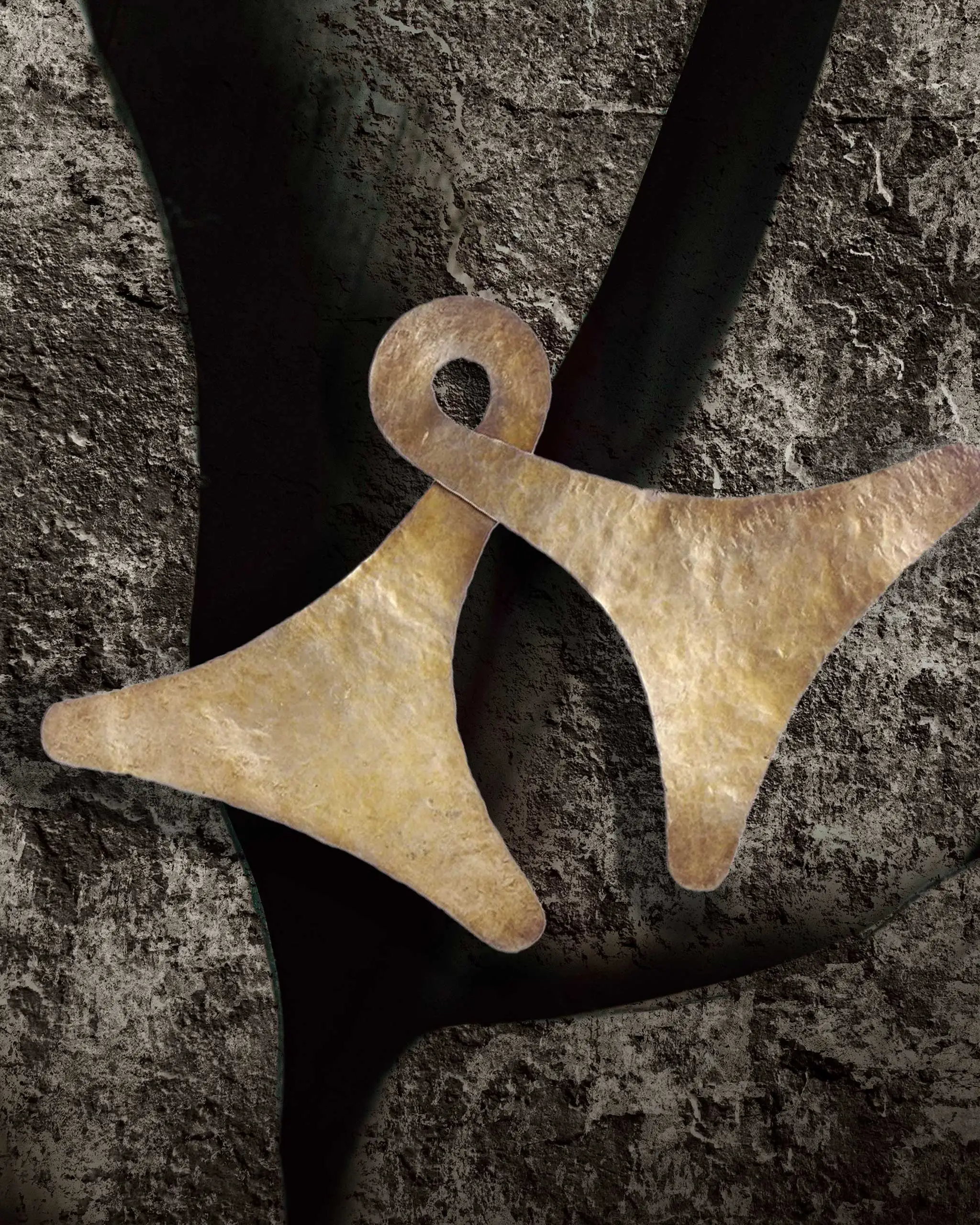
Photo courtesy of Marian Pastor Roces. Artwork by Bea Lu
Marian Pastor Roces writes about her marangga, a postmodern piece of jewelry that carries ancestral history.
Fetish
If ever a human actually loved a thing, deeply and insanely, that would be me.
The object of my passion is, exactly, an object. It’s called a pectoral in the field of body accoutrements (a.k.a. jewelry), a form that hangs, often hugely and strikingly, against the breast or upper chest. Man or woman. “Pectoral” is, of course, the word in anatomy for breast and chest muscles.
The object of my love summons its direct and only meaning from its conflation with a body part. It, pectoral melded to pectorals, stages itself as an apparition made flesh. Or flesh made metal.
Love this peculiar is either dismissed or investigated as fetishistic. Anthropologists and witches think the fetish to be something invisibly pulsating at the nether side of normal. Fetish, then:
“…an inanimate object worshiped for its supposed magical powers or because it is considered to be inhabited by a spirit.”
Which is to say that the worship part of love, or its lust or affection features, spins on a presupposition of magic or confidence in spirits. And those spirits may also be animating the thing like a desired body part.
“…a form of sexual desire in which gratification is strongly linked to a particular object or activity or a part of the body other than the sexual organs.”
My thingimie is both kinds of fetish. It has what I know of a lover’s power over me, not excluding erotic edge. Its paired metal triangular flanges with rounded angles feels silver-cold; projects details of subtle and uneven corrugation; touches back with remoteness and familiarity at once.
But it is more than a fetish.
Descent
My marangga is a loving reproduction from about 20 years ago, created by my friend, the Conceptual Artist Judy Freya Sibayan, during a hiatus to refine jewelry-making. Antique versions command attention and top price in the market for ethnographic objects. It is thus classified (ethnographic) because the originals were made at least a century ago on the island of Sumba in the extreme east of the Indonesian archipelago, in the province is called Nusa Tenggara Timur (and, fondly, NTT).
Museums that own them can hardly avoid effusive description. Here, documentation from the Museum of Fine Arts Boston, of one that it owns: “With their elegant shape, pectorals from western Sumba, called marangga, are among the most iconic works from Indonesia. Originally created from precious metal such as gold or silver, artists have more recently fashioned them from alloys of other metals. Marangga were among the heirlooms clans accumulated over time and displayed during feasts. These objects represented the wealth of their owners, embodied histories, and alluded to ritualized exchanges of valuables between families that helped reenact and confirm alliances, such as marriages.”
Loving texts of love in the innards of museums, I pay attention. The marangga speaks to me, firstly, as a sadly/happily translocated emblem of ancestry, shifted from Sumba men’s chests to Boston, to reside in glass boxes and pull-out steel storage shelvings. Still throbbing.
My ancestry. Not “Indonesian” in the sense of the postwar political entity. Not “Filipino” in the sense of the Philippines as Southeast Asian (nor, heavens! ASEAN). Rather, I discern the line of cultural descent sensed in the affinities shared by more than 400 languages spoken in what became these archipelagic modern nations.
Touching the marangga form animates, for me, 4000 years of loving eroticism that birthed the languages of nearly 25,000 islands on the eastern continental shelf of Asia. Sumba of my obsessive cultural interest and the Luzon of my birth are islands first before parts of “national identities.” I love the fluid subversion (dissolution) of the modern.
I love that the waters and languages of this region continue to create much deeper ancestral connections than do nationalisms. Descent into the archaic, upon touching the marangga, is both fetishistic magic and hardcore science.
Ascent
A lover in this telling, I am prone, too, to anger about everyone’s unknowing. Many museum descriptions of the marangga, other than the above, focus on male wear of this “symbol” of “power.” The almost inevitable inflection on maleness and hierarchical power, as well as wealth accumulation and display does not recognize the bilateral female energy so striking about island Southeast Asian culture.
Nor is there proper recognition of power as, in fact, fetishistic and erotic, rather than exclusively bound to class construction, pomp, outward projection. The marangga touches a field of body sensation that is at once spiritual. On the chest, it shows a dualism, a simultaneous male/female, spirit/body, raw/refined, pleasure/distance formal dynamic.
And when my object of love, itself a lover, this marangga, ascends from anger to equanimity—lifts us from rage to serenity—it is in the form of itself. A dyad with interacting twinned parts, in momentarily arrested fluidity.
As a piece of postmodern jewelry, created by an avant-garde artist, I wear mine, I embody mine, to generate equilibrium amongst my moving identities.


