
At the Venice Biennale, Jon Cuyson and Mara Gladstone Explore Filipino Migration Through the Sea


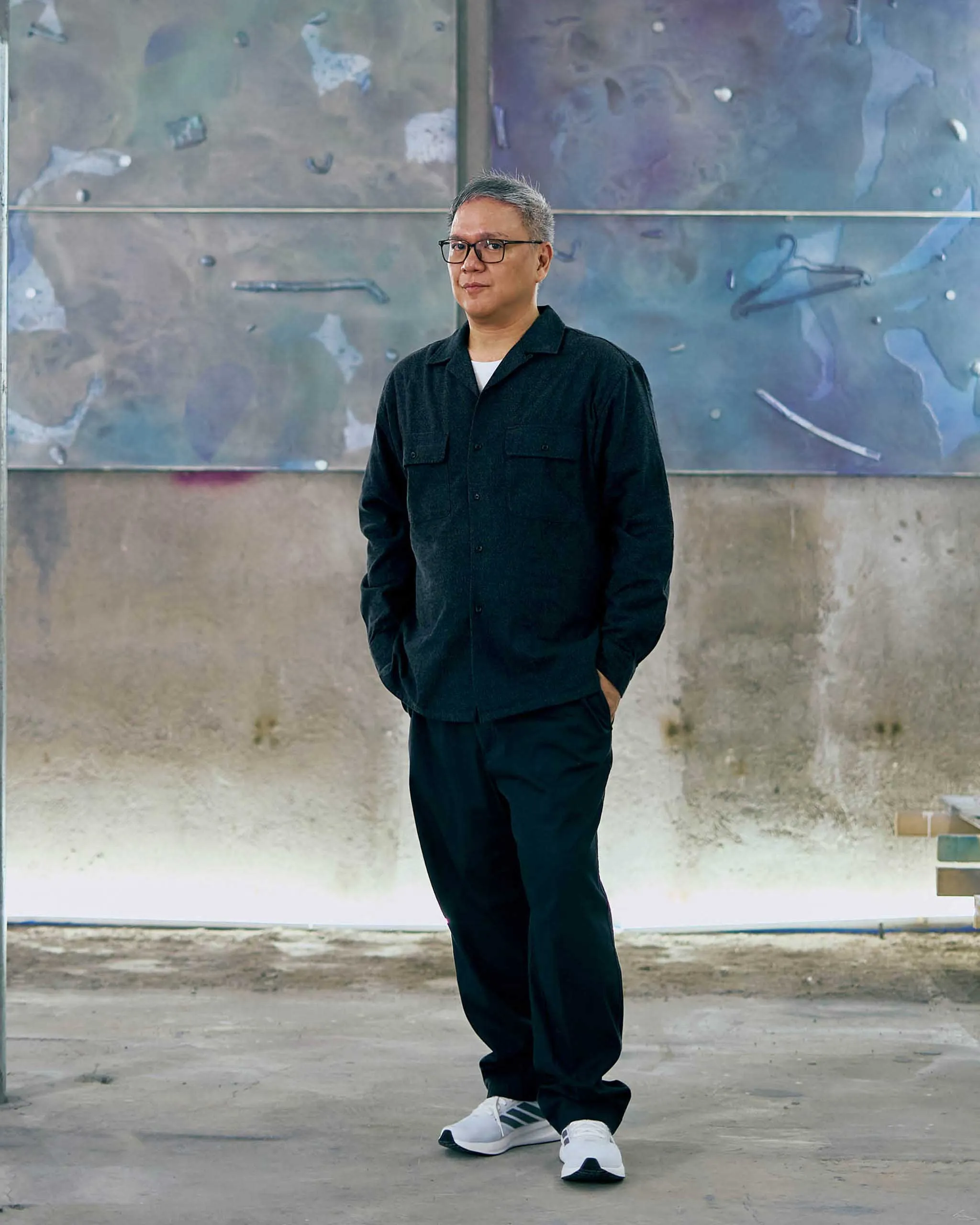
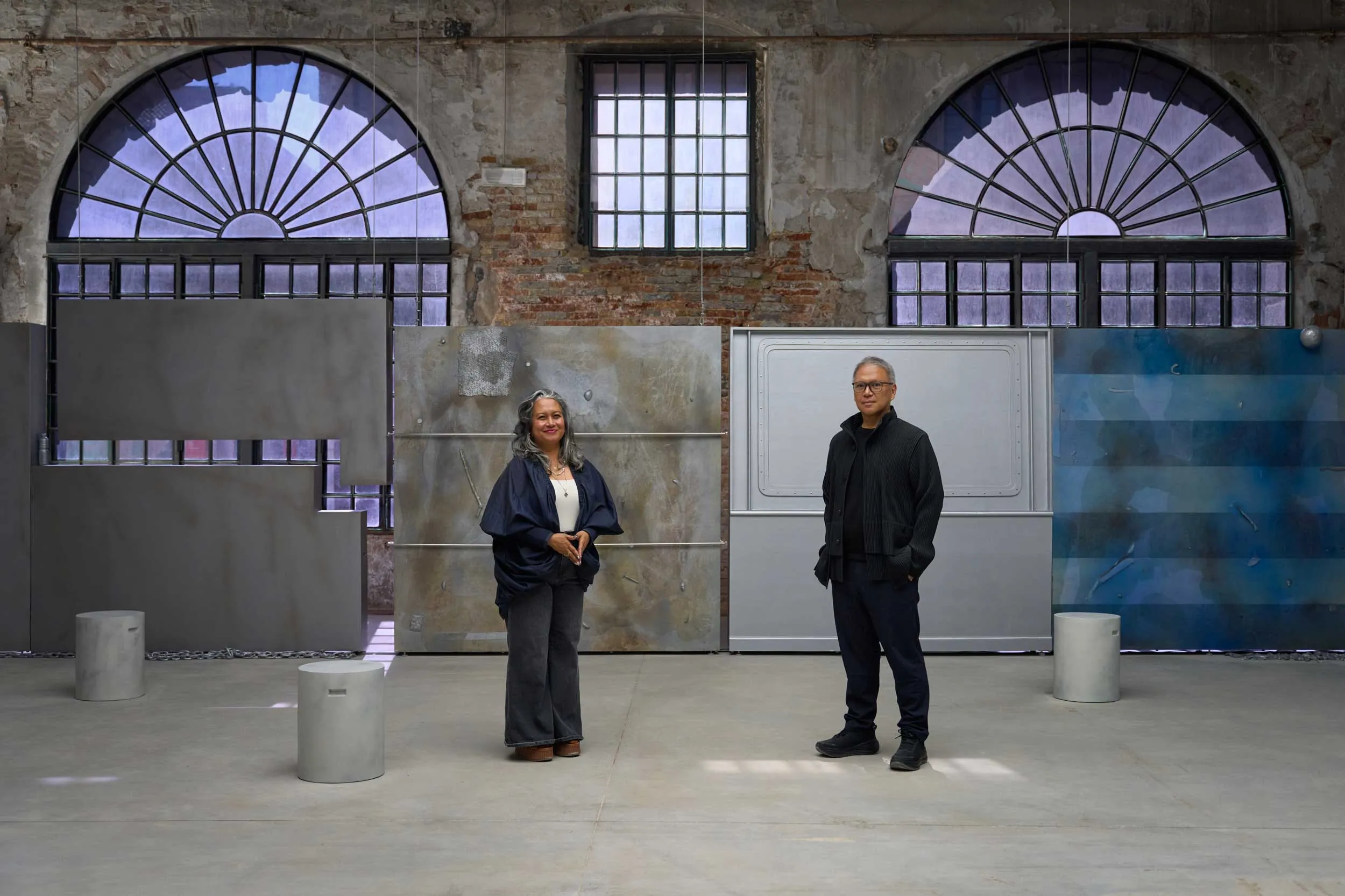
Jon Cuyson is an interdisciplinary artist that explores queer and postcolonial ecologies through the sea, with exhibitions and paintings featured at the Brunei Gallery, SOAS in London, and the Bronx Museum in New York. Photographed by Kieran Punay for the May 2026 Issue of Vogue Philippines
At this year’s Venice Biennale, Jon Cuyson and Mara Gladstone turn to the sea as a living archive of Filipino migration, labor, and love.
There are roughly 400,000 Filipino seafarers moving across the world’s oceans at any given time. They crew cargo ships that transport a variety of goods, effectively keeping global trade in motion. Yet, most of them remain unseen. Their labor unfolds far from the mainland, and far from the images we usually associate with migration and other OFWs. In the work of artist Jon Cuyson and curator Mara Gladstone, that distance becomes the point of entry. For the duo, the concept of the sea is no longer just a medium for travel, but a record that holds memory, and an accumulation of lives lived in transit.
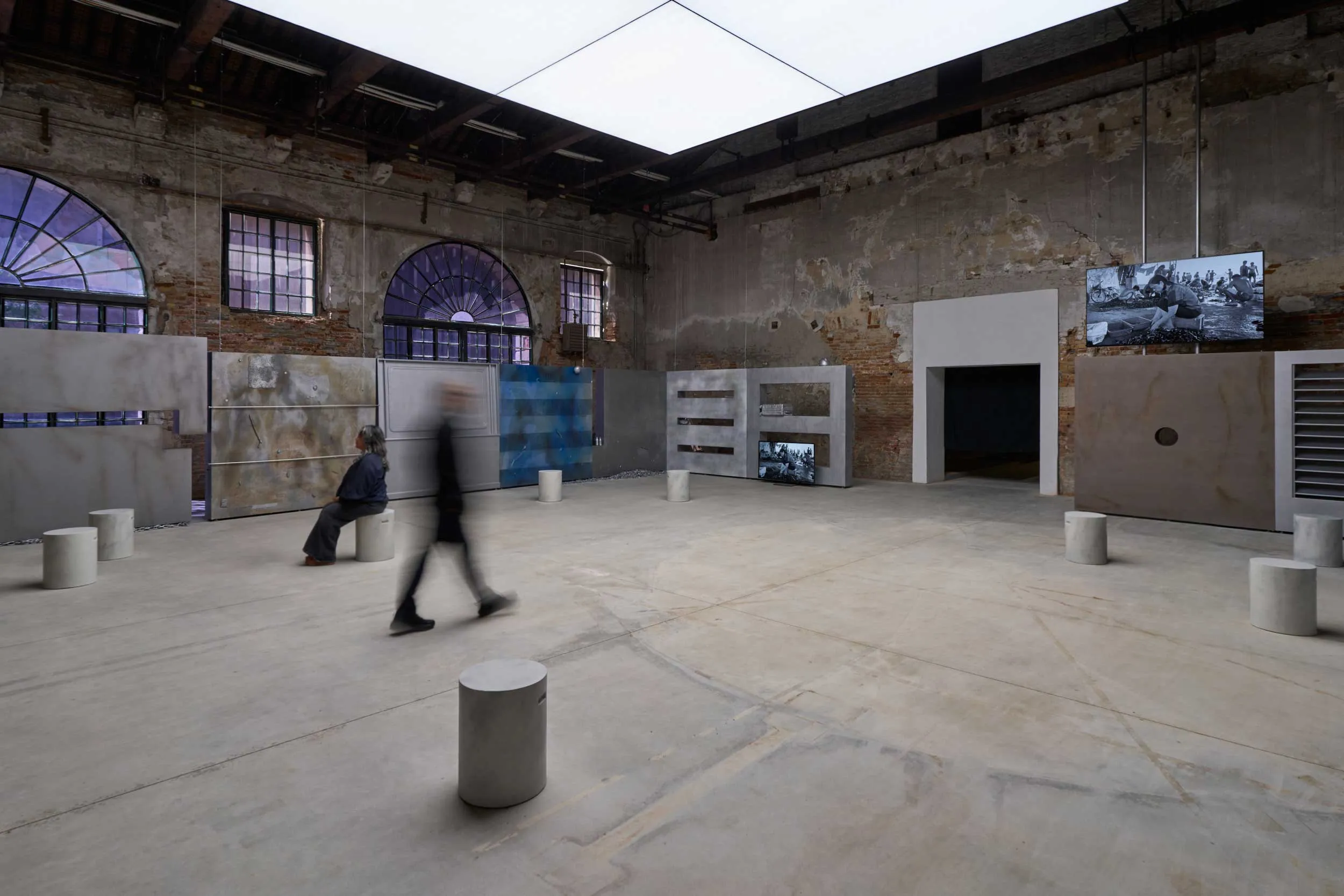
For the 61st Venice Biennale, where they will represent the Philippines, that condition takes form in Sea of Love, or Dagat ng Pag-ibig, an exhibition that gathers three decades of Cuyson’s practice into a single, shifting environment. Composed of paintings, films, and sculptural elements, it’s an exhibit that does not have a singular way of seeing. It drifts instead between different forms, between timelines, and in the ways we understand what it means to move across water.
Established in 1895, the Venice Biennale has long been positioned as a site for international cultural exchange, usually described as the “Olympics of contemporary art.” Held in Venice, it remains one of the most visible global exhibitions, where nations present artists that attempt to challenge common ways of thinking through identity, history, and how these elements interact with the present. The Philippines first participated in 1964, returning in 2015 after a 51-year hiatus. This year marks its sixth participation since that return, with the Philippine Pavilion commissioned by the Philippine Arts in Venice Biennale.
But for all its scale, Dagat ng Pag-ibig’s premise is direct: to honor the labor of Filipino seafarers. There is no attempt to monumentalize, and instead, the art leans into the emotional logic that defines movement.
Cuyson’s entry into this world began with literature. “I’m spelling it Q-U-E-R-E-L-L-E,” he says, referring to Querelle of Brest, a novel by Jean Genet centered on a sailor navigating desire and violence, later adapted into film by Rainer Werner Fassbinder. “It made a big impact on me,” he says, and what followed was a localized transformation. “I wanted to co-opt the character, but decolonize it and turn it into something Filipino.”
Since 2013, this figure has appeared across Cuyson’s works as both character and vessel. But Kerel does not exist alone. He moves within a network of relationships, alongside a trans lover named Mutya, and a semi-blind babaylan mother named Nanay Cleo. Together, they form a narrative that unfolds across a trilogy of films, all of which will be shown in Venice alongside a fourth, newly developed piece.
Water had always been a central focus in the artist’s work, but Cuyson clarifies that “more specifically, it’s about maritime labor, not just the sea, but labor at sea.” That distinction sharpens the exhibition’s focus. Because while the sea has long been romanticized in art and literature, the creative team of Jon and Mara attempt to treat it as a site of work, of endurance, of repetition, and of absence. And yet, they resist reducing this experience to hardship. It keeps returning to a more difficult question: why do people leave?
“There’s a moment where he buys medication for his trans lover,” Cuyson says, describing a scene from one of the films. “So it’s really about the purpose of work, why migrants, why OFWs go through these sacrifices. It’s about love.” In this framing, labor becomes inseparable from care. Distances imposed by the sea are held together by something else, love that persists despite it.
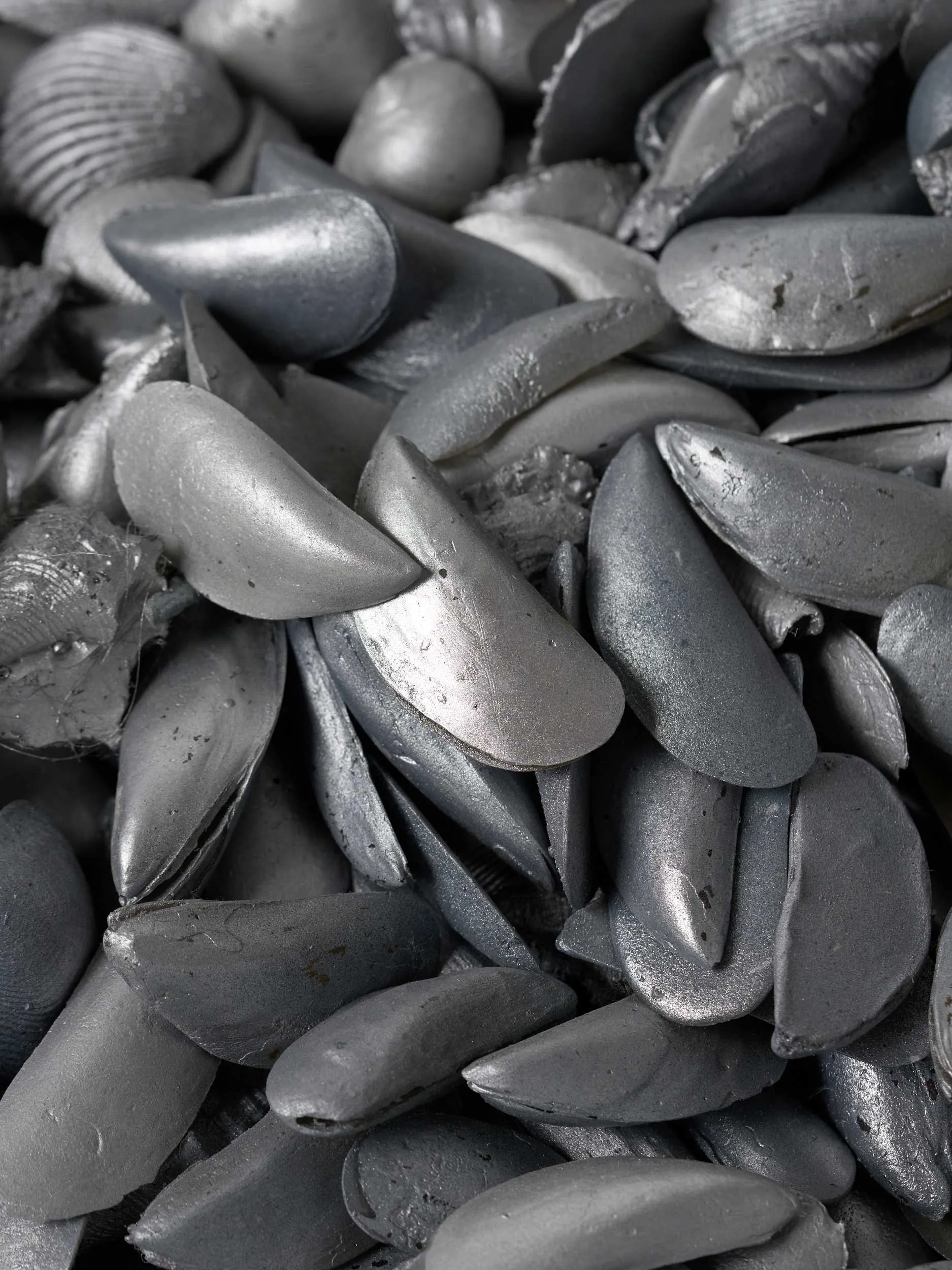
To better understand these concepts, Jon turns to a non-human character he had developed as the subject of his latest film, a framework titled “Mussel Thinking.” According to the artist’s research, the mussel is one of the few animals to have survived the five great mass extinctions, and for him, can also be viewed as a way of adapting to modern versions of complex issues, such as migration, and both the climate and economic crisis we face today. “It’s about survival within systems, and the ocean works both ways. There’s pain in separation, but also love. People leave because they love their families, they love their country. It’s labor and sacrifice that connects us. The Philippines is shaped by water.”
If Kerel provides the emotional center of the exhibition, the sea itself holds its deeper history. Cuyson traces this through the material record of the Philippines as an archipelago. “If you look at early artifacts in archaeology museums, you’ll see boats.” He points to the Manunggul Jar, where two figures sit atop a vessel, mid-crossing. “That’s how we imagined crossing islands.” Before colonial influence introduced painting as a dominant medium, Filipino culture was expressed in pottery. Movement across islands were already embedded in these objects. “The sea, for me, becomes a kind of living archive,” he explains, “and it carries our hopes, our desires, our anger. You cross it for a reason, to survive, to find someone, or to build a better life.”
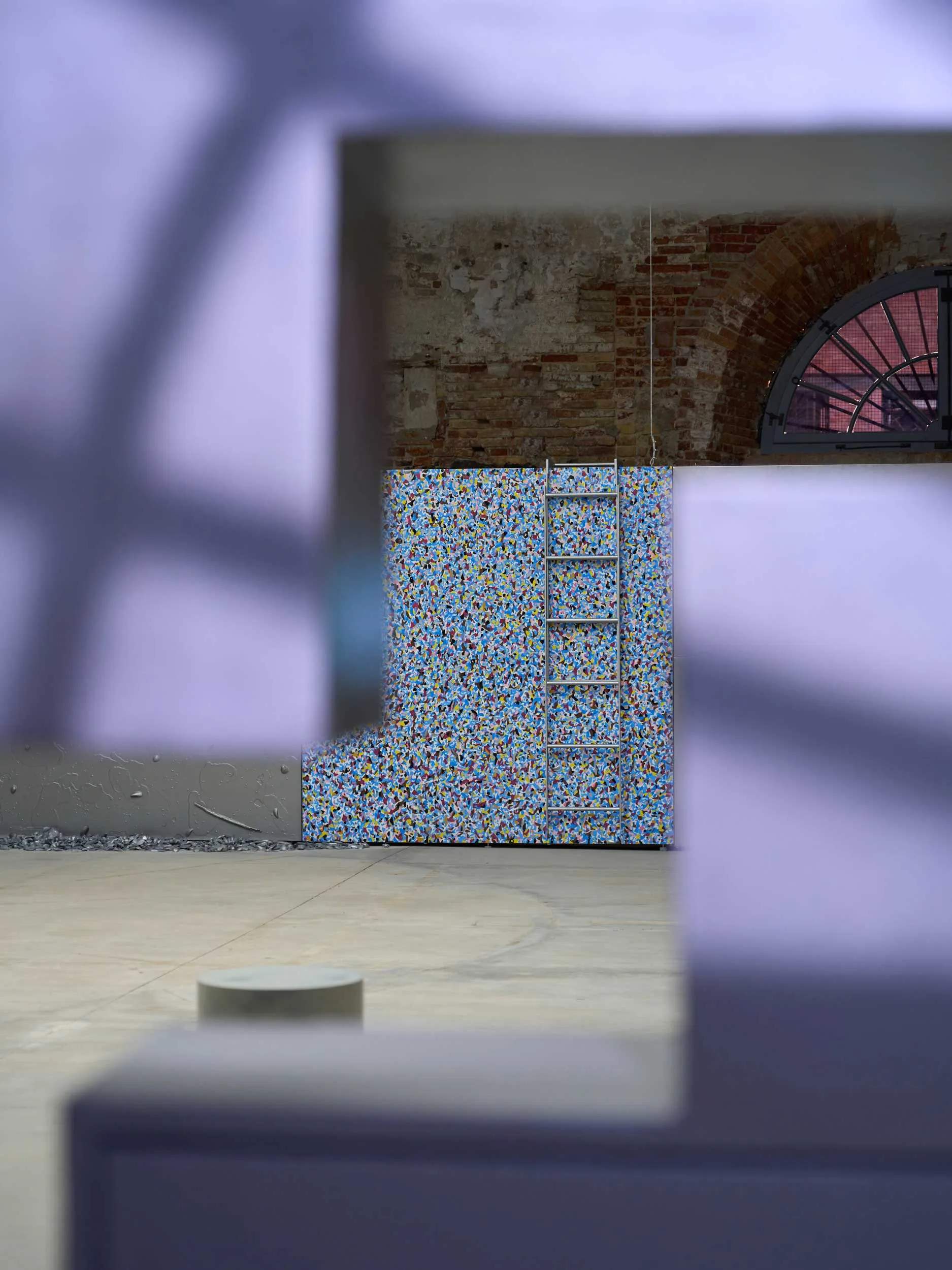
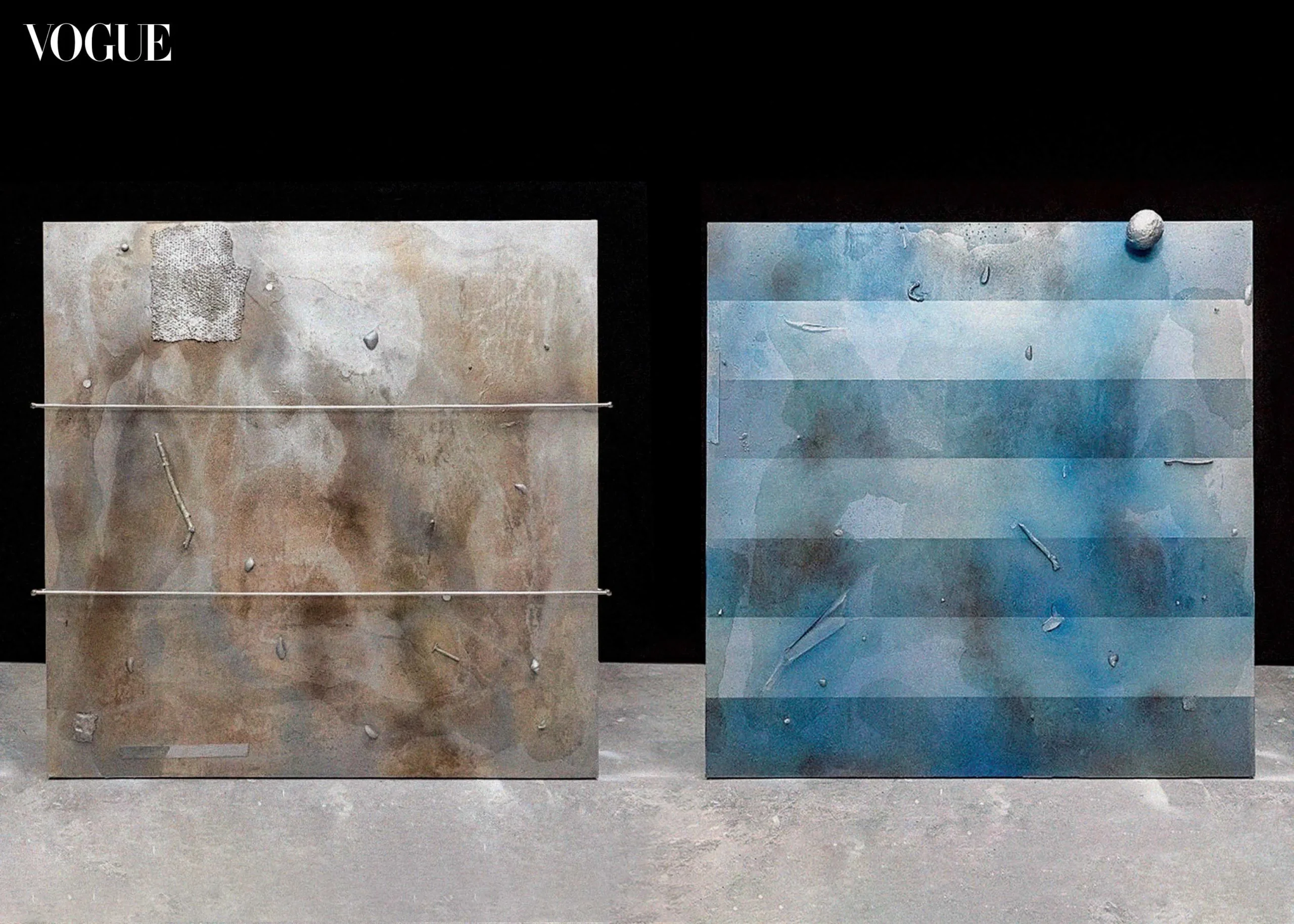
This idea of the ocean as an archive that is constantly shifting extends into the structure of the exhibition itself. Around 20 paintings form a fragmented horizon, their surfaces built through thin, repeated layers of acrylic. Each layer is allowed to dry before the next is applied, “like metal weathered by sun and salt,” creating a surface that feels worn and exposed, giving the appearance of a boat out at sea.
These paintings hold their own internal logic, and for the exhibit’s curator, Mara Gladstone, this was essential. “We didn’t want the paintings to function as mere backdrops to the films,” she says. “Instead, both mediums needed to coexist.”
Her interest in Cuyson’s work began many years ago. “He was committed to painting, specifically geometric abstraction, at a time when it wasn’t necessarily in step with broader trends,” she recalls. Coming from a background steeped in California abstraction, she recognized the lineage, but also the departure from the norm. That tension became a point of entry for their collaboration, which began in 2019. “It wasn’t a top-down collaboration. It evolved organically through conversation and trust.” The exhibition, in its final form, is the result of around 30 iterations.

The result is a space that moves like its subject. Four films play across multiple monitors, sometimes overlapping, sometimes pausing, and there is no fixed sequence. Viewers are invited to move and to piece together fragments. “The installation is designed so people move freely within it, like navigating at sea,” she explains. Here, the paintings form a horizon that is never quite complete.
It is this sense of “paglalayag” that becomes central to how the exhibition is experienced. “In archipelagic thinking, islands are not isolated, they are linked beneath the surface,” Gladstone says, so the ocean, then, becomes a connective force.
As its curator, this also required a deliberate restraint. “We were intentional about not turning the project into a spectacle,” she says, and in a setting like the Venice Biennale, where scale often defines visibility, this decision feels almost counterintuitive. But it is precisely what allows the work to hold its ground.
“The installation is monumental, but not overwhelming,” she adds, “so its power comes from stillness and attention.” Because at its core, Dagat ng Pag-ibig is about making visible what has long remained out of sight.
“There are many queer Filipino seafarers who remain unseen, who choose to stay hidden,” Cuyson says. “This is my way of saying, I see you.”
Both Cuyson and Gladstone believe this sense of distance is not abstract. Gladstone, who is currently based in the United States while remaining in touch with her diasporic roots, approaches this with an awareness of what it means to remain connected across geographies. “Like many Filipinos, I have loved ones across different parts of the world, and this exhibition echoes that reality, that idea that connection persists across distance.”
Cuyson echoes this in his own way. “On a personal level, the work deals with emotional life shaped by distance. I’ve lived in the U.S. on and off, so there’s a constant movement between places, between memories.” In this sense, Kerel becomes a proxy, for the Filipino seafarer, for the overseas worker, and for the artist himself.
By the time the exhibition opens in Venice, what will be on view won’t just be a culmination of three decades of work, but a way of thinking, one that moves between Filipinos personal and collective histories. And like the sea, it remains constantly in motion.
Frequently Asked Questions
The exhibition is titled Sea of Love / Dagat ng Pag-ibig. It is a multimedia installation by artist Jon Cuyson and curator Mara Gladstone that explores the lives of Filipino seafarers, treating the sea as a living archive of migration, labor, and human connection.
The exhibition is part of the 61st International Art Exhibition at the Venice Biennale. It is located at the Arsenale in Venice, Italy, and is open to the public from May 9 to November 22, 2026.
“Mussel Thinking” is a conceptual framework developed by Jon Cuyson. Inspired by how mussels cluster, filter water, and survive in harsh environments, it serves as a metaphor for resilience, kinship, and the interconnectedness of people across the global maritime industry.
The installation unfolds through four distinct perspectives: the sailor, his mother, his lover, and the “sea of echoes.” It uses a spatial system of 20 freestanding paintings, video works, and sculptures to create an immersive, oceanic environment that humanizes the often invisible labor powering global trade.
This marks the Philippines’ sixth participation at the Venice Biennale since its return in 2015. Represented by the National Commission for Culture and the Arts (NCCA) and the Department of Foreign Affairs (DFA), the pavilion highlights the country’s archipelagic identity and its profound, historic role in the global maritime landscape.