
Bianca Carague Reimagines a Kamayan Feast Through Jewelry That Doubles as Cutlery


Photographed by Renzo Navarro
Set in a future with harsher climates and technologically mediated lives, Bianca Carague’s Technospoonism reimagines traditional Filipino dining.
In the Philippines, environmental problems plague the nation with the constant threat of pollution, deforestation, climate change, and biodiversity loss. Given the current crises the country faces, it may be hard to imagine a better tomorrow. But in Bianca Carague’s Technospoonism, not only do we have a future in which humanity endures, but also one in which communal gatherings and celebrations are still practiced.
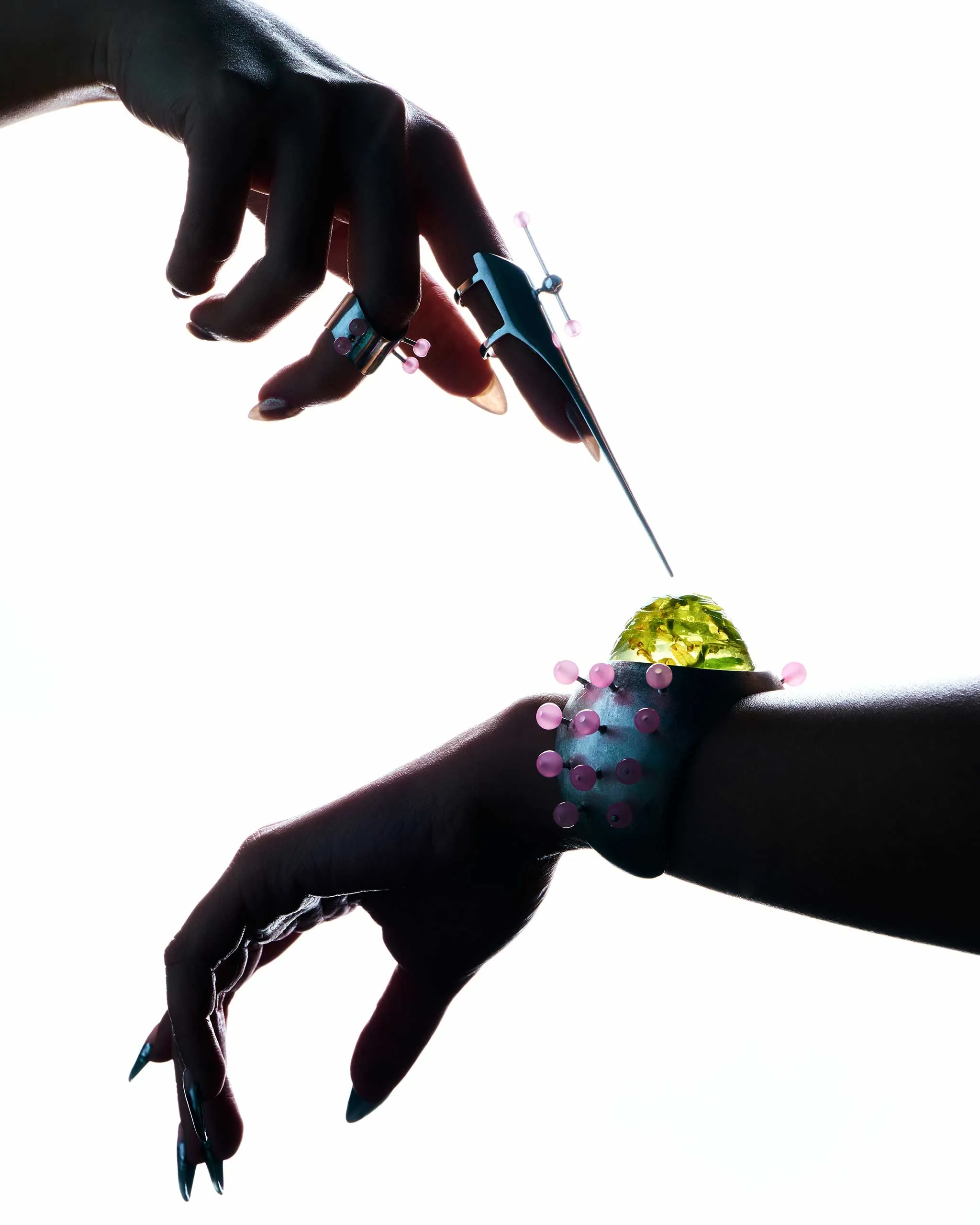
A part of this year’s Benilde Open Design + Art exhibition, Technospoonism reimagines the kamayan, the Filipino practice of eating using one’s bare hands. Set in a future that’s altered by climate and technologically mediated, Carague imagines the practice evolving through a collection of jewelryJewelryDecorative adornments worn on the body, from fine pieces in gold, diamonds, and pearls to fashion jewelry made of accessible materials. Jewelry completes an outfit and often holds sentimental orGo to Jewelry Glossary that doubles as cutlery and tableware. Cuffs serve as plates, rings as forks, and pendants as vessels.
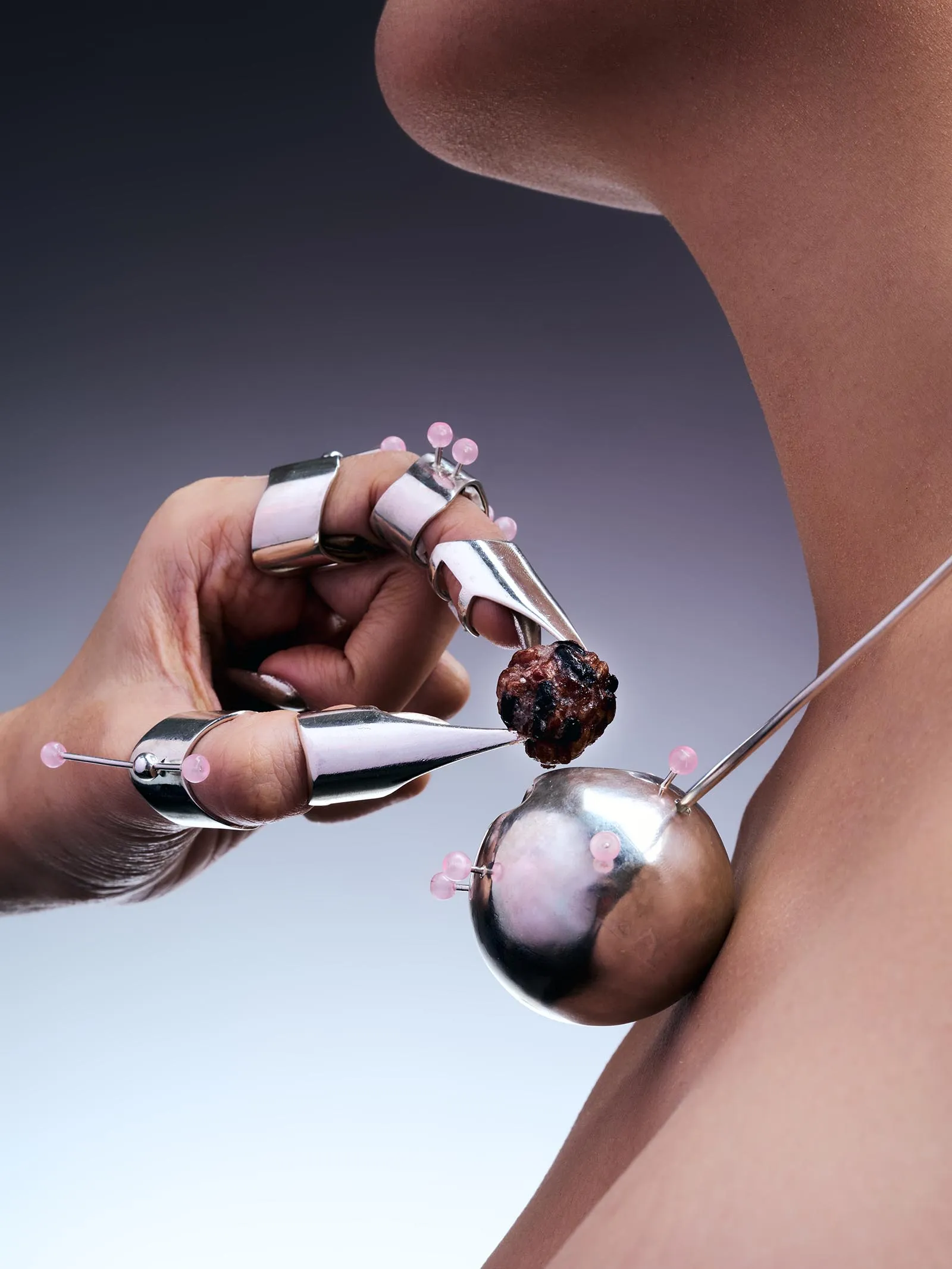
The concept came from different things. First, her desire to create objects again, her interest in dining practices, and her desire to work with chefs. “There’s not really one linear way to tell you why I wanted to work on this, or how I thought of it in the first place,” she shares. “[It] was a slow simmer of random ideas and interests, and things that I wanted to do in my mind.”
For the jewelry pieces, the design began with the idea of creating pieces that acted as extensions of the hand and body. She shares that she had “more of an idea of the feeling of the experience,” describing her goal of making it feel “weird,” “futuristic,” and “absurd.” “I didn’t know what that was going to look like exactly. It took some time,” she says.
Led by these feelings, she began by taking inspiration from Batok tattoos, the traditional hand-tapped tattooing practice from the Cordillera region. Taking the symbols for the sun and the moon, Carague tied these in with her concept. “Tattoos, they’re permanent, whereas these pieces I was making, they’re pieces you can wear, you can change, you can remove,” she says. “That comparison of permanence on the skin versus mutable, changeable, and adaptable, I feel that’s how I see survival in culture. It’s something that relies on adaptation rather than rigidity and permanence.”
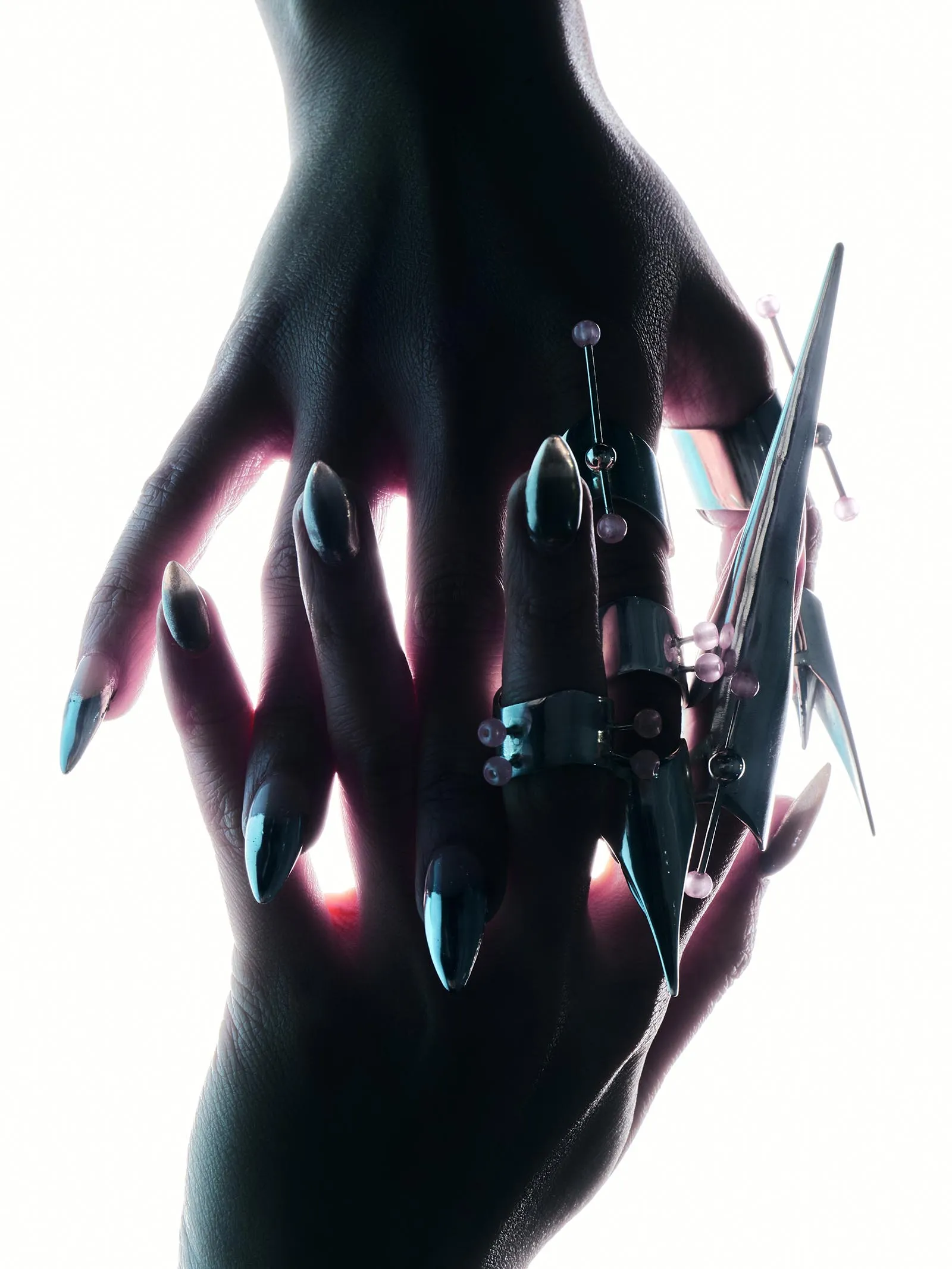
After a few sketches, she created models with clay and 3D printing, then arrived at a more streamlined collection. But the story doesn’t end with just the jewelry, but with a collaboration. To explore how the pieces could be utilized in her imagined future, Carague collaborated with chef Kelvin Pundavela, a key member of Now Now Canteen’s “reNOWn” gastronomy team.
If the future of the Philippine climate is harsher, certain crops may not be readily available, theoretically making hardier crops such as tomatoes, potatoes, ube, and kamote more abundant. Seaweed may also be more abundant, which they incorporated by turning it into agar-agar, suspending ingredients in the shelf-stable gelatin alternative. “The lore got deeper, and it got bigger when I brought other people in, even just to document the project,” she says. “This is really what it’s about for me, you know. It’s about just putting an idea out there and letting people run with it and see where it goes, and watching it grow bigger.”
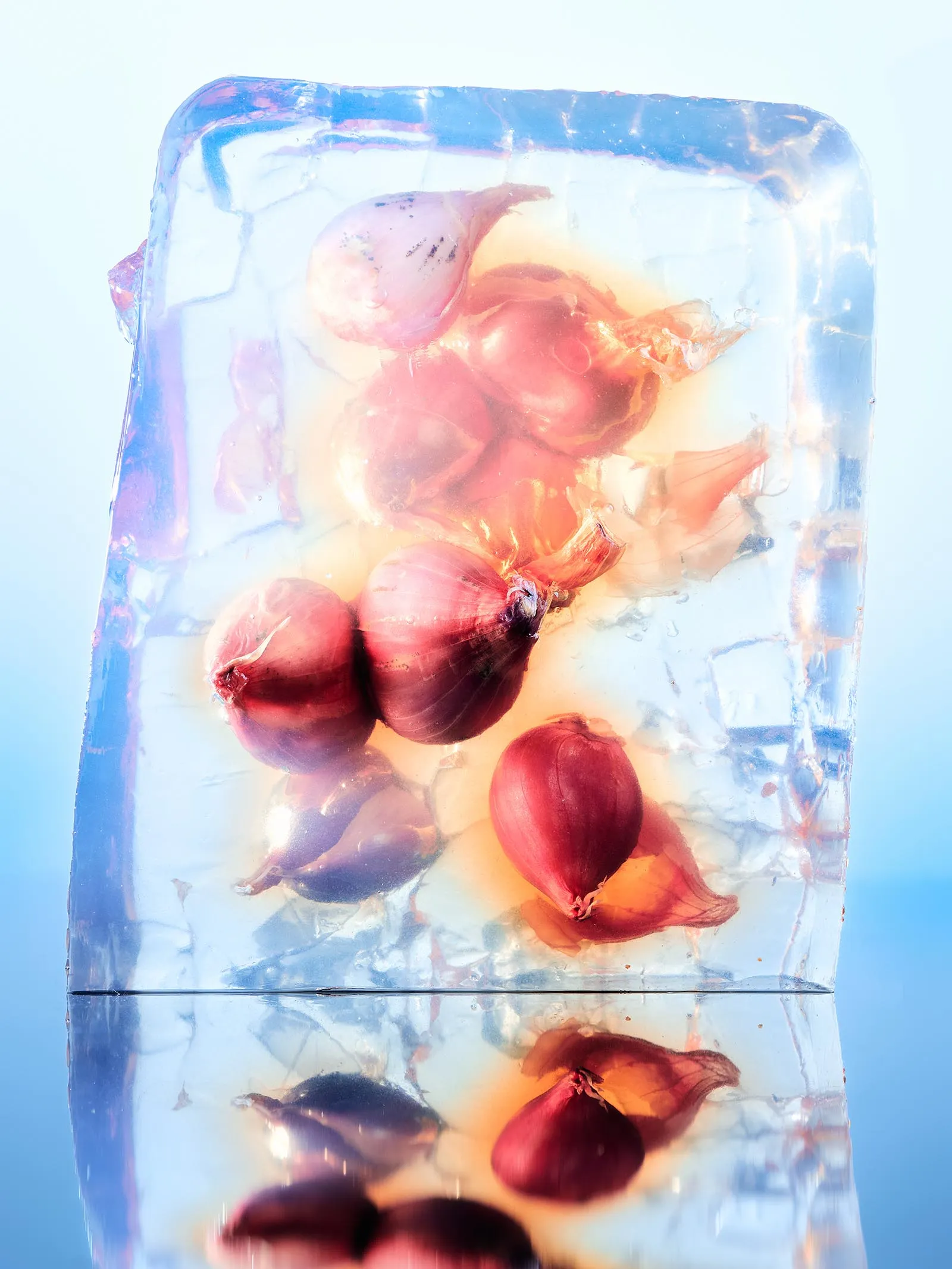
In her view, the project itself is neither optimistic nor pessimistic about the future. “I think it’s just taking a current situation and imagining a different way to be,” she says. “At the end of the day, you can’t have a future if you can’t imagine it first, right?”
And when she did imagine the future, she thought about what might matter in times of uncertainty. “Would we hold on to beauty and community and ways of being together?” she says. “My opinion is that that’s what we hold on to in times of crises, different ways of being together and feeling like we’re in it together.”
Though it seems far-fetched that we’ll be using jewelry as cutlery soon, Cargue’s Technospoonism brings some comfort about the future. That somehow, amidst all the challenges, humans will always need each other and come together to endure.
For more information and the schedule of activities, visit Benilde Open’s official website and social media accounts.
Frequently Asked Questions
Bianca Carague’s Technospoonism is a speculative design collection showcased at the Benilde Open Design + Art exhibition. The project transforms traditional Filipino tableware into wearable jewelry that doubles as personal cutlery, preparing the body for a climate-altered, technologically mediated future.
The collection translates kamayan—the ancestral Philippine practice of eating with one’s hands—by creating wearable structural extensions for the skin. In this speculative ecosystem, arm cuffs evolve to function as presentation plates, rings act as forks, and pendants hold liquid vessels.
Carague integrated symbolic motifs from Batok, the ancient hand-tapped tattooing practices preserved by the indigenous communities of the Cordillera region. By referencing symbols for the sun and moon, she examines how cultural systems adapt and mutate to survive environmental crises.
The designer partnered with chef Kelvin Pundavela of the “reNOWn” gastronomy team at Now Now Canteen. Together, they formulated a contextual menu reflecting deep climate shifts, relying on resilient, local Filipino crops like ube, kamote, and agar-agar derived from seaweed.
The installation presents an alternative view of climate survival, using fashion and object design as a medium for social inquiry. It examines whether human communities will continue to safeguard ancestral rituals, beauty, and communal intimacy during times of ecological collapse.