
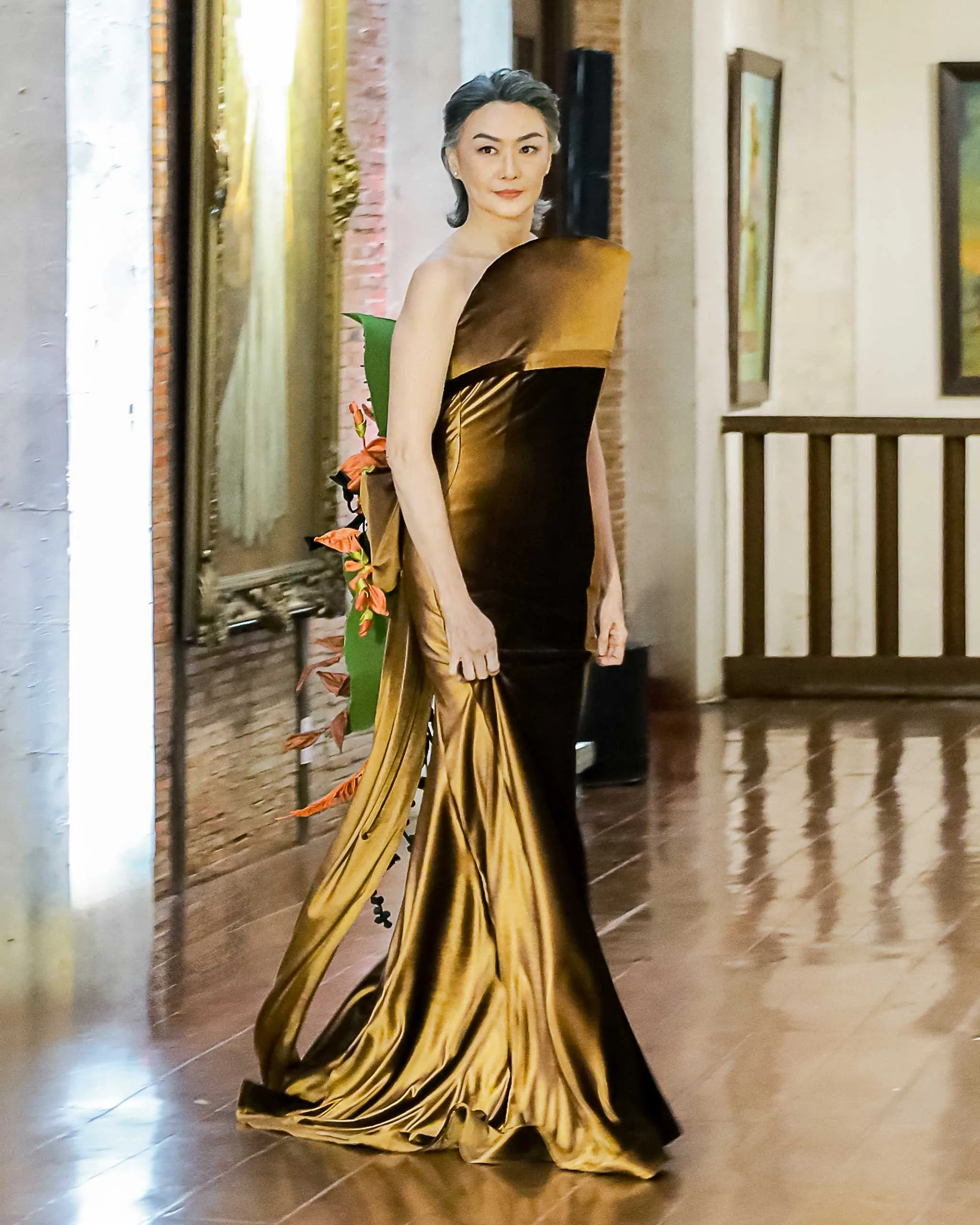
Veteran beauty queen, fashion model, and actress Marina Benipayo dons Garbo’s closing look. Photographed by Julius John G. Baysic, Courtesy of the National Museum of the Philippines Bohol
Through Garbo, Noel Bompat Estopito and Christian Kent Paglinawan honor Boholano traditions, landscapes, and crafts that raised them.
When we visit the National Museum of the Philippines – Bohol, on view are the works of Napoleon “Billy” Veloso Abueva, a National Artist for Sculpture who is a native of the province. That Sunday, the admissions-free museum is not as busy as one would expect. Usually, churchgoers from the Tagbilaran Cathedral across the road drop by after hearing mass, says Neil Reyes, the museum’s information officer. But not today. Today, the second floor, which houses most of the artworks, is cordoned off in preparation for Garbo, the fashion showcase of Boholano design duo Noel Bompat Estopito and Christian Kent Paglinawan of Noel Estopito Couture.
“Actually, his hometown is two towns away from mine,” comments Kent of Abueva. We meet the Boholano creative just hours before his and Noel’s showcase, at the Paglawig exhibition dedicated to the Boholano way of life. Surrounding us are vestiges of what and how their ancestors used to create; artifacts pertaining to all sorts of handiwork, from boat-building, fishing, and farming, to metalsmithing, jewelry-making, and weaving. The large room has been transformed into a makeshift closet and holding area for the models, and in fact, when we run into Kent and Noel, they are welcoming veteran beauty queen, fashion model, and actress Marina Benipayo to whom they’ve assigned the show’s closing look.
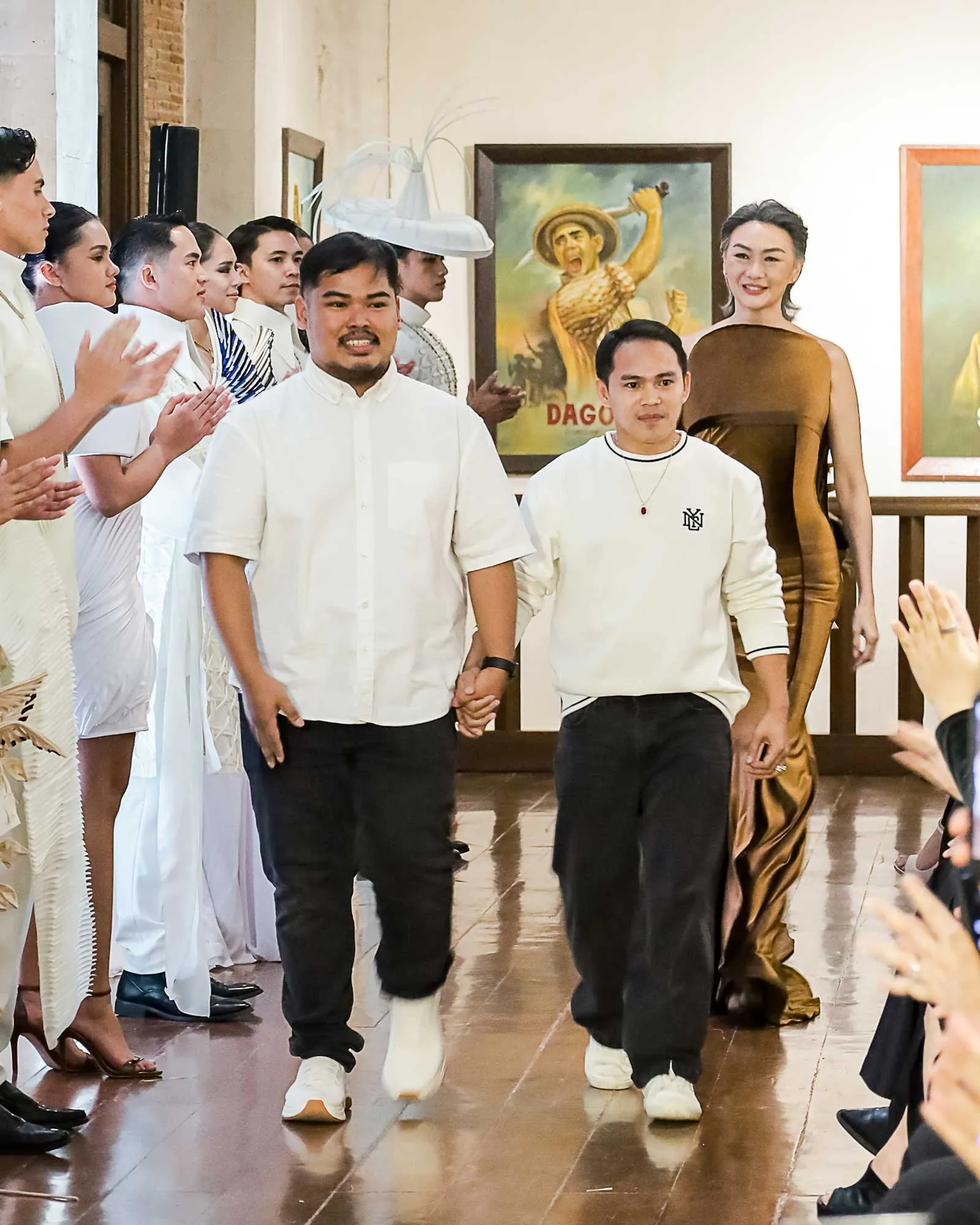
Noel, in a face mask, accompanies Marina out into the hallway. When Kent and I settle on a bench, he prefaces our conversation with an apology: it will only be him speaking with me this afternoon. Noel, he explains, is slightly stressed, and not very comfortable with interviews.
It’s the calm before the storm, yet Kent appears to remain calm. The anteroom we inhabit is dedicated to the production of asin tibuok or artisanal sea salt, which was recently inscribed on the UNESCO List of Intangible Cultural Heritage in Need of Urgent Safeguarding. An apt location for our chat, considering that the collection they’re presenting tonight is inspired by Boholano traditions and elements.
It is the second time the duo is presenting in the museum, following a group show in 2024 centered on raffia. This time, the two are in the spotlight for National Arts Month, as selected by the local government.
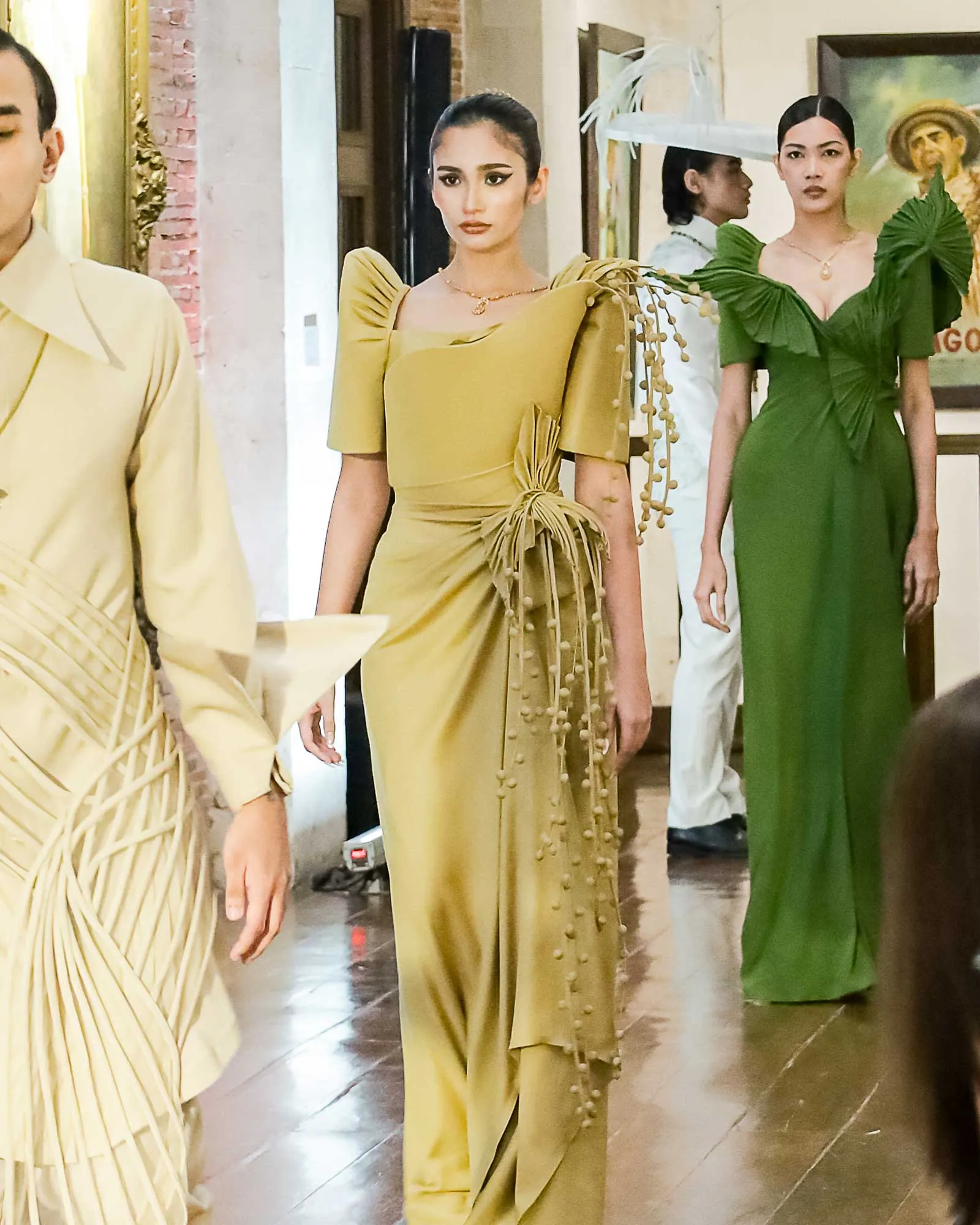
“Garbo means ‘pride’ in Bisaya,” Kent translates. “In this collection, pride is not loud and performative. It’s the introspective, quiet type of pride that you see in everyday life.” The 20-piece showcase is the duo’s largest to date, rife with local and cultural references: palm trees lining the Loboc River’s deltas, or the 400-meter high Alicia Panoramic Park. Kent is quick to offer a disclaimer: “It’s really open for interpretation. This is not literal imagery.”
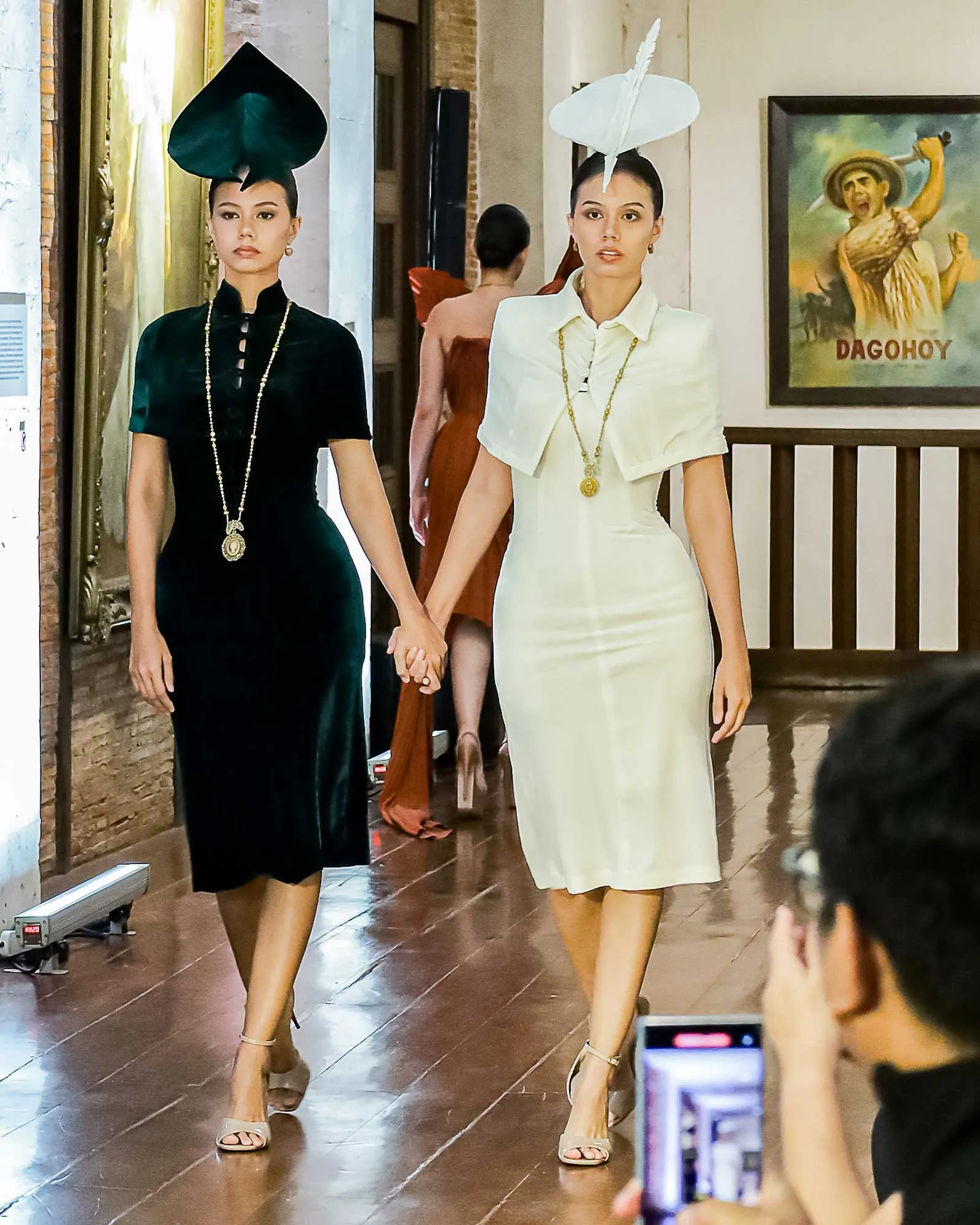
He cites a beige terno cascading with sparse fringes adorned with marble-sized spheres, which call back to the summer tradition of picking lomboy or java plum fruits. Simultaneously, it can also allude to seeds of buri palm trees, used to make raffia. (Their pieces, crafted from piña cocoon, velvet, and jersey, also included leftover raffia from their former collection.) Their menswear is mostly interpreted in white and cream, inspired by garbs of asin tibuok traders who used to exchange their artisanal salt for rice and produce; canvases, like all their other looks, embellished with antique Filipino jewelry sourced from all over the country by Michael Amores and Janssen Bantugan.
The show is a feat for the two, who began their brand over the pandemic without formal training in fashion. “I have to be frank,” Kent intimates, “it’s very difficult to be a fashion designer in the province, precisely because different individuals from your life would tell you to pursue a path that is much more stable, much more reflective of the middle class, provincial way of approaching success.”
Young designers who wish to pursue fashion often have to relocate to Cebu or Manila, journeys that require a hefty financial capacity. Hence, their non-traditional paths to becoming designers. Kent comes from a maritime background having been a seafarer, while Noel began in fine arts before shifting to hotel and restaurant management later on. Over the lockdowns, the life and business partners were overcome by their desire to create.
“I always tell people that Noel and I are closest when we design, when we create something,” Kent says with a smile. Of their dynamic, Kent describes himself as being in charge of the vision, before Noel comes in with his own ideas and brings their shared narrative to life. The two dialogue closely when they are commissioned by clients and stylists, but it is Noel who does the patternmaking, cutting, and sewing, while Kent is involved in the finishing. Beyond design, Kent takes on an outward-facing role akin to a press officer, while Noel manages internal administrative responsibilities.
Noel’s hands-on work never fails to leave Kent in awe. “It’s one thing to create patterns. It’s another to understand the garments, to see how they behave, hear the way they talk. You have to converse with the material, otherwise it fights you,” he muses. “And I think my partner Noel has a way of speaking to fabrics; understanding how they fall, understanding how they restrict or how they sometimes have a life of their own. You have to respect the material you’re working with.”
For the two, this reverence for materiality comes from an intrinsic part of them that grew up knowing to treat their land with unconditional care.
“For a lot of people, Bohol is a tourist spot, Bohol is a paradise. For us locals, it’s home,” Kent insists. ”A lot of Boholanos create not because we compete, but because it’s an innate part of our identity. It’s our way of interacting with the community and nature around us. Many of our artisanal crafts are produced because of our relationship with the land, and our relationship with our community, and with our history and practices. When it comes to our artisanal endeavors, it comes from a place of shared belonging, relationships with our ecology, and remembrance of our ancestors.”
Garbo was presented by the City Government of Tagbilaran through its Council for Culture and the Arts, in partnership with the National Museum of the Philippines Bohol, The Bellevue Resort Panglao, Casa Bacarro Museum & Heritage Restaurant, and the Sigala Arts and Cultural Heritage Research & Development Foundation, Inc. Production by the Tagbilaran Council for Culture and the Arts. Directed by Alexis Cadeliña. Traditional ornaments by Casa Bacarro Museum & Heritage Restaurant and the Sigala Arts and Cultural Heritage Research & Development Foundation, Inc.


