
A Look Into Alfonso Ossorio’s Life and Works


Photographed by JV Rabano for the November 2026 Issue of Vogue Philippines
Vogue Philippines takes you inside Lito and Kim Camacho’s collection of the Filipino-born artist who lived at the center of Abstract Expressionist movement.
Yayoi Kusama may have ascended to the great infinity room in the sky, but here in the Camacho art house/gallery, the Japanese artist feels more alive than ever. A giant dotted pumpkin squats by the entrance, seemingly floating on the arowana-filled pond into which, according to the household manager, many a guest have fallen. A second gate appears, a grid entangled with silver vine-like protrusions. It is Kusama’s “Prisoner’s Door” (1994), part of her soft sculpture Accumulations series. Nearby, a statue of Venus de Milo is obliterated by Infinity Nets. Welcome to one of the largest private collections of Kusama’s artwork in the world.
Though the dots are dazzling and dizzying, and one could spend hours, if not a lifetime, entranced by Kusama’s orbs and molecules, we are here to see a different artist, whose work Lito and Kim Camacho also possess in significant quantity: Alfonso Ossorio.
Ossorio, he of the Angry Christ, Patron of Pollock, the unheralded link between France’s Art Brut movement and New York’s Abstract Expressionism. Ossorio was a Philippine-born American artist whose 10-month stay in Negros when he was 34 years old proved pivotal to his artistic development. From 1952, he lived in a massive, horticulturally impressive estate in the Hamptons called The Creeks with this partner Ted Dragon, where Ossorio created and collected art until his death in 1990. This November, the Metropolitan Museum of Manila will be exhibiting 44 pieces from the Camacho collection in the largest Ossorio retrospective since Ayala Museum’s 2018 show Alfonso Ossorio: A Survey 1940-1989.
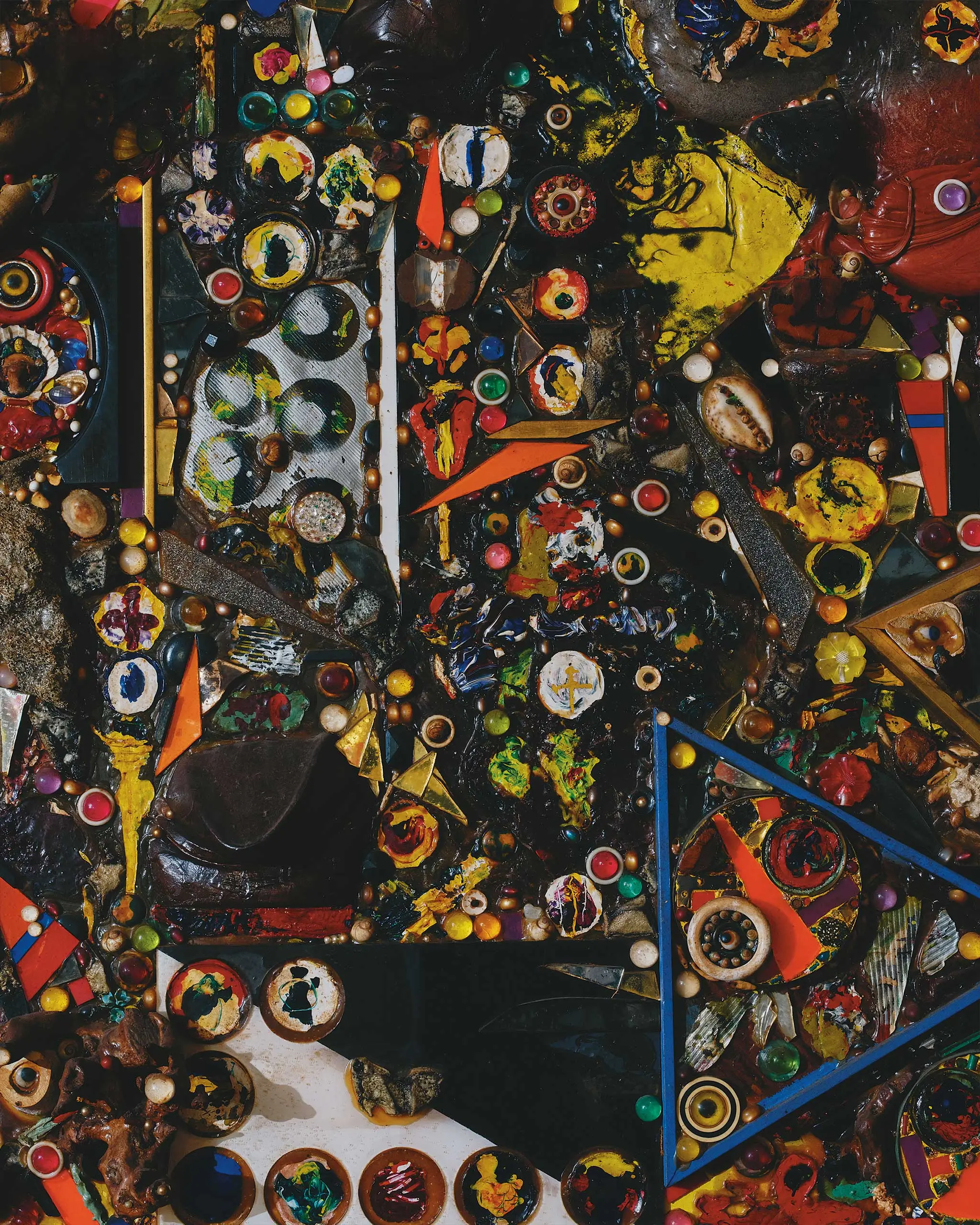
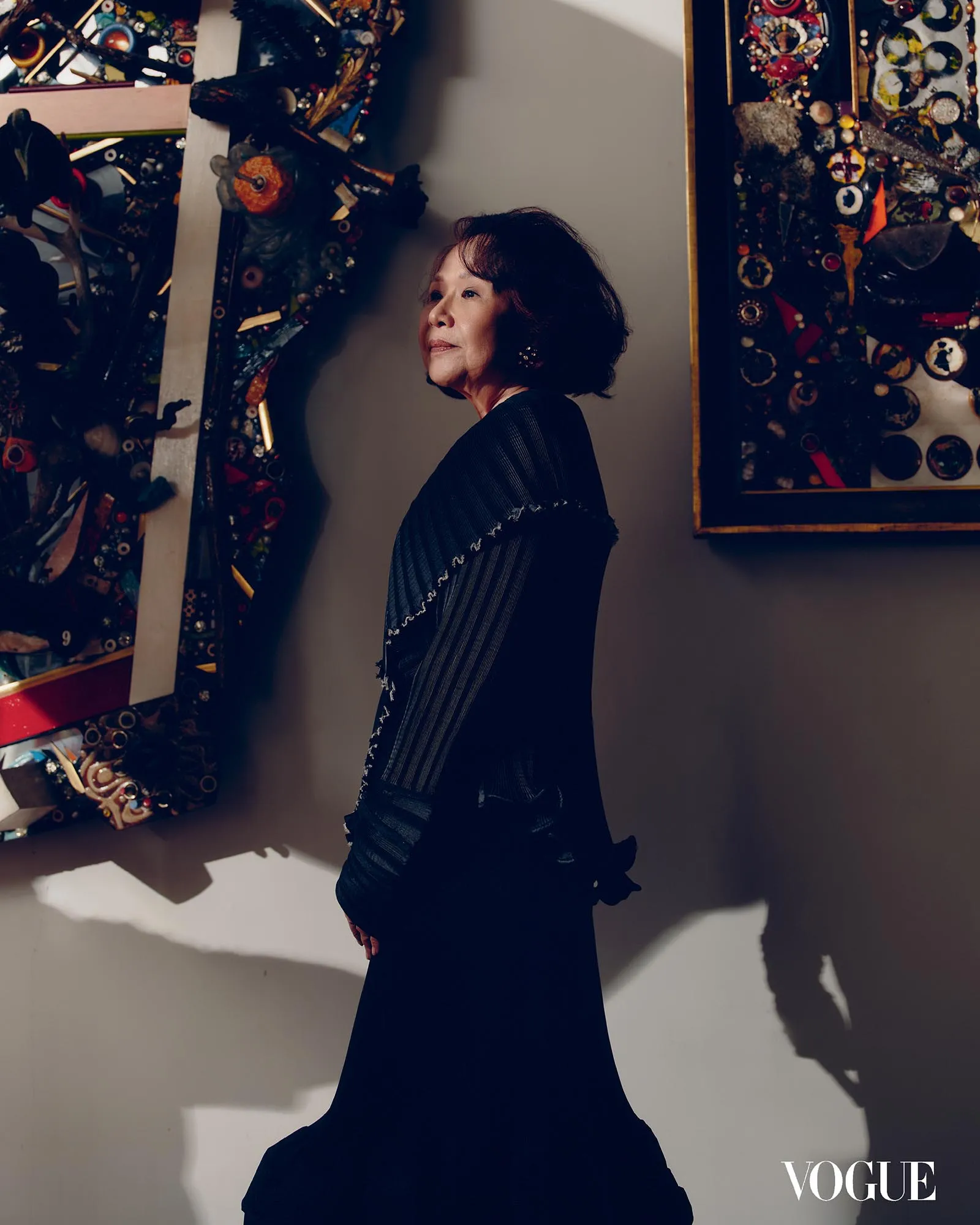
The Ossorio works on the first floor of the house are impossible not to notice: three-dimensional forms packed with eyeballs and buttons, brains and antlers, shells and bone, fused together with plastic and coated with a “devilishly gaudy” varnish. Bric-a-brac collages, or bricolages that he baptized as “congregations,” given his Catholic bent. A few of these came from a 2002 exhibition at Michael Rosenfeld Gallery in New York aptly titled Alfonso Ossorio: Horror Vacui, which refers to the (arguably Filipino characteristic) of an aversion to empty space. As the gallery described it, the works were also an attempt to “synthesize beauty with decay, refinement with crudeness.”
The congregations, which Ossorio began making in the early ’60s, clearly referenced Jean Dubuffet’s assemblages. Ossorio had house Dubuffet’s 1,200-piece Art Brut collection of outsider art for ten years. Yet unlike the raw, instinctive processes behind Art Brut, Ossorio’s work was “impeccably constructed, its concepts resulting from deep meditations and personal beliefs,” as Tats Manahan described in “The King of The Creeks,” a 2014 article in Rogue Magazine revealing how Ossorio’s immense wealth overshadowed his sheer artistic talent.
“He was always considered a dilettante. He was so wealthy he didn’t have to sell art for a living,” Kim Camacho explains. “He didn’t go with the abstract expressionists to their dingy clubs; when he was with them it was always in the comfort of his home.”
Ossorio was born in Manila in 1916 to a life of incredible privilege. His father was a Spanish-American sugar baron who established Victorias Milling in Negros Occidental, while his mother came from a Filipino-Chinese family who made their fortune in shipping. Children of that ilk were usually sent away to boarding school at a young age, and Alfonso, at eight, left for England, then the United States where he was educated in private Catholic schools. He studied Fine Arts at Harvard and followed it with graduate studies at the Rhode Island School of Design.
Having spent most of his life abroad and his holidays in ritzy European resorts, Ossorio felt little connection to the Philippines. That would change when he was invited, perhaps summoned, to Negros in 1950 to paint a mural inside St. Joseph the Worker, a chapel built for the workers of Victorias Milling, which had been destroyed during the war. Alfonso’s younger brother Frederic had taken over the family business and was spearheading the refinery’s rehabilitation. A former Monuments Man who helped retrieve artworks stolen by the Nazis, he assembled an international team for the chapel: the Czech-born modernist architect Antonin Raymond who designed the structure, Belgian artist Adelaide de Bethune who created the mosaics, and local artisans Arcadio Anore and Benjamin Valenciano who crafted the brass plates and wooden sculptures.
The philosophical ideas that underpinned Ossorio’s research for the mural were based on psychoanalyst Nandor Fodor’s book The Search for the Beloved, which argues that adults subconsciously yearn to return to the womb and that the trauma of birth manifests in adults as anxieties and other mental afflictions. These concepts provided a lens through which he could process the conflicting emotions dredged up by returning to a land that was quite foreign to him, as well as latent anguish around his racial and sexual identity.
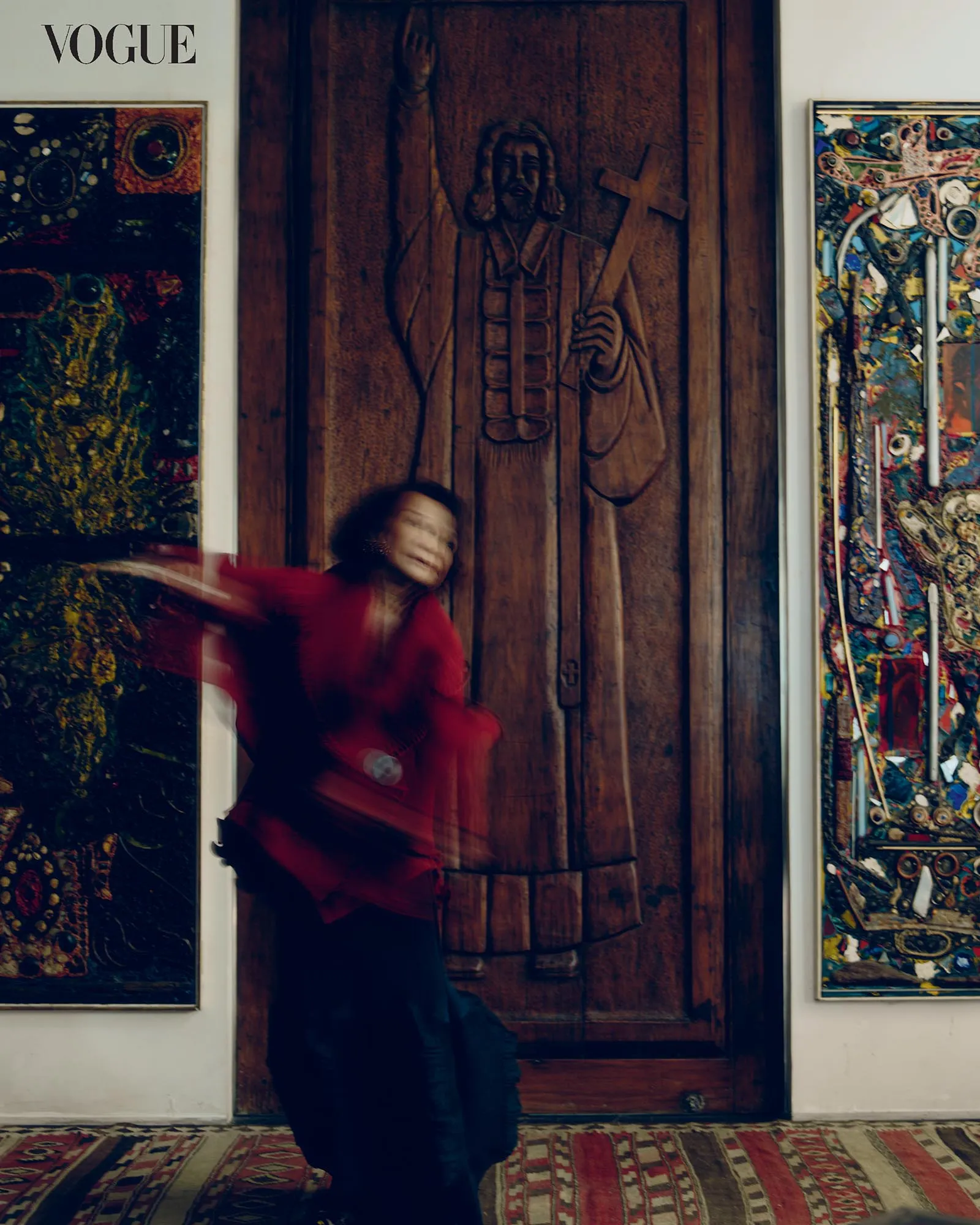
His resulting painting, “The Last Judgment,” was unlike anything previously portrayed in liturgical art. Using a fiery palette bound with ethyl silicate, Ossorio pushed the limits of traditional Catholic iconography. Filipino Jesus’s intense, fierce gaze led the work to be dubbed The Angry Christ. “It’s hardly a comforting idea, but there’s a lot that isn’t comforting in Christianity,” he later said of the work in an 1979 interview. During those months, he also managed to produce nearly 400 paintings using a new wax-resist technique he had developed. Drawing from Fodor’s book, much of the paintings’ subject matter had to do with embryonic forms, infants, and mothers, as well as explicitly religious figures rendered in a primitivist way. The Victorias Drawings, as they are called, marked a creative breakthrough in his output, followed by a fruitful period in which he held many solo exhibitions.
Kim Acuña Camacho grew up gazing at The Angry Christ. Born in Bacolod, her father was a sugar planter with farms in Victorias City. “So I’ve always known Ossorio,” she says. “The chapel is awesome. I think it’s the biggest masterpiece in the Philippines. It’s more than a national treasure, it’s a global one.”
It was only until 2012, however, that she and her husband started to seriously collect his works, acquiring pieces from the Ossorio Foundation and at auctions including Christies, Sothebys, and Leon Gallery. Their fascination with Ossorio was ignited by their son Enzo, an artist who graduated from Harvard. Enzo and his art partner Ami Lien, have for several years been making works that examine the relationship between The Angry Christ and the politics of sugar production in Negros.
“He was such big influence on my son’s artworks,” Camacho says. “And I’m obsessive. When I start collecting someone, I go all out.”
“I’m obsessive. When I start collecting someone, I go all out.”
After his tenure in Negros, Ossorio went to Paris for an extended stay, bringing his recent work with him. He spent time with Dubuffet, who would publish Peintures Initiatiques d’Alfonso Ossorio in 1951, a rare book of which the Camachos own a few copies of. Back in New York, Ossorio resumed contact with his friend Jackson Pollock, who, as Liza Guerrero Nakpil described, was the “alpha male of the lot, and quite possibly the most talented artist of their generation.”
Pollock’s background was the complete opposite of Ossorio’s to-the-manor-born upbringing: he grew up on a farm in Wyoming to working-class parents who moved around frequently due to financial instability. Still, he managed to attend art school in New York and study under several mentors. He shot to household-name fame when Life Magazine in 1949 posed the question: “Is Jackson Pollock the greatest living American artist?”
While Ossorio was in the Philippines, Pollock created some of his most important drip paintings, huge canvases that he flung paint over from the floor of his ramshackle barn in East Hampton. Ossorio purchased one of them, No. 1/Lavender Mist, which he hung prominetly in the 40-room Italianate mansion on a 60-acre property he acquired, also in East Hampton. Though technically neighbors, Pollock lived in relative squalor. His alcoholism would be his undoing: he crashed his car into a tree on the way to one of Ossorio’s legendary parties and died on The Creeks grounds in 1956.
Another artist who visited The Creeks in 1955 was Fernando Zobel de Ayala. Like Ossorio, he was born in the Philippines, came from generational wealth, went to Harvard, and was profoundly influenced by the Abstract Expressionists. Zobel offers a rare glimpse into the Ossorio enigma in a diary entry written after a night of drinking together:
“We talked mainly of painting and of being a painter. The gist of his remarks, repeated over and over again with variations and a kind of anguish: ‘Don’t let them stop you.’ About 10 years older than I, unquestionably good, with a desperate, Dostoyevskian sort of goodness. Completely generous, completely humourless. Inflexible and full of pratfalls. Completely committed to his art, which, for him, is an extension of religion.”
Ossorio for a long time remained in the margins of art history, perhaps because he was difficult to place. Across five decades of making art, he resisted the notion that he was merely a rich eccentric dabbler. His work traveled though surrealism, figuration, abstraction, arriving at his congregations, where everything comes together: the beautiful and the grotesque, the hellish and the sublime, bound in worshipful unity.
In Victorias, The Angry Christ mural awaits the completion of its restoration, while the Camachos’ collection brings Ossorio’s work back into conversation with the country of his birth. In their home, surrounded by his strange congregations, Kusama’s dots, and elsewhere, the radical, energetic work of Japan’s postwar Gutai movement (another Camacho obsession) a dialog is already happening. Here, Ossorio comes into view as an artist at the crux of a mid-century cultural shift, one whose encounter with a little-known rural chapel in Negros gave him a visual language for expressing torment and desire, death and rebirth, and the eternal questions of existence that have always bedeviled an artist.
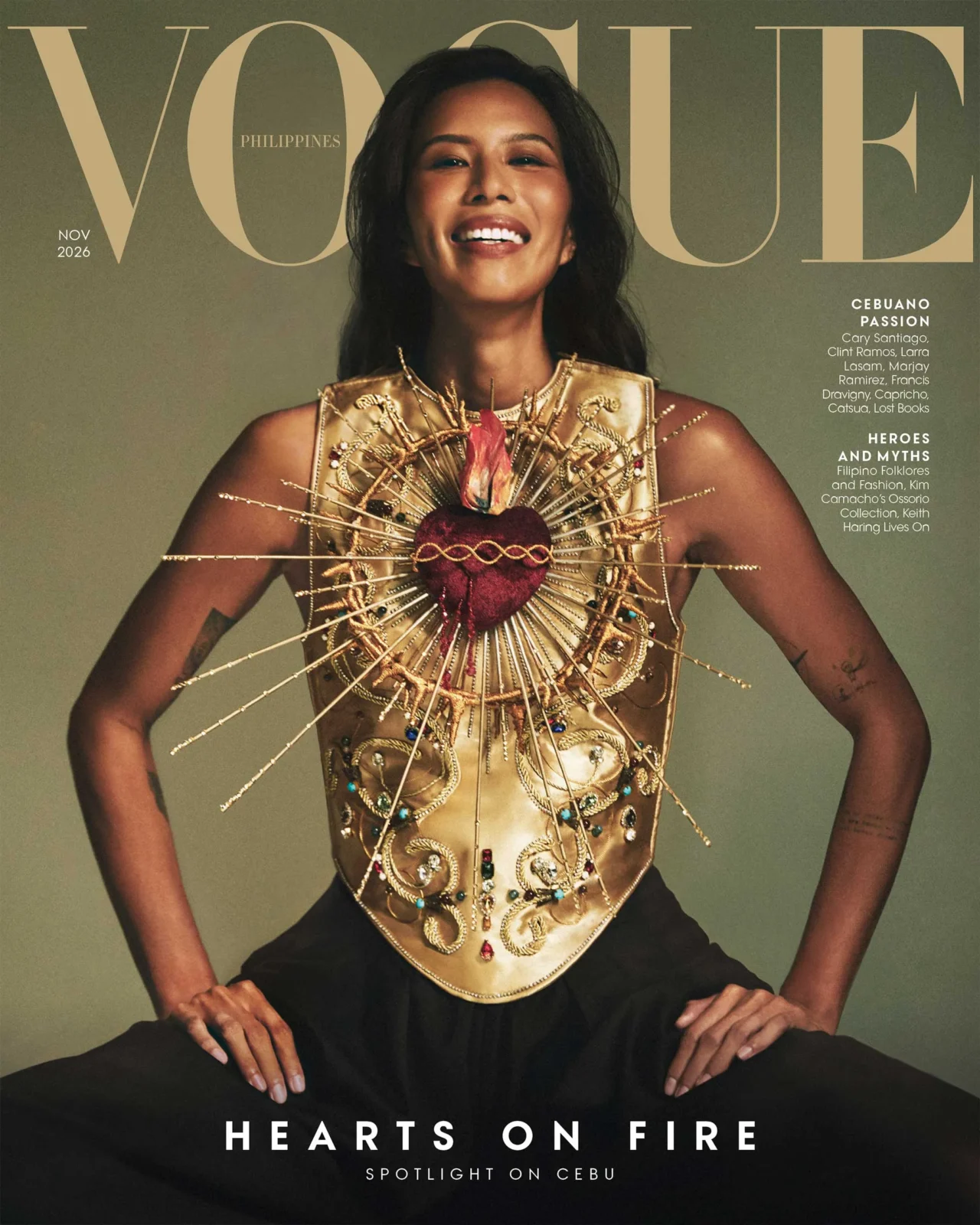
By AUDREY CARPIO. Photographs by JV RABANO. Deputy Editor: Pam Quiñones. Fashion Editor: David Milan. Art Director: Jann Pascua. Multimedia Artist: France Ramos. Producer: Mavi Sulangi. Makeup: Patricia Acejo. Hair: Ash Akim. Photography Assistants: PJ Salazar and Erwin Arda