
The Odyssey Costumes Discard the Sword-and-Sandals Playbook


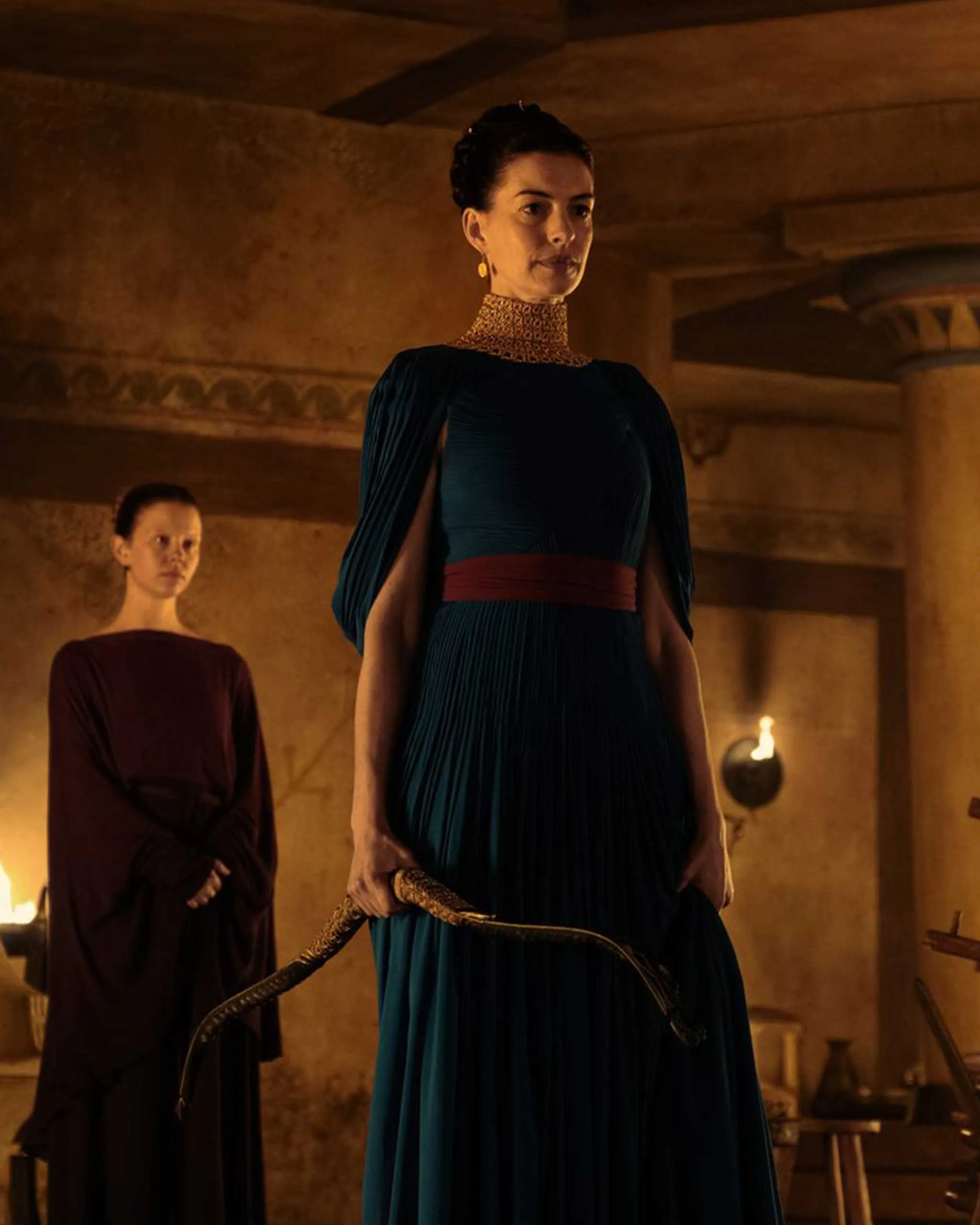
Mia Goth as Melantho and Anne Hathaway as Penelope.Melinda Sue Gordon/Universal Pictures
Director Christopher Nolan never wanted The Odyssey to be another sword-and-sandals Hollywood epic. “He has an aversion to movie clichés about antiquity,” says Ellen Mirojnick, the film’s costume designer, who previously worked with Nolan on Oppenheimer. “We were not after a historical period. We were after a timeless period.”
Still, while they avoided fashioning a frozen-in-amber Bronze Age period piece, Mirojnick did want the transcendent tale to appear ancient. “It had to hold an emotional literacy for a modern viewer,” she says. To strike that balance, she utilized fabrics that were available at the time. “There was linen, there was leather, and of course there was bronze,” she says. “That was actually another trope because bronze, in those sword-and-sandals movies, is usually gleaming.”
But Mirojnick was dropped into a story over 10 years in the making. The Odyssey picks up at the end of the Trojan War, the soldiers and their garments weathered by the harsh conditions. “It was a world exhausted and haunted and salt-stained and fractured,” says Mirojnick, who outfitted Odysseus (Matt Damon) and his crew in patinated bronze and battle-tested leather. “Every costume had to carry the feeling of that world. The aesthetic was about texture and the weight and the erosion of the fabrication. We wanted it to look as if it really was pulled from the earth.”

Odysseus is a particularly tricky character to costume. “Odysseus, in our story, deteriorates, he reconstructs, disguises, adapts, survives,” Mirojnick says. “He’s evolutionary. The design challenge was always to allow the audience to feel his erosion without losing the core that really did define him.” Simplicity proved the best route to convey our hero’s shifting identity in the various worlds he inhabits. In the end, she says, “the armor becomes a memory rather than power.”
Ithaca, however, was a different story. As Penelope (Anne Hathaway) and her son, Telemachus (Tom Holland), await Odysseus’s return, a crowd of impatient suitors urges her to choose a new husband. In fact, the only gleaming bronze viewers will see in the film is on Penelope’s suitors, like Robert Pattinson’s Antinous, whose garments are festooned with intricate brass embellishments. “All of these men are sitting there for years on end waiting to be the king, hoping to be the king, so they are exhibiting their best,” she says.

Even the deities’ wardrobes, which could have easily fallen into the fantasy trap, are defined by their utility. Zendaya’s Athena is expressed, as Mirojnick puts it, through “her simplicity and restraint” and is fittingly cloaked in off-white linen. As a counselor to Odysseus, “her presence needed to just glide through that kind of composed authority,” she adds. The same could be said for Calypso (Charlize Theron), who detains Odysseus on her island for seven years. “Her costumes are grounded in the reality of the environment she’s connected to, which is nature, eternity, and isolation,” Mirojnick says. “Everything that she covers her body with is of a practical nature.” Calypso wears a dress topped with a layer of netting, which Mirojnick imagines the nymph would use to fish.
It was a world exhausted and haunted and salt stained and fractured. Every costume had to carry the feeling.
Ellen Mirojnick
Circe is another case of practicality. Rather than having a costume that aids her in some way, though, Mirojnick created a piece that reflected Circe’s beguiling nature and all those who crossed her path. “She has accumulated the artifacts from every single traveler that has passed her door, and she wears them with great pride,” she says. “That makes up who she presents herself as when the men arrive.”

However, Mirojnick took a different approach to the mortal queens.
When it came to Helen (Lupita Nyong’o), for whom the Trojan War was waged, Mirojnick decided she deserved something akin to armor. The costumer originally found inspiration for Helen from a headless statue, which led her to create a brushed bronze chest and shoulder plate for the queen using a massive piece of golden metal. “When we fit it, I asked Lupita, ‘Is this going to be okay? It’s, like, 30 pounds,’” Mirojnick recalls. Nyong’o responded gamely, “I’ve worn 30 pounds of pearls. I can wear 30 pounds of golden metal.”
But the weighty armor wasn’t Nyong’o’s only challenge—she also took on the role of Clytemnestra, Agamemnon’s wife. Mirojnick, in an effort to create a visual distinction between the two characters, outfitted Clytemnestra in Tyrian purple, an ultrarare shade made from the mucous glands of sea snails. (An unfathomably laborious undertaking, it required up to 12,000 snails to produce one gram of dye.)
And though The Odyssey charts Odysseus’s decade-long quest to get home, his wife, Penelope, is fixed in place. “Instead of visual change, we expressed her costumes through subtle shifts of the silhouette, like softening or sharpening, layers becoming more isolated, using the palace colors,” she says. “She’s preserving a kingdom through her stillness while Odysseus survives through motion.”
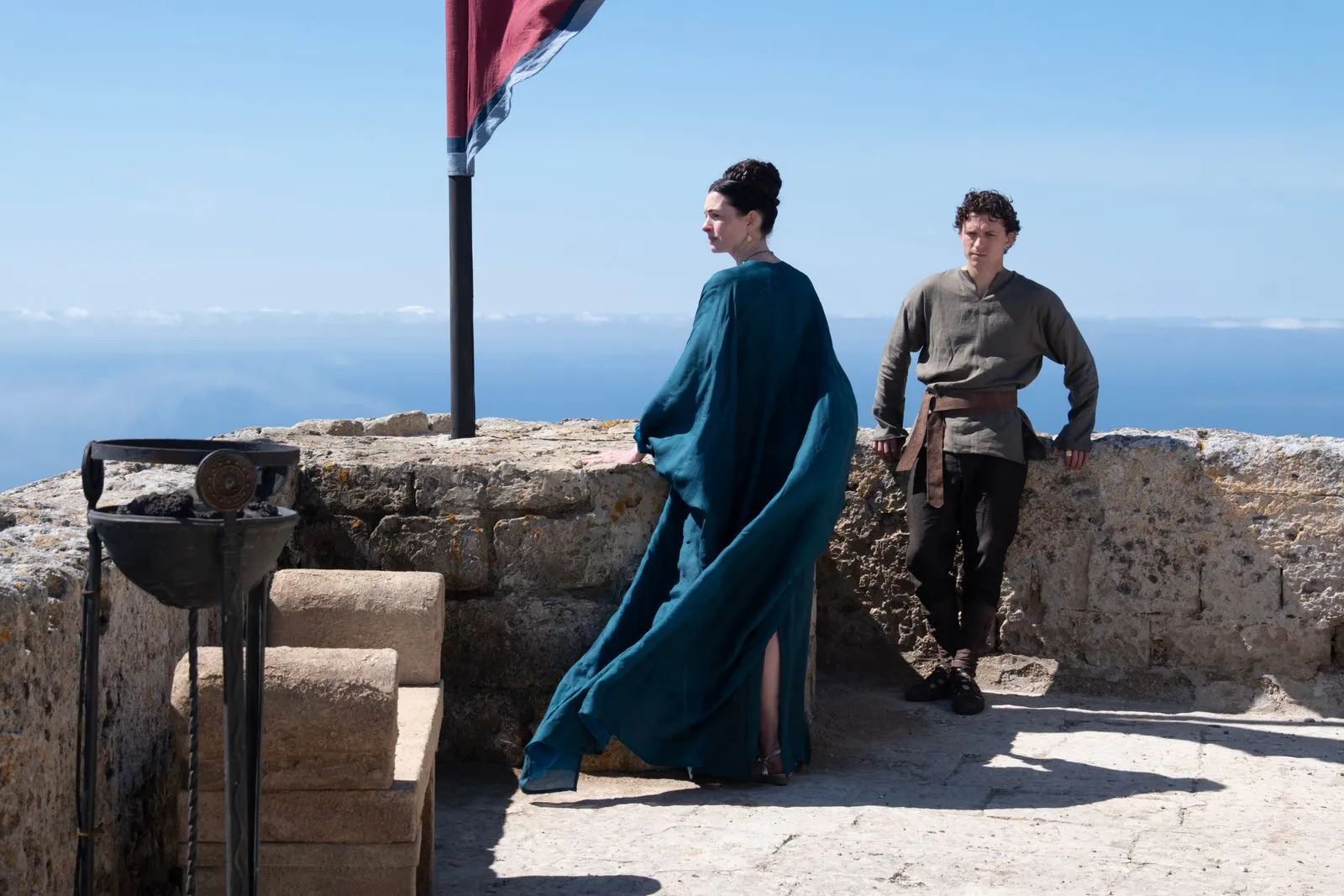
When people watch The Odyssey—be it opening weekend or generations on—Mirojnick hopes that the transcendent costuming helps capture the enduring appeal of the ancient epic. Or as she puts it: “We’re not designing a period but really authoring a mythology.”
This article was originally published on Vogue.com.
Frequently Asked Questions
Ellen Mirojnick is the costume designer of The Odyssey, who previously worked with Christopher Nolan on Oppenheimer, aiming for a timeless rather than historical look.
Odysseus, played by Matt Damon, is dressed in patinated bronze and battle-tested leather, with his armor designed to reflect erosion rather than power.
Helen’s costume features a brushed bronze chest and shoulder plate, inspired by a headless statue, crafted from a roughly 30-pound piece of golden metal.
Clytemnestra is dressed in Tyrian purple, an ultrarare dye made from sea snail mucous glands that required about 12,000 snails to produce one gram.
Zendaya’s Athena wears off-white linen reflecting simplicity and restraint, while Charlize Theron’s Calypso wears practical garments, including a fishing net-topped dress.