
At the Spanish Pantry Festival, Michelin-Starred Chefs and Vietnamese Heritage Come Together


Courtesy of Regent Phu Quoc
Michelin-starred chefs and Vietnamese heritage converge at Regent Phu Quoc’s Spanish Pantry Festival.
The legend of Phu Quoc’s well that never runs dry is a miracle of sword and stone. Nguyen Anh, an 18th-century Vietnamese lord, was leading his troops in battle, attempting to quash a rebellious faction, when they were cornered and driven to thirst and starvation. Desperate, he thrust his sword into the rock and prayed for divine intervention. Fresh water sprang from the cracks, with enough fish to feed his army. Lord Nguyen eventually proved victorious and proclaimed himself Emperor, heralding the beginning of his dynasty. It is because of the Nguyen Dynasty, the final ruling family in Vietnamese history, that nearly half of all Vietnamese people share the surname Nguyen, including myself.
This tale of the King’s Well has been illustrated into a bespoke pattern that appears throughout Regent Phu Quoc’s printed materials, from envelope linings to the underside of umbrellas. Designed by a contemporary Romanian artist, the pattern evokes the Old World, with a blue-robed, vaguely wizard-like man among arching waves, surrounded by elements that have become symbolic of Phu Quoc: anchovies, black pearls, pods of peppercorns. This pattern struck me, standing out against the restrained taupe palette of my insanely beautiful Ocean View Suite.
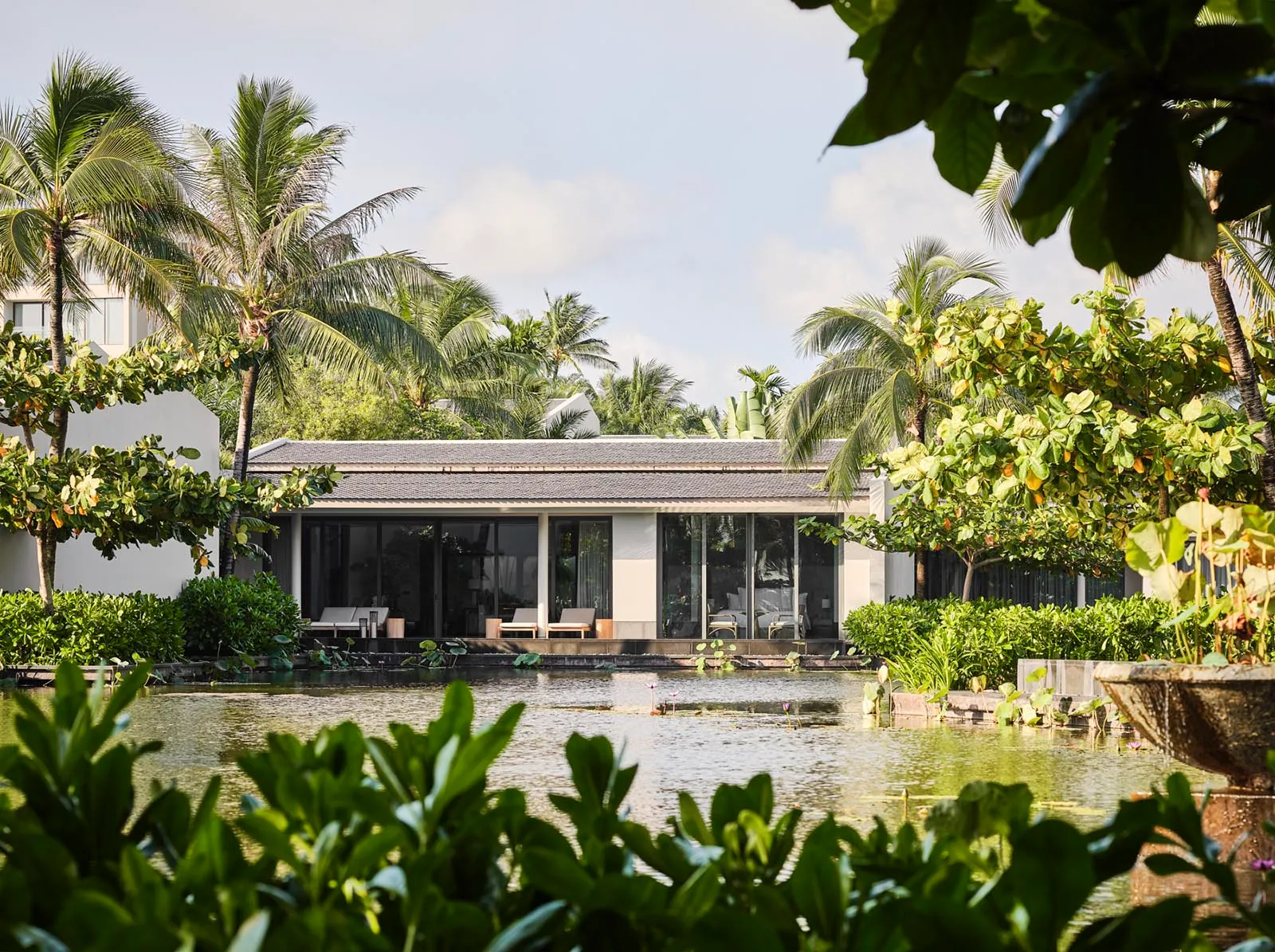
I have come to associate luxury hotels in Vietnam with ostentatiousness, wildly appropriating European grandeur to near hallucinatory effect. But Regent Phu Quoc was a spa for the senses, the pared-back interiors allowing the landscape to become a room’s focal point. This beach resort, situated on the western coast of Phu Quoc Island at the southern end of Vietnam, was the setting for a week-long Spanish food festival. Why would someone from the Philippines, a former Spanish colony, fly to Vietnam for Spanish cuisine? The answer lies in two two-Michelin-star chefs, a tapas master, a paella master, and all the Spanish wines matched to every course. All of that is true. But I also wanted to see whether Phu Quoc, an island I’ve never been to, held anything I could hold on to, besides a well that has been enshrined in honor of the emperor from whom my mother’s family inherited its name.
The Spanish Pantry Festival has previously been held in Beijing, Zurich, Berlin, and now Phu Quoc, making this Vietnam’s first Spanish gastronomic showcase. “Our vision for An Ode to Spain has always been to share the richness, warmth, and spirit of Spanish culture with Asia through gastronomy, wine, and human connection,” said Alejandro Paadín, curator of the Spanish Pantry Festival. “Vietnam felt like the natural place to begin.”
The cuisine of Vietnam needs no introduction, having been famously championed in Western media by Anthony Bourdain, who ate on low plastic stools along the sidewalk like every other local. The collaboration between SPF and Regent Phu Quoc takes a different approach, aiming to position the island as an emerging center for world-class culinary experiences. “By bringing world-renowned chefs and culinary experts to Phu Quoc, we are creating a dialogue between cultures,” said Juan Losada, Regent Phu Quoc’s general manager.
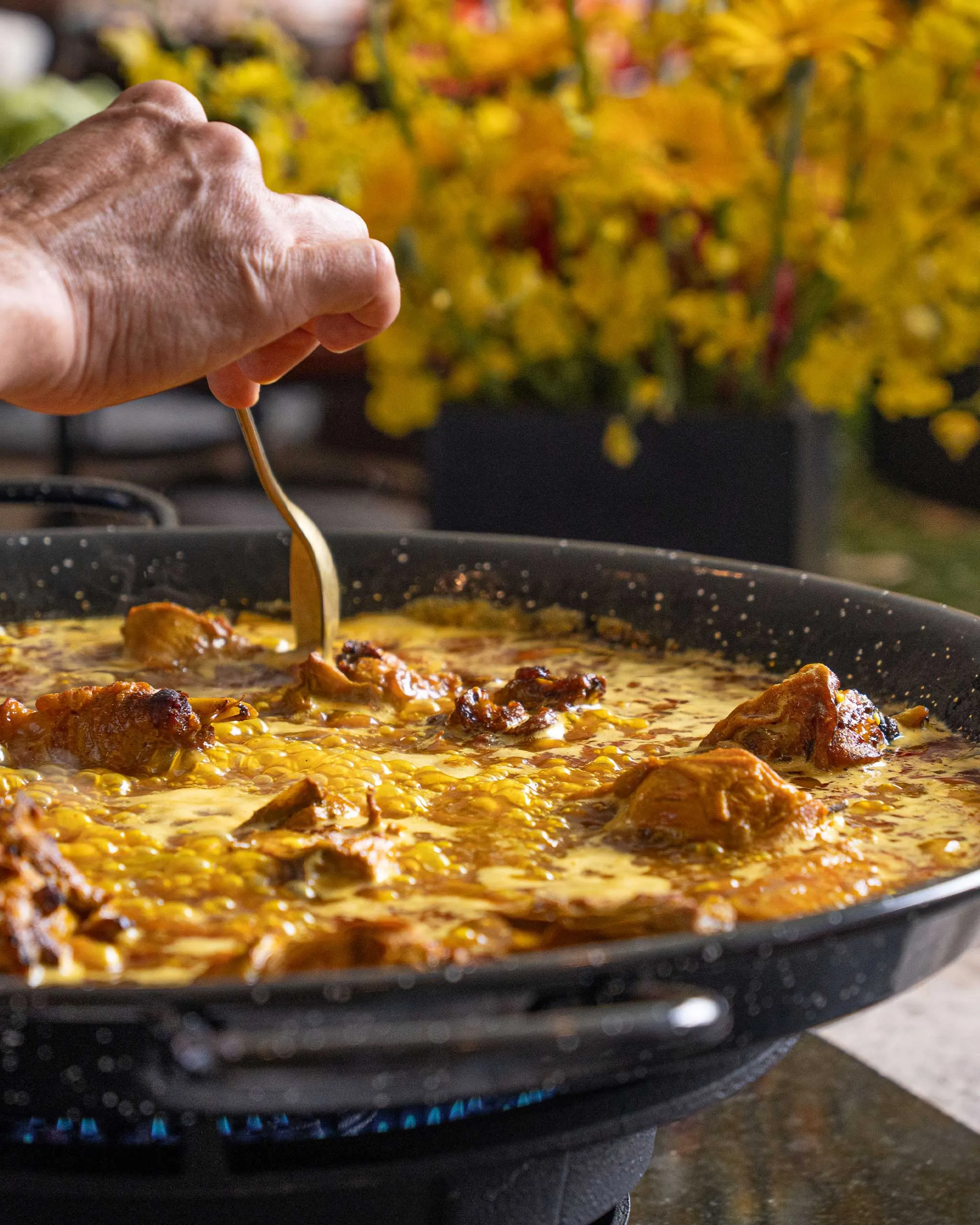
The fiesta began at Ocean Club, the hotel’s beachfront restaurant, with Amor y Sabor: The Art of Tapas, led by chef Ager Urigüen and a table piled high with a variety of cold cuts and cheese. The jamón Ibérico, carved on the spot, flowed freely. It was only the prelude. A nine-course tapas dinner followed, consisting of elevated interpretations on traditional dishes like ham and melon, salmorejo, gambas al ajillo, and a Valencian paella with the perfect socarrat. The Spanish chefs reminded us that Spanish eating was celebratory: “We don’t eat in silence.” In Spain, the art of tapas is as much about conversation and the pleasure of sharing a meal as it is about the food.
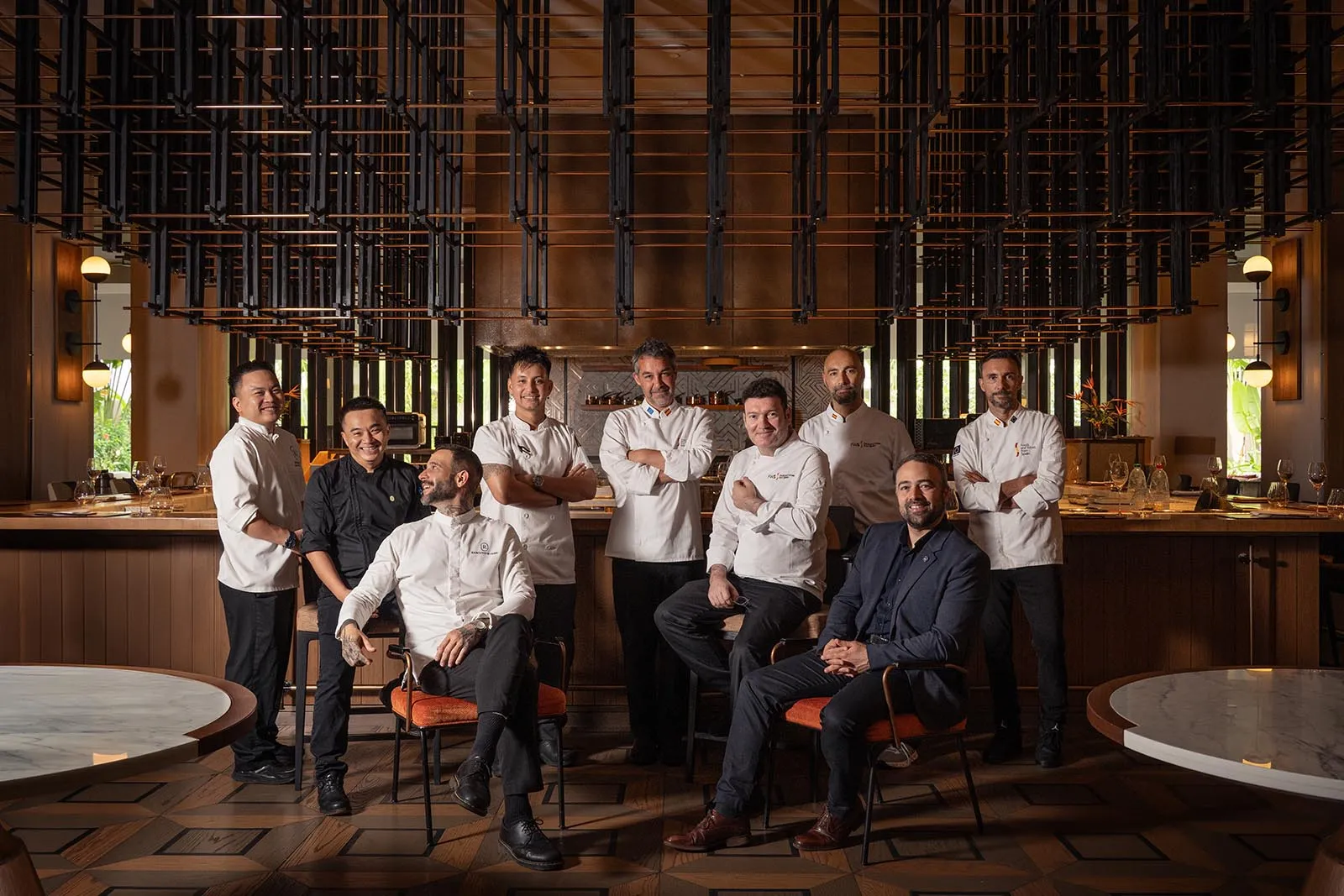
The next night’s dinner was the festival’s centerpiece event, a six-hands dinner featuring Spanish chefs Javier Olleros of Culler de Pau in Galicia, Benito Gomez of Bardal in Andalusia, and Vietnamese American chef Andy Huynh of Regent’s own Japanese-French restaurant, Oku.
“The north and south of Spain have nothing in common, so it’s really important to show the diversity and the ingredients where they come from,” says Gomez, “and also to connect Spanish gastronomy with ingredients that are local to Vietnam.” There are challenges, naturally. Produce differs from one place to the next. The chefs are known to work closely with small-scale farmers and fishermen from their respective terroirs. “We are far from the land where these dishes were created,” says paella chef David Montero. Interestingly, language has not been a barrier among the many cooks in the kitchen: “Even if you don’t speak any English, the language is not needed when you’re working with respected chefs. There is a universal language,” Olleros says.
This is exactly the kind of dialogue that the festival intended to create, not only between cultures, but among cooks. “It’s always an honor to have chefs of this caliber here working with us. It’s great for team morale, to be able to share something from outside Vietnam,” Huynh says. “The fun part is, when they taste our food, they’re just as excited about the ingredients we have here.”
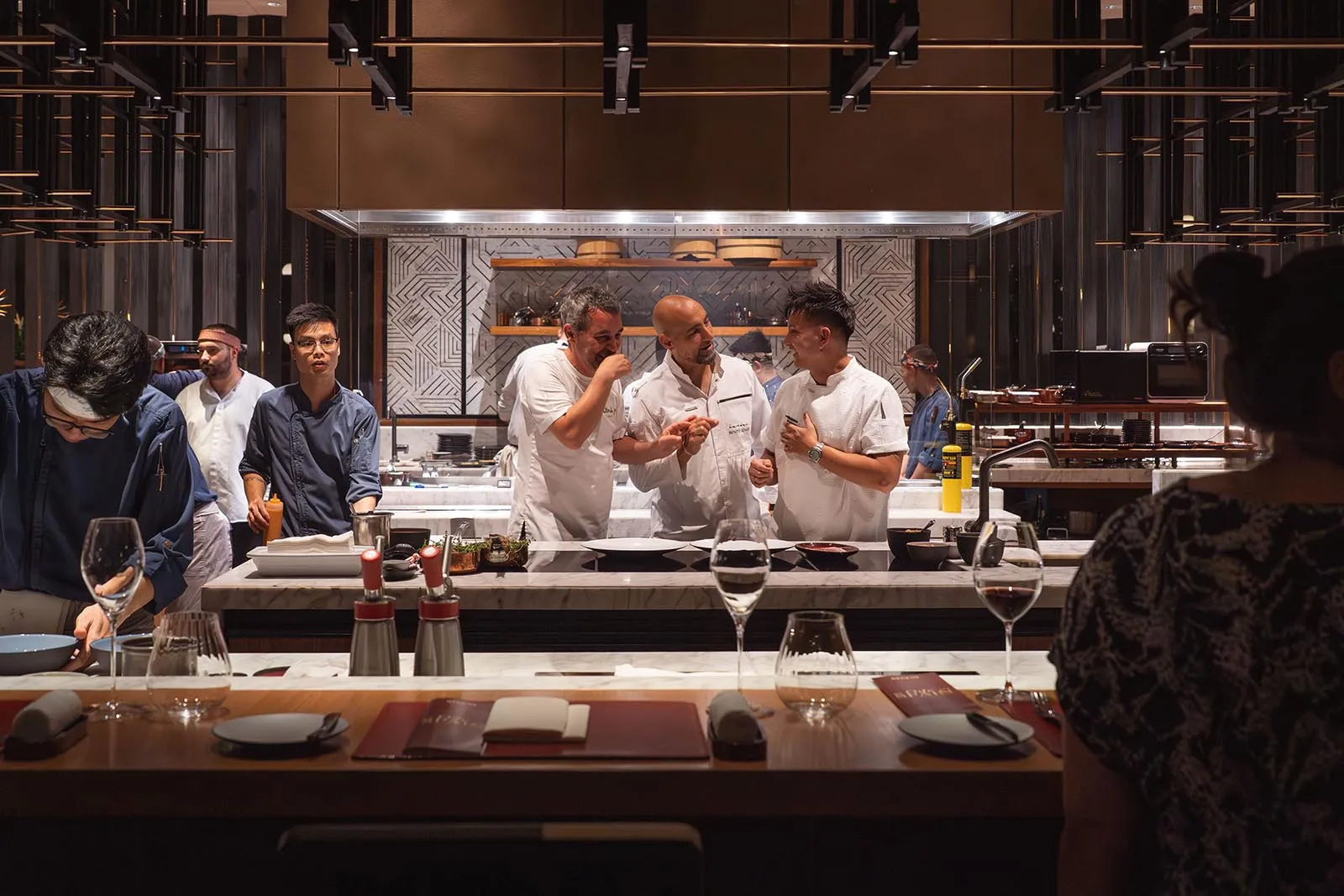
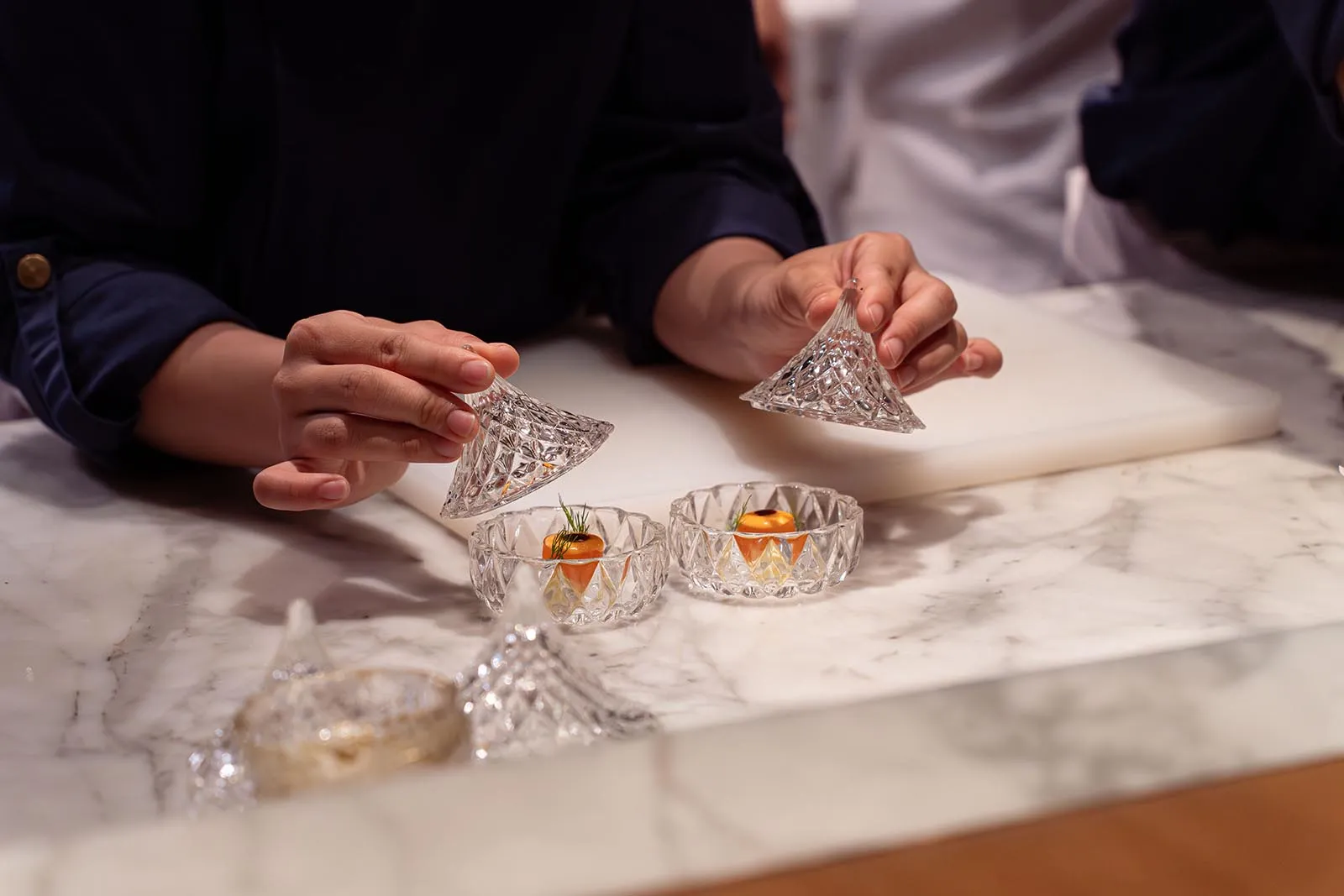
The open kitchen at Oku allowed the diners to witness the choreography of the kitchen and interact with the chefs as they served and explained each concoction. Every course had its own author, but the progression was harmonious. Galician-style scallops gave way to fermented gazpacho with Japanese shrimp, which led to hot-and-cold onion soup, culminating in fricandó, a Catalan stew using Wagyu. Dessert was arroz con leche with Asian touches of koji, jasmine, and coconut. The confluence of flavors and cultures, distilled through exceptional technique and pure ingredients, was a privilege to experience. I may never go to their Michelin-starred outposts in O Grove or Ronda, Spain, but I could have a taste of them in Phu Quoc, Vietnam.
While the evenings were reserved for modern Spanish gastronomy, the days were my own, and all I wanted was to tuck into a comforting bowl of pho. I didn’t have to go far. Regent’s Rice Market restaurant served the best pho I’ve ever tried, upscaled with slices of A5 Wagyu and a broth simmered for 16 hours, yet faithful to everything that makes pho what it is, nothing added, nothing taken away. It was the kind of pho that Bourdain would have approved of. More importantly, it was pho my mom would approve of.
Frequently Asked Questions
The Spanish Pantry Festival is a global gastronomic and trade event organized by ICEX (Spain’s Foreign Trade Institute) and the Economic and Commercial Offices of the Spanish Embassy. Its primary goal is to promote Spanish food, wine, and culinary culture to international audiences.
The Spanish Pantry Festival is a global gastronomic platform that travels to various international destinations rather than being held in one single location.
Regent Phu Quoc is a luxury beachfront resort located on the southwest coast of Phu Quoc Island in Vietnam, overlooking the Gulf of Thailand.
Juan Losada is the general manager of Regent Phu Quoc.
The Spanish Pantry Festival is not held on a single fixed date or in one specific location. Instead, it is a traveling gastronomic showcase and culinary event that pops up in various cities around the world throughout the year, typically hosted in partnership with local luxury resorts, chambers of commerce, or the Spanish Embassy’s trade divisions (ICEX).