
Watch: In The Studio with Filip + Inna’s Len Cabili


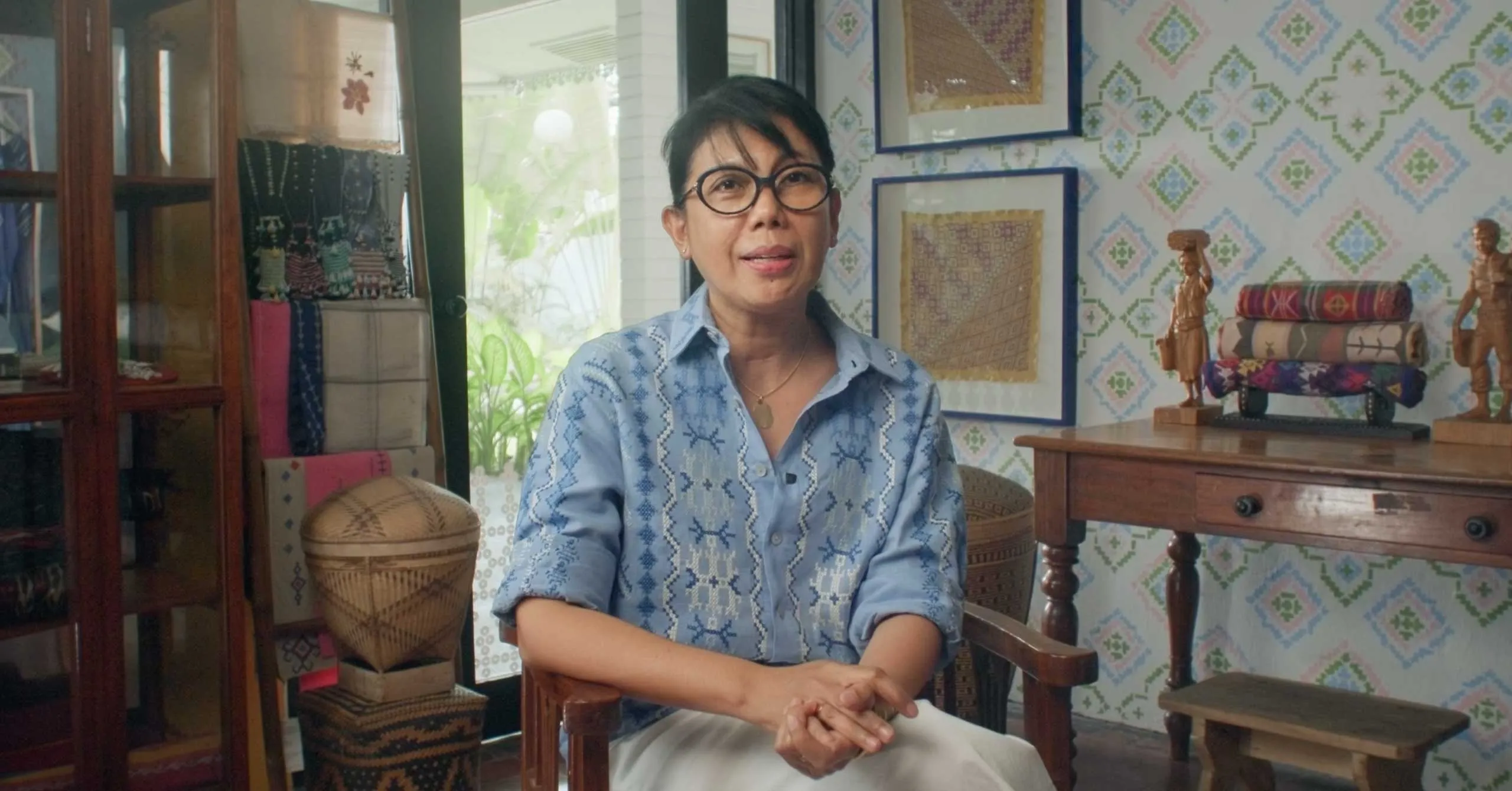
For In The Studio, Filip + Inna designer Len Cabili talks about her connections with Mindanao artisans, the sense of time that informs her slow fashion practice, and the optimism she finds in Philippine culture.
Beneath the shade of a large sampalok tree, Len Cabili walks through the garden of her Mandaluyong studio, enjoying the breeze that cuts through the summer heat. It takes her back to her childhood home in Iligan, where her family tended to a big garden, and where her father (as former mayor) would host guests from indigenous groups across Mindanao.
Decades later, the designer reflects on that early cultural exposure with her team in Manila, whose handicrafts carry the vision of her brand, Filip + Inna.
“I knew it had to point back to the Philippines. There were going to be two elements coming together to create something,” she says of the name. “For Filip + Inna, it was tradition and contemporary weaving together. It’s us and the artisans working together.”
In this episode of In The Studio, a series that features craftspeople in their distinct spaces, creative director Len Cabili talks to Vogue Philippines about her collaborations with indigenous communities, the rituals that punctuate her daily routine (such as a preference for dark chocolate instead of coffee), and the events that shaped her over a two-decade career.
The conversation brings us to her days as a clothing technology major at UP Diliman, and the challenges she faced following a thyroid cancer diagnosis at age 28. “I’m very protective of my health,” she shares. “I stopped wearing a watch because I felt time was controlling my day.”
While the pressure to pause or produce was there, Cabili admits that she didn’t feel the need to stick with either path; she wanted to look outward and reach out to the people whose craft traditions she admired. This led her to join her mother’s trip to Mindanao in 2006, where she met local weavers, and officially founded her brand in 2009. She reflects, “Whether it’s creating a garment, how you want to create it, how you want to work with others, that you can control.”
Over the past five years, the Filip + Inna studio has grown to reflect those relationships: from the traditional patterns painted on the walls of the boutique to the brand’s previous labels inspired by traditional Filipino motifs, framed outside the design team’s office.
Here, Cabili opens a package off-camera, unfurling a vibrant roll of fabric that seems about 12 feet long. Between planning aloud with her assistant Nuni (“maybe quilt it, para maiba [to set it apart]”), she pauses to pet her dogs Desmo and Filippa, and glance at embroidery references on her desk.
It’s a dance that defines her process, which always begins with material. “I rarely sketch,” she tells us after our interview. “I touch the tela, alam ko na! [I touch the fabric, and I already know what to do]!” When she sends the finished pattern to the artisans, the waiting part of her slow fashion practice begins, and she opens herself up to letting go of control.
As the afternoon closes with a tour of the sewing and finishing rooms, where the in-house team is hard at work, the designer brings out a Bagobo garment bought with the earnings from her first trunk show. She recalls the feedback she received from her customers in New York, who said the work of the Filipino artisans was unlike anything they’d seen before.
“I think, in a way, people are attracted to the garment because even if they don’t know the story, they feel it,” she says. “That there is a real person who took the time to create this piece. And there’s a certain gift that the artisan has shared with us.”
Following the brand’s latest pop-up, which saw their largest stock and sales to date, the designer conveys her optimism for the future of the local fashion industry and the conservation of our material heritage.
“I haven’t gone back to the US or abroad for trunk shows. I think that’s such a good sign that I don’t need to, because the market here is enough to keep us busy,” she beams. “Philippine culture is at the forefront of the fashion industry now, which is so inspiring.”
Watch the full episode of “In The Studio with Filip + Inna’s Len Cabili” on the Vogue Philippines YouTube channel.
Director: Anz Hizon. Interviewer: Aylli Cortez and Anz Hizon. Videographers: Liam R. Tangan and Church Cabreira. Video editor: Liam R. Tangan. Colorist: Nala Chincuanco. Media Channels Producer: Angelo Tantuico. Media Channels Video Lead: Wainah Joson. Introduction by Aylli Cortez.
Frequently Asked Questions
Born in Iligan, Len Cabili is a Filipino fashion designer who aims to celebrate and preserve Philippine heritage. She is the creative director of Filip + Inna.
Len Cabili is best known for her ready-to-wear and custom pieces, which are made in collaboration with indigenous communities across the Philippines.
The brand name celebrates pride of place in the Philippines, while the plus sign signals the coming together of local artisans with the brand’s in-house team.
Founded in 2009, Filip + Inna is a local fashion brand that blends traditional Philippine textile arts with contemporary designs and silhouettes.
The Filip + Inna showroom is located in Mandaluyong. For more information on pop-up locations and offerings, visit the brand’s Instagram page and website.