
How Indigenous Women in Bolivia Are Reclaiming Their History With Their Clothes


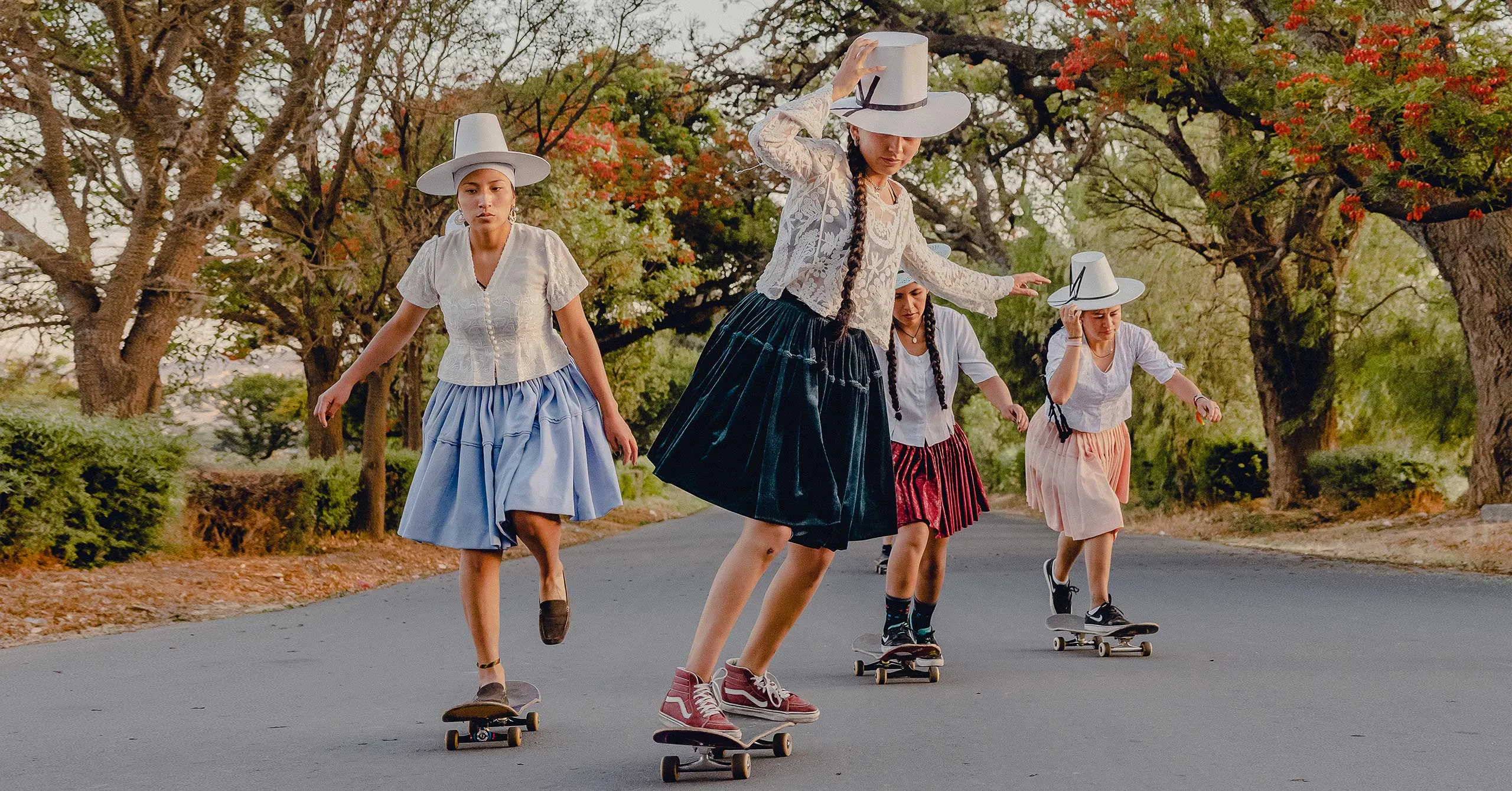
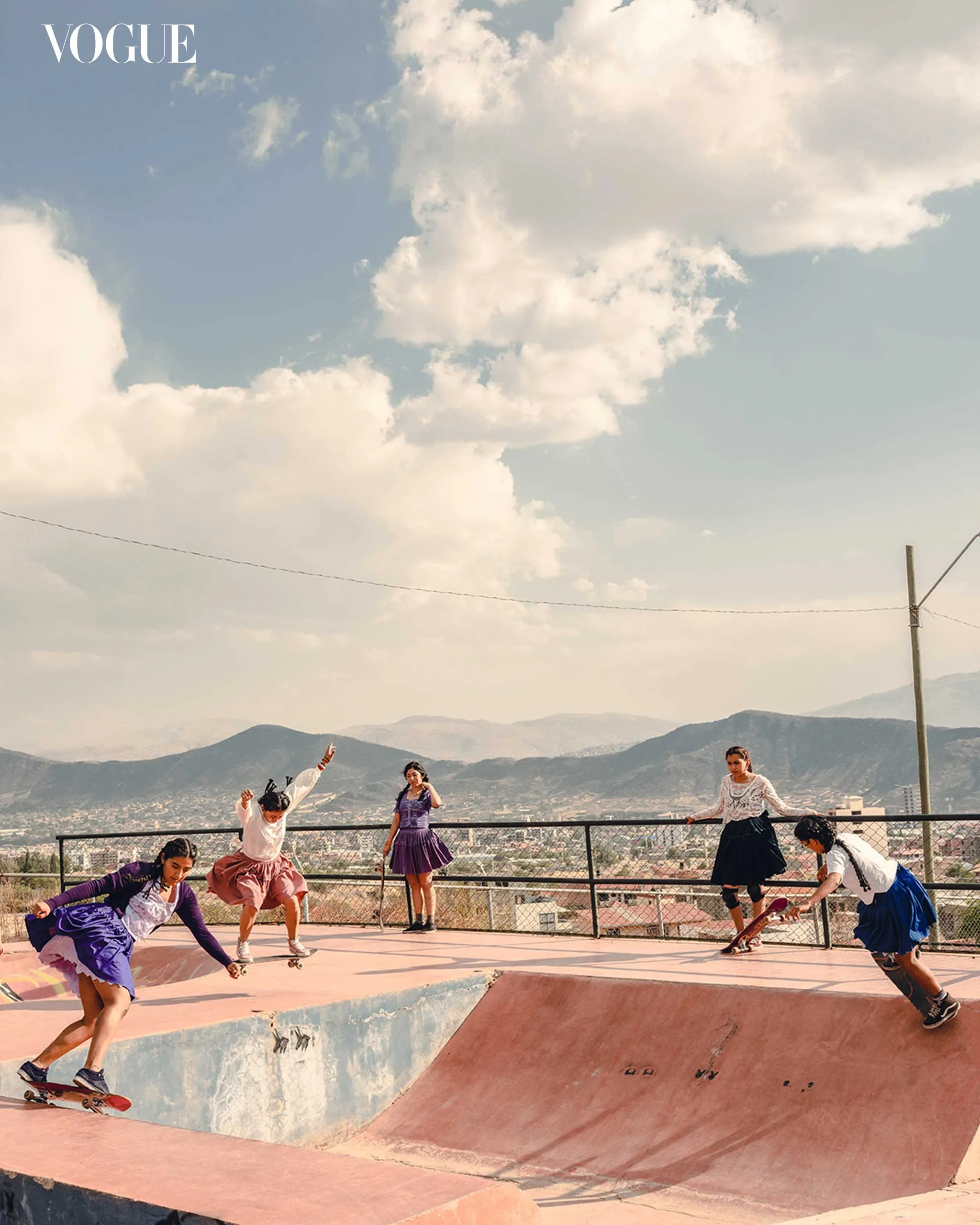
The female collective Imilla Skate was created by a group of friends in 2019. Paired with sneakers, they wear the polleras out for skating to empower women and push their message of inclusion and acceptance of diversity. Photographed by Luisa Dörr
The female collective Imilla Skate was created by a group of friends in 2019. Paired with sneakers, they wear the polleras out for skating to empower women and push their message of inclusion and acceptance of diversity. Photographed by Luisa Dörr
In the Andes, clothing has long been a site of control and defiance. Today, indigenous Bolivians are wearing that history forward, through fashion, architecture, and new acts of cultural reclamation.
In Cochabamba, the afternoon light catches on pleats and pavement at once. Wheels scrape, then glide. A skirt lifts in the rush of air. Long black trenzas whip behind bowed shoulders and outstretched arms. Bowler hats, perched with precision, hold steady as the young women carve through the street in polleras, their bodies low and loose over their boards, their silhouettes at once familiar and startling.
They are the women of Imilla Skate, photographed by Brazilian artist Luisa Dörr over two weeks, published in National Geographic. In her images, they do not appear as symbols frozen in tradition, but as young women in full momentum. Imilla is a reclaimed word for indigenous girl. The pollera, too, is a reclamation. In interviews, the skaters have said that wearing it is an intentional act, a way of confronting not only gender discrimination but the racial prejudice long directed at cholitas. Some have said their mothers no longer wore polleras, and so they turned instead to their grandmothers.
That return runs through Bolivia in ways both intimate and monumental. It can be seen in the drape of a manta, in the careful pleats of a skirt, in a market stall lined with imported fabrics, in a museum vitrine, in the blazing geometry of a building in El Alto. For Daniela Monasterios-Tan, who left Bolivia in 1997 at the age of 10 but always knew she would come back, the path home arrived through fashion research: through the study of how indigenous dress and style continue to shape contemporary urban life in the Andes.
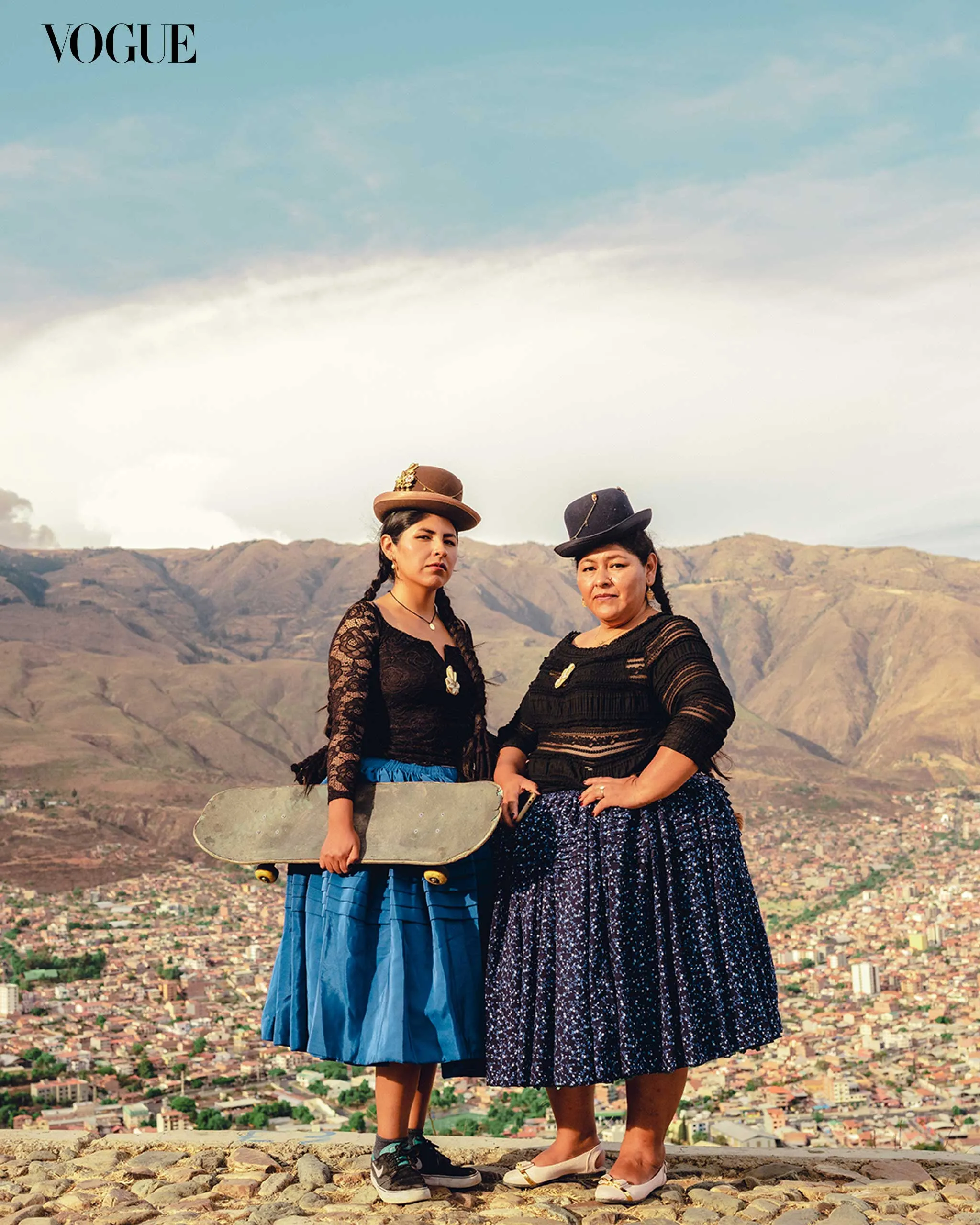
There is now a global push to decolonize design and to re-indigenize knowledge. In Bolivia, those conversations land with particular force. During the republican period, mestizo and criollo elites used dress as a tool to segregate indigenous people in urban spaces. Indigenous dress was treated as something to be regulated, even prohibited. People could be barred from wearing it in public office. Their movement through the city, including access to public transportation, could also be controlled through the politics of appearance.
The 1952 Revolution shifted Bolivia’s social order and introduced universal suffrage, opening new political visibility for indigenous populations. But recognition did not undo history. Indigenous people continued organizing against neoliberal policies and systemic inequities for decades afterward, a longer continuum of struggle that culminated, in one historic moment, with Evo Morales taking office in 2006 as Bolivia’s first indigenous president. That milestone has often been used to explain the flourishing of indigenous expression in the country’s urban centers, but the story did not begin there.
Nowhere does that feel more palpable than in El Alto. Perched high above La Paz, the city has become a center of migration for indigenous people moving from rural areas into the orbit of the capital. It is also where a distinctly urban indigenous presence has found one of its boldest forms. El Alto has become a center for the burgeoning expression of Aymara and Quechua architecture and fashion, a place where indigeneity is neither hidden nor softened for acceptance. In Bolivia, the term cholo, for males, and chola, for females, is a term to refer to urban indigenous people, and in the past would have been a derogatory term that now has been repossessed with pride.

The city itself tells part of that story. In the early 2010s, the work of Aymara architect Freddy Mamani began to draw global attention. His buildings, saturated with color and geometry, came to define what many now call Neo-Andean architecture. The term cholet followed, a play on cholo and chalet, referring to the structures that rose in dazzling tones against the high-altitude light. Mamani has often been credited with inventing the style, though he himself frequently points to older sources: the ruins of Tiwanaku, traditional weaving motifs, ancestral knowledge that predates any label placed upon his work.
And labels, in his case, have often revealed more about the people assigning them than about the buildings themselves. In a documentary by Isaac Niemand, a professor of architecture refers to Mamani as a “decorator” rather than an architect. The comment is dressed as critique, but it carries the familiar logic of colonial taste: the idea that Western modernity is best expressed through restraint and sobriety, and that indigenous visual exuberance can only be excess, never authorship. Mamani’s buildings are not only private residences or commercial structures, but places where fiestas and community events take place, where social life unfolds. They have inspired imitators across the neighborhood. In 2025, Fondation Cartier pour l’art contemporain in Paris commissioned Mamani and placed his work at the center of its newly renovated space.
If El Alto gives that memory architectural form, the Museo Nacional de Etnografía y Folklore in La Paz, known as MUSEF, gathers it more quietly, in textiles, archives, and galleries that make visible the continuity of indigenous life. Since 2013, the museum has been led by indigenous poet and artist Elvira Espejo Ayca, whose stewardship has centered the voices of indigenous nations preserved in its collections. For Monasterios-Tan, entering the museum for the first time brought into focus the centrality of the earth and its relationship to human flourishing.
The first gallery, “Weaving Life,” begins not with finished garments but with material itself. Fiber comes from animals in the Andean highlands and from plants in the lowlands. From there unfolds the chain of labor and knowledge that allows something to be spun, dyed, woven, worn. The gallery traces the stages required before a textile can clothe a body, carry goods, or offer protection. The lesson is not merely technical. Espejo writes of Uywa Uywaña, or mutual nurturing, an Amerindian worldview in which the earth is inseparable from human wellbeing. To follow fiber into fabric, then, is also to follow a philosophy of relation: one in which making is tied to reciprocity, care, and survival.
Elsewhere in the museum, garments appear beside their pre-Hispanic antecedents and alongside the colonial interventions that sought to discipline indigenous appearance. In Bolivia, dress has long carried the weight of shared memory. It has also borne the pressure of regulation. Historical accounts show how indigenous people navigated these constraints in multiple ways, sometimes subverting imposed codes, sometimes dressing as mestizos to avoid paying taxes to the Spanish crown. After indigenous uprisings in Cuzco and La Paz, Spanish authorities imposed a ruling in 1795 prohibiting clothing and accessories that evoked Inca rule. But prohibition did not erase memory. It changed the terms through which memory could be worn.
This is especially clear in the history of the pollera, the voluminous pleated skirt now so closely linked to chola identity that many women describe themselves as mujeres de pollera. At MUSEF, the pollera is shown not as a frozen emblem of tradition but as the result of centuries of adaptation. Its lineage can be traced back to the urkhu worn by indigenous women before Spanish colonization. Under colonial rule, the silhouette changed, absorbing Spanish influence and eventually taking on the form recognized today. The pollera is therefore not untouched by history. It is shaped by imperial intervention, by global exchange, by coercion and transformation. And yet, for all that, it remains one of the clearest expressions of indigenous continuity in Bolivia.
Other elements of chola dress tell equally layered stories. The bowler hat is often linked to a shipment of men’s hats that arrived too small for British railway workers in Bolivia and were instead taken up by chola women. The manta shawl carries another route entirely. Its history is tied to the Manila Galleon trade that connected Spain, China, the Philippines, and the Americas. Even here, in the landlocked Andes, indigeneity was never sealed off from the world. Trade, migration, empire, and commerce were all stitched into what would become local style.
That entanglement remains visible in the present. Chola fashion today is a rich and fully formed industry. Certain neighborhoods in La Paz are home to modeling agencies, magazines, and shops devoted to it. In El Alto, a large section of the 16 de Julio Market is dedicated to its commerce. During her fieldwork, Monasterios-Tan was shown the many stylistic choices and fashion shifts that animate the scene. Such encounters complicate the common impulse to sort garments too neatly into the traditional or the indigenous, as though either existed outside time. Many chola garments today are made from imported Chinese fabrics, a reminder that even at high altitude, fashion in the Bolivian Andes remains connected to wider global circuits. In 2016, Aymara designer Eliana Paco Paredes made that connection visible on one of the most watched stages in fashion when she showed her work at New York Fashion WeekFashion WeekA series of seasonal events where designers debut their latest collections, setting the tone for upcoming fashion trends and showcasing creativity, craftsmanship, and innovation across the global fashion industry.Go to Fashion Week Glossary, bringing cholita fashion into international view.
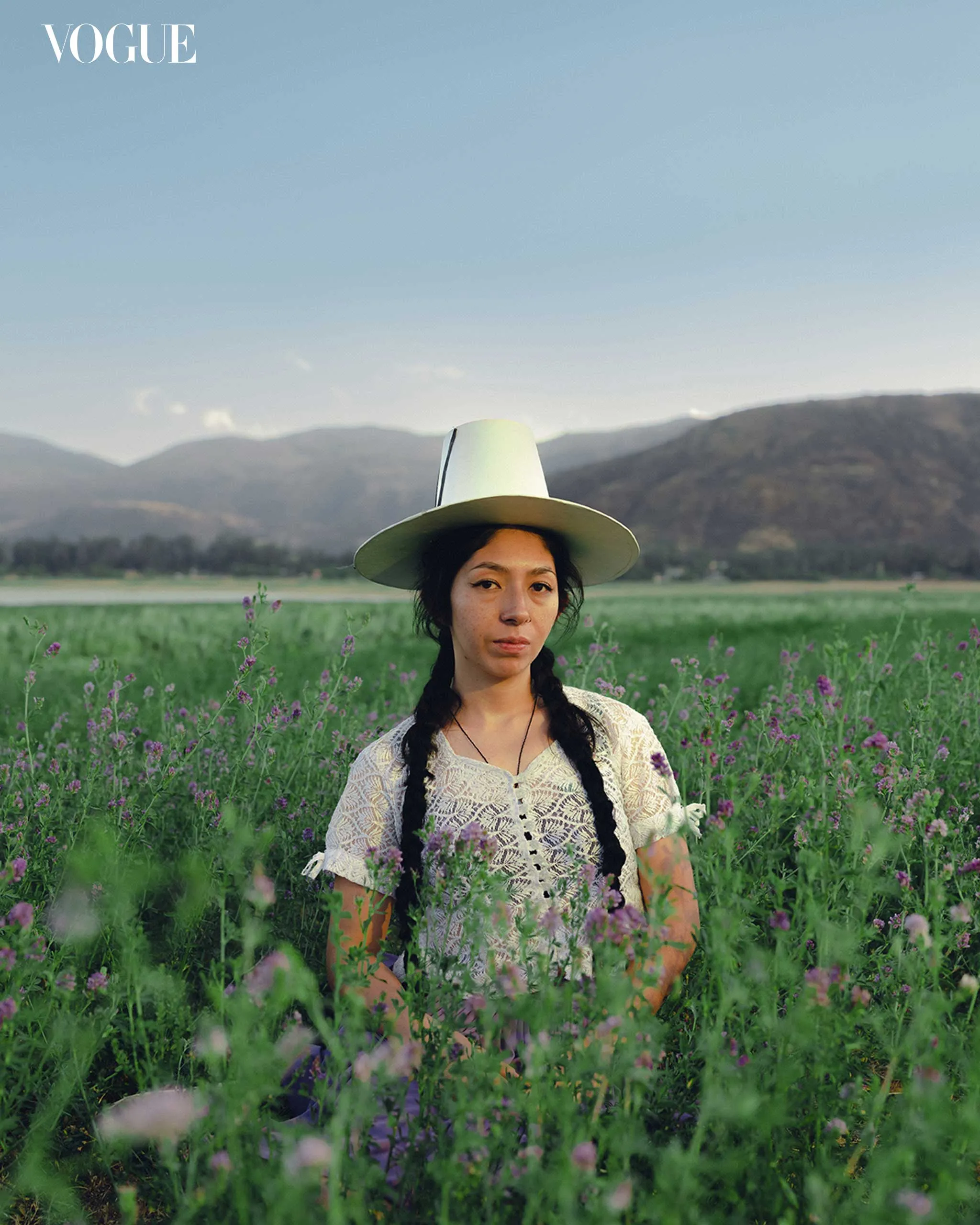
Recently, Vogue México featured Albertina Sacaca, a young indigenous content creator who has become one of Latin America’s most visible voices on indigenous representation in fashion and media, for its spotlight on Bolivian creatives in celebration of the country’s bicentennial. For the shoot, the label Juan de La Paz dressed her in antique Andean awayus. She was photographed by Valentina Luizaga and produced by Haniel Dueri at the historic Parador Santa María la Real in Sucre. The resulting image is richly layered: Sacaca is draped in textile history, but she looks straight at the camera with composure and confidence, fully inhabiting the present tense of her own image.
“As indigenous Bolivians continue to reclaim and reimagine what identity means in contemporary life,” Monasterios-Tan writes. “They embody how culture is not a static motif but a living language, more complex and beautiful for its resilience.”
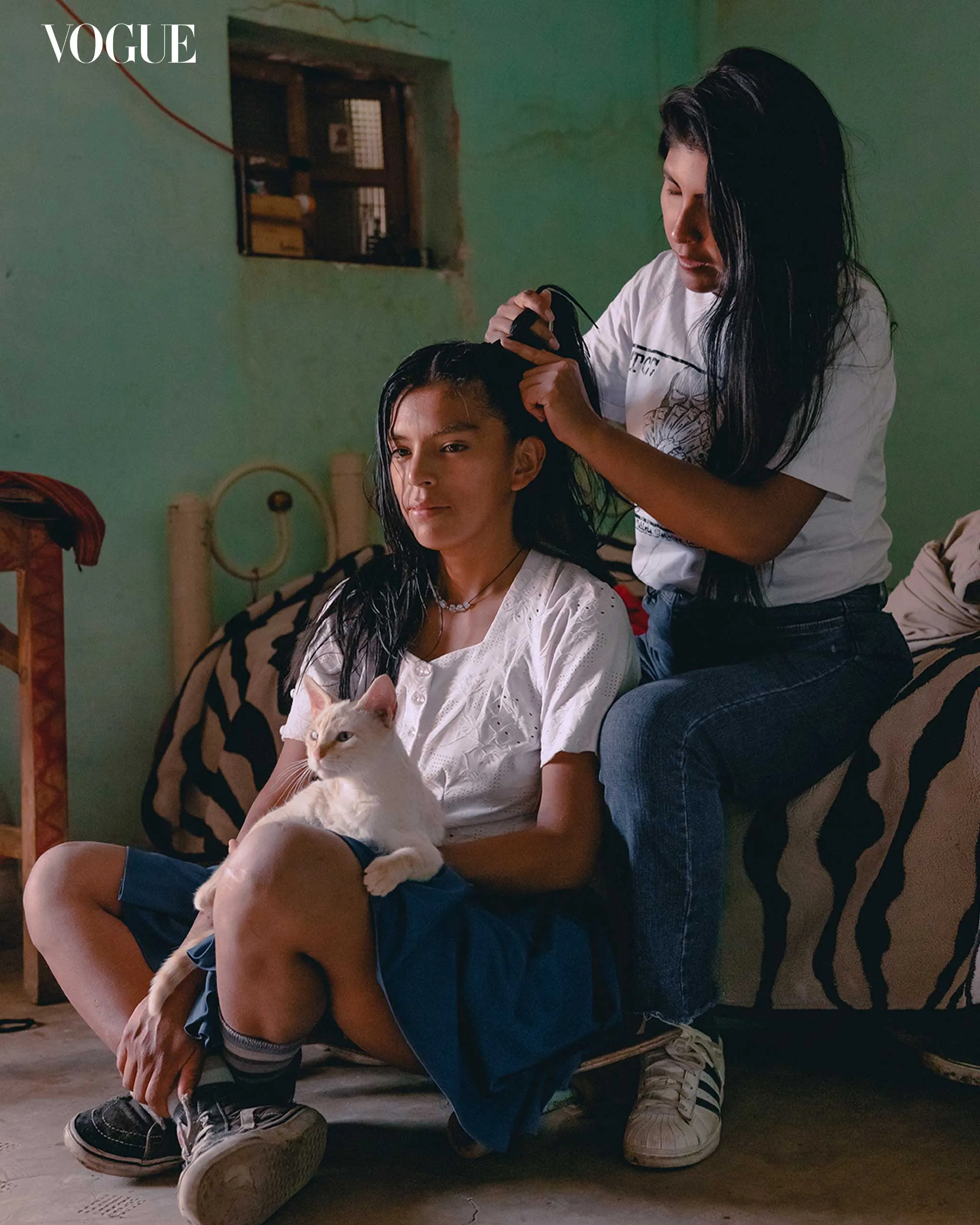
And in Bolivia today, that living language is everywhere: in a pleated skirt catching the light, in a shawl folded over the shoulders, in a building blazing against the Andean sky, in a grandmother’s hands braiding a granddaughter’s hair before she pushes off and rides forward.

Frequently Asked Questions
Bolivia is a country in western-central South America, bordered by Brazil, Paraguay, Argentina, Chile, and Peru.
Cholitas are indigenous Aymara and Quechua women in Bolivia, known for their traditional attire: layered pollera skirts, bowler hats, shawls, and long braids.
Bolivian indigenous dress is characterized by layered pollera skirts, embroidered shawls, and bowler hats.
Neo-Andean architecture, also called “cholet” style, is a colorful, geometric building style associated with Aymara architect Freddy Mamani in El Alto, Bolivia. Mamani credits the style’s origins to Tiwanaku ruins and traditional weaving motifs, and his work was commissioned by Fondation Cartier pour l’art contemporain in 2025.
The pollera traces back to the pre-colonial urkhu garment, later transformed under Spanish rule into its now-recognizable pleated form. Despite a 1795 Spanish ban on Inca-associated dress, the pollera endured and adapted, becoming one of the clearest present-day expressions of indigenous continuity in Bolivia.
- Laufey Is Throwing Away the Rule Book
- Fashion by Bottega Veneta, Jude Macasinag, and More Find a Fitting Sense of Place in Venice
- Ahead of the 2026 Met Gala, We Assembled a Stellar Lineup of Creatives in Fashion Worthy of a Museum
- From Horse Barbie to Dolls, Geena Rocero Has Lived Life as a Storyteller