
As Tashigi in One Piece, Filipino American Actor Julia Rehwald Returns to Familiar Worlds


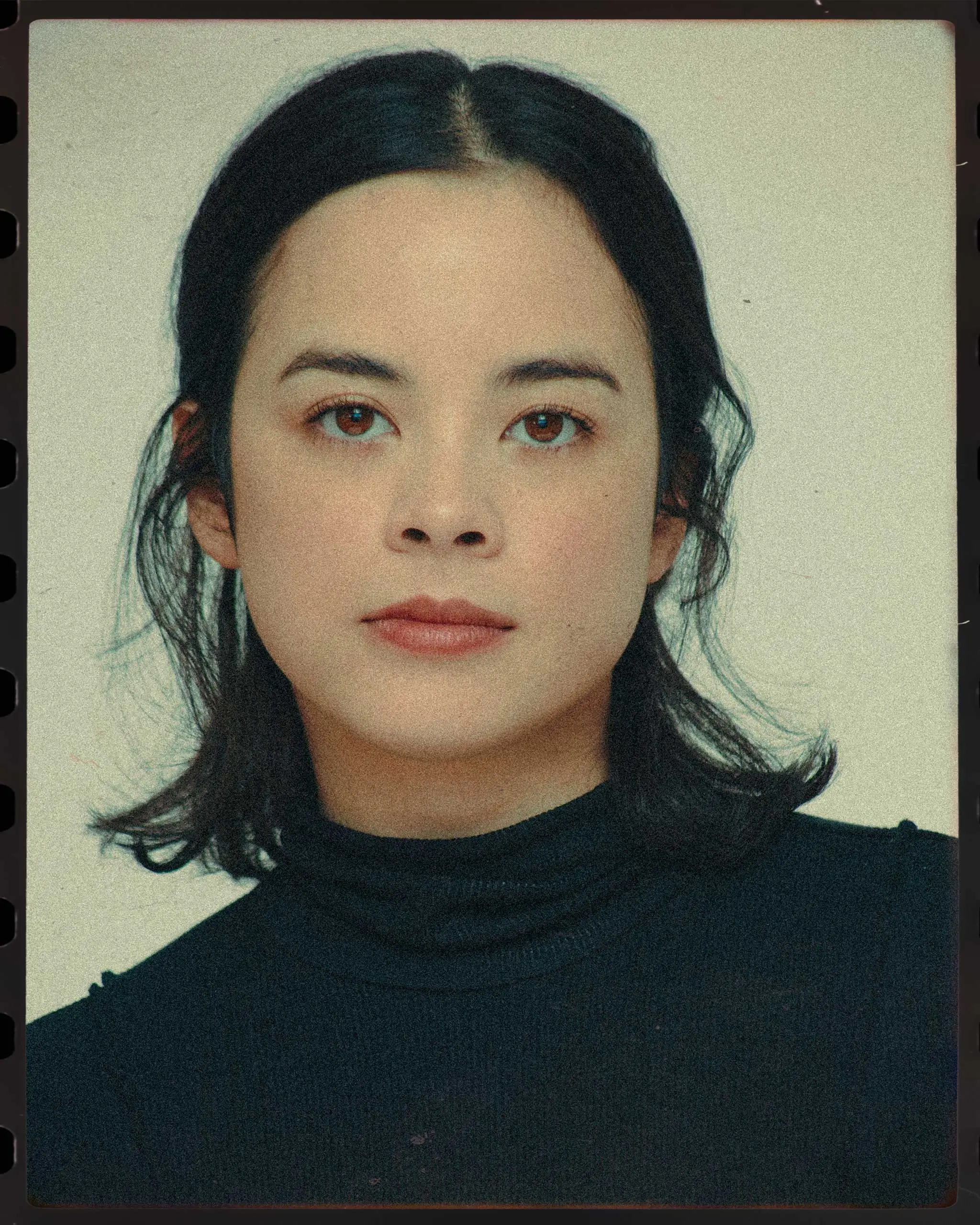
Photographed by Patrick Donovan. Courtesy of Julia Rehwald
Following her breakout role in Fear Street, Rehwald finds herself navigating both a new character and a new sense of direction with the latest adaptation of One Piece.
As a child, Julia Rehwald glimpsed other worlds. Never fully, and not in a way she completely understood. Only in fragments, with pirates clashing somewhere in the distance, blades drawn against impossible odds, and fruits that granted abilities no one could explain. Episodes of One Piece played somewhere in the background, on a television left running in a room she once drifted through. She didn’t follow it closely then, but it stayed lodged in her memory. Years later, that world would return, this time asking something of her.
By then, acting had already taken shape in her life in a more deliberate way. The young actor traces it back to a school production in her senior year, the first time the idea felt like something more than an extracurricular. “After that show, I got permission from my parents to go to acting school,” she recalls. It carried into college, where her focus moved toward screen acting, a medium she found herself more drawn to.
Her first professional experience came through a pilot for Amazon, a project that marked the transition into a lifetime in the arts. It confirmed something she had begun to suspect: that acting, particularly for film and television, was not just an interest she could sustain, but one she wanted to build a career around. Roles would follow, including her breakout in Fear Street, where she played Kate Schmidt, a character defined by sharpness and composure. “I think the character that I played [there] was sort of the character that I’d always seen myself getting cast in,” she says, “the sort of sharp, sarcastic, and dry, and gutsy kind of girl.”
That sense of familiarity is what makes her casting as Tashigi in Netflix’s live-action One Piece: Into the Grand Line feel like a turn. “I didn’t ever really see myself as playing this sort of earnest, clumsy, nerdy kind of character,” she admits. “And I don’t think many other people had seen me in that way, so this was totally different.”
Tashigi, a Marine who was also guided by a strong moral code and a deep respect for swords, required a different approach compared to what she was used to. Where earlier roles leaned into wit and control, this role begins from uncertainty, “like someone still learning how to take up space.”
In some ways, that trajectory mirrored Rehwald’s own entry into the series. She arrived in its second season, stepping into a cast that had already formed its own rhythm. The process of landing the role unfolded quickly. She had prepared herself for a longer series of callbacks, managing expectations the way actors often learn to do. When the call came, confirming she had been cast, the reaction was delayed. “It didn’t really register in my mind for quite a bit,” Rehwald says. It wasn’t until she was on a flight to Cape Town, where the series films, that the reality settled in, “and then it just all sort of hit at once, and it was really absurd and beautiful.”
The scale of the production confronted her almost immediately, with fully constructed environments, detailed sets that could be walked through, and a cast already grounded in the world of the show. On her first day, she stepped into Loguetown, a complete town square built from the ground up. “It’s not green screened, this is all real,” she recalls. The experience was both grounding and disorienting, having to quickly find her place within something already in motion.
Preparation became a way of doing that. The actor works from psychology outward, focusing first on how a character thinks; what they want, what guides their decisions. For her character Tashigi, that meant identifying two core elements: her sense of justice and the goal that drives her forward. “Every character has that, their driving force,” she explains, and once those were clear, the physical details followed, from posture, voice, and mannerisms.
The work also extended beyond the script, where she spent weeks training physically, beginning in New York before continuing on set. Sword work became part of her daily routine, something she approached without prior experience. Over time, choreography layered onto that foundation, and it required a shift in how she understood movement. “It’s not light and airy [like ballet], you need to be grounded and quick,” she says. The adjustment was technical, but also internal, and similar to her character’s story arc, was a process in learning to occupy space with intention.
“So I hope that Filipinos get to watch it and see me and feel excited, hopefully, and maybe a little bit proud that there’s a Filipino in One Piece now, which feels kind of crazy to get to say, but it is very exciting.”
Rehwald describes Tashigi’s story as one of gradual confidence. Someone who begins uncertain, then learns to assert herself through experience. It’s a progression she understands. Looking back, she sees a similar movement in her own life.
“I think that’s something that I could see a bit in myself, like watching this season back, I know what it’s like to be the younger new kid who doesn’t really know how to fully stand up for herself yet,” she recalls. “And then getting the courage and encouragement from friends and really stepping into her own, which I think is something we’ll see more even in season three of, [where] she becomes a leader and becomes independent, and I think that’s sort of how I see myself now, fully independent and sure of herself.” The distance between then and now registers not as a break, but as a series of adjustments.
As a Filipino-American, she is also aware of the visibility that comes with being part of a global series. “You want to make your family and your people proud,” she says. “So I hope that Filipinos get to watch it and see me and feel excited, hopefully, and maybe a little bit proud that there’s a Filipino in One Piece now, which feels kind of crazy to get to say, but it is very exciting.” And it’s a responsibility she doesn’t separate from the work itself.
Looking ahead, Rehwald is interested in expanding the range of stories she participates in. She mentions romantic comedies as a direction she hasn’t yet explored. “We need some hope. We need some romance and love.”
For now, though, she remains in the world that once existed at the edges of her attention. Filming continues, with a new third season building on the last. The work is ongoing, but there is a sense of return in it. “I think getting to be in the live action adaptation of something that is so nostalgic of childhood for you is like a position that I don’t think I’d ever thought was something I’d live through,” she says. “I think the young version of me is probably watching One Piece on Saturday morning on TV.”
But the difference now is not just participation, but perspective. What once played in the background has moved to the foreground, and Rehwald, who once observed from a distance, now shapes what others will see.
Frequently Asked Questions
Julia Rehwald is a Filipino American actor known for playing Kate Schmidt in Fear Street. She now stars as Tashigi in Netflix’s live-action One Piece: Into the Grand Line, joining the series in its second season.
Rehwald plays Tashigi, a Marine guided by a strong moral code and deep respect for swords, in Netflix’s live-action One Piece: Into the Grand Line. The role marked a departure from her earlier, more sharp and composed character work.
Rehwald trained in sword work for weeks, beginning in New York and continuing on set, despite having no prior experience. She approached the character psychologically first, identifying Tashigi’s sense of justice and driving goal before developing physical mannerisms.
The series films in Cape Town, where Rehwald encountered fully constructed sets, including a complete town square built for Loguetown, which she noted was real rather than green-screened.
As a Filipino American, Rehwald said she hopes Filipino viewers feel proud seeing her in the global series, noting the significance of representation while treating it as a responsibility connected directly to her work on the show.
- Saad Amer on Clean Air, Climate Justice, and the Cost of Delay
- Paperback Writer: David Guerrero on the Beatles’ Bad Date with the Philippines
- The One Piece Live Action Continues with Season 2 and Fresh Cast Additions
- Why Virgin River Actor Marco Grazzini Feels Like His Career Is “Just Getting Started”