For Dancer Joshua Serafin, The Body Is a Portal


Photographed by Michiel Devijver for the November 2025 Issue of Vogue Philippines
Photographed by Michiel Devijver for the November 2025 Issue of Vogue Philippines
Joshua Serafin unpacks mythmaking, showcasing their work around the world, and using the human body as a tool for expression.
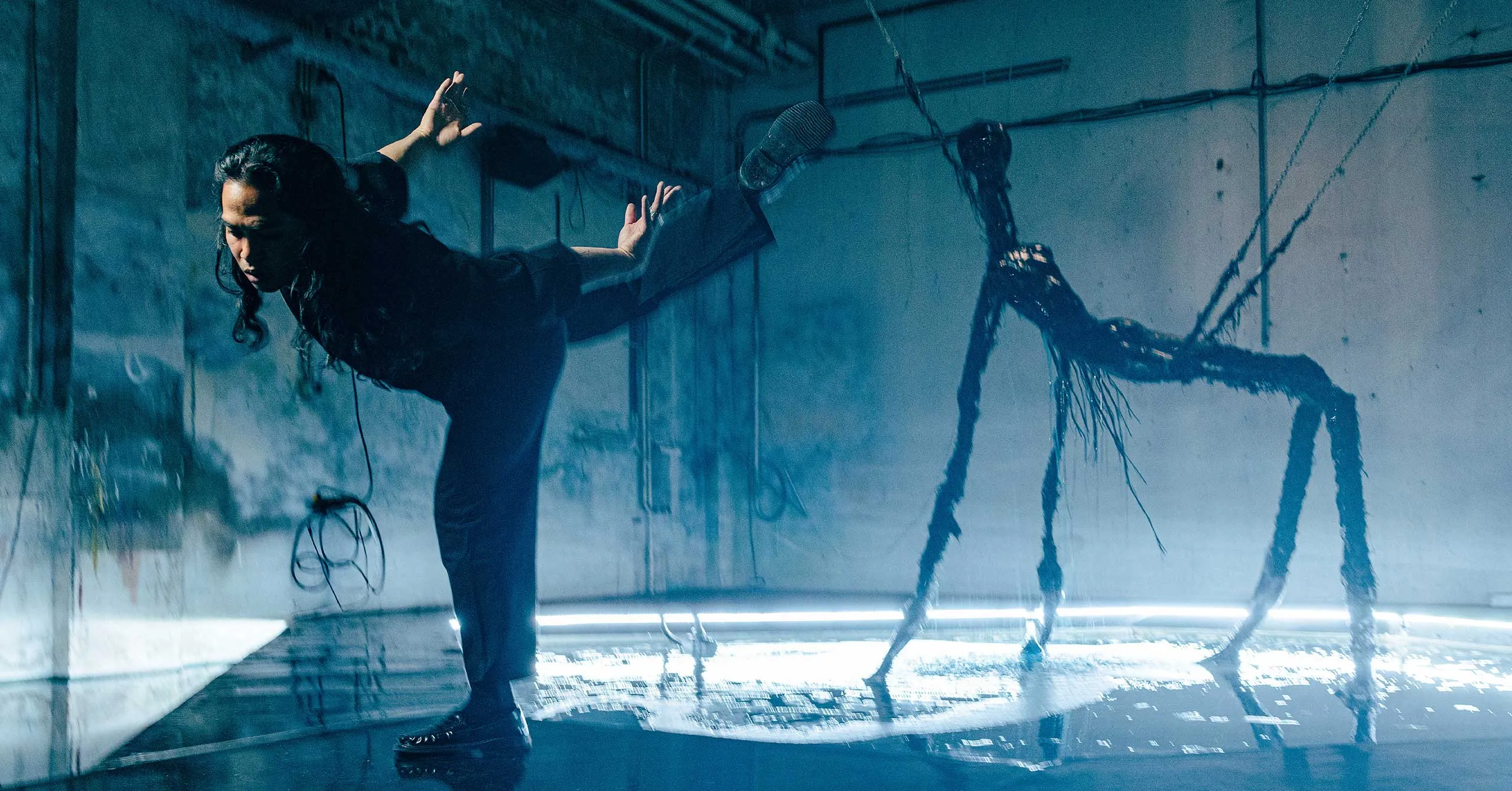
The lore of multidisciplinary performance artist Joshua Serafin thus far can be divided into two parts. There is pre-Venice Biennale: a continuous cycle of auditioning and grinding, before the madness wrought by clips of them performing “VOID” went viral in 2024. This was before millions of people saw Serafin, a newly born deity in the throes of a frenetic dance, flailing as if possessed, while coated head to toe in black primordial ooze. And there is post-Venice Biennale: where Serafin’s schedule is booked solid till 2028.
“I never work toward virality. I’m just making my own stuff,” muses Serafin in a video call, while sitting on a white sofa, in a living room in Brussels where the Bacolod-born artist is based. “Last year, I really needed to learn and understand because virality comes with all the possibilities in the world and the world offers you everything. Everyone and everything wants you all of a sudden.”
“VOID” is part of Cosmological Gangbang, a series of works based on Serafin’s research on queerness, spirituality, indigeneity, and ecology. Unlike their first solo work “Miss,” where Serafin takes on the transgender pageant industry of the Philippines and submits a “brown exoticized body” to the audience, “VOID” diminishes it: Serafin’s figure is an anthropomorphized oil slick, a liquid symbiote with long hair and the slightest hint of genitalia. “I wanted to be seen as a body that is skilled, that is power, that cannot be categorized,” says Serafin.
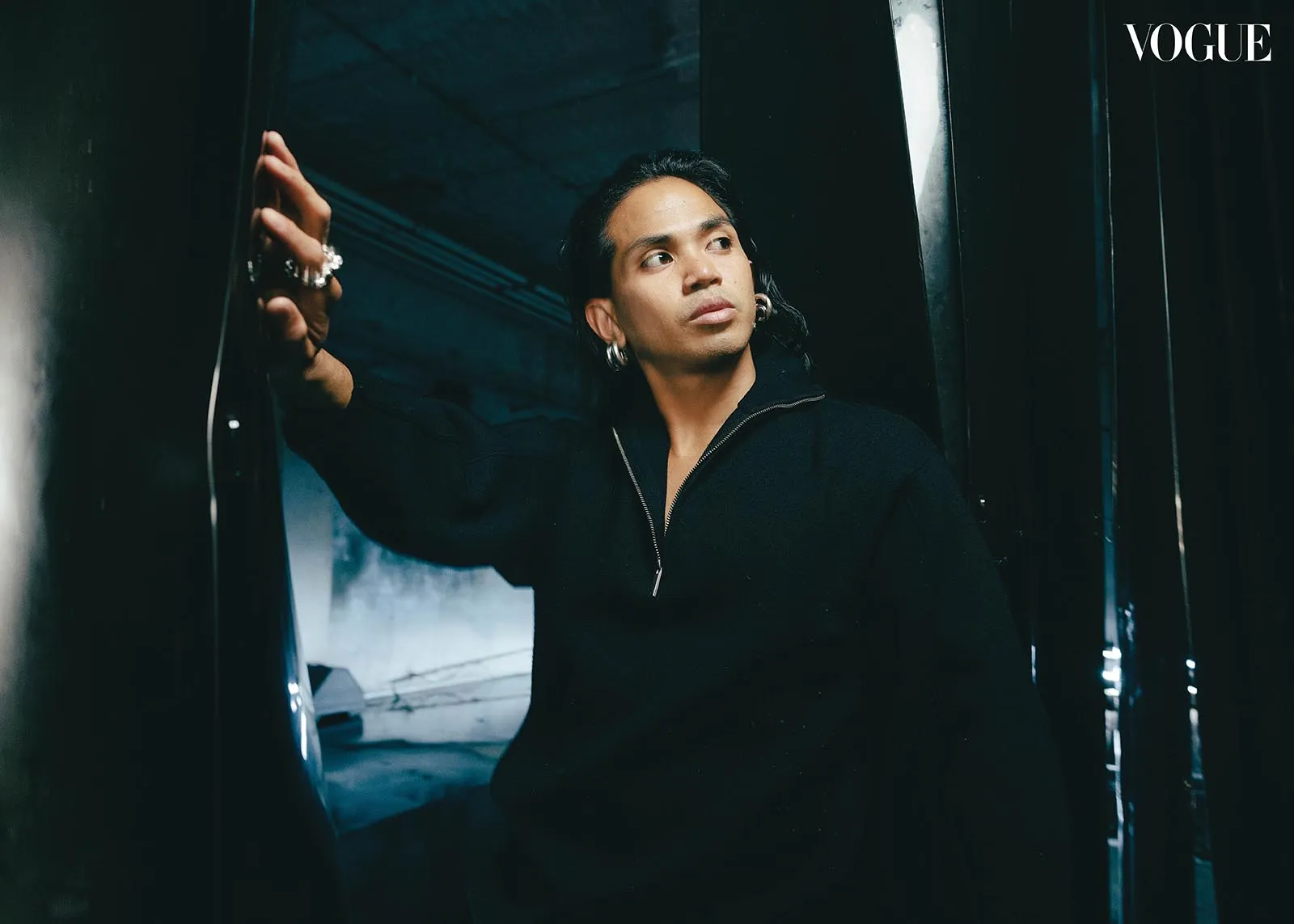
Since receiving that fateful email from Adriano Pedrosa, curator of Foreigners Everywhere, the main art exhibition of the 60th Venice Biennale, Serafin has been approached by Hollywood superstars, film auteurs, music video directors, and creatives of all stripes wanting to swim in their work’s viscous black liquid. With the blazing heat of the spotlight on them and an endless stream of notifications popping off every time they would post a reel, Serafin escaped to Sicily for a week (“just to be nothing”) sans mobile phone. “I closed myself… it was very loud,” they say of that crazy time. “I really needed to take time to understand where I want this work to go, who this is for, why we are doing it, which direction we want to take it, and who we want to give the work to. If it’s in every music video all over the world, you lose the integrity of the work,” Serafin adds. “And it’s not just the work, but also: where do I want to be?”
Born in 1995, Serafin is an itinerant and artistic soul who grew up in a middle-class family in Bacolod. While their older siblings had their noses stuck in books, studying to become nurses, Serafin was dancing, singing, drawing, and playing in the mud. It was as a theater arts scholar at the Philippine High School for the Arts (PHSA), in the embrace of Mount Makiling, that Serafin first saw the full potential of the human body as a tool for expression. “I wanted freedom of movement and the capacity of abstraction without being tied up to a text,” they say.
“I’m taking in everything, different practices, different choreographies, different kinds of ideas, different kinds of making, to create my own.”
From PHSA, Serafin studied contemporary dance at the Hong Kong Academy for Performing Arts, a pivotal moment in their career because it introduced them to a global network of curators, artists, and performers, people who remain dear to Serafin, who set them on the path of “wanting context, histories, and philosophies on performance and dance.” And after Hong Kong, Serafin found their way to PARTS (Performing Arts Research and Training Studios), a school in Brussels that is notoriously difficult to get into as it auditions students only every three years. In Serafin’s batch, a mere 44 were accepted out of more than a thousand hopefuls. “Brussels . . . gave me all the tools for the body,” says Serafin, who has remained in Belgium since then and was named a house artist for Viernulvier, an arts institution in Ghent, until 2027.
“I’m taking in everything, different practices, different choreographies, different kinds of ideas, different kinds of making, to create my own,” says Serafin. “As I feed my own worlds, I’m also eliminating things that I don’t need. I guess it’s a question for what is lacking in the world… I’m making my own vocabulary based on what is not yet there because I’m bored of the things that have already been made.”
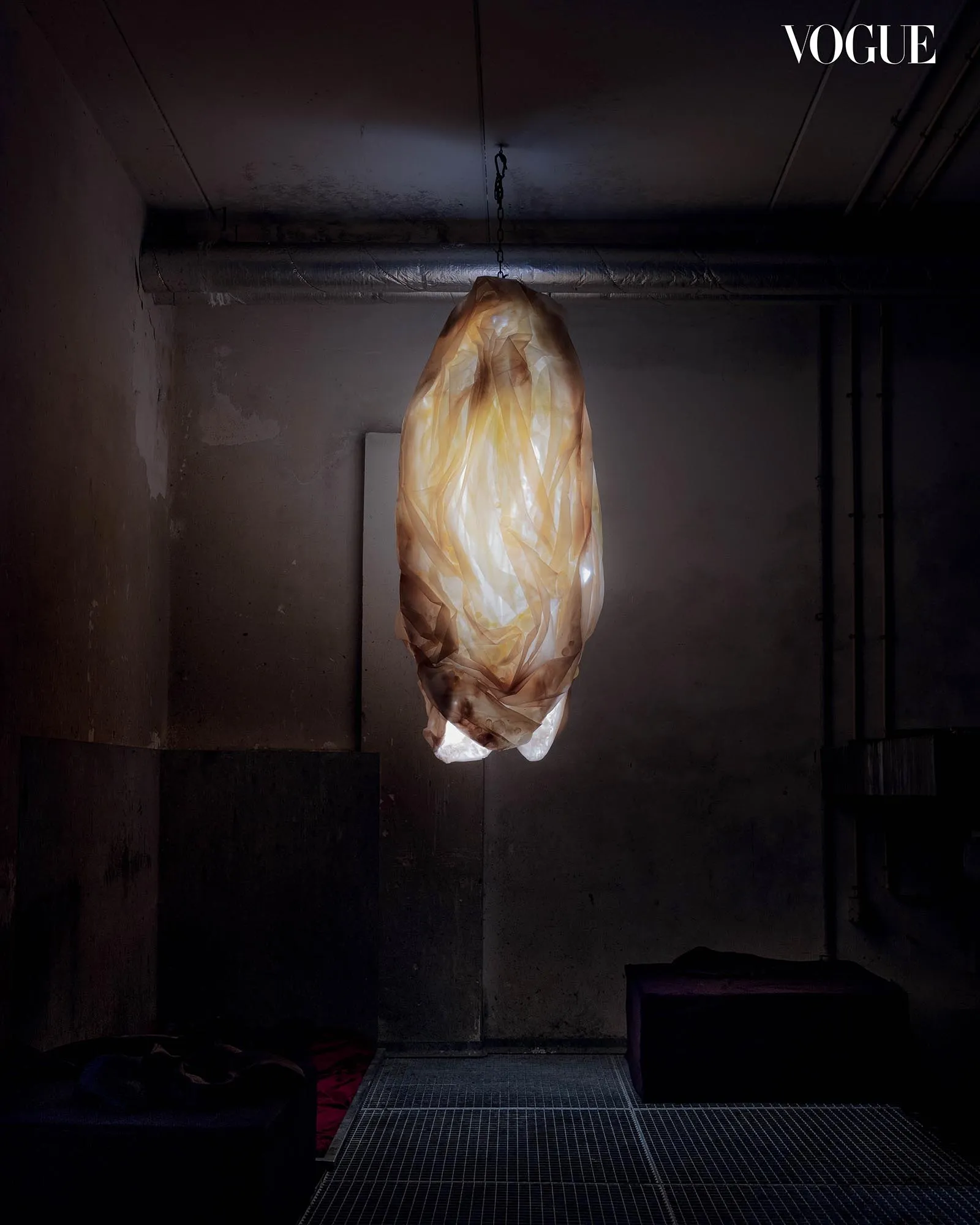
Serafin’s latest work, a performative space titled “Buried in a Coffin the Size of a Grain of Rice,” is part of Belgium’s Horst Expo 2025. Combining design, installation, sculpture, and Serafin’s multihyphenate pursuits, the piece is, according to Horst, “a portal [that] connects the ancestral with the mortal world and allows entities to watch over the current mortal realm, offering guidance to those willing to receive.” This cosmological realm is the birthplace of all of their works, which have been mounted everywhere, it seems: Singapore, Norway, Finland, Hong Kong, Germany, Mexico, and the United States, except the Philippines.
Serafin is also starting a new series called Lost Ancestors, which explores narratives of loss, grief, and connecting with the past. Their first stop is Fukuoka, Japan, where Serafin will do research on their great-great-grandfather, a Japanese carpenter who moved to Negros in 1909 to work for an American-owned lumber mill. Ambitious in scale, Lost Ancestors is a multiyear project that will culminate in 2027 through an immersive four-hour journey that at once combines and questions “the experience of an exhibition and the theatricality of performance,” says Serafin, who likes mythmaking and having the audience revel in the textures, feelings, and sensations of a world that they have created. “It’s about unshackling the structures of theater. I don’t want a fourth wall.”
“The scale of my work is really huge and really quite expensive,” admits Serafin, who has screened films, held talks, and, just this June, co-organized an artist residency called Swamp Gathering in the Philippines. “I’m working my way toward bringing these works home eventually. That’s the main goal since these works are made by a Filipino for the Filipinos. It just needs a bit of time to arrive, but it’s not impossible.”
By SAM L. MARCELO. Photographs by MICHIEL DEVIJVER. Installation photos by ELINE WILLAERT and ANGELINA NIKOLAYEVA.