With Rosemead, Lucy Liu Reshapes Tenderness Into Strength


Photographed by Luca Chiandoni
In this digital exclusive, Vogue Philippines traveled to the revered Locarno Film Festival for an intimate afternoon with the Asian-American icon, hours before she received the festival’s Career Achievement Award.
Moments before Lucy Liu enters the Piazza Grande, her name rings out over the loudspeakers, followed by a familiar syncopated shaker. It’s the opening of “Independent Women Part I” by Destiny’s Child—the theme song of her breakout film Charlie’s Angels. The thump sends the crowd of thousands—diverse, international, and multilingual—dancing in their seats. Tonight, they are gathered at one of the world’s largest open-air screening venues to get a glimpse of Liu as she receives her Career Achievement Award and presents the international premiere of her new film, Rosemead.
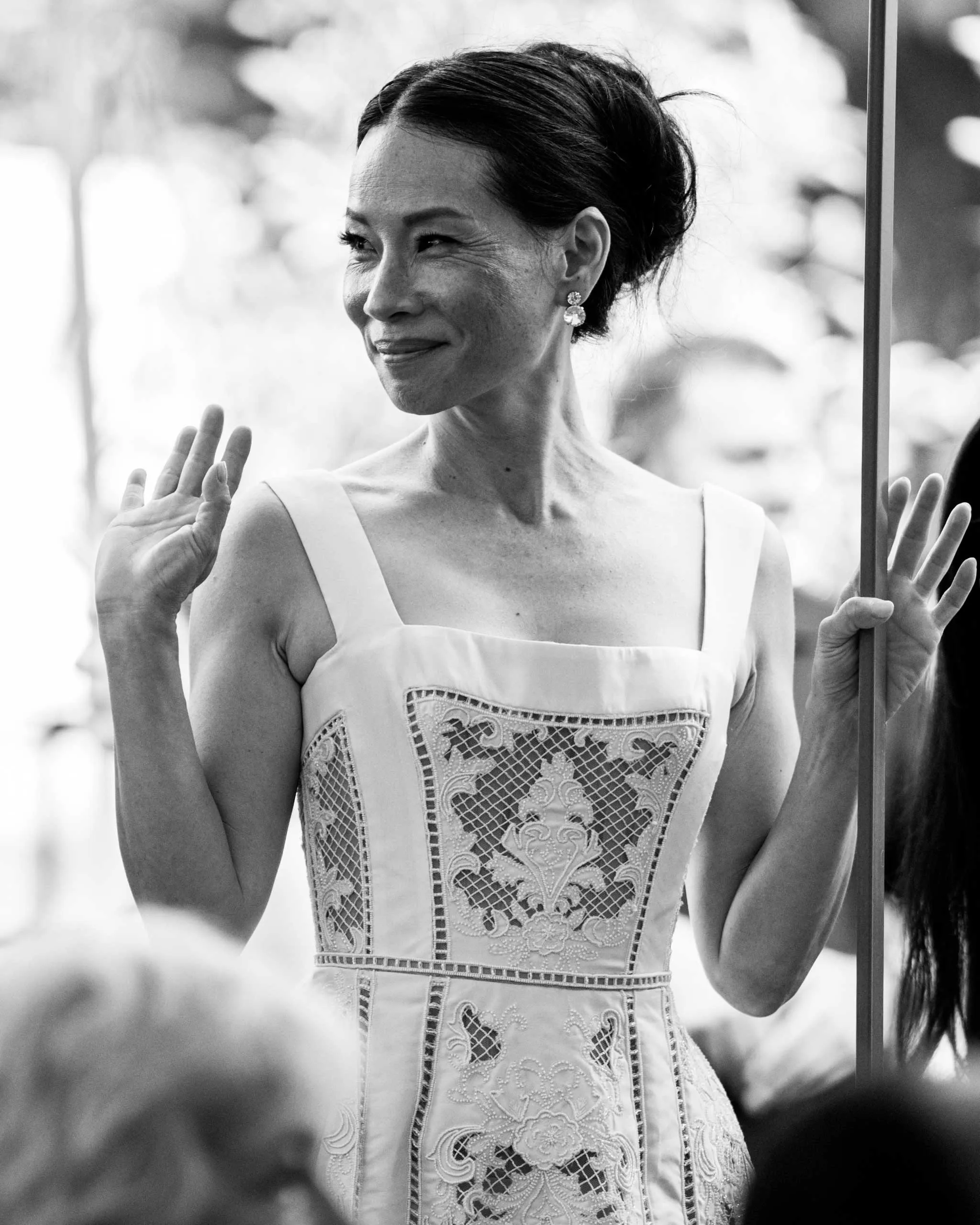
Hours before, Liu joined us at the Sala Affresco of the Hotel Beldevere, built at the foot of famous pilgrimage site Madonna del Sasso, for an intimate conversation ahead of the film’s premiere at the Locarno Film Festival. She enters the room wearing a silk mikado tea-length gown from Paolo Sebastian’s 2024 Spring/Summer Couture Collection, her semi-messy updo leaves the square neck and cutout embroidery visible, embodying the “undone romance of old-world Italy” that characterizes Sebastian’s collection and this part of Switzerland.
“I’m quite introverted. If you saw me before this…” she jokes. “I don’t even own this. As soon as I’m done, they’re going to rip it right off my body.” Everyone in the room, including the press officers, laughs along with her.
Though she remains one of the few globally recognized Asian-American actors, Liu has been notably private throughout her three-decade career as an actor and artist, revealing her more playful side only in conversations with close friends like fellow Charlie’s Angel Drew Barrymore or painter Sasha Gordon. But today, there is a tenderness and vulnerability to her demeanor—partly because she considers this award—which has gone to the likes of Harrison Ford, Jacqueline Bisset, Dario Argento, and Alfonso Cuarón—and her work on Rosemead as a turning point in her career.
“I came to this business to act. I think it’s sometimes hard to get the opportunity. You get to do a lot of other fun roles… [But] the opportunity to do something like a real life story, sometimes it goes to a different race,” says Liu to the table of journalists who are, at most, two seats away from her in a round table. “People like you in a certain role and…they want to continue seeing you in that role. Understandably. It’s fun. It’s entertaining. But it’s important to tell stories. That’s why I got into the business to begin with.”
Partly based on Frank Shyong’s heartbreaking 2017 Los Angeles Times column, Rosemead charts the singular journey of Irene—a newly widowed print shop owner whose efforts to care for her teenage son, Joe, are complicated by a cancer diagnosis. As Joe exhibits worsening signs of early-onset schizophrenia and develops an increasing fixation on mass shootings, Irene goes to greater lengths to protect him and their family in a Chinese-American neighborhood that refuses to acknowledge such struggles.
Liu has been on board since the project’s inception and carried it to term as both star and producer after seven years. “It’s a heartbreaking story and I wish it wasn’t true,” says Liu. “But if it wasn’t true, no one would believe it.”
She has built a career portraying the fiercest and most confident women in film and television history—from the brilliant yet coldhearted Ling Woo in the legal drama Ally McBeal and the deeply caring Princess Pei-Pei in Shanghai Noon, to the cunning female Dr. Watson in Elementary and the beloved Viper in the Kung Fu Panda franchise. Even her future roles in David Frankel’s sequel to The Devil Wears Prada and Lulu Wang’s Audition alongside Charles Melton continue her legacy of complex female characters.
But Rosemead focuses on a different side of Liu: tapping into unwavering maternal strength instead. The role echoes her role as Rebekah in Steven Soderbergh’s Presence, where dread and anxiety are mined from the familiar and familial, as grief ravages the lives of her characters. In Rosemead, the Asian-American sex symbol is unrecognizable—donning baggy clothes, frizzy hair, and a loose grip on the English language hidden underneath a thick Chinese accent.
It’s tempting to place Rosemead among the recent wave of Asian-American films exploring dysfunctional parent-child dynamics: Jon M. Chu’s romcom blockbuster Crazy Rich Asians features a young economics professor seeking approval from her boyfriend’s disapproving mother; the Daniels’ Oscar-winning Everything Everywhere All At Once uses the multiverse as a common ground for an immigrant family too busy struggling to survive to see each other’s unhappiness; and Sean Wang’s Sundance-winner Didi attempt to bridge the cultural chasm between a long-suffering matriarch and a rebellious son.
But Rosemead veers away from the maximalism and stylization of these films. Instead, it opts for the authenticity and intimacy of a straightforward family drama until it descends into bleaker, more punishing territories to address stigmas too often left unspoken.
It isn’t Liu’s first foray producing projects that interrogate spatial and racial politics. In 2009, she co-produced Redlight, a searing documentary feature about global child sexploitation and trafficking of young Cambodian girls, even lending her voice as narrator. Later in 2021, she served as executive producer of Unzipped: An Autopsy of American Inequality, which examined wealth disparity and homelessness in Venice, California. However, none of these projects have required Liu to be as deeply intertwined in image and production as Rosemead.
“Producing is all-encompassing and I don’t recommend it to the faint-of-heart,” says Liu. “But I do feel that it’s worth the effort. The importance of the authenticity of this was crucial. So every word, every sound…you have to account for everything.” Even until the last moment, Liu was helping correct captions, even down to the smallest “eh.” Part of why Liu is so careful about the story and its treatment is tied to her own upbringing.
“She wasn’t that far from my heart because I feel I understand her. Growing up, I didn’t understand English for so long…I remember feeling not invited to the party, not being cool, not having the strength to speak out when people were making fun of my mother, or that her accent was strong,” says Liu, who was born in Queens, New York to Chinese immigrant parents. “I grew up in that situation where my parents were misunderstood or thought less of. Nobody advocated for [them] because they didn’t speak the language well. Even though there were scientists [and] civil engineers, people talked down to them…I think it’s really important to not necessarily disguise it, but to expose it. That’s what I try to do with her—to expose the trauma and the smaller side of myself to reach her.”
“When she came on board, we spent so many hours poking at every scene, every line of dialogue, and it just showed her commitment to the story and how much she cared about it,” says director Eric Lin. “It took us a long time to make this film, and many times we didn’t think it would get made. And even after it’s made, you know, she’s helping us shepherd it. She’s going beyond stepping on the day of the shooting and moving on to other stuff. We all, I think everybody who made this film cares so much about the story and that it gets out in the world in the right way and that, you know, people hopefully connect with it. And so, you know, I can’t be more thankful that she’s also producing.”
“There was pressure to change the location of the story. But what was specific about Rosemead was that it’s a Chinese ethnic enclave,” adds Lin whose parents, like Liu’s, migrated because they were chasing the promise of opportunity in America. “If we took it out, it would have been about an immigrant woman who was isolated because of language and culture. But because it happens in Rosemead, it wasn’t that she was cut off from the world around her. She had opportunities to ask for help [and] to speak to people. It makes it even more pointed that she is internally shutting off these avenues…because of shame [and] cultural expectation.”
One might wonder if Liu feared that Rosemead would reinforce existing stereotypes about Asian immigrants living in and struggling to assimilate in America. But she pushes back against being boxed in—especially when her Caucasian counterparts aren’t subject to the same scrutiny. This refusal has defined her career but was reinforced in 2021, when she wrote a thoughtful response via The Washington Post to a Teen Vogue piece that described the ruthless Yakuza leader O-ren Ishii in Quentin Tarantino’s Kill Bill: Vol. 1 as just another “dragon lady.”
Years later, especially after the rise in Asian hate brought about by the pandemic, Liu remains adamant that the AAPI community is not monolithic and many stories have yet to be told cinematically. “No matter what I do, they can put me into a prescription from the past. It’s like they want to continue to keep you in the bottle. I don’t play to that…If people keep labelling you, then it becomes passed down to other generations…[These] umbrellas are ignorance. They’re dated. It continues to generate prejudices and it can be damaging.”
Case in point: Midway through Rosemead, a second-generation Chinese-American psychiatrist offers Irene help. He speaks speedily in only English and promises that a laundry list of expensive combination therapies would help Joe deal with his traumas. When Irene finally opens up to him about her worries and shares sensitive information, Joe is suddenly found in the police station. Though these links are circumstantial, she feels a deep betrayal. Overwhelmed, Irene ends the conversation by saying one of the film’s defining lines: “Just because you have a Chinese face, it does not mean you are one of us.”
It’s a ruthless and complex sentence that carries the weight of her frustrations, revealing the character’s more deep-seated paranoia. “Even though he had nothing to do with what happened at the police station, she has already put him on the other side,” says Liu. “It’s such a dangerous thing…There’s a general truth out there. But now, it’s shifted so much that truths are becoming more and more insular. There’s such an individualization that occurs. There’s no unity. That’s when we lose each other as a community.”
When Frank Shyong’s story was first published, the surviving relatives of the family took action against the friend who spoke to the LA Times, leading her to be isolated further from the community. “After she told the story, she was also somewhat excommunicated from that area because she exposed something that was shameful,” says Liu. “There are so many of those layers that we have culturally, as all communities do, that don’t want to expose the bad. They only want to show the surface of not the side that is maybe not as shiny as what you would like to appear as.”
Rosemead aligns with Liu’s broader artistic ethos as it tackles the same themes of security, salvation, and home she probes in her paintings and exhibitions. But she sees the film as a starting point for a larger cultural conversation around seeking help, especially for a community that tries to maintain the illusion of strength and independence. “You can’t just leave the audience afterwards. You really need to talk to them and ask them,” says Liu. “Everyone has a different perspective and feeling and question. That’s the whole point of art: to talk about it.”
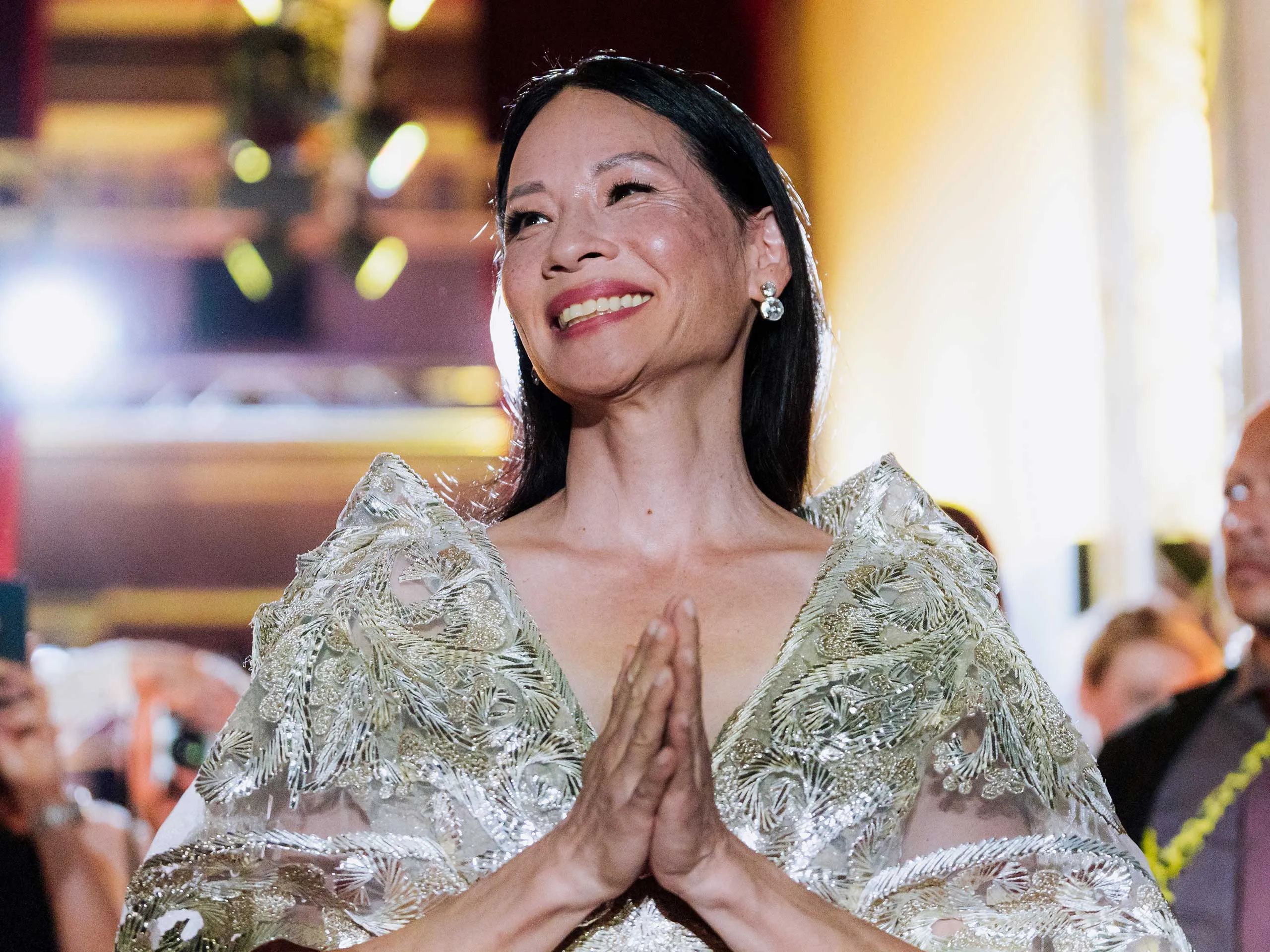
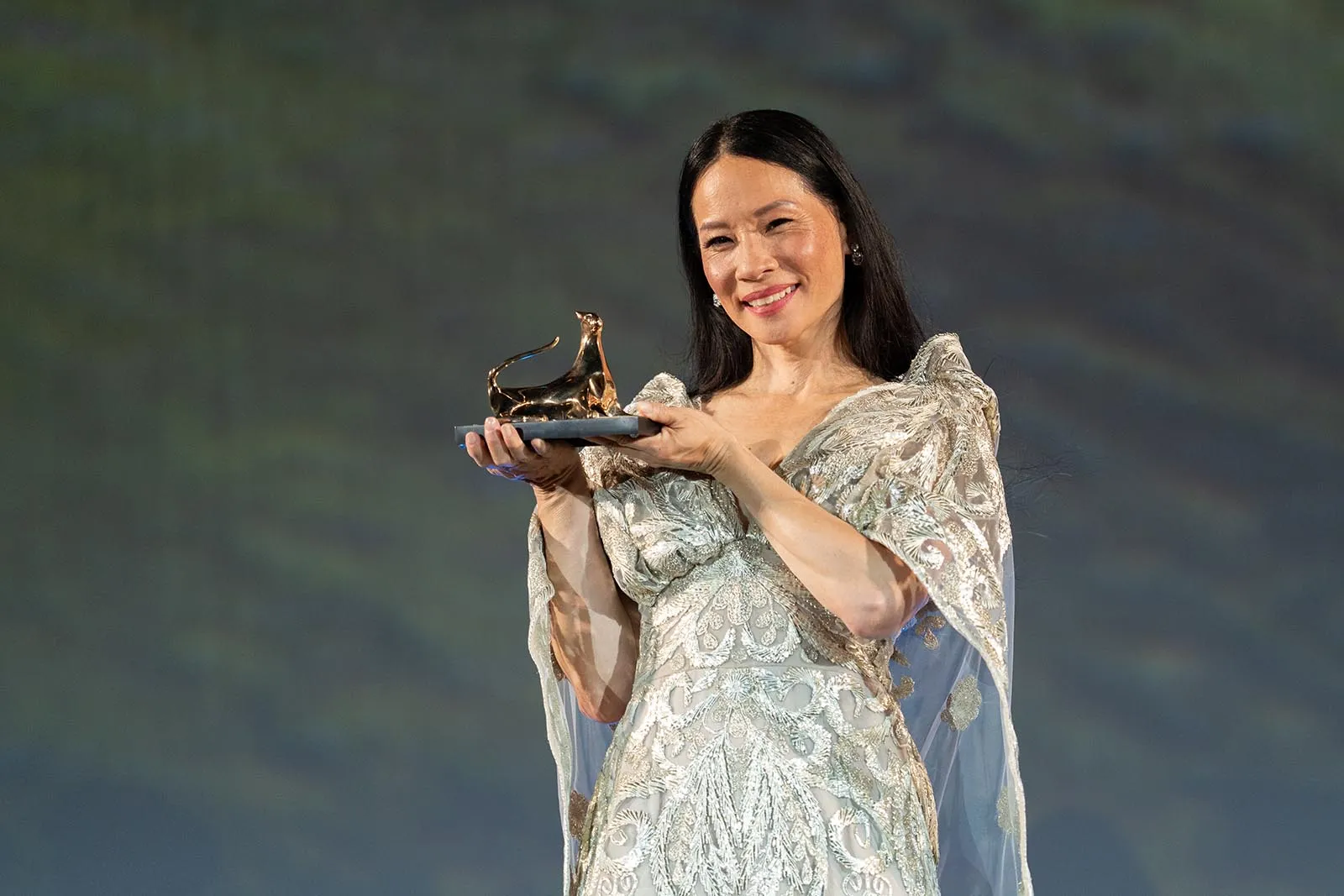
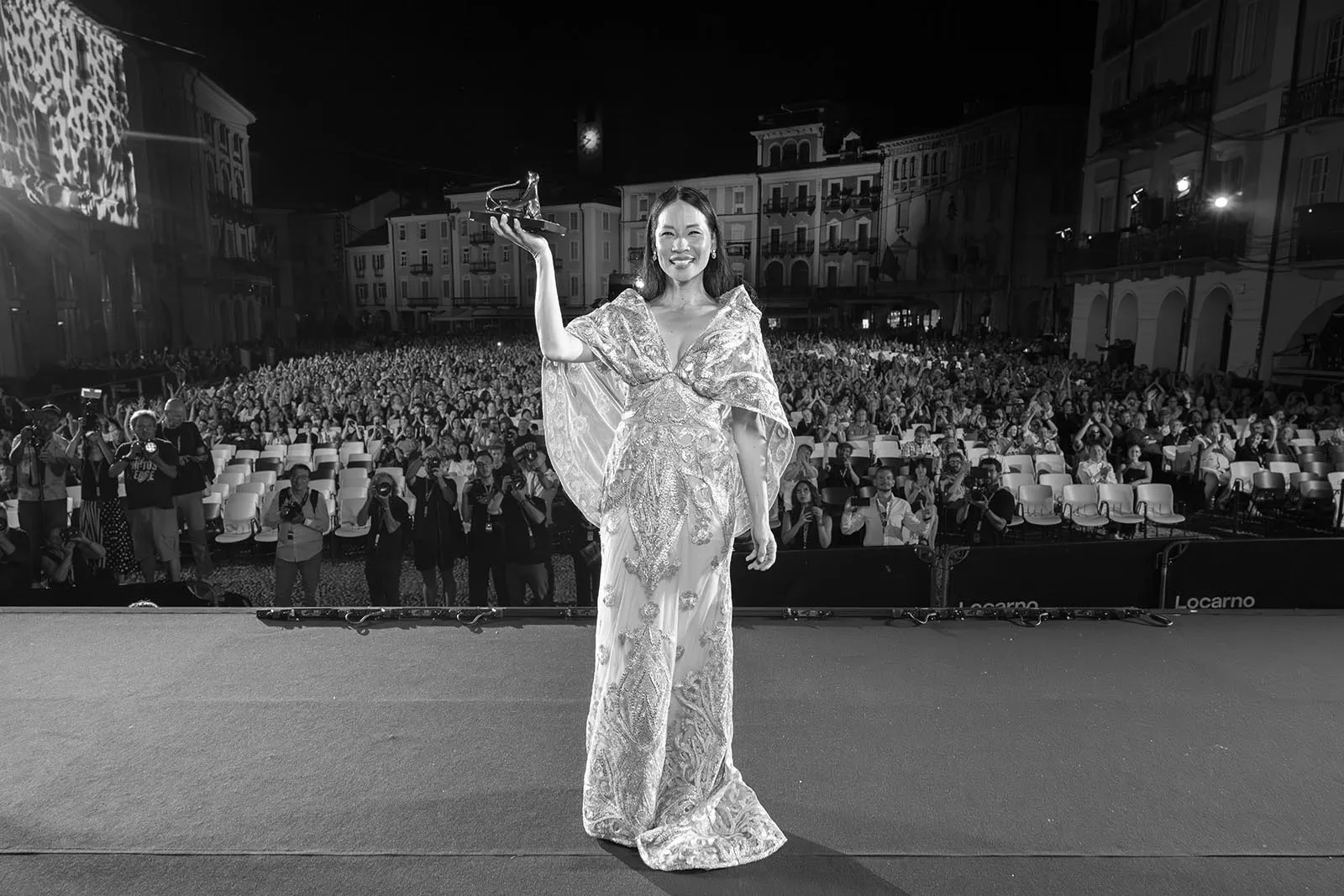
Later, at the Piazza Grande, Liu returns to the red carpet in a ribbon-embroidered gown from Naeem Khan’s Spring 2024 Collection, the hooded V-neck dropping just enough to give her arms the silhouette of angel wings. As she ascends the stairs, she’s slowly surrounded by the Rosemead team, including editor Joseph Krings whom Liu takes the time to spotlight later on. During her speech, she refocuses the conversation away from her own personal wins and instead connects this milestone to her immigrant origins.
“To me, this is not about my body of work. It’s about how I have learned to love—more bravely, more deeply throughout my life and through this career I have been so blessed to have been on,” she says. “Coming from immigrant parents, they really shaped me, the way I see, the way that I listen, the way that I behave with other people. They sharpened my ability to be more cognizant [towards] stories that were more on the edge.”
Soon enough, Locarno artistic director Giona Nazzaro hands her a statue of a golden leopard. The thunderous applause is now mixed with hoots and hollers. She is smiling ear-to-ear. Flashes from cameras everywhere make it appear as if she is a star in the night sky. She ends her speech as she began our interview earlier: “I feel like my career is just starting.”
Rosemead is currently showing exclusively at Robinsons Movieworld. For tickets, visit Robinsons Movieworld’s official website.
***
Jason Tan Liwag is one of ten international critics selected for the Locarno Critics Academy 2025. His participation was made possible through the support of the Quezon City Film Commission, the Film Development Council of the Philippines, and the CIIT College of Arts and Technology. Special thanks to Christopher Small, coordinator of the Locarno Critics Academy, and Claudia Wintsch of elliot ag for making this interview possible.
- Anton Tantoco Huang Honored in The Business of Fashion BoF 500 Class of 2025
- At Now Now Canteen, Celine Lee Puts Rice at the Center of the Table
- Behind the Vision of Autumn Durald Arkapaw, One of Hollywood’s Most Talked-About Cinematographers
- Exclusive: Guillermo del Toro on Bringing Mary Shelley’s Frankenstein Back to Life
Frequently Asked Questions
Lucy Liu received the prestigious Career Achievement Award at the open-air Piazza Grande venue. The honor recognizes her three-decade contributions to cinema, placing her alongside previous icons like Harrison Ford, Jacqueline Bisset, Dario Argento, and Alfonso Cuarón.
The independent drama is based on journalist Frank Shyong’s 2017 investigative column for the Los Angeles Times. The narrative chronicles a newly widowed Chinese-American print shop owner navigating her own cancer diagnosis while trying to manage her son’s worsening schizophrenia.
Liu debuted two couture ensembles during the festival. For her daytime press round tables, she selected a silk mikado tea-length gown from Paolo Sebastian’s Spring/Summer Couture collection. To accept her award, she transitioned into a hooded, ribbon-embroidered gown by Naeem Khan.
Unlike the stylized maximalism seen in Everything Everywhere All At Once or Crazy Rich Asians, director Eric Lin’s film avoids hyper-stylized production elements. It focuses on the raw, intimate realism of an immigrant family dealing with severe mental health struggles within an ethnic enclave.
Following its festival circuit launch, the independent film is showing commercially as an exclusive cinematic release at Robinsons Movieworld theater locations. Ticketing schedules and regional availability can be accessed directly via the official Robinsons Movieworld platform.