
Art in the Cloud: 24 Hours at Khao Yai Art Forest With Trickie Lopa


Photos courtesy of Khao Yai Art Forest
Photos courtesy of Khao Yai Art Forest
TRICKIE LOPA spends a day at the Khao Yai Art Forest.
Our 9:30 A.M. call time was somehow both too early and too late. We had been told (or gently urged) to leave earlier, warned about the traffic creeping out of the city on the Labor Day holiday weekend. We made it out by 10 A.M. Not too bad considering this was a Sunday morning after a Saturday night out in Bangkok town.
Comrades-in-art, we held six different passports between us (Singapore, Indonesia, Malaysia, China, Taiwan, me), worked in art fairs (3), ran an art foundation (1), strategized for cultural projects (1), and worked for a museum (1). All of us brought to Bangkok for a long weekend with the Asian art crowd by either a fabulous wedding overlooking the Chao Praya River, a 50th birthday dinner at a heritage home, gallery and gastronomy hops, or all of the above. Today, we glided north for a chance to experience one of the most stunning projects in Southeast Asia: Khao Yai Art Forest.
The first half of the ride was a collective haze, nodding heads and a soft silence filling the van. But sometime after the halfway mark of this three-hour road trip, the mood lightened. Al Green triggered singalongs, munchies came out of bags, and spirits lifted with the promise of what would come ahead.
By 1:30 P.M. we were checking into a quiet resort nestled in the mountains. We didn’t want to have to drive back that evening. Barely had we begun lunch when we were urged to hurry. Other visitors waited. You can only rush the hungry and slightly hungover so much. We made it, as we had originally promised, at 3:30 P.M.
Winding roads, surroundings growing greener and denser, and then a row of parked cars, signalled we were in the right place. Guards motioned us toward a tunnel. We emerged onto a wooden pavilion bustling with staff and visitors.
Marisa Chearavanont, the visionary behind all this, welcomed us. Serene in a long silk dress printed with eco-dyed patterns of local flora, straw hat and rubber boots completing what we would later learn was her “forest uniform.” The silk, she told us, came from worms raised nearby. We would later find out that she dressed the most sensibly, the silk kept her cool at the hottest times of the day, the length of her skirt and sleeves protected against mosquitos.
Ms. Chearavanont, Khun Marisa, is a longtime art collector and patron, equally at home in museum benefits as she is in fashion weeks all over the world. She is founder and president of Khao Yai Art, and has launched two ambitious art initiatives within a span of a year. In 2024, Khao Yai Art took over a derelict complex in Yaowarat, Bangkok’s Chinatown, transforming it into the Bangkok Kunsthalle. The space hosts four exhibitions a year, working with both Thai and international artists. Together with Stefano Rabolli Pansera, Khao Yao Art’s director, it has already made its mark for its distinctive experimental programming.
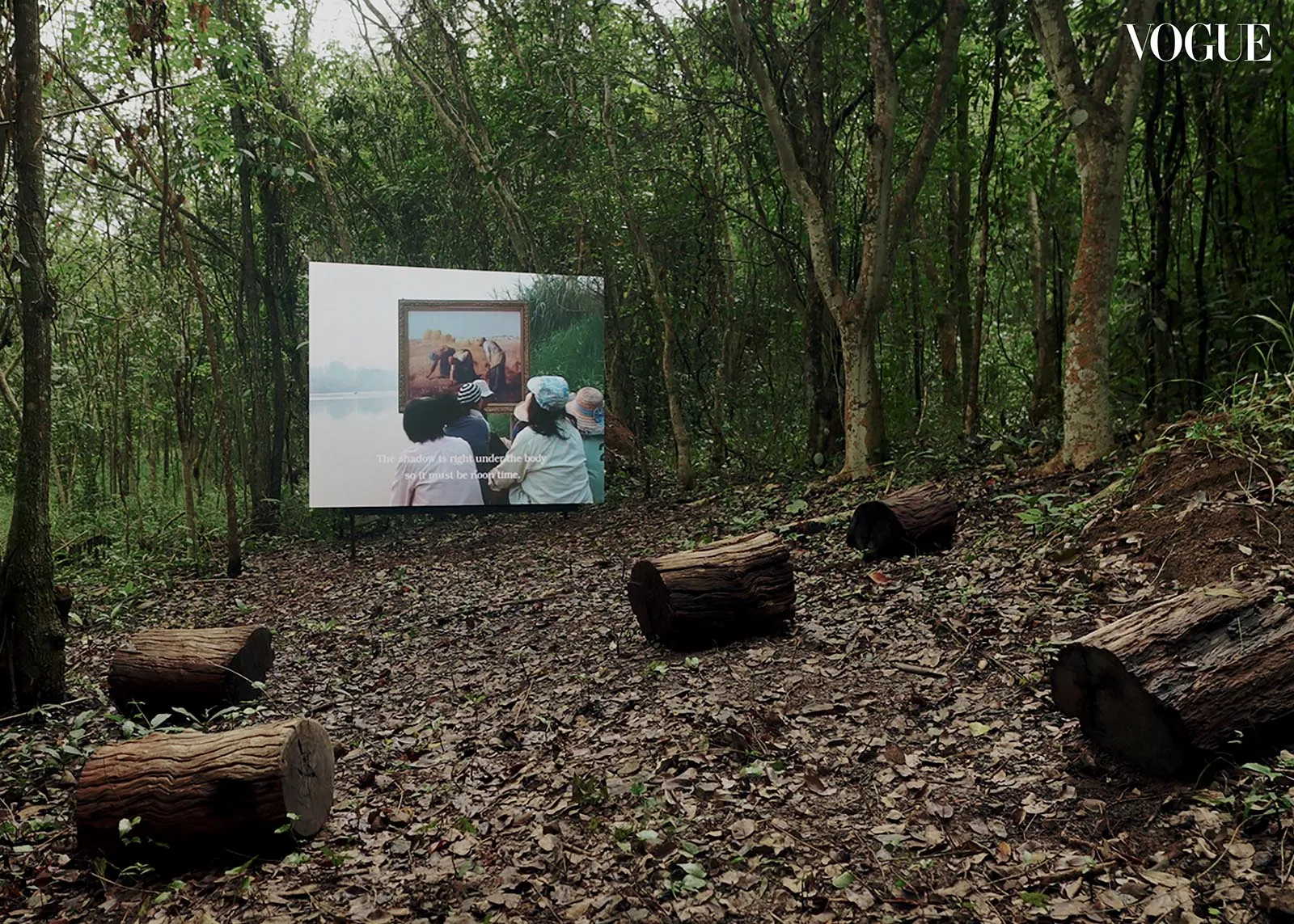
After donning wellington boots provided onsite (the ground was red clay, damp, and soft) and sipping on herbal welcome drinks, we began our slow pilgrimage through the forest’s seven installations.
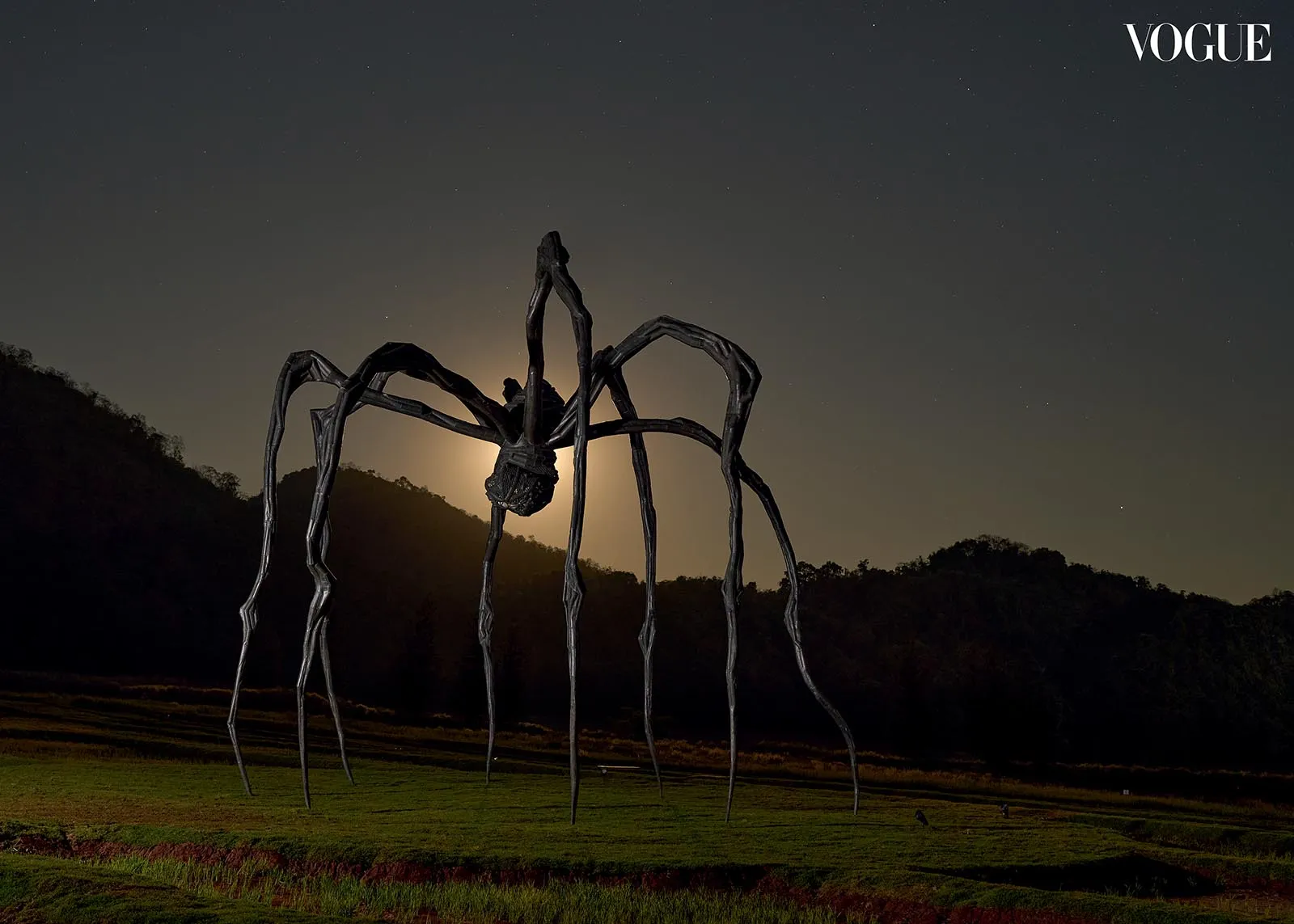
The first was Louise Bourgeois’ “Maman.” We had caught sight of her from the road. No matter how many Bourgeois spiders you’ve encountered (in Tokyo, Milan, or upstate New York), nothing quite prepares you for “Maman” in a wide open rice field. She loomed ominously in the horizon. The closer we approached, the more impressive she became, a 30-foot tall mother fiercely protecting the basket of eggs beneath her belly. You couldn’t help feeling reverent. This particular one will stand here, quiet and watchful, until mid-August 2025.
“In the dark, the fog had weight. It was not just mist, but presence. You could hardly see the person beside you. It was like standing inside a cloud. You only had yourself for company. It felt eerie, but serene.”
It was while walking back from the fields into rough roads that Khun Marisa told us about how she conceived of the art forest. “During the Covid lockdown, our family retreated to my husband’s family home nearby. All 21 of us would have breakfast, lunch, and dinner together. You can imagine how claustrophobic that can get. I would escape by going on early morning walks through the forest. And that’s when I appreciated the healing power of nature. I would bring home wildflowers. But they never survived past two days at home. It made me think that what belongs in nature should stay in its natural habitat.”
When she speaks about Khao Yao Art, Khun Marisa’s singularity of purpose reveals itself. Her certainty carries with it the quiet determination of a leader who has thought this vision through. You don’t hear a trace of ambiguity in her words, no questions arise on the sincerity of her intentions.
Artists commissioned to realize work for the forest did so by using materials and resources endemic to the area. Each work scattered throughout, whether commissioned for a particular site or not, is installed with an intuitive sensitivity to its surroundings, for visitors to encounter as if it’s just sprung from the terrain. One such piece, land artist Richard Long’s “Madrid Circle,” a perfect ring of flat slate stones made by the artist in 1988, rests quietly on a plateau. We made our way to it on golf carts as the roads rose steeper. Once we got there, its location, with its vista of surrounding hills, set it out so perfectly. It seemed natural for us to sit next to it as the sun lowered behind the trees, meditating in a circle that echoed the work. We turned inward as the light softened into the early evening.
The most compelling pieces though are those conceived by the artists after surveying the land. Elmgreen and Dragset’s K-Bar pays homage to the late German artist, Martin Kippenberger. In keeping with the artists’ penchant for absurdity, you don’t quite know what to make of this structure surrounded by foliage in the middle of nowhere. You peer into a single pane of glass to see a fully-stocked bar, shelves lined with half-drunk bottles. To the left hangs a Kippenberger painting that you can only view from an angle. No one can enter. Like a desert mirage, it is a bar only open to the imagination. It stands as incongruous as their Prada store in the middle of a deserted highway in Marfa, Texas where no consumers exist.
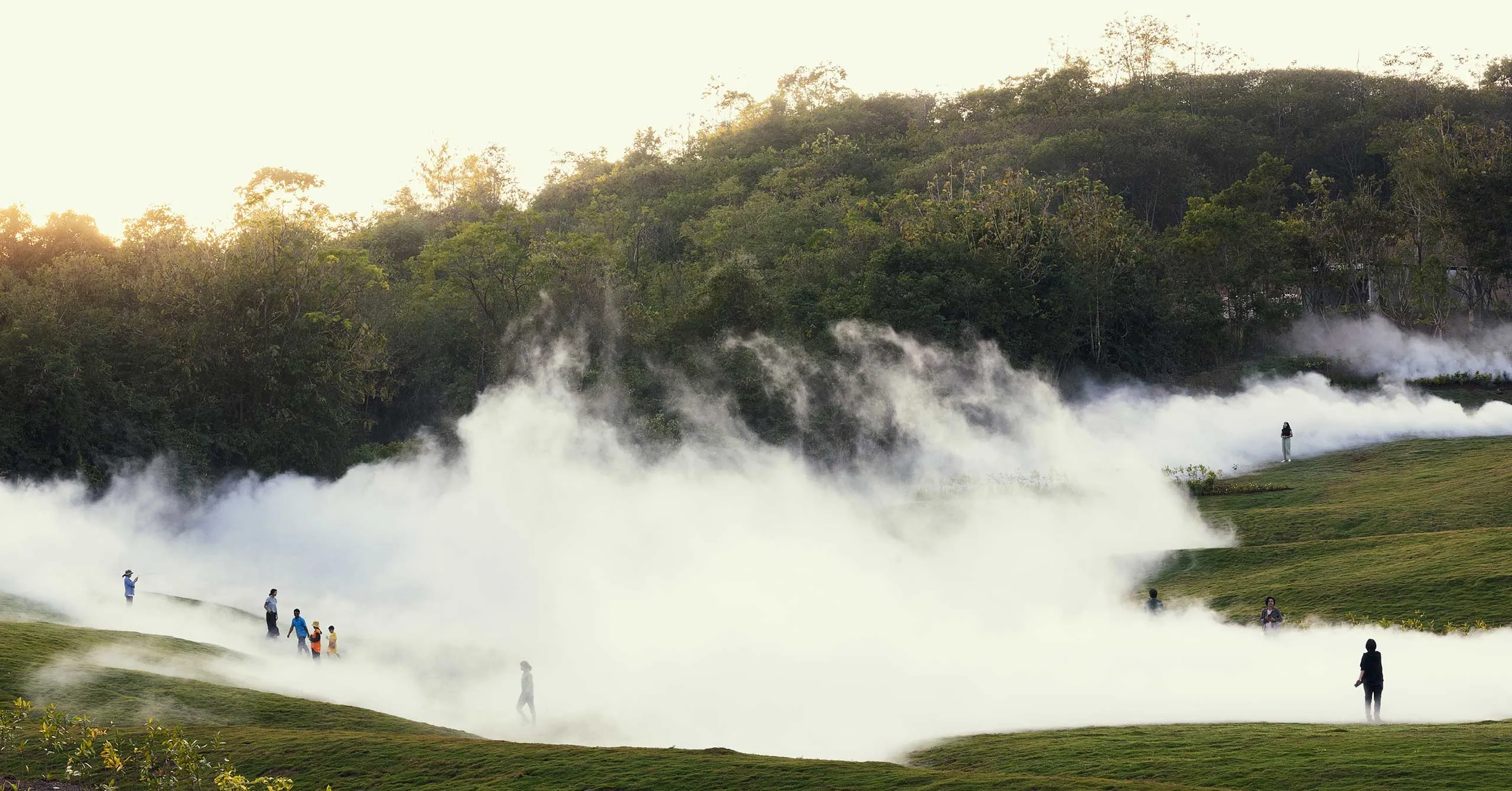
The soul of the forest, however, comes from Fujiko Nakaya, the 92-year old Japanese artist. “Khao Yai Fog Forest, Fog Land #48435” took two years from conception to realization. At first, its location looked like nothing much: a gentle rise in the land, a clearing. Then we learned that the hills were man-made, sculpted by the artist from what was originally fields of taro. She had spent time here, sat in silence, and conceived of something deceptively simple: to turn drinking water into mist. We were led there first in the middle of the afternoon, made to remove the cumbersome wellington boots, and walk barefoot on the grass.
The fog slowly began as a low hiss, a drift of smoke, a gradual shrouding of the landscape. In minutes, the clearing transformed. The hills disappeared. People became silhouettes. Sound dropped away. You couldn’t really talk, even if you wanted to. The fog wrapped itself around your ankles, your arms, your breath. Some people lay down. Others stood, eyes closed.
Later, after sunset, when we had been led to long tables set up for dinner, and given flutes of champagne, live music playing in the background, it seemed we were to finally sit down marking the end of our visit. But we were told to come follow the Khao Yai Art team once again. In the dark, we didn’t recognize the hills. We were led by candlelight, to the same spot where we were earlier in the afternoon.
The fog began again, cooling our skin, dampening our hair. Everything else: sound, color, form—fell away. In the dark, the fog had weight. It was not just mist, but presence. You could hardly see the person beside you. It was like standing inside a cloud. You only had yourself for company. It felt eerie, but serene.
On our way back, there was one final work of art before dinner: Francesco Arena’s “GOD,” a rock deity made from majestic stones quarried from the forest. It seemed apt to pay homage under the light of a full moon. Once you’ve stood in darkness, amidst the swirling fog, on a man-made hill in the middle of a Thai forest with only lanterns to guide you, you feel that something sacred has happened. And that makes you want to give thanks.
By TRICKIE LOPA. Photos courtesy of KHAO YAI ART FOREST