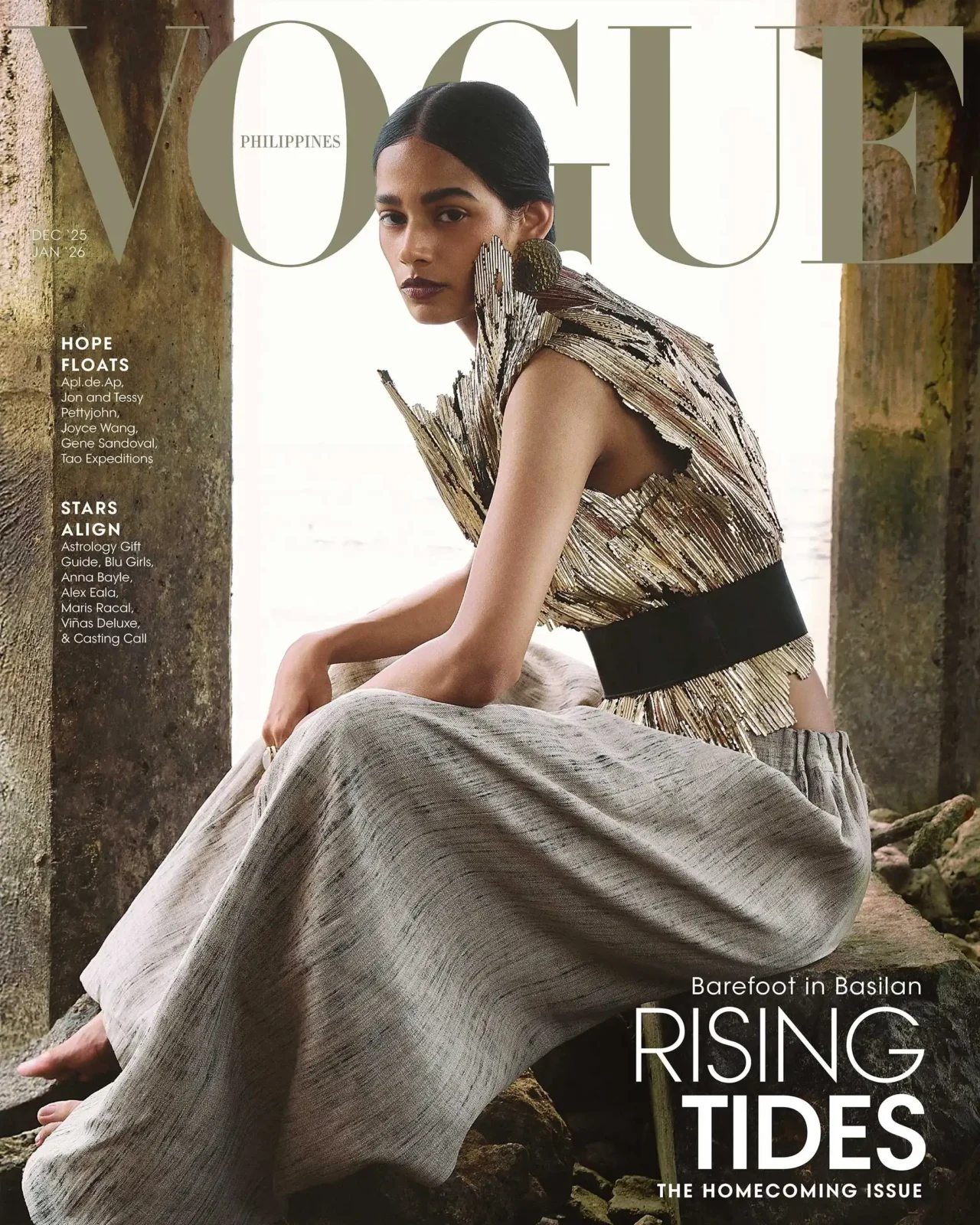
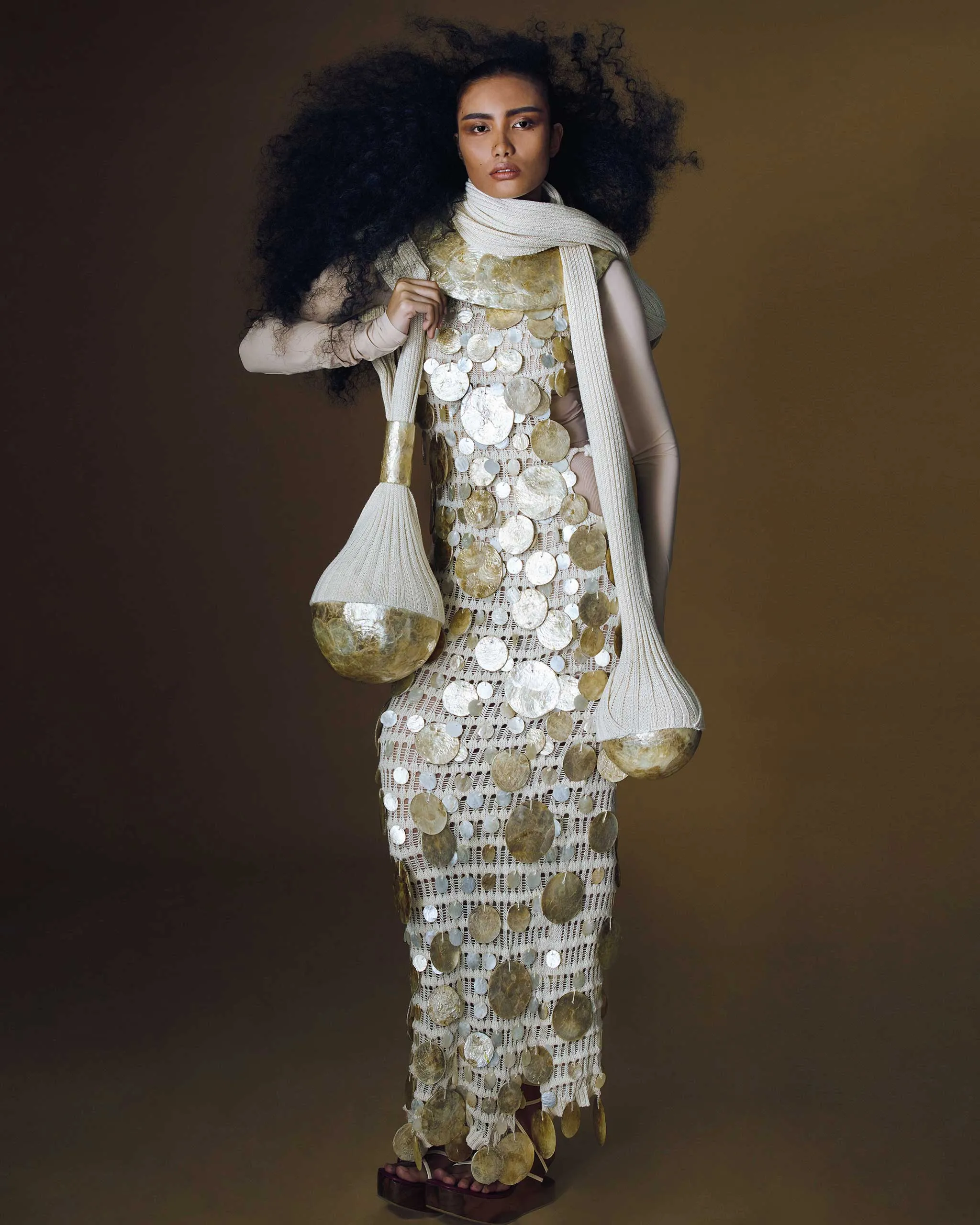
Jerome Lorico’s organic knit and mother-of-pearl dress, neckpiece, and scarf are inspired by the Sama’s salibut tatik and salibut togeng from Tawi-Tawi: throw fishnets made to catch fish from deep and shallow waters. Photographed by Mark Nicdao
Reflections from designer Jerome Lorico, one of 12 delegates chosen for the inaugural FASHIONPhilippines Milan mentorship program.
A nudge woke me up from a deep sleep that I’ve been missing for a long while. With eyes half open, I started becoming aware of the cabin flooded in an offensive shade of white light. A nice lady with a polyester scarf asked rather mechanically if I would prefer chicken or beef. I unfolded my table, asked for orange juice, and stretched my legs, excited at the opportunity to finally have the first meal in a more than 10-hour flight.
A few weeks before the flight, I was running around trying to finish a collection for an upcoming exhibition in Milan happening during the fashion week. This initiative, the FASHIONPhilippines Milan Mentorship Program 2025 was conceived by Tetta Ortiz Matera of LIT Fashion Consultancy and Sara Sozzani Maino of Fondazione Sozzani in collaboration with The Department of Trade and Industry (DTI) through The Center for International Trade Expositions and Missions (CITEM), and The Philippine Fashion Coalition (PFC). With the mission to educate, expose, and inspire Filipino creatives, the program featured 11 Filipino designers and their brands who underwent an immersive mentorship experience with key people from the international fashion industry. Delving into important and relevant topics such as design direction, buying, marketing, image curation, and sales and showroom management, the designers were also given the chance to present their portfolios and collections to experience a personal dialogue with the chosen mentors to elevate the potential of their brands.
In between stitching and draping were meetings, phone calls, and dozens of emails to offices both private and public in the hopes of finding support for the project. Written in fine print on the application, I knew early on that if I would be selected for the program, I would have to gather my own resources to afford making a new collection, book my tickets and accommodations, and my living allowances.
More than ten years ago, I had the same experience when I did an exhibition for London Fashion Week through a project called International Fashion Showcase. It was the first of its kind at the time, when the industry was just waking up to the idea of welcoming global talents, sustainable fashion, and diversity of points of view. It was a very difficult time; as a delegate, I had to shoulder everything, including the shipping of the mannequins, display materials, and the collection that I was presenting. But help, as they say, always comes for those who are brave. Fortunately, sponsorships came in just in time to help us. But we still had to cut the costs. I remember how my friend and I decided to wear some pieces of the collection so we didn’t have to pay for extra luggage. Or how we partly survived by eating plain sugar-coated Tesco donuts that we hoarded for 10p a piece. But in spite of these, we managed to meet the right people and experience the real magic of a fashion week.
It’s always a huge honor and responsibility to represent the country and our local fashion industry on an international platform. When I received the word that I was selected by the Italian mentors, it wasn’t just excitement, but also a bit of anxiety that I felt. I knew I had to start racing against time to make sure everything was ready before the flight.
During the first meeting of the designers and the organisers, I was still having doubts as to whether I was going to be able to join the delegation. Until I realized again that opportunities such as this don’t come often, and that this was a chance for our industry to finally have a seat at the table of a global industry that is usually selective and very competitive.
“Dreams can be expensive, and this is a reality that is oftentimes left unmentioned.”
For me, Milan is not just an ordinary place, but one of the most important in terms of fashion and design. This hallowed Italian city gave birth to brands that other designers imitate or use as a template in terms of taste and quality. For this reason, I believe that to represent our creative and design industry means getting out of my comfort zone and tunnel vision, to examine how our industry can find parallel points in what they do in Milan and what I create.
The strength of one’s point of view takes years to hone. And how much you can stay true to that point of view takes an even longer time to develop. Going out into the world to showcase something and learn doesn’t just require the ability to be receptive, but also the challenge to edit and take in just enough to maintain what keeps you distinctive. Some designers and fashion institutions in our country operate on a different wavelength; it may easily be seen as niche and insular. For someone who was given a few opportunities to observe and experience fashion communities abroad, it is a bit difficult for me to not agree with their analysis. But each industry is tailored to the needs and the demands of its own unique market.
For a long time, part of my job as a Filipino designer was to try to understand what the Philippine fashion market is about: how it operates, how it behaves, and how it takes in and digests creativity and trends. It is easy to give in and follow what the market wants, but oftentimes I ask myself if our market is even aware of what it really needs. At times, I am under the impression that it is just a blind follower of a culture that is not even ours. I realized that working in this industry requires a bit of compromise. At the end of the day, the lifeblood of a local fashion brand depends on how many gowns, suits, or trousers you can make for every event there is. How I envy younger designers, those who are just discovering their creative prowess and learning their language. They are raw and untainted, able to give away more and express with a sense of affirmation and conviction without the pressure of business and commerce.
As I sat next to the first mentor during the one-on-one sessions, I instantly had this overwhelming feeling of being inadequate. Years of adapting in an industry churning out the usual pieces for special events gave me a feeling of being out of touch and fatigued. In an industry that requires you to be different but punishes you for the same thing, having to create a collection to present to an international group of people feels like being doused with cold water. It was a shock that I needed and was missing for a long time.
Before I even took that first seat, I was still questioning if I was ready for it, or if I even deserved to be there. It was the worst time to experience an imposter syndrome, but as I had a quick look at the other designers with me, all focused and beautiful in their own ways, introducing who they are not just as brands but as people from a common origin, I saw how much importance that moment must really have, not just for us but for other creatives back in our country and our industry as a whole.
The whole process of the mentorship was fast and timed perfectly down to the last second. It felt a little militaristic; it was a challenge to shift our focus from one important topic to another because every mentor offered a different specialization. Sitting across a mentor for 30 minutes straight and then jumping immediately to the next one felt brutal but riveting. It was a cold and rainy day, but everyone felt more awake than ever. I didn’t even have the chance to touch a cup of coffee as I breezed through the first batch of mentors on my list.
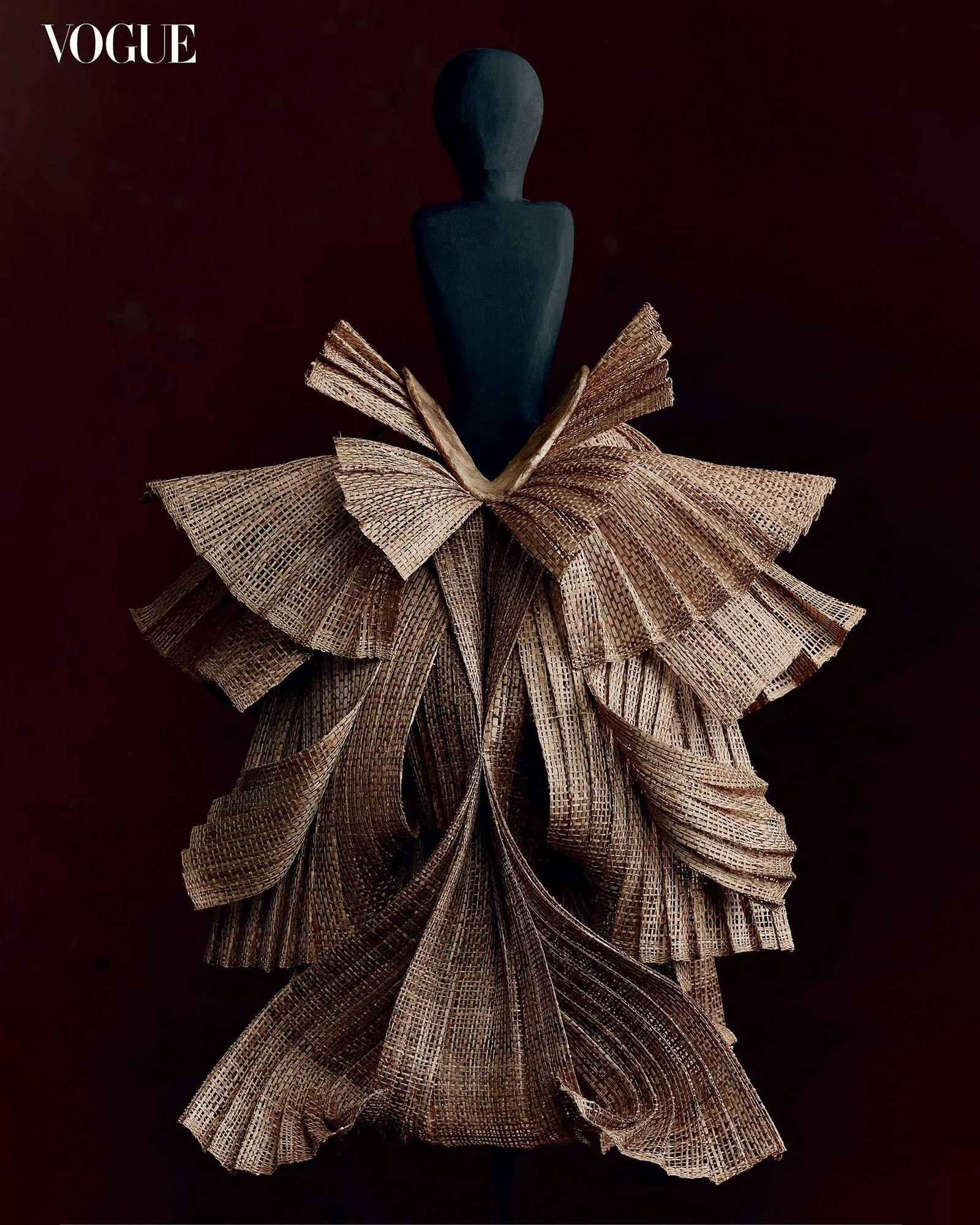
Towards the end of the mentorship, I was already sipping champagne to manage my nerves and to have the courage to introduce and tell the story of my brand to my last mentor. Feeling emboldened both by adrenaline and alcohol, my last session with Sara Sozzani Maino was honest, direct, and heartfelt. As I sat there listening, she felt more like a priestess than a mentor. Someone who’s seen the future but also understands the past.
As she excused herself to take a phone call, I had the chance to breathe and remember every word she said. Every opportunity opens just enough for one to jump in and be able to leave a mark. In an industry that is becoming more competitive every year, creatives now are challenged to step up and give more of themselves compared to before; to take advantage of everything that comes your way because some doors rarely open at all, especially for designers like us who do not come from a well-supported industry.
We ended our session with a selfie, my smile hiding how I was feeling so emotionally connected in the moment, and how I wished there was more time to talk and listen.
As the last designer and mentor wrapped up their session, everyone cheered and applauded. There was a feeling of relief, as well as the notion that as the designers were learning from the mentors, they too were learning something from us. It was a neutral space where everyone was encouraged to collaborate, not just purely about business and the industry, but more importantly on culture, heritage, and craftsmanship. It felt like a modern tribal commune with its members sitting around a fire that illuminates and heals.
Meeting people and creating a dialogue with them during the exhibition was just as informative. The interactions, more natural and spontaneous, were lessons in cultural exchange, business acumen, and a reminder on why we created our individual brands in the first place. Talking about our design processes, our diverse voices, and the stories behind every stitch, every fabric, and material was not just meant for the visitors, but also for us.
As I introduced my brand and the vision behind it for the 10th time to students and people who came up curious enough to ask, my words felt more like a reminder to myself, a chant that I needed to repeat over and over to exhume that creative part of me that I have forgotten. Standing for hours felt like nothing, as I realized how fortunate I was to be able to share something to an industry that is thousands of miles from my own.
In the Philippines, although we are rich in the design aspect, certain components are still either weak or entirely missing. An industry is supposed to be a conglomeration of different parts actively operating and activating one another. Production is still a challenge for most designers. Although studios can be efficient in producing direct-to-consumer orders, this is difficult to scale up once faced with the challenge of global retail demands. The supply chain management has always been a weak link as well. Raw materials for products are either limited or unavailable. Textile mills are only available for huge orders and generally the materials are not produced with the direction of what the fashion industry needs.
“I have always felt stronger when a purpose is beyond myself.”
It’s a good thing to note, though, that the presence of an agency such as The Philippine Textile Research Institute (PTRI) is now more open to listening to designers and the requirements of the industry, as they continue to develop new fabrics and materials that are not just backed by science and technology, but also by our rich culture, history, and heritage.
On the other hand, knowledge of retail operations is slowly developing in the Philippines. With the advent of social media coupled with natural Internet savvy Filipino designers, online platforms and e-commerce are gaining more traction every year, and our local industry is learning how to handle marketing strategies as well. In my many years of being part of the local fashion community, I have been both active and reserved, trying to balance creative expression and knowledge on business. It is not easy, especially for someone without proper training or formal education in these fields, as well as a business partner to rely on. Keeping a one-man show going and afloat amidst different challenges and the changing of tastes and trends is not for the faint of heart. But as Filipino creatives, we are used in making things happen, despite the limitations and disadvantages.
In our country, making clothes usually begins only after taking the measurements of a private client. Materials such as fabrics do not even start unrolling without a down payment. This is a form of security, especially for the majority of designers who operate on a limited scale. And for the longest time, we were doing fine. But the call of international recognition and acceptance is still a dream for everyone. How amazing would it be to see a local brand lined up among international brands that we grew up looking up to. It would be an achievement to uplift the local industry, as well as everyone who’s been part of it from the very beginning. But as giant retailer SSENSE began to unravel, and as the list of fashion brands that are affected by their crash spread like wildfire, we couldn’t help but wonder if we are ready for a storm like this.
As we were setting our eyes on the wholesale market, designers like Robert Wun shifted towards the made-to-order model, enabling his brand to focus on elevating their products while retaining control of their production. This is the complete opposite of why we were in Milan in the first place. By the looks of it, we are running away from something that is innately us, to chase something that others are trying to leave behind.
The Filipino designer is a unique creature, built by adversities, a volatile industry, and a passion to achieve great things. In the beginning of my attempts to become part of this profession, I remember how the word “fashion” solicited disapproving opinions from people that I tried asking for support from. It was a grueling process that I needed to endure, but I believe was necessary to build my grit and my ability to pursue anything I deeply believe in.
Dreams can be expensive, and this is a reality that is oftentimes left unmentioned. For this reason, dreams require constant fuel to stay alive and endure. For a designer like me, it is still a constant struggle between balancing the books, late loan payments, delivery to clients, rental, and employee welfare and needs, while still managing to come out at the end of the day in one piece. It almost feels Sisyphean, but the rock that I had to push every single day is also the reason for my being. It may sound overly philosophical, but that imaginary tension grants me the ability to be present and aware of where I am and where I am heading.
The designers who were part of the program were like a sponge that absorbed what they had to take in. Amidst our differences, we realised that we are united by a common dream and conviction. We may believe in something that still doesn’t exist, but by believing passionately in something non-existent, we eventually create it. It is about sufficiently desiring a goal while preserving our principles and what we deem as right versus what is only acceptable.
We took a couple more pictures on our run that day, practicing our limited Italian phrases while we brisk-walked, casually promising each other that we will be back.