
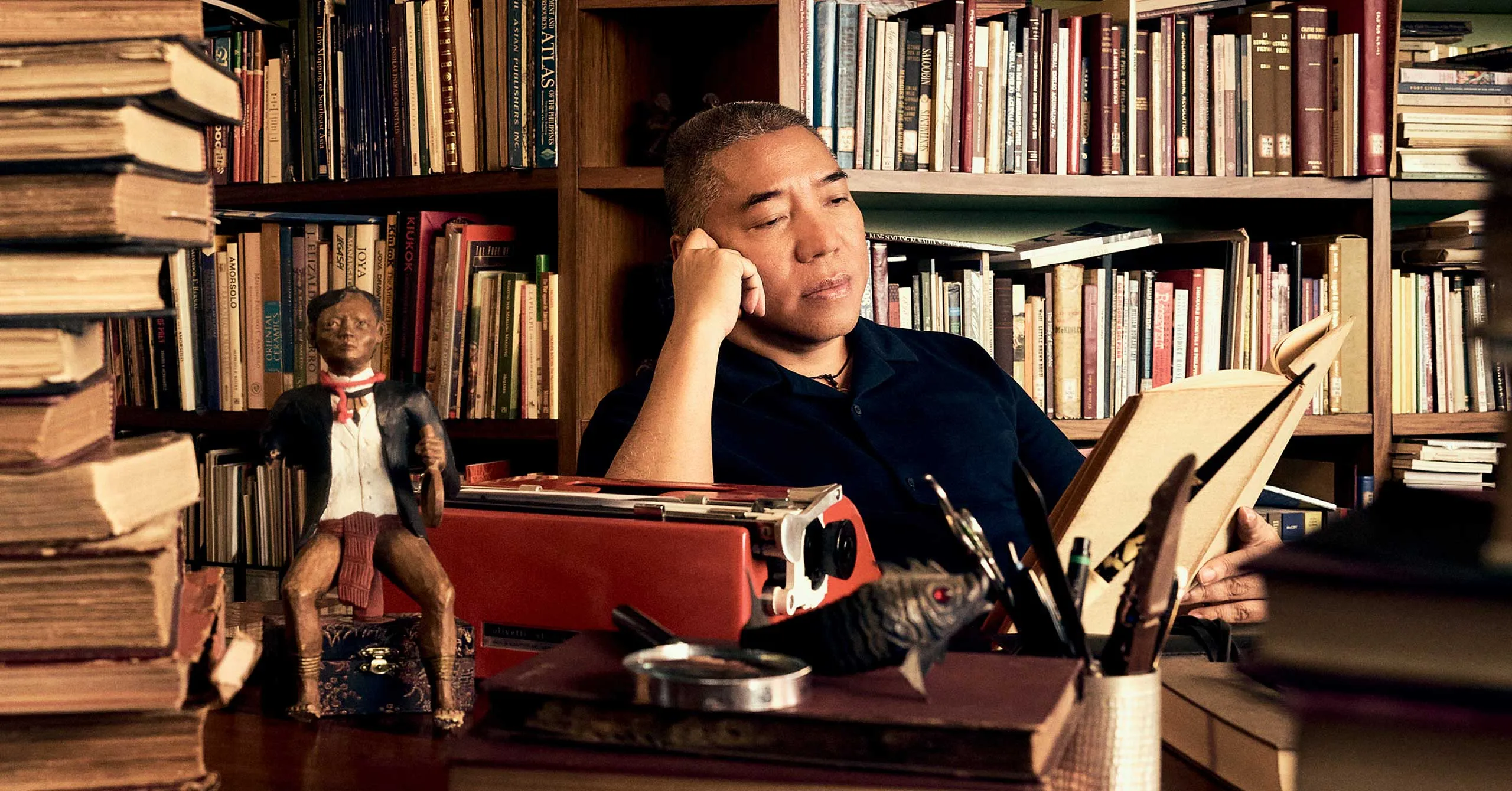
Photographed by Gabriel Nivera for the February 2026 Issue of Vogue Philippines
Photographed by Gabriel Nivera for the February 2026 Issue of Vogue Philippines
Ambeth Ocampo on how the mundane can hold stories that shape our future.
Romance, as a way of seeing, shapes more than personal relationships. It informs how people design their lives, approach their work, and remain open to the world around them. For Vogue Philippines’ Love Issue, we profile individuals, across disciplines, who live a life shaped by romance.
In the classroom, Ambeth Ocampo teaches his students to read grocery lists, receipts, diaries. These objects most people would overlook without a second thought. He asks them to linger on what appears mundane, to treat everyday records with the same seriousness reserved for monuments and dates. This is his way of easing them into a larger idea: that history lives not only in grand events, but in the texture of ordinary life.
“History found me,” he says, explaining how he arrived at this way of seeing. “I did not think, plan, or aspire to be a historian.” Instead, the path emerged slowly: “Writing for a magazine meant that I had to present Philippine history in an engaging way, different from our boring textbooks,” he explains. That necessity pushed him toward the small, human traces that reveal how people actually lived. “We know the big narrative of the past but not its details,” he explains. Those details, he believes, are where understanding begins.
Ocampo was born in Manila, grew up and studied in Quezon City, and came of age in Makati. As a child, he remembers little in the way of ambition. “I don’t remember if I had any aspirations growing up,” he says. “But I knew I didn’t want to be an engineer like my father nor an entrepreneur like my mother.” There is, however, a story told by the late National Artist Alejandro Roces, that when Ocampo was first introduced to him as a boy, he said he wanted to be a writer. “If that’s true,” Ocampo reflects, “I guess that came from growing up in a house with books, reading a lot and widely in grade school.”
Even now, as a storied historian, author, and teacher, the habits of that childhood remain visible in the way he works. His study is filled to the brim with books and art of all kinds: stacks of paper, yellowing volumes, marginalia accumulated over decades. He sits at the center of it all, a computer open, student papers piled nearby, moving easily between past and present. Ocampo has written extensively on Philippine history, most notably through his long-running newspaper column and books that return historical figures to their human scale. He spent nearly a third of his early life in the monastery, drawn to the Benedictines for their twin aims of “love of learning and the desire for God,” a period marked by silence, reading, and reflection that continues to shape his intellectual rhythm.
“‘History’ is not taught as a discipline that develops critical thinking, rather it is taught to show how the nation came to be, and how citizens should love their country.”
Advertisement
“Writing history made me realize that K–12 Araling Panlipunan or what passes for History in the early grades is actually Civics,” he reflects. “‘History’ is not taught as a discipline that develops critical thinking, rather it is taught to show how the nation came to be, and how citizens should love their country.”
When asked why he loves history, he doesn’t take a beat to answer. “I teach history so that the present will stop reading like the past,” he says, a faint smile on his face. “Talking to students and readers made me realize that my work touches lives, changes lives. That is my reward.”
By BIANCA CUSTODIO. Photographs by GABRIEL NIVERA. Beauty Editor JOYCE OREÑA. Talent: Ambeth Ocampo. Art Director: Jann Pascua. Multimedia Artists: Mcaine Carlos and France Ramos. Videographer: Angelo Tantuico. Producer: Mavi Sulangi. Hair: John Alrey of Toni&Guy. Photography Assistants: Jason B. Sevilla and Shemuel Lopez.


