
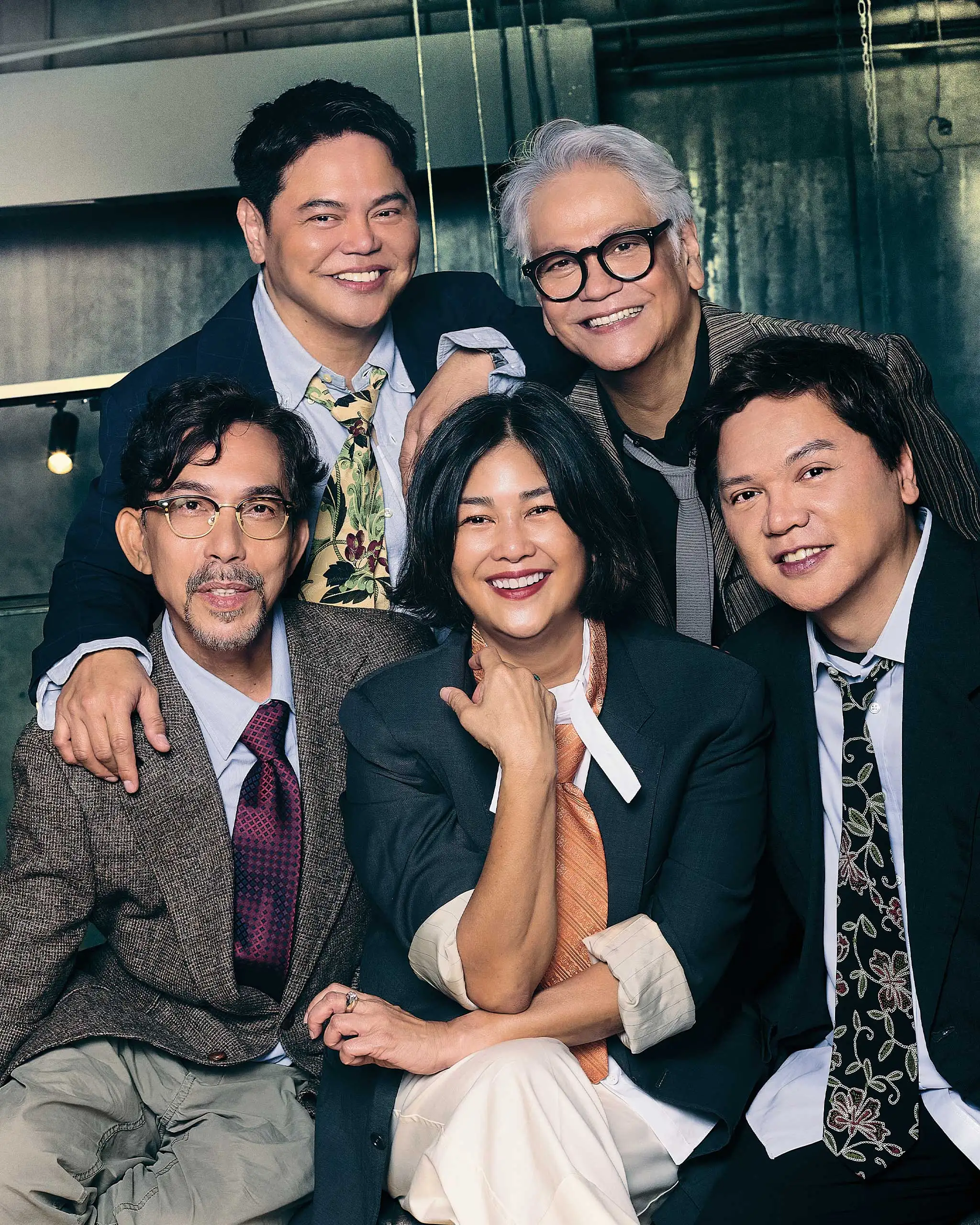
Jing wears a COS blazer and trousers and UNIQLO shirt; Ting wears an archival CHRISTIAN DIOR blazer, STEFANO RICCI necktie, and CHRISTIAN DIOR shoes; Jay wears an archival VERSACE blazer and UNIQLO shirt; Marlon wears a RALPH LAUREN shirt and STEFANO RICCI necktie; Juan wears a MARKS & SPENCER blazer and shirt and an archival CHRISTIAN DIOR necktie. Photographed by Ricky Villabona for the September 2025 Issue of Vogue Philippines
Propaganda, the first fashion and beauty collective including Juan Sarte, Cristine Duque, Jay Lozada, Marlon Rivera, and Jing Monis, reunite in front of the camera for the first time in years.
It’s a holiday morning in Manila, and upstairs at the Jing Monis salon in Makati, five pioneering figures of the Philippine creative scene are immersed in animated conversation. For their first Vogue Philippines shoot, Filipino creatives Juan Sarte, Cristine Duque, Jay Lozada, Marlon Rivera, and Jing Monis reunite in front of the camera for the first time in years. Behind the lens is photographer Ricky Villabona, inadvertently responsible for the name the team would formally adopt in the late ’90s: Propaganda.
“‘Propaganda’ was supposed to be the name of an entertainment magazine we were putting together in 1995,” Villabona explains. “The next year, Marlon Rivera told me about the plans he had with other makeup artist and hairstylist friends to put together a team for a salon. I told him he could use the name, since we did not use it for the magazine. He said, ‘Ay gusto ko yan. Pro ako sa pagpapaganda! [Oh, I love it. I’m an expert at making things beautiful!]’ I laughed.”
The name was perfectly suited, Villabona remarks. “Almost serendipitous.” Propaganda was the first fashion and beauty collective of its kind in the country, a creative structure that hadn’t existed before. The group of hair and makeup artists, hailing from diverse industries and styles, went on to dominate the Manila beauty scene throughout the ’90s and into the aughts, creating a lasting impact on the industry as we know it today.
Villabona had been a witness to the group’s early beginnings, long before the collective was even formally established. He was friends with Marlon Rivera and Juan Sarte from their days in advertising, where Sarte worked as a caster and Rivera as a creative director, producer, account manager moonlighting as a theatre costume designer and makeup artist. “Name it,” Villabona interjects, “Marlon had done it.”
In 1993, while freelancing as a copywriter for PR veteran Edd Fuentes, Villabona pitched a workaround for a beauty shoot with Melanie Marquez when the proposed budget couldn’t accommodate an established photographer. Instead, he suggested gathering younger talents for the project, including Raymund Isaac, Lita Puyat, and himself. Rivera offered to style the shoot; Sarte came on as makeup artist, a skill he allegedly had picked up out of frustration with unprepared models during castings. When they came over to review contact sheets, they brought along Jay Lozada, who they also knew from advertising. That was the first time Villabona met him.
Of the five, Lozada was then the most established as a hair and makeup artist for television commercials, a visual artist, and a talent discoverer. Cristine Duque, on the other hand, was a U.S.-based makeup artist who had returned to the Philippines in hopes of establishing a local career. Jing Monis, a trained hairdresser, had just left Roger Craig Manila for Hong Kong. He also did makeup, as artists then were often hired to do both.
It was Monis who first floated the idea to band together. He met Rivera and Sarte in retail, and Sarte collaborated with Duque in a shoot with stylist Michael Salientes, who had just returned from the States. After one meeting, all five decided to form Propaganda.
Decades later, that same familiarity still hums in the room. After a series of test shots, Villabona endearingly calls out to the group: “Come, my friends from the ’90s.” The five are asked to stand close, faces nearly pressed together. A comfortable laughter settles in between takes, the kind shared only between longtime friends.
Through the overhead speakers, pop music turned bossa nova echoes throughout the salon. Midway through, the familiar melody of George Michael’s “Freedom! ‘90” catches the team’s attention. The group perks up, humming and swaying slightly in place. Reminiscent comments about the era passed around the room. The timing felt apt.
Inspired by the January 1990 British Vogue cover by Peter Lindbergh, the song’s music video famously replaced the artist with supermodels Cindy Crawford, Linda Evangelista, Christy Turlington, Tatjana Patitz, and Naomi Campbell, marking a shift in who and what held visual power. In 1997, what’s now considered fashion’s “Big Bang” was unfolding globally. The year was marked by the rise of bold new designers, supermodels-turned-muses, and revolutionary runway shows.
At the same time in Manila, a similar energy was building throughout the decade. Young creatives began working together to tell daring new stories, stage experimental presentations, and open spaces like Homme et Femme that introduced global thinking to the local scene.
Robby Carmona, allegedly the youngest fashion show director at the time, recalls this period as a turning point for the industry, and for his own career. There was an energy like no other. “It was 1995. That was my first major fashion show, Denims and Diamonds. And that was also the birth of Propaganda,” Carmona shares. “It was such a good collaboration because they were so creative and in sync. They were the first group to actually conceptualize a distinct hair and makeup look for a fashion show.”
“It would be kind of egotistical to say Propaganda was the movement. We were as much a product of the time.”
At the time, there were no Pinterest boards to reference. “They would illustrate everything: the color palettes, the eye makeup, the lips, even the hair! I remember seeing drawings all over the wall,” he exclaims, wide-eyed at the memory. “Can you imagine? Pre-internet. We didn’t know what was happening in other fashion capitals, so we wouldn’t know the trends until it comes out six months later. Imagine the creativity of Propaganda in creating those looks from scratch. You really have to use your own imagination!”
“Of course, we had magazines. Back then, those were really our only references,” he adds. “That’s why we’d get so excited whenever we got our hands on a copy of Vogue. It was our holy grail!” Carmona recalls returning from trips with luggage filled to the brim with magazines.
In the ’90s, western fashion was changing, and Manila witnessed it all through print. Every month, as the next issue arrived, magazines were pored over from cover to cover, trends distilled on the glorious glossy pages of local and international titles or in beauty books by Kevyn Aucoin. Before the group formed, each member of Propaganda was an avid consumer of fashion in print. Access to trends and information was not free, and the other cost was excitement without an outlet for application. So much was happening, and quick: jeans on the cover of Vogue, couture colliding with street, casual meeting minimal, grunge fading. On the beauty front, hair loosened, brows thinned, jewel tones faded into neutrals.
An array of new products sprawled across pages, most if not all of which weren’t yet available locally. Travel then, Carmona adds, was how the Propaganda team sourced makeup: “You really had to be resourceful in the ’90s to create those looks.” Before the age of online shopping and international products were available locally, the team would fly to Hong Kong to stock up on products.
Despite the limitations of the era, or perhaps because of them, Propaganda managed to set a new standard for local fashion productions. “It wasn’t just work. It was fun,” says Carmona. “They really understood each other. The execution was always seamless.”
The scene was shifting in real time, and the team was in a unique position. Propaganda intersected with many groups who were also raring to ride the wave of ‘90s change. Rising photographers like Villabona and Ronnie Salvacion were friends of the group; nights out at the Giraffe bar meant mingling with editors and models. A new crop of faces for editorials and commercials, including Christina Garcia, Joey Mead-King, Wilma Doesnt, Jo Ann Bitagcol, Teresa Herrera, Angel Aquino, to name a few, became regular collaborators. Fashion designer Rajo Laurel tapped Propaganda for his first fashion show, and editors would approach the group for trends and opinions on beauty. They guest-starred on TV programs, judged beauty competitions, did celebrity makeovers, and applied hair and makeup to models in low-lit bathrooms for fashion shows held in malls and nightclubs.
As global beauty brands became more accessible, Propaganda members became the first local brand ambassadors; Duque for Chanel, Rivera for Estée Lauder, Lozada for Guerlain, and Sarte for Dior. Working with Carmona, they also ushered in the launch of Make Up For Ever in Manila. Soon, celebrities were requesting Propaganda for shoots, and glam teams were born.
As opposed to the perception in the ’80s, being a beautician was now cool, and a career worth pursuing. Their influence reached beyond Manila. The team worked on shows and musicals in Brunei and joined campaigns in Hong Kong and Australia. New artists gravitated toward them: Peddy Acebo, Lowel Buenaventura, Rudy Adriatico, RS Francisco for Rama at Sita. The next wave of Propaganda talents emerged in Lala Flores, Ricci Chan, Chechel Joson, Nina Ricci Alagao, and more. Their final major collaboration brought them together with hairdresser and salon owner Alex Carbonel to open Propaganda Salon, a space that drew younger clients, corporate heads, society figures, and readers who had discovered them in magazines. For proms and weddings, who your beauty team was became as much of a flex as who designed the gown. Fresh graduates began coming in to ask the team how to become makeup artists.
“It would be kind of egotistical to say Propaganda was the movement,” Rivera laughs. “We were as much a product of the time.”
To the band of five, they weren’t doing anything radical. They simply carved out a new space. United by a shared passion for beauty and fashion, but drawing from diverse industries and aesthetics, the Propaganda team paved a way for new collaborative configurations.
Suddenly, the hair and makeup artist shifted from behind-the-scenes service to frontrunners of the creative team, having clear and forward-facing vision, and at times leading the charge.
Suddenly, Rivera narrates, the salon became a place where photographers, models, and editors mingled with regular clients. Suddenly, the “beautician” (as they would call themselves to reclaim a dismissive label) stood as creative peers. Propaganda was everywhere all at once.
See more of this story in the Anniversary Issue of Vogue Philippines, available at the link below.
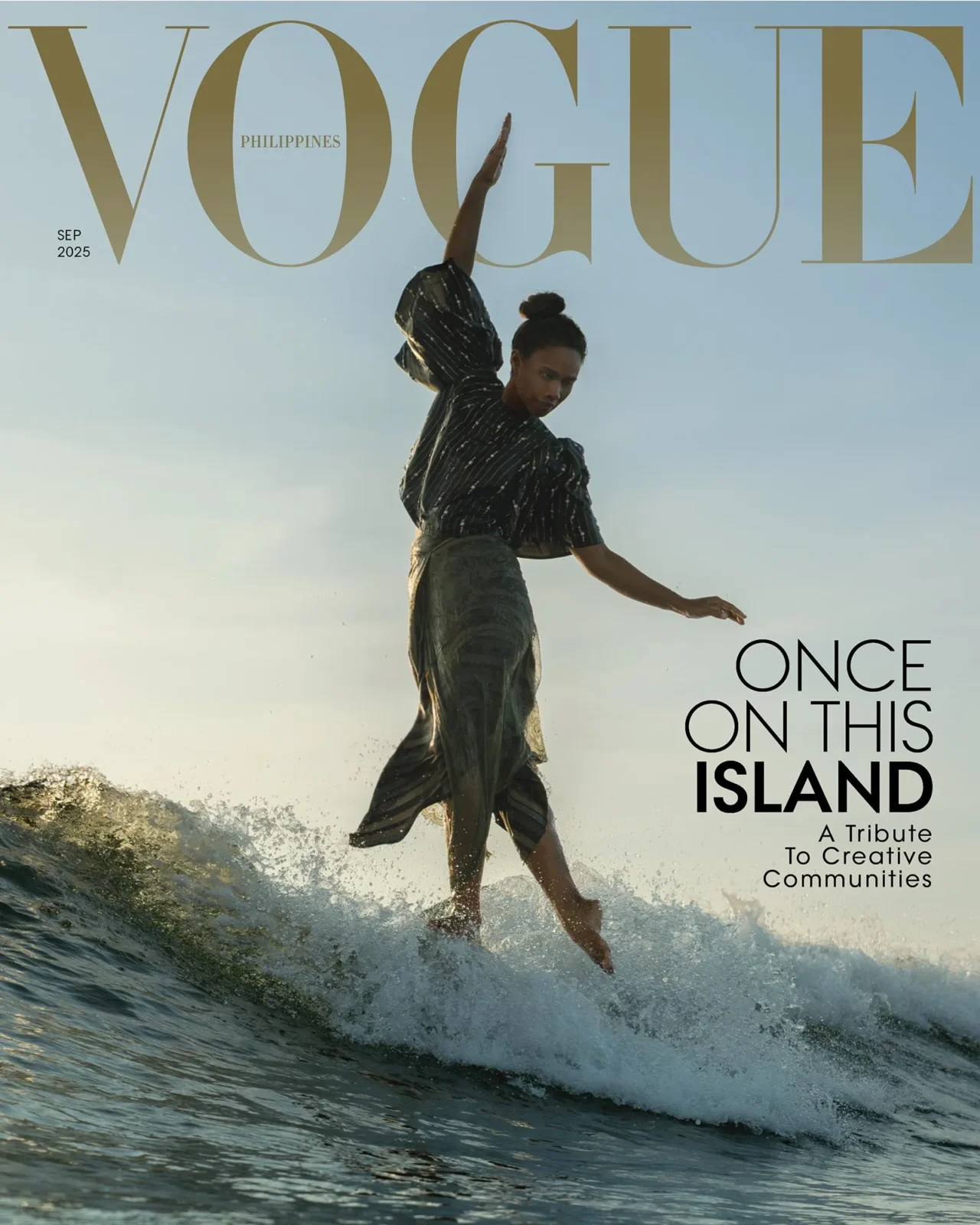
By BIANCA CUSTODIO and MARLON RIVERA. Photographs by RICKY VILLABONA. Talents: Jay Lozada, Jing Monis, Juan Sarte, Marlon Rivera, and Cristine Duque. Styling: Renée de Guzman. Hair &Makeup: Dollie Verniz and Barceliza Gimeno of J/Monis Salon. Deputy Editor: Pam Quiñones. Fashion Editor: David Milan. Beauty Editor: Joyce Oreña. Media Channels Editor: Anz Hizon. Art Director: Jann Pascua. Fashion Associate and Stylist: Neil de Guzman. Producer: Julian Rodriguez. Vogue Man Writer: Gabriel Yap. Media Channels Producer: Angelo Tantuico. Multimedia Artist: Mcaine Carlos. Photography Assistant: Jason Tan.
Shot on location at J/Monis Salon.
- Four Pioneers of Philippine Fashion Image-Making Look Back on an Era They Helped Define
- Over 200 Filipino Creatives, Spread Across Decades of Behind-the-Scenes Work, Unite to Share the Frame
- The Members of Aktor PH Take On Their Most Meaningful Role Yet
- The Mahal Kita Crue Is Building a Home for Filipino Creativity in Copenhagen


