
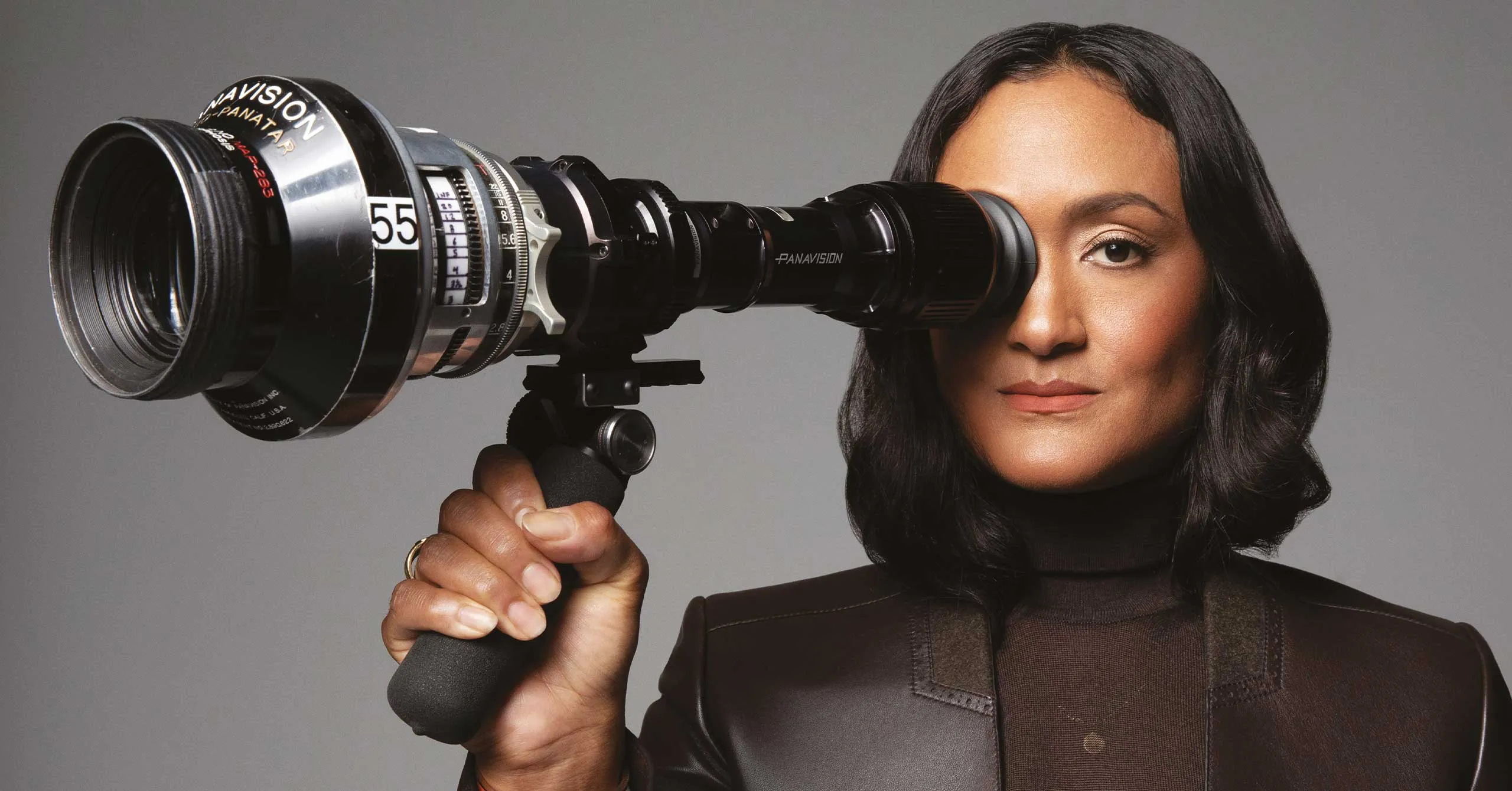
HERMÈS jacket, turtleneck, and leggings, MICHAEL KORS COLLECTION boots, talent’s own jewelry and watch. Photographed by ROMER PEDRON for the October 2025 Issue of Vogue Philippines
Photographed by ROMER PEDRON for the October 2025 Issue of Vogue Philippines
Cinematographer Autumn Durald Arkapaw reflects on her beginnings in independent film, her long-term collaborations, and how she is expanding the audience’s vision.
It’s June. Autumn Durald Arkapaw is on the set of a commercial shoot in Kansas City. The weather is sweltering, the meetings are never ending. But she is quiet and cool. Today’s schedule is relatively loose compared to a year ago, when she was on the set of Sinners with Ryan Coogler and hundreds of other crew members, shooting Michael B. Jordan and Hailee Steinfeld. Or four years ago, when she was on set for the first time with Coogler, filming Letitia Wright, Lupita Ngyong’o, and Angela Bassett on Black Panther: Wakanda Forever. As winter grows closer, the work will undoubtedly pick up again.
The average person might not always know what a cinematographer does, but they’ve likely seen Durald Arkapaw’s work. Whether seen on the big screen or on TikTok, Durald Arkapaw has been responsible for some of the year’s most indelible images and cinematic moments, especially after lensing Sinners. Initially downplayed by trade publications in the US, the film went on to gross USD366 million worldwide, the rare original genre film to earn both critical and commercial success. Now one of this year’s best films and one of the year’s biggest Oscar contenders, Sinners has also pushed Durald Arkapaw’s name into the mainstream.
Her path to becoming one of the most talked-about cinematographers wasn’t straightforward. She hadn’t envisioned a life in filmmaking at all, even if her fascination with images could be traced back to childhood. “I grew up taking pictures and making little films in iMovie,” she says. Convinced these connections to images were tied to larger interests in art, she majored in art history at Loyola Marymount University. Though she took photography classes, learned how to develop film and use a printing machine, she was convinced she’d work at a gallery in New York, helping a curator.
A life in film only came into view after a genre film course in LMU changed her life. Watching Broadway Danny Rose and Raging Bull on the big screen “just opened my mind up to film in a new way,” says Durald Arkapaw. “I got excited and I wanted to know how they were made, and who was behind the camera, and what their job meant.”
The transition from art history major to cinematographer wasn’t instant. She didn’t have friends or family in film, nor was she close to anyone working in the industry. After graduating from LMU, Durald Arkapaw worked for three years at AOL-Time Warner, first as a temp inputting used car information into an online system for dealerships then working on ad space presentations for sales of ads online. The money was good. The people were great. The corporate world sharpened skills that would later transfer to work on set. But life behind a desk just wasn’t a life in the arts. She knew this was only a detour.
Nights and weekends were spent looking up film schools. She told her mother, who is a Filipina, that if she got in, she’d use her own savings, maybe even take out a loan, to become a cinematographer. Looking back, her parents’ supportiveness gave her the courage to take the leap. “It sounds crazy now because there weren’t as many female cinematographers [at that time]. My parents didn’t even know what a cinematographer was,” she says, laughing. “I’m about to quit a good job, go to film school instead and end up owing the government lots of money?” In 2007, she was accepted into AFI Conservatory’s cinematography program.
“My parents didn’t even know what a cinematographer was… I’m about to quit a good job, go to film school instead and end up owing the government lots of money?”
Durald Arkapaw’s time at AFI introduced her to some of her longest and most important collaborators. In summer between her first and second year, she shot Rafael Palacio Illingworth’s Macho (2009), a mumblecore dramedy about the crumbling relationship of a long-distance couple. Made in around 18 days and shot on 35mm, it won Best Micro-Budget Film at Raindance in 2010. “It was one of the most enlightening and rewarding experiences I could have ever had to make a first film,” she says. “I’m glad I was able to make my first film with my best friends.”
Shortly after graduating, a classmate introduced her to writer-director Gia Coppola, who met with her after needing a camera test shot. The two became fast friends and collaborators, first working on a series of fashion films together with their friends. “Sometimes, we shot at her house or down the street or in the streets of Hollywood. We’d run around with the camera, finding shots, and having fun,” she says. “There’s a real comfort in exploring and discovering your voice with people who are also your friends beyond work.” This looseness and comfort has defined their collaboration, fooling even seasoned film critic Peter DeBruge into thinking a sequence in Coppola’s debut Palo Alto was filmed using Steadicam. Durald Arkapaw later lensed two more of Coppola’s feature projects, including the Golden Globe-nominated Pamela Anderson-starrer The Last Showgirl.
Though Durald Arkapaw was included in Variety and IndieWire lists of cinematographers to watch out for, she only felt like she made it later on in her career. First: when she booked The Sun is Also A Star, the YA romance adaptation starring Charles Melton and Yara Shahidi backed by Warner Bros. Pictures and Metro-Goldwyn-Mayer Pictures. “We got to shoot at the Natural History Museum and in the streets of Manhattan… Everyone gathered around in the streets, watching as I shot the film,” she says. “It wasn’t a huge production, but in that moment I felt truly accomplished.”
Second: when she booked the first season of Loki. “Tom Hiddleston, who’s amazing, was so in support of the director Kate Herron’s concept: to open up the world and make it something fresh and new,” says Durald Arkapaw. Working with production designer Kasra Farahani, she was able to incorporate lighting into “elaborate ceilings” and use frosted incandescent ceiling lights as key lights. Shot on a Sony Venice with Panavision T-series anamorphic lenses, Loki is regarded by many as one of the best-looking works within the Marvel Cinematic Universe. “It’s important when you get your first big studio production, you now have to answer to an important group of people, and you don’t want to mess that up.”
It wasn’t the last time she’d work within the MCU. When Black Panther cinematographer Rachel Morrison couldn’t return for the sequel, she recommended Arkapaw to Ryan Coogler, who had known of her since 2014 after Selma cinematographer Bradford Young vouched for her work to be considered to lens Creed. A decade and two projects later, she describes Coogler as “one of the most inspiring people that I’ve ever been around, and that many people I know have ever been around.”
The night before her first day on The Last Showgirl, Coogler sent Durald Arkapaw the script for Sinners. On paper, the two films couldn’t be more different: the former found a glamorous performer wrestling with her future after their show closes down, the latter focused on twin World War I veterans returning to the Clarksdale in the hopes of a fresh start, only for their juke joint dreams to be dashed by a malevolent force. But beyond these genre divides, there are clear parallels between the two in how they interrogate displacement, heritage, and family, themes that recur within Durald Arkapaw’s work. “I knew that going to New Orleans to stand next to him, to make this movie, even though I hadn’t known yet how successful it would be, that he was going to take care of us,” she says. “I knew that he was going to take care of my time and make it a worthy experience. That’s how he is.”
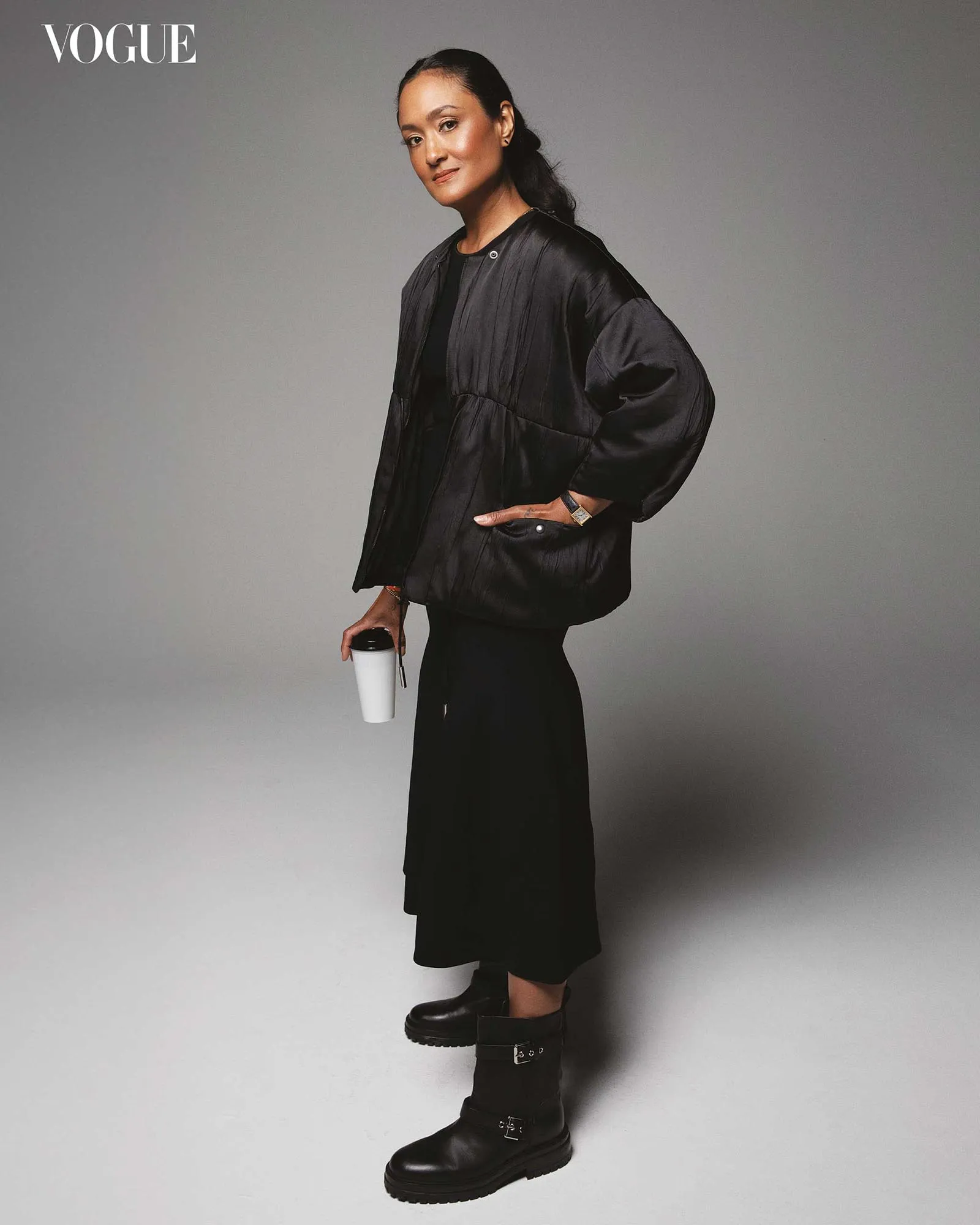
Motherhood changed how Durald Arkapaw approaches cinematography, at least on a practical level. She regularly works on commercials and music videos on top of her film work because these short stints allow her to be with her family, especially her nine-year-old son Aedan. Big-budget projects like Black Panther: Wakanda Forever and Sinners require anything from six months to even a year. “Those were probably the two times as a mother I had to leave the longest. It does weigh on me,” she says. “But when I work with him [Coogler], I feel very confident that it’s going to be important for my family… It makes a difference to me that my son will one day see these and he’ll know that they were made to inspire him. I want him to be proud of his mom.”
Sinners is the first film of its kind to “incorporate 65mm in its widest aspect ratio, Anamorphic Ultra Panavision 70, and tallest aspect ratio, IMAX format, within the same production,” making her the first female director of photography to shoot 65mm in IMAX format and the first and only cinematographer to shoot in IMAX 15-perf film format using KODAK EKTACHROME film stock, which was specifically manufactured for this production. As media critic and filmmaker Thomas Flight already extensively details, only 10 films have been made entirely using Ultra Panavision 70, including the epics Ben-Hur and The Hateful Eight. The combination of these formats recalls old 1930s photographs of the American rural South, fusing technology from the past and the present and mimicking the film’s narrative conceit even in its form. In doing so, they incorporate the historical environment that grounds the film without sacrificing the intimacy and feeling of the time, even for the untrained eye.
It’s absurd to think that this love for the anamorphic format and dreamlike celluloid landscapes has led to this milestone. Durald Arkapaw thanks her mother for providing her with her foundations by showing her films like Manhattan and The Last Emperor early on. “The imagery was grand and larger than life, a cinematic world that felt aspirational,” says Durald Arkapaw. “I’d been to New York before, but I’d never seen it look like that, and that’s when I connected most with the anamorphic format.” Later on, when she became a cinematographer, she looked up what lenses and formats her favorite films were shot on and would see that most of them were shot on anamorphic.
Surprisingly, her commercial work has also been formative in developing her sensibilities as “an emotional shooter.” From her work with director Kahlil Joseph in London and Barcelona shooting a commercial with Neymar and Wilshere for Nike FC to her shoots in Haiti during carnivale for Arcade Fire’s “Porno” music video, such cultural immersions have built her taste and challenged her to discover new ways of connecting people through images.
“You travel all over the world. You see the light in different places, experience different cultures, cuisines, sunsets, languages, skin tones… I pay attention to all of that, and that has informed not only my movie work, but everything that I do,” she says. “I care deeply about connecting with people and different cultures, and that’s what good filmmaking is really about. When the images move you emotionally, you stop feeling like you’re just watching a film.”
This intentionality with the camera, built over years of paying attention to a plethora of lives and experiences, is what sets her apart as an artist. From “the incredible long-take that defines Sinners” to B-rolls of a woman on a porch braiding a little girl’s hair, she makes deliberate choices to use film as a way to connect people to their histories and each other. “I want to do work that people can relate to and they also feel connected to. I found the best partner in Ryan because that’s so important to him. He’s a filmmaker who keeps everyone in mind when he’s making a film. And that’s very rare,” she says. “Not only is he thinking about what he likes himself, but he’s thinking about the audiences watching it; the little kid or the older man and grandmother in the theater. He’s just one of the most caring individuals in an industry that can tend to be very self-centered.”
“We know there will be black and brown girls and boys who see themselves in us, looking for inspiration.”
Save for maybe one quick commercial stint, Durald Arkapaw hadn’t been back to New Orleans since Hurricane Katrina ravaged her grandparents’ home. Working on Sinners became a way to reacquaint herself with her father’s side of the family and her Creole roots. “I was able to hang out with my aunties and my cousins. They came to set. Ryan put my auntie in the film. She’s in the grocery store scene,” she recalls. “I started talking to her about my great grandmother who was born in Mississippi. I learned new things about my family I hadn’t previously taken the time to explore. He gave me that opportunity. Not only is he giving me a job to shoot this amazing movie, it allowed me to connect with my relatives and my heritage in a new way.”
At one point, Durald Arkapaw felt like she was looking into the past while filming. Coogler was aware that she had a passion for Westerns. Her father loved Westerns and even named her after John Ford’s 1964 epic Cheyenne Autumn. When she read the sequence of Choctaw vampire hunters wrangling the Irish-immigrant vampire Remmick, a thrill ran through her. “Hannah built an amazing farmhouse on this piece of land and we angled it properly so we could get the sun setting behind it. The horses were there. The Choctaw were there. It was a very special day,” she says. When the shoot concluded, they took a black-and-white photo with her, Ryan and the Choctaw on the porch. “We took that picture, and I swear it felt like looking into the past, as if I had already lived beyond the movie and my entire life. It was as though I was meant to be there, and the moment had found me.”
During her earlier years at AFI, she wondered if she was going to make it. “I started looking up who shot the films that I appreciated and I didn’t find a woman cinematographer,” she says. Pouring through her favorite films, she discovered Blow was lensed by Ellen Kuras, who is now a friend. It gave her hope. “At that moment, there was this young girl searching for someone she could relate to. It took me a second, but I found her.” Since Sinners premiered, she’s been flooded with messages from young girls who dream of becoming a cinematographer and even shooting on IMAX, and she can’t help but feel emotional.
One would think that being behind-the-camera has made her averse to such attention. But she’s always strived to channel her upbringing on set. Hopping in front of the camera to talk with Coogler about the work is merely an extension of this ethos. “There aren’t many people who look like Ryan or me making films at this level with such reach to wide audiences, and we take that responsibility very seriously,” she says. “We know there will be black and brown girls and boys who see themselves in us, looking for inspiration. If we approach our work with care, it can help light the way for someone else’s journey, and to me, that’s truly beautiful.”
See more exclusive photographs from this story in the October 2025 Issue of Vogue Philippines, available at the link below.
By JASON TAN LIWAG. Photographs by ROMER PEDRON. Styling by EJ BRIONES. Makeup: Reginald Raphael. Hair: Pavy Olivarez. Deputy Editor: Pam Quiñones. Features Editor: Audrey Carpio. Producer: Laresheya Roberson. Vogue Producer: Bianca Zaragoza. Production Assistants: Tene Closson Prager, Rian Finney, Astrid Rosero Curet, and Jasmine Rezk. Assistant to Autumn: Alan Certeza. Catering: Tyrisha Johnson at The Honey Coco. Studio: AGP West, courtesy of Alexey Galetskiy, Ivan Shentalinskiy-Feklenko. Special thanks to Panavision.


