
A Tribute to Brenda Fajardo: The Artist, Teacher, and Cultural Worker Who Dreamt With Her Eyes Open


Photographed by Sela Gonzales for the February 2026 Issue of Vogue Philippines
Like the archetypes she painted, Brenda Fajardo lived between interconnected worlds.
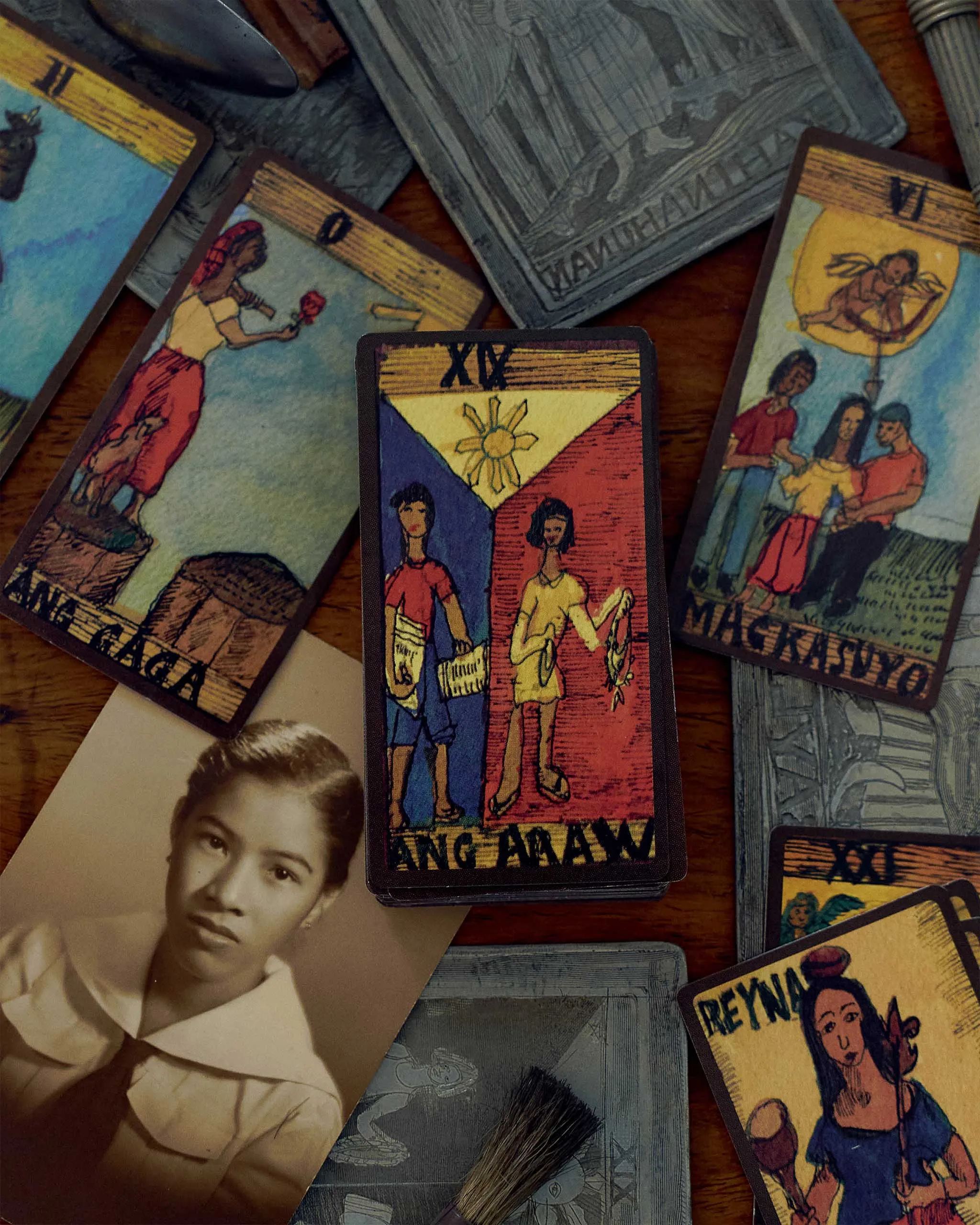
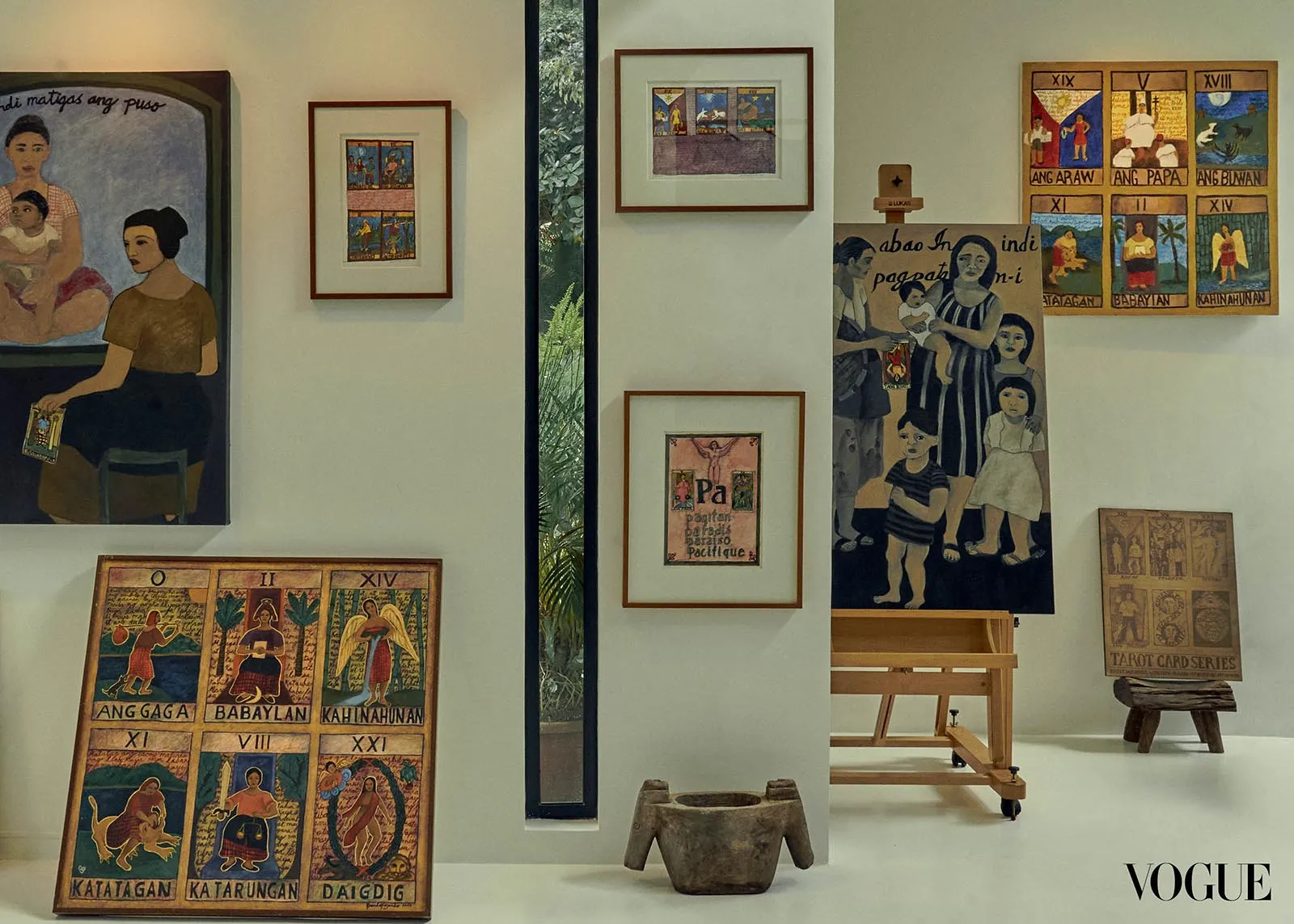
Brenda Fajardo liked to call herself the Gaga, the Fool. Her most celebrated work drew from the archetypes of the Tarot deck reimagined through a Filipino lens. Across the numerous paintings of her Tarot Series, the Gaga appears time and again in baro’t saya with a dog playfully nipping at her heels, an affectionate nod to Fajardo’s love for her pets. The Tarot sees the Fool as the free-spirited traveler, ever the optimist, ready for adventure.
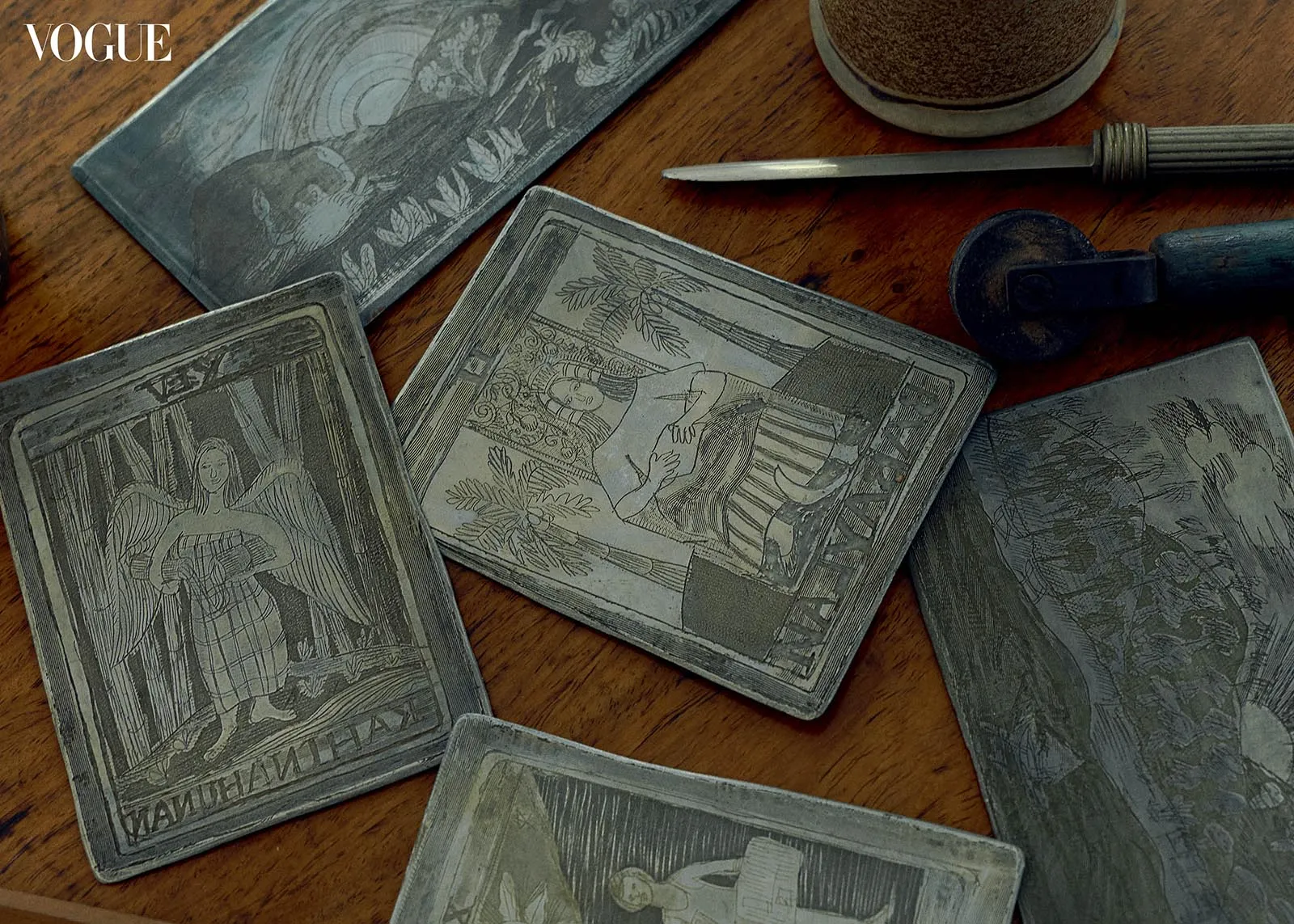
Fajardo’s sister, Mary Joan, founder of the Manila Waldorf School, brought home a set of cards from Europe in the 1980s. Fajardo started using the Tarot to create visual tableaux, compositions that allowed her to articulate social, political, and historical realities with a feminist slant. Images of Tarot cards with Filipinized archetypes, the Babaylan, the Salamangkero, Taong Bigti, frame sketches from Philippine history, or surround commentaries on the burning issues of the day. Her thoughts, streaming freely in cursive, flow across the surface of her images, superimposed onto the scenes.
She painted with hues drawn from the flora and fauna of the Visayan city of Bago, in Negros, where she grew up; her figures rendered along the deliberately simple lines of folk art. This echoed an ethos that closely identified with the everyday Filipino.
It seems impossible, however, to reduce Brenda Fajardo to a single persona. Throughout her life, until her death at 84 in 2024, she moved fluidly to embrace many roles, as varied and interconnected as the figures in her deck of cards.
This multiplicity extended to the communities she helped build. One of her most enduring legacies is co-founding KASIBULAN, Kababaihan sa Sining at Bagong Sibol na Kamalayan (Women in Art and Emerging Consciousness) together with fellow artists, Imelda Cajipe Endaya, Julie Lluch, Ana Fer, and Sister Ida Bugayong. This, in 1987, in the wake of the EDSA Revolution.
Fajardo and Cajipe Endaya met as printmakers in 1970. They stayed lifelong friends. “I think what we did was not just any women’s organization,” Cajipe Endaya recalls, reflecting on KASIBULAN. “What was important to us was that the women artists believed in our vision of trying to unearth our indigenous beginnings identified with the Babaylan or the priestess, healer, and warrior. It was quite inspiring if we could align ourselves with this identity history, the precolonial strength of women.”
The group emerged from a pivotal moment in Philippine history. “We saw each other marching in the streets protesting during the pre-EDSA Revolution. And soon enough, in ‘86, ‘87, we said, ‘What do we do? We are done marching in the streets, we have to make this more productive. So we organized. We have to do this through our art’.”
Fajardo’s role as an educator defined her as well. Cecile De La Paz, a professor at the University of the Philippines Art Studies program, studied under Fajardo. Later on, they worked together as faculty, with Fajardo as department chairman. “It was under her tenure that the Department of Humanities became the Department of Art Studies. Because the art form should speak about society, should speak about spirituality, should talk about history and so much more ‘no?”
“Like the Babaylan, who mediates between heaven and earth, cultural workers like us serve as conduits, not to offer solutions, but to start conversations.”
Fajardo felt strongly about art that related directly to the lives of Filipinos, art rooted in everyday experience, rather than work meant merely for viewing and appreciation. This conviction deepened after a trip to Paete with Cajipe Endaya, an encounter that later led her to pursue a PhD in Philippine Studies. In Paete, she witnessed firsthand the making of the objects identified with the town, papier-mâché taka figures, woodcarvings, even bakya. These practices involved the coming together of the community, the passing down of skills. Sining Bayan, culture for the people, is the term De La Paz uses for what Fajardo meant: art that emerges from local traditions, grounded in the reality of daily lives, seemingly unsophisticated, yet able to capture the Filipino soul.
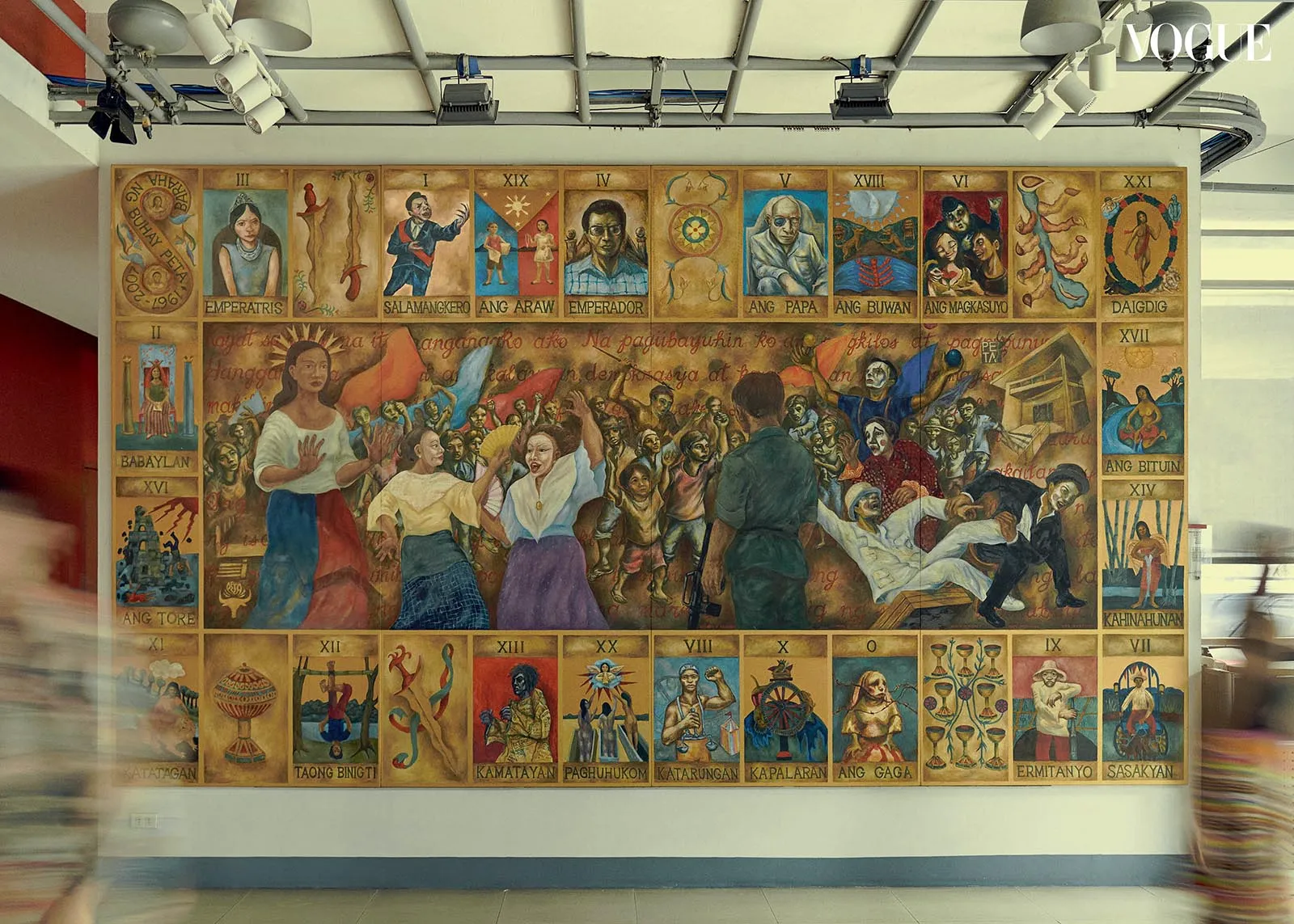
This commitment to Sining Bayan manifested across all her involvements throughout her life. At PETA (Philippine Educational Theater Association) she served as curriculum director, and worked on set and costume designs from its earliest productions in the 1970s, remaining engaged in its activities for decades. Baraha ng Buhay PETA, Fajardo’s largest work for the Tarot Series looms over the lobby of the PETA Theater in Quezon City, a monumental work from 2008 conceptualized by her, but completed with the help of four other artists. While it drew from the same Filipinized archetypes that animated her paintings, the mural perhaps embodies Sining Bayan best. She created it with a community of artists, for a community of other artists, to stand in a shared public space.
She embraced a holistic view, integrating art, spirituality, education, and social responsibility into a single way of being. Eya Beldia, a former student and Fajardo’s personal archivist since 2020, speaks of an outlook honed by anthroposophy, from the Waldorf-Steiner philosophy.
In his eulogy following Fajardo’s passing, Dr. Patrick Flores, another former student and now chief curator of the National Gallery Singapore, shares her impact: “As a young writer then, Brenda presented to me a remarkable mingling of a teacher, a visual artist, an actress and designer for the theater, and a cultural worker involved in the initiatives of women, regional artists, and art educators. That someone embodied all these sympathies and went to school every day was inspiring.”
“Her house in New Manila was really a space for congregation,” remembers De La Paz. “In her garden, she had a gazebo where she hosted meetings almost every day, each day taken over by a different organization.” She adds that “she always stressed the importance of the tagapagdaloy, the facilitator. Like the Babaylan, who mediates between heaven and earth, cultural workers like us serve as conduits, not to offer solutions, but to start conversations.”
The Babaylan, who moves between worlds, embodies the fusing of all Fajardo’s facets into one life purpose. The Artist, The Teacher, The Organizer, The Cultural Worker all come together to push many of the ideas she stood for: inclusivity, the elevation of crafts as fine art, the value of integrating art into community life, and the power of women. These may seem commonplace today, but in the 1970s and 1980s, she must have raised a few eyebrows, even been branded a radical. Yet she persevered, often without recognition. Because the Gaga dreams with her eyes open, and leaps in first.

By TRICKIE LOPA. Photographs by SELA GONZALES. Art Director: Jann Pascua. Producer: Bianca Zaragoza. Features Writer: Gabriel Yap. Multimedia Artist: France Ramos. Acknowledgements: Dawn Justiniani Atienza, Eya Beldia, Louie Sevilla of Nineveh Gallery, Patrick D. Flores Collection, Mark Orozco Justiniani, and Joy Mallari, Marya and Nathaniel Salang, Eileen Legaspi-Ramirez, and Alice Salita.
- For Filipino English Musician Towa Bird, Existence Is an Act of Embodied Rebellion
- The Romantics: For Paloma Urquijo, Design Is an Act of Care
- What the Year of the Fire Horse Means for Each of the Signs, According to Feng Shui Experts
- The Secret Garden: An Hour Outside Paris, Inspired by the Stillness of Asian Cinema
Frequently Asked Questions
Brenda Fajardo (1940–2024) was a monumental Filipino visual artist, educator, and cultural worker. She pioneered the reclamation of precolonial history by layering social, feminist, and political commentaries onto folk-art-inspired compositions, most notably through her celebrated Tarot Series which reimagined standard Western archetypes through a distinct Filipino lens.
KASIBULAN is a landmark progressive women’s art collective founded in 1987 in the immediate wake of the EDSA Revolution. Brenda Fajardo co-founded the group alongside fellow vanguard artists Imelda Cajipe Endaya, Julie Lluch, Ana Fer, and Sister Ida Bugayong to unearth indigenous precolonial female strength.
For Brenda Fajardo, Sining Bayan represented culture for the people—art directly integrated into the daily realities of local communities rather than reserved for passive gallery appreciation. This philosophy prioritized community collaboration, accessible folk traditions, and the transmission of ancestral skills across generations.
Fajardo’s largest public work, the 2008 community mural Baraha ng Buhay PETA, is permanently installed in the lobby of the PETA Theater in Quezon City. The monumental piece reflects her extensive history as the theater company’s curriculum director, costume designer, and scenic artist.
The Babaylan (indigenous priestess, healer, and warrior) serves as the primary conceptual anchor for Fajardo’s life. She viewed cultural workers as tagapagdaloy—mediators and facilitators who, like the ancient Babaylan, navigate between disparate worlds to initiate vital social conversations and foster community inclusivity.