
Angelina Jolie in Manila: “It’s Not a Sacrifice to Live a Life for Others”


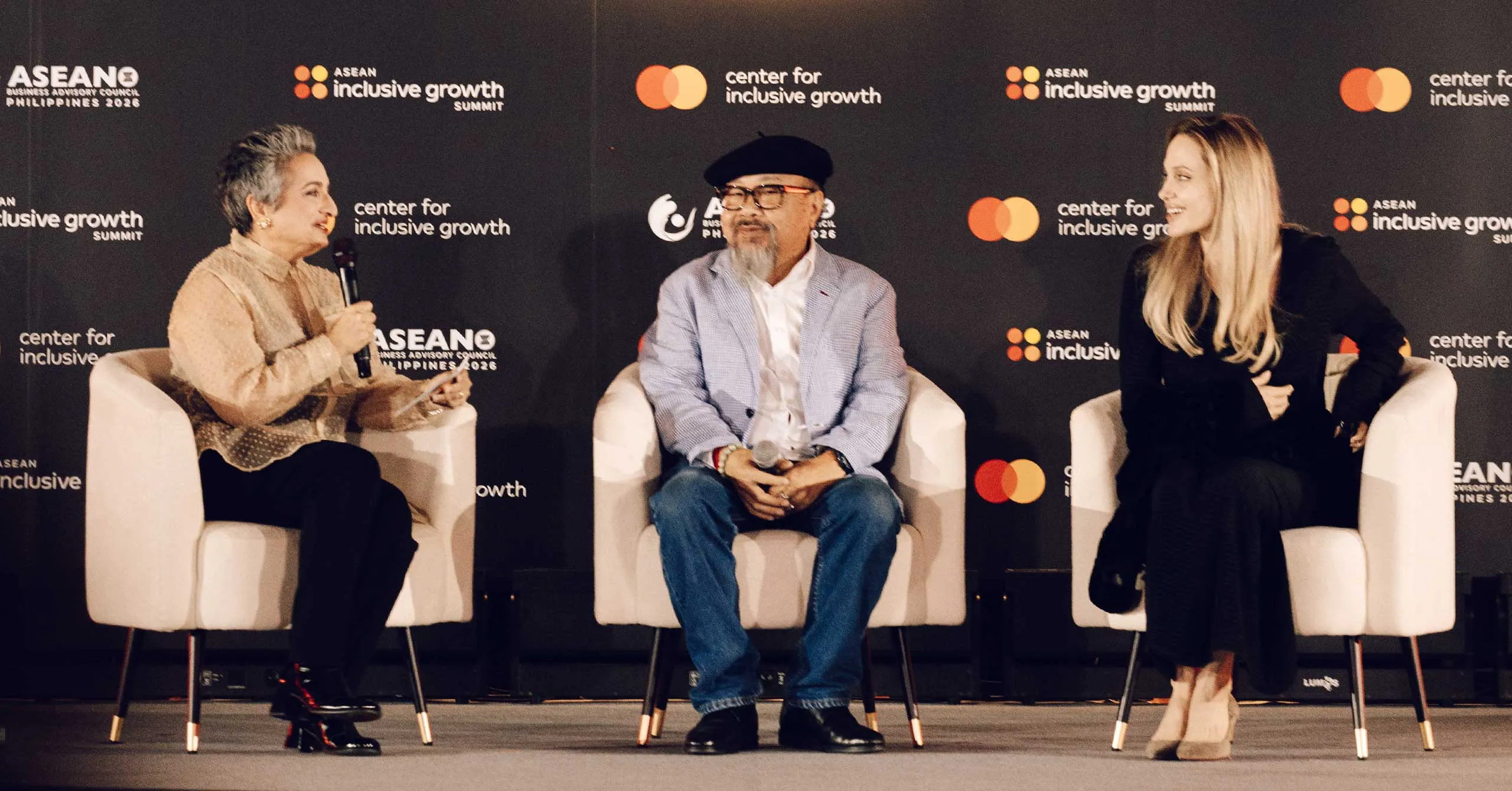
Mastercard Center for Inclusive Growth founder and president Shamina Singh; Cambodian filmmaker Rithy Panh; and actress, filmmaker, and humanitarian Angelina Jolie. Photographed by Excel Panlaque
Mastercard Center for Inclusive Growth founder and president Shamina Singh; Cambodian filmmaker Rithy Panh; and actress, filmmaker, and humanitarian Angelina Jolie. Photographed by Excel Panlaque
At the 2026 ASEAN Inclusive Growth Summit, the actress and humanitarian reflects on motherhood, her enduring connection with Cambodia, and the joy of serving others.
Angelina Jolie first arrived in Cambodia in 2000 to film Lara Croft: Tomb Raider. Aware of the country’s history of conflict and displacement, she had expected a more guarded reception. Instead, she encountered people whose warmth and resilience left a lasting impression.
“I anticipated meeting people who would not be as welcoming, maybe darker energy because of all they’d gone through,” she recalled. “And I found these people to be so warm and open, and I couldn’t believe their spirits were so strong after all they had suffered.”
There was also an immediate sense of belonging. “You go to certain places and you just feel at home,” she said. “There was something about the place and the people.”
Jolie returned two years later to volunteer at a school. While spending time with the children, she had a thought that would change her life. “I had this thought, as clear as day, that my son is here, and I have to find him.” She eventually met and adopted Maddox, who was born in Cambodia.
During her talk, “Cambodia, Courage, and the Power of Staying,” with Cambodian filmmaker Rithy Panh and moderated by Mastercard Center for Inclusive Growth founder and president Shamina Singh, at the 2026 ASEAN Inclusive Growth Summit in Manila on November 11, Jolie spoke about how motherhood had deepened her connection to the region. She later adopted Pax from Vietnam and Zahara from Ethiopia, and described her family as Asian, African, white, and of immigrant descent.
“It’s the greatest gift that I’ve been allowed in my life,” she said, referring to the privilege of being a mother to her children and learning about their cultures. She had never taken for granted the welcome she and her family received. “I didn’t assume I would be welcomed to be their mother in their country. I didn’t assume I would be welcomed in their countries. I didn’t assume our family would be accepted.”
Her gratitude extended to her work in the region. “It’s such an honor to be allowed to work in Cambodia, to show their history, their talents, their culture,” she said. “It’s a gift. It’s a gift to be here. It’s a gift to work in this part of the world.”
That sense of respect shaped her approach to filmmaking. When she decided to adapt Loung Ung’s memoir, First They Killed My Father, she sought the guidance of Panh, whom she described as a dear friend and one of her favorite directors. She wanted to make a film with Cambodia, rather than simply make one about it, involving the people whose history it told in the telling of their own story. The 2017 film recounts Ung’s childhood under the Khmer Rouge.
Jolie also reflected on the importance of being present in humanitarian work. In earlier assignments abroad, she sometimes felt separate from the people she was there to help, as though she were witnessing a situation or working within a program without forming a deeper connection.
“I’m very happy to spend more time in places and make friends and neighbors,” she said. “So much of life is listening, listening to the other person, another person in your own family or another person across the world.”
For Jolie, meaningful engagement requires more than arriving with assistance. It means listening, learning, and understanding the everyday realities of a community.
That understanding has informed her work in the Cambodian area where she has made her home. When she first arrived, the land was heavily mined. “We actually found 48 landmines,” she said, recalling the early work of clearing the area and ensuring that schools, neighborhoods, and roads were safe.
Other challenges followed, including illegal gem mining, poaching, and deforestation. Jolie spoke about the need to protect the land from activities that may bring quick returns but ultimately damage communities and their future livelihoods. “We’re not against business,” she explained, advocating for economic opportunities that do not come at the expense of conservation.
Her work has included livelihood projects such as beekeeping and honey production. The larger goal is to move beyond short-term relief and help people become self-sufficient.
“I really want to find a way where it goes from aid relief to really just investment,” she said, “so people are taking care of themselves and don’t need you, and you’re investing in their independence.”
Jolie and Panh are also exploring a broader cultural program in Cambodia, with plans that include restoring old buildings and theaters, supporting traditional practices, and continuing conservation and livelihood initiatives. Jolie hopes to make her home available as a residency for artists and practitioners to spend time, exchange ideas, and engage with the community.
The value of culture and creativity also informs Atelier Jolie, her creative collective. Drawing on more than two decades of work with refugees, she said she had often seen countries treated as though they had nothing to offer, when in fact they possessed rich cultures, talented people, natural resources, and the capacity to thrive.
“What struck me was that the countries that are treated like they have nothing often have so much,” she said. “If they had been given the support and they could trade fairly and they could produce fairly, they wouldn’t need that much at all.”
AtelierAtelierThe French word for workshop, describing the studio where a designer's garments are cut, fitted, and finished by hand. In couture, the atelier is the heart of the house, homeGo to Atelier Glossary Jolie aims to give artists and makers opportunities to share their music, books, products, and other creations, while building local communities and international networks. Its model gives priority to local work, complemented by international exchange. Jolie also sees potential in an online store to bring these creations to wider audiences.
The ambition, she explained, is to connect artists and businesses and “break through some of the trade barriers” that limit their reach. It is an effort to give creative talent not only visibility, but also access to meaningful economic opportunities.
Looking a decade ahead, Jolie raised questions about the impact of technology, particularly artificial intelligence, on creative work and the concentration of economic and political power. She stressed the importance of making thoughtful choices now about how young people are educated, trained, and prepared for the future.
As a parent, her hopes are also personal. She spoke of wanting a simpler life, passing things on to her children, and continuing to be of service. “It’s not a sacrifice to live a life for others,” she said. “It’s a great joy.”
She hopes to see the next generation become more connected, sharing their voices and creations across borders. “Hopefully, the positive side of technology, watching this next generation be more connected than ever, and watching countries be able to share their own voices through what they’re creating with you more than ever,” she said. “I hope for a more united world.”
Frequently Asked Questions
Angelina Jolie visited Manila to participate in the 2026 ASEAN Inclusive Growth Summit, where she joined Cambodian filmmaker Rithy Panh for a conversation titled “Cambodia, Courage, and the Power of Staying.”
Jolie spoke about her 25-year connection to Cambodia, motherhood, humanitarian work, sustainable livelihoods, cultural preservation, and the importance of creating opportunities for local communities. She also shared her thoughts on technology, creativity, and the future of the next generation.
Jolie first visited Cambodia in 2000 while filming Lara Croft: Tomb Raider. She returned in 2002 to volunteer at a school and adopted her eldest son, Maddox, who was born in Cambodia. Her connection to the country has since extended to filmmaking, conservation, and community development.
Atelier Jolie is a creative collective founded by Angelina Jolie. It aims to give artists and makers opportunities to share their work, build local communities, connect with international networks, and access fairer trade opportunities. Its vision includes bringing together creativity, culture, and commerce across borders.
The ASEAN Inclusive Growth Summit is a Mastercard-led regional gathering that brings together leaders, policymakers, business figures, and advocates to discuss ways to advance inclusive economic growth across Southeast Asia. The 2026 Manila edition featured conversations on entrepreneurship, financial inclusion, technology, culture, and community development.