

JAGGY GLARINO top, RAJO LAUREL trousers and archival belt, and NEIL FELIPP earrings. Photographed by Karl King Aguña for the December 2025/January 2026 Issue of Vogue Philippines
Inspired by Manila’s rooftops and the experience of arrival, Jaggy Glarino discusses the Yero Top worn by Suganya on the cover of the Homecoming Issue.
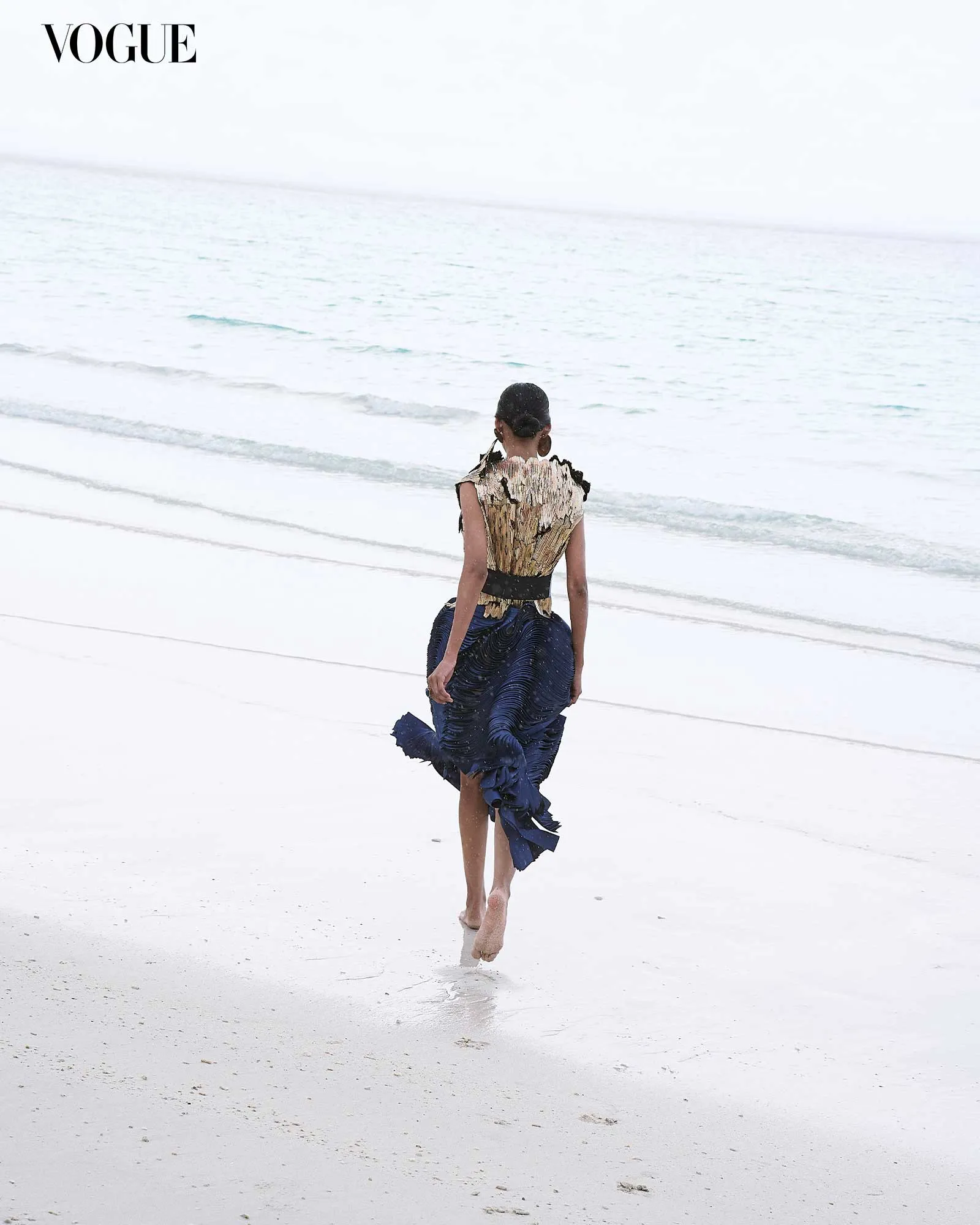
For Jaggy Glarino, the idea originated from a texture that is instantly recognizable in Filipino life. “While sourcing, I came across this corrugated, gold-toned board that looked like a miniature metal sheet,” he explains. “Immediately, it reminded me of the rooftops along the Manila Skyway, those patchworks of old yero pieced together into walls and homes.”
Originally, it was too unblemished for the story he wanted to tell on the body. “The material itself was quite polished, almost too pristine, so the real challenge was deconstructing it, coloring it, and distressing it to evoke the familiar nostalgia of weathered roofs. I wanted it to feel lived-in, touched by rain and sun, like it carried stories.”
Cemented in Glarino’s own narrative, the showpiece captures the central truth behind his IGNO collection. “For me, the Yero Top is a memory piece. It traces back to the moment I arrived in Metro Manila from the province fresh from the airport, overwhelmed by the unfamiliar, yet strangely drawn to the raw charm of urban decay. Those rooftops were my first glimpse of the city’s chaos and promise. This top is my way of encapsulating that arrival, that collision of grit, new beginnings, and the quiet poetry found in the most overlooked things.”
He reflects on the idea of being labeled probinsyano, a word that often carries assumptions about access and sophistication to the upper echelons of Manila society. “Firstly, there’s a vast pool of untapped talent in the far-flung provinces of the Philippines. Many young creatives outside the major cities may be less exposed to global fashion references, but they are abundant in skill, resourcefulness, instinct, and vision. What they lack in access, they make up for in ingenuity.”
Metamorphosis begins from within. “I think the real shift begins with self-acceptance recognizing that your so-called ‘provincial’ background isn’t a handicap but a unique vocabulary. Your upbringing, your surroundings, your memories… these are cultural advantages, not limitations.”
In his own state of mind, he sees his beginnings as an advantage. “For me, being ‘probinsyano’ isn’t something to outgrow. It’s a grounding force. No matter how far we travel or evolve, there’s always that small-town version of ourselves that keeps us honest, imaginative, and connected to home.” He wants the industry to value this rather than polish it away. “The industry can confront the stereotype by valuing this perspective instead of polishing it away, by celebrating creators who are rooted, not just cosmopolitan.”
Glarino hopes that the design, and the storytelling behind it, encourages young designers to speak from where they come from. “I hope IGNO sparks conversations about owning your narrative especially for young designers who arrive in the city carrying their provinces in their pockets like a quiet inheritance.”
Emphasizing that design becomes more powerful when created from truth. “Your stories, your values, your background, your failures, your small wins-they create a visual language that no one else can replicate. There’s something deeply healing in being able to speak from that place.”
He sees this tender honesty as an engine for expression. “When you design from honesty, the work expands beyond aesthetics; it becomes a form of self-recognition. Self-representation is a magnifying lens. It sharpens your point of view and allows others to see the world the way you lived it, and that’s powerful, even if we don’t always realize it.” Glarino wants young creatives to know that their origins are an asset. “I want young designers to feel that they don’t have to dilute where they come from to belong here. The city isn’t a place you must adjust to; it’s a place you can rewrite through your own lens.”


