
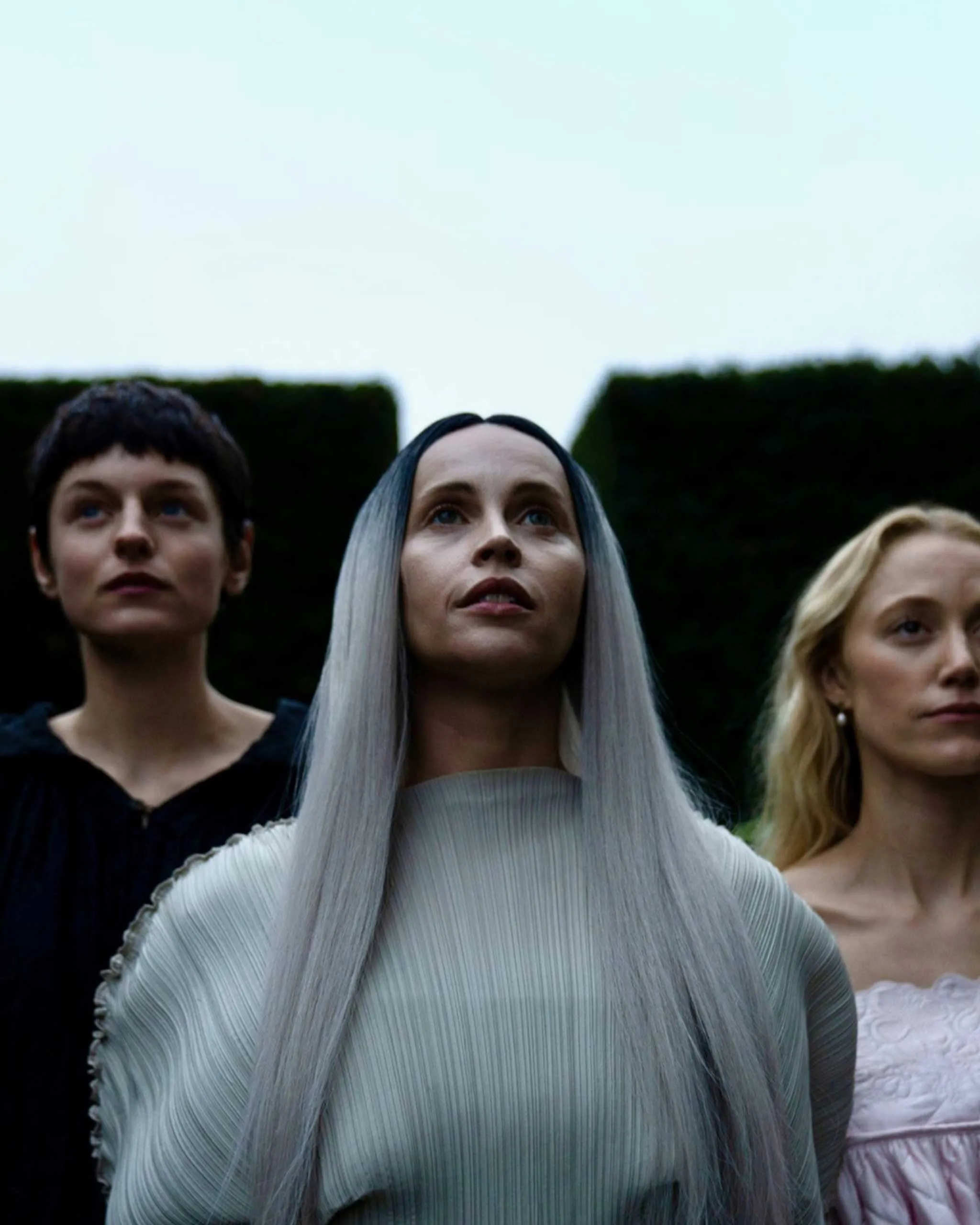
Photographed by Jed Knight, courtesy of Independent Film Company.
Vogue Philippines spoke to costume designer Susie Coulthard about the costumes of 100 Nights of Hero, starring Emma Corrin, Maika Monroe, Felicity Jones, and Charli XCX.
Rated-R fairytales, uncensored by Disney and DreamWorks, have been having a moment in recent years, with films such as Gretel & Hansel, The Green Knight, and The Ugly Stepsister. This month, inspired by the classic Middle Eastern folktales ofOne Thousand and One Nights and adapted from Isabel Greenberg’s graphic novel. Julia Jackman’s film 100 Nights of Hero stars Nicholas Galitzine, Maika Monroe, Emma Corrin, and Charli XCX in a melange of gothic history, contemporary colloquialism, and fancy frocks in a kingdom that feels perpetually perpetual.
For costume designer Susie Coulthard, that sense of otherworldliness was intentional from the start. “We had just a few weeks prep time, and not wanting to be too drawn into the original source material I just did a brief glance at a few of the graphic novel pages and knew immediately that a direct translation would not suit the language of the location,” she says. “But it was apparent straight away that a rendition of the monochromatic architectural style would.”
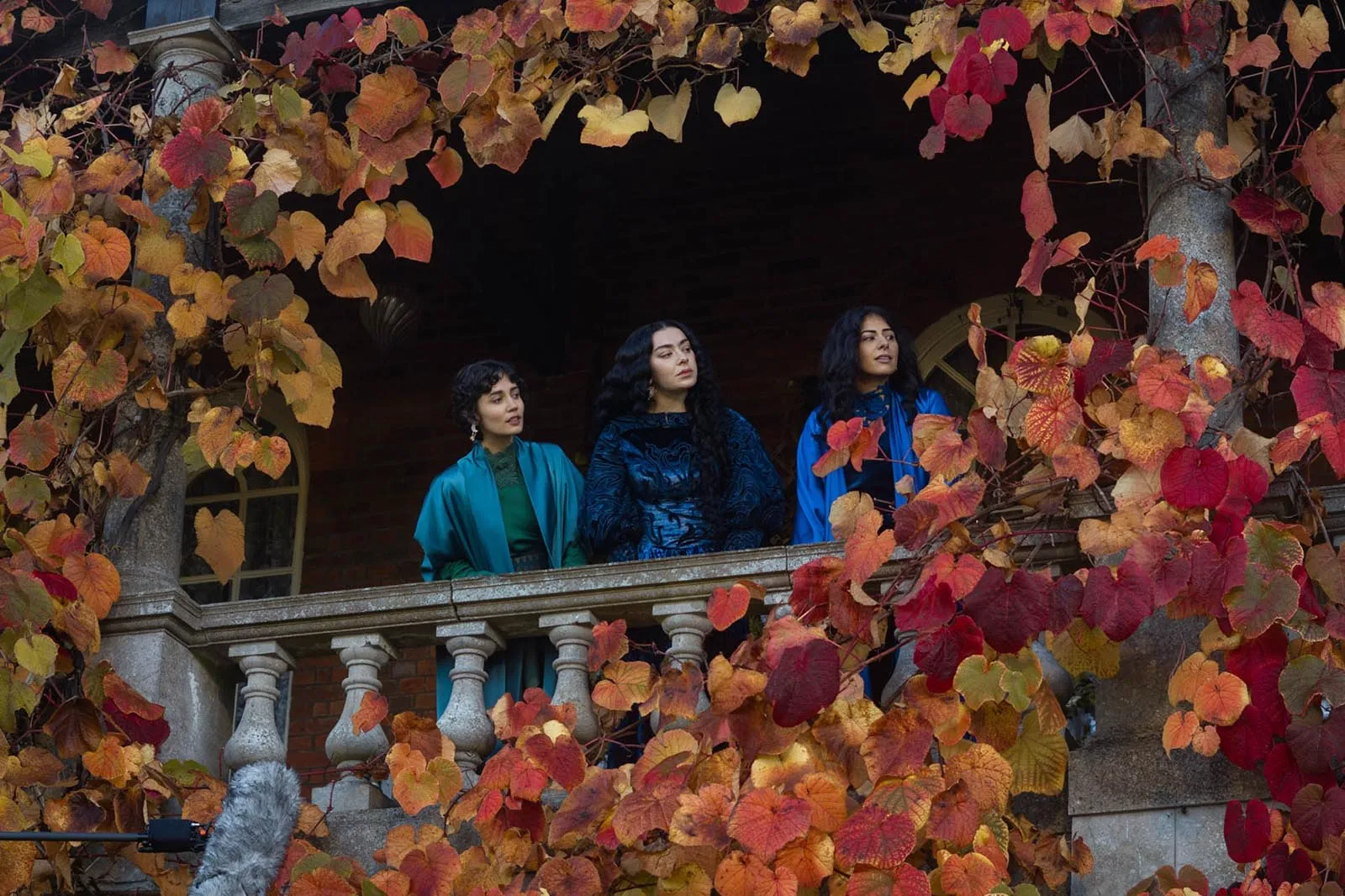
Rather than reconstructing a specific historical moment, Coulthard focused on creating an identity that supported the film’s internal logic. “I wanted the costumes to feel unique and yet sell the story which the characters are telling,” she explains. “Using fashion influences merged with medieval references I knew that we had to design and make as much as we could to create something visually of a new world.”
That transcendental domain was developed with Jackman, whose direction shaped the film’s unified aesthetic across the board. “Julia was an amazing collaborator, she responded to my designs immediately and helped refine the look and steer everything in the direction she envisaged,” Coulthard says. With limited prep time across departments, she adds, “really the cohesive aesthetic is down to Julia’s direction.”
In Migal Bavel, women are forbidden to write but permitted to tell stories, and that disparity is directly sewn into the silhouette. “I really wanted the women to feel restricted,” Coulthard says. “The caged corset on Cherry and the strict uniform of Hero, with the men reflecting a more free-spirited attire.” Authority, meanwhile, is rendered through exaggeration. “The ridiculousness of the Beaked Brothers in their clerical robes and beaks,” she adds, is “a commentary on the inherent patriarchal society and their subjugation of women.”
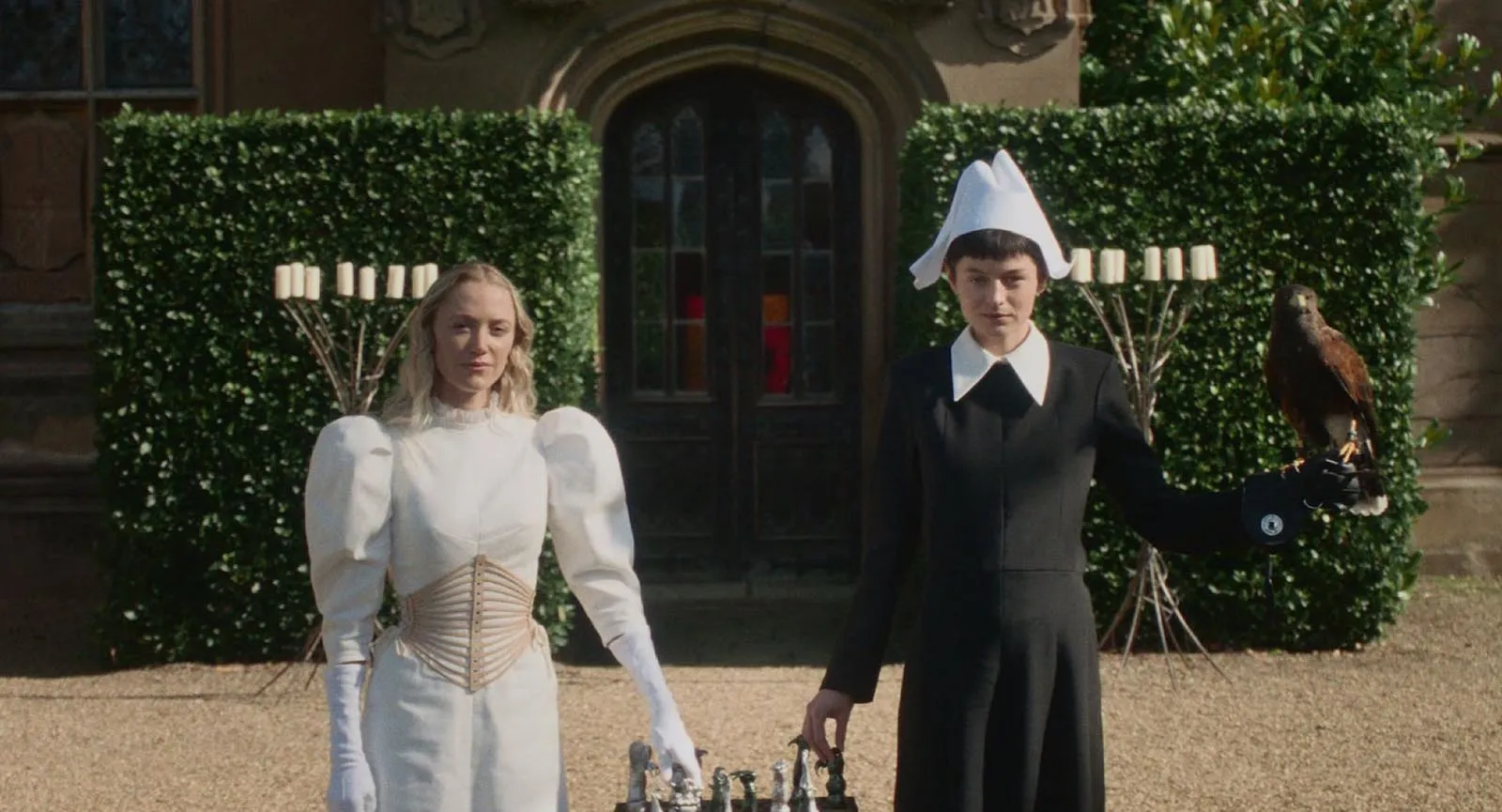
Although Greenberg’s graphics provided an initial framework, Coulthard’s catalyst came from fashion imagery rather than historical costume. “My main reference was Edward Enninful’s styling for Steven Meisel’s ‘Organised Robot’ shoot for Vogue Italia back in 2006,” she says. “The styling is genius with reams of character.” Evidently seen in the film’s monochromatic palette, sharp tailoring, and delirious uniformity.
The process of realizing those ideas was second nature. “My first port of call is always my amazing cutter and tailor Clinton Lotter,” Coulthard says. “We have worked together for 20 years and have a great shorthand together.” Sketches became toiles, refined directly on the stand. “We worked through many iterations of the sleeves for Cherry’s outfits with little time to get them to the final point.”
Millinery became a central tool in defining the world of Migal Bavel. Coulthard worked with Hood London to produce bespoke headpieces for the characters, while sourcing additional hats from costume houses and specialist shops to populate the court. “I knew the millinery was a really important part of the world building,” she says. “I have worked with Adèle for over 20 years, she gave her all to this project working on many iterations of the Hero hat until we hit the exact note.” For Coulthard, the result was not ornamental but story-driven: “I feel this adds not just a stylistic element but very much character driven intention to the film.”
Materials were aquired through a mix of specialist suppliers and contributions from the industry. Fabrics came from The Silk Society and Goldhawk Road, while linen for Richard E. Grant’s Birdman costume was donated by The Hackney Draper. “Richard’s Birdman helmet was designed and made by the legendary armourer Terry English,” Coulthard says, providing authority to one of the film’s highly symbolic figures.
“We worked with fashion PR companies to facilitate some of the pieces for Cherry and Rosa, knowing we did not have the time or resources to make so many outfits,” Coulthard explains. Maika Monroe wore loaned Cecilie Bahnsen pieces, Elie Saab provided Charli XCX’s wedding dress, and Felicity Jones’ Moon wears Issey Miyake from CLTHD, the London-based designer fashion rental platform founded by Coulthard herself.
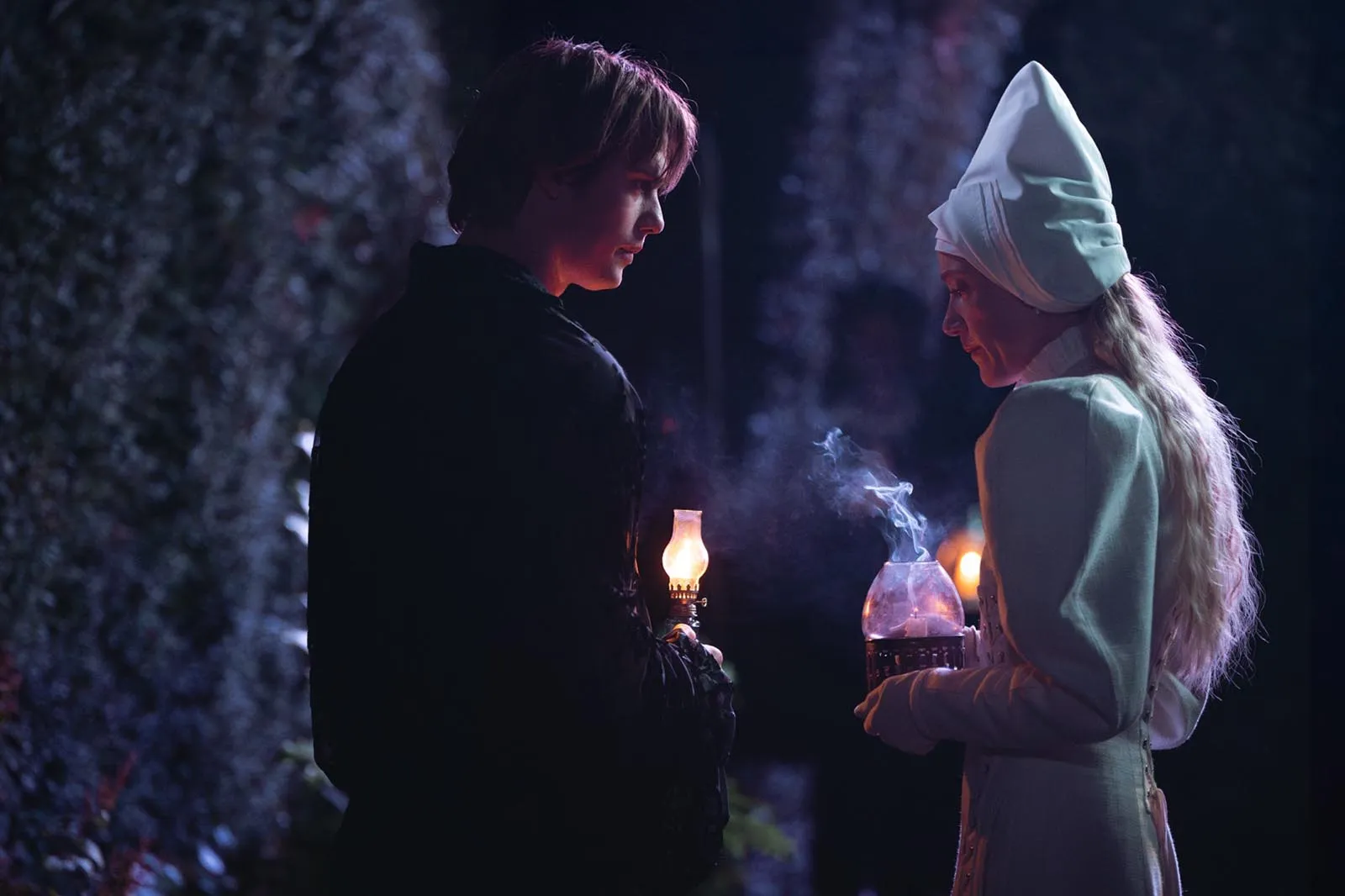
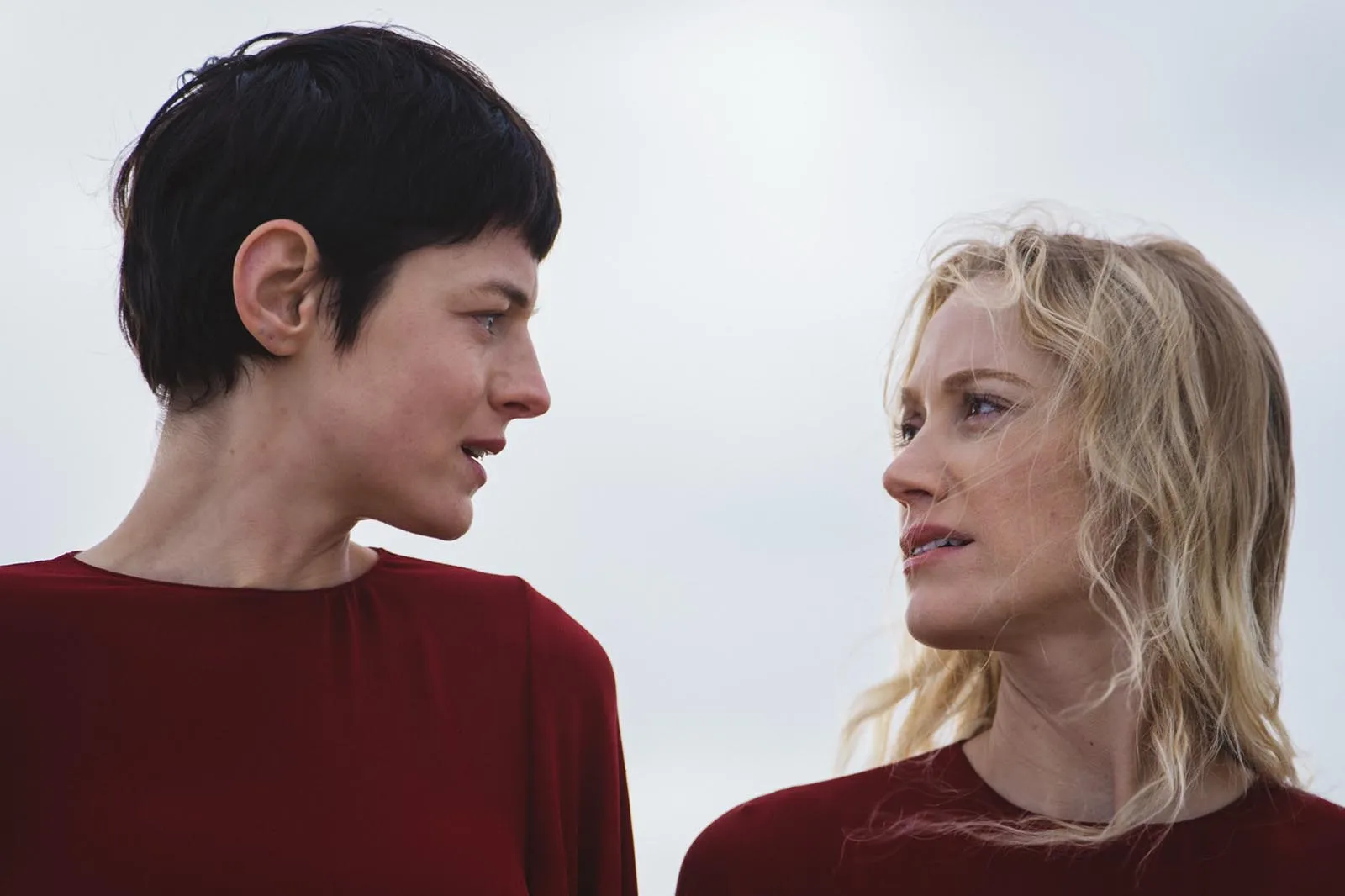
Character development happens through subtle change rather than drastic transformation. Hero’s change is intentionally kept subtle. “I really wanted simplicity in her’s outfit, a little humour and adventure in her hat, and her transformation to be slight,” Coulthard says. “Just the removal of her collar or hat as she reveals herself.”
Cherry’s character development is a process. “We see her sleeves change as she softens to Manfred,” Coulthard says. “And she becomes more undone and relaxed as the story unfolds.” Manfred, by contrast, uses dress as a peacocking performance. “Manfred arrives as a brute and transforms, peacocking himself to try and attract the attention and heart of Cherry with softer and more fluid and textural fabrics.” In the end, 100 Nights of Hero returns storytelling to its elemental purpose, where moral and cultural lessons are swathed in action. The tale cuts close to the bone of a society ruled by men, echoing a universal reality. As Coulthard puts it, “I guess the clerical theme of the Beaked Brothers is definitely a diss on patriarchy and female subjugation.”
- “Costume Art” Is the First Exhibition in the Costume Institute’s New Permanent Galleries at The Met
- From ‘Past Lives’ to the ‘Materialists’: Katina Danabassis on Dressing Character
- Vogue Exclusive: Behind the Costumes of ‘Wicked’ with Paul Tazewell
- In The Roses, PC Williams Charts Love and Power Through The Costumes of Olivia Colman and Benedict Cumberbatch


