
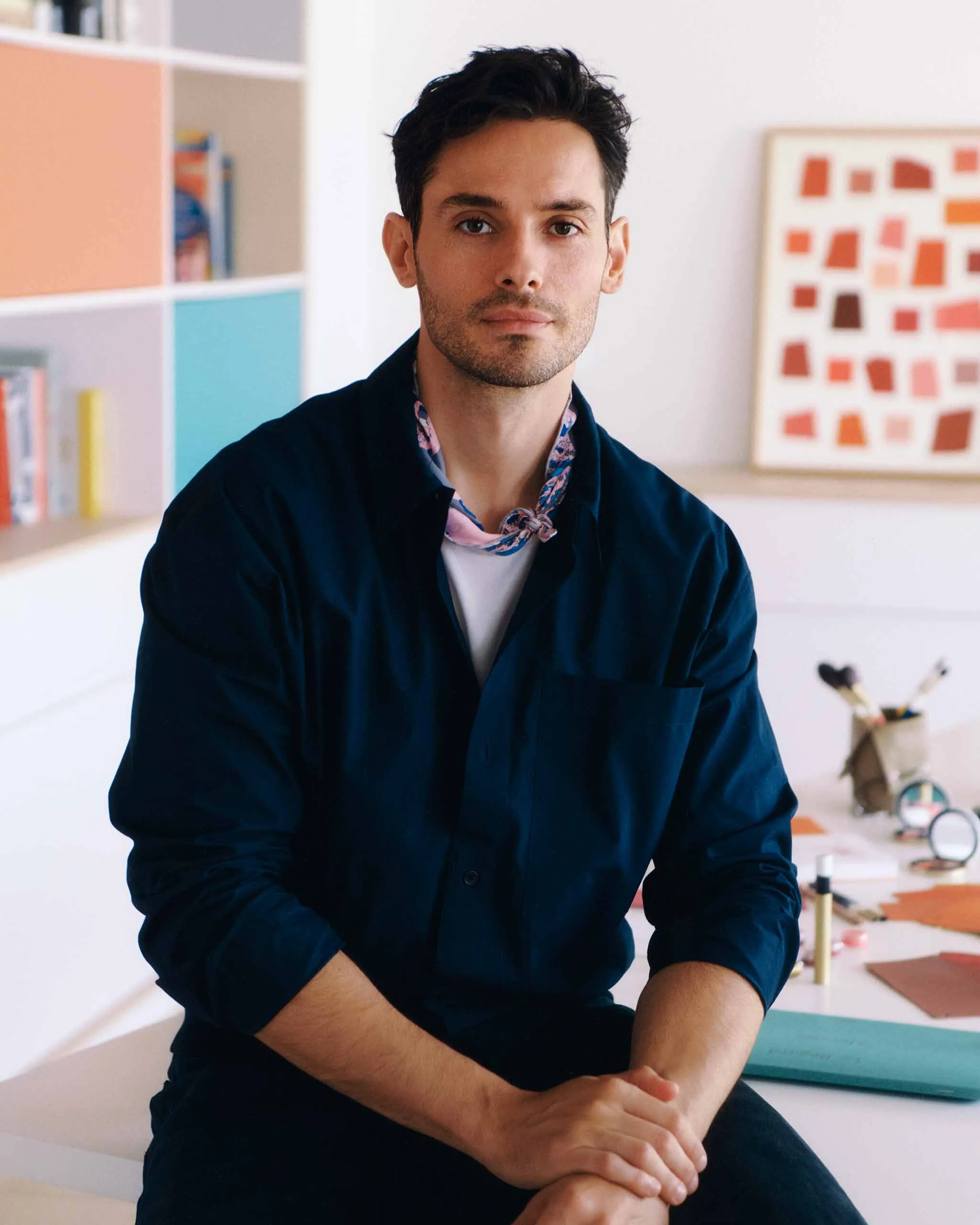
Courtesy of Hermes Beauty
For Hermès Beauty’s creative director Gregoris Pyrpylis, beauty isn’t created; we simply train our eyes to find it and learn to refine it. In an intimate conversation with Joyce Oreña, Beauty Editor of Vogue Philippines during the Rouge Brillant Silky launch in Singapore, he revisits the memories, philosophies, and quiet curiosities that shape his work, from a childhood surrounded by light and nature in Greece to his newest expression of color through Hermès’ latest lipstick.
In a private room of the Hermès House in Singapore, a spread of Hermès lipsticks sits arranged with near-ceremonial precision. Rouge Brillant Silky, the brand’s newest launch, gleams in muted metallic casings, each tube holding a glossy, translucent color inspired by the textures of silk. Fourteen permanent shades form the core of the collection, joined by three limited editions, all designed for intuitive, buildable wear. Even before the first swatch, the lipsticks already feel like objects meant to live in the hand.
Gregoris Pyrpylis sits just behind them, thoughtful and unhurried. There is a reflective quality to the way he speaks about beauty. For him, the act of creating is inseparable from the landscapes of his childhood: the bright Mediterranean light, the scent of apothecary creams in his parents’ pharmacy, the softness of chiffon brushing his cheek as his mother lifted him from school. Rouge Brillant Silky carries all of these traces: its melting texture, its translucent shine, its ability to reveal rather than conceal.
In an intimate conversation with Vogue Philippines, the creative director shares his story, his process, and the sensibility behind Hermès Beauty.
Vogue Philippines: Where did you grow up, and what was life like there?
Gregoris Pyrpylis: I grew up in Greece. The late ’80s and beginning of the ’90s were my childhood, and I only have beautiful memories. I grew up in the countryside in a place where nature is taking over, and the place was surrounded by sea, lakes, beautiful villages, mountains. So I grew up in nature, I would say. I grew up in a small town, where my parents were both pharmacists, they’re retired now, and I spent so much time in their pharmacy after school or during summer holidays. I preferred going there and learning and understanding what they were doing. I think my passion for beauty, well-being, skincare, and makeup came from a very early stage of my childhood. And it was really interesting because when I later became a makeup artist, that’s when I understood why I always felt this kind of passion for beauty.
I remember my mom and dad would create their own creams for clients. They would have prescriptions from dermatologists and create creams for a painful knee, a rash, or a reaction. I have this very unique smell in my memory. Sometimes when I pass by a pharmacy today, I can still smell the same scent, no matter where I am anywhere in the world.
My mom managed the skincare counter and had loyal clients who came to her for advice. I was very intrigued, from a very young age, by how loyal people can be to a product that works for them. It ignited something in me, though in a very subconscious way.
Did you ever think about becoming a pharmacist as well?
I did. But my dream from about age five or six was to become an English teacher. That was the first thing I wanted to do, and it lasted for a long while, until I went to the University of Athens to study English language and literature. That’s where I discovered makeup. I’ve always been keen on beauty in general, in arts, photography, and nature. I’ve always reached for harmony and aesthetics. My parents, of course, wanted me to become a pharmacist, but you can’t control what your kids want to do in their life.
During my first year of university in Athens, I met a good friend, a classmate of mine. And one day she wanted to go out and I did her makeup, just to have fun. She started applying a blanket of cream, and it felt a bit like there was a calling for me to do her makeup. And I did her makeup with three or four products, and the result was pretty nice. She felt very confident and told me, “Gregoris, you should go to a makeup school. You have a talent.” That’s where everything started.
It’s also important for me to say that from a very young age, wherever you’d look for me, I had crayons in my hands, painting all the time, painting pillows, walls in my grandparents’ house! They were kind enough to let me do it because they knew they could repaint. From a very early age as well, I was interested in fashion. Since I was the age of 12, I started looking in all these beautiful covers of Vogue, and all these magazines, watching Fashion TV and World Fashion. I would watch the designers’ interviews, hearing their stories to understand how they work. At some point, I could see a cover and instantly know who photographed it, who did the makeup, who did the hair. I was very curious to know and to understand this world. But growing up in a small town, I never expected I could do this as a job.
After university, did you go straight into makeup?
When I started studying at the university, a year later I discovered makeup, and I did both schools at the same time. I also worked to pay for my makeup school because I didn’t want to ask my parents. At first, I felt makeup was just something to occupy me, like a hobby.
For about three years, I continued both. I finished makeup school, worked at a MAC store as a salesperson, and continued university. But at some point, it became too much for me. The university program was four years; at the third year, I dropped out and followed my career as a makeup artist. After MAC, I found my first agency in Greece. I started working in fashion, then with local celebrities. Pretty fast, at around 22 or 23, I became the spokesperson for Maybelline New York in Greece and Cyprus. I traveled to New York for the shows because, back then, Maybelline was a major sponsor. That’s when I realized that if I wanted to do this properly, I had to go to New York, Paris, or London.
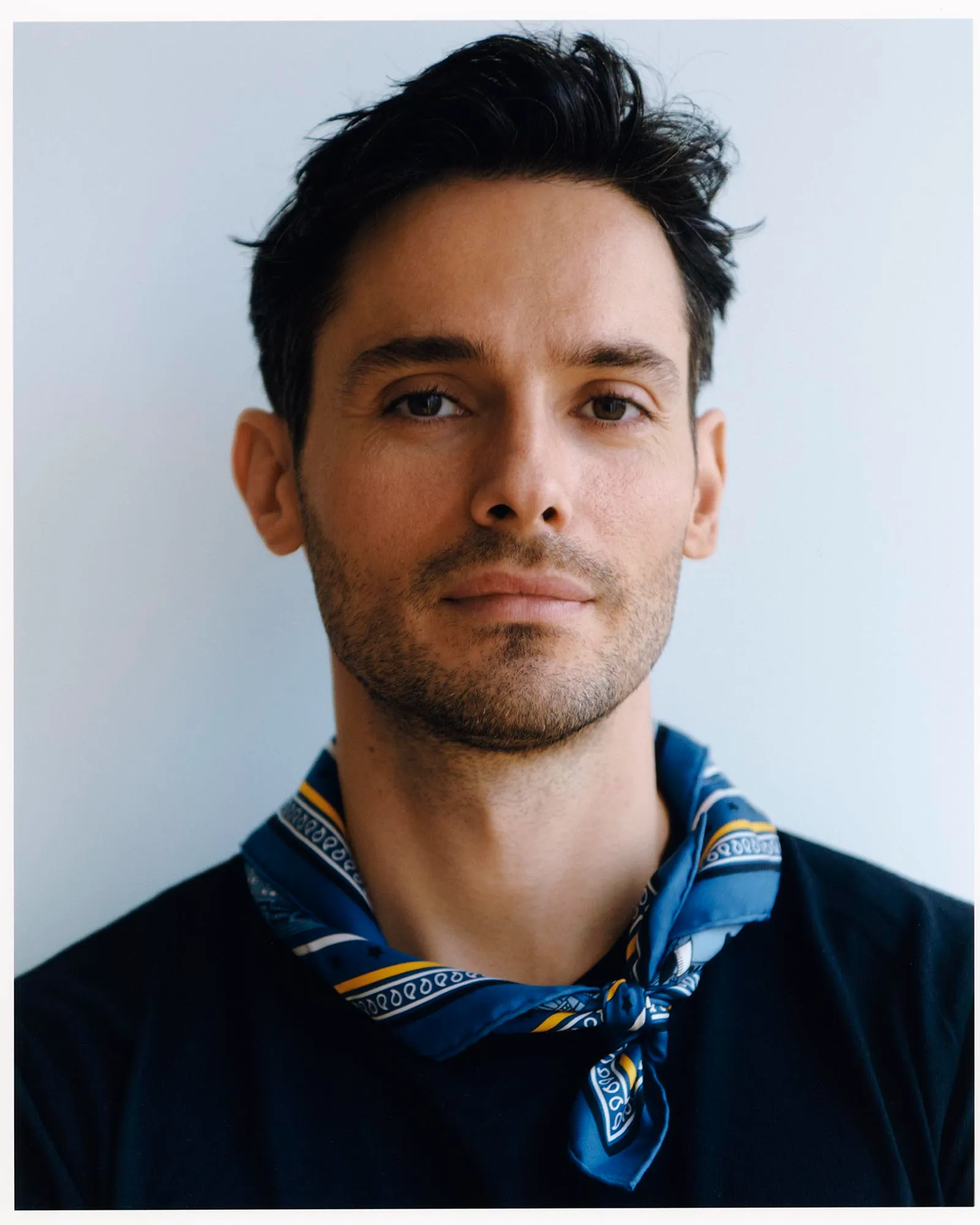
So where was the first stop for you?
I went to New York quite a few times, and this is where I had the opportunity to meet Tom Pecheux, who was my mentor in makeup, based in Paris. After a couple of years, the opportunity came to move to Paris as his first assistant. It was in 2012, and everything started from there. It was my dream to assist him, not anyone else. I found that his work, his universe of aesthetics, spoke to me. Sometimes the stars align and with hard work and a bit of luck, life brings you to your path.
You’ve mentioned that your roots influence your creative approach. How do these memories of your early life, your culture, and your background shape the way you view beauty today?
We’re all shaped by where we grow up. Greece is in southern Europe, very close to where the Middle East begins in the map, so we have influences from everywhere. But what is very unique in Greece is the light, the perception of light, and the influence of ancient architecture, philosophy, and arts in general. Inevitably, I had all these influences that shaped who I am today and what I perceive as beautiful and aesthetic today.
In Greece, back in the day, the first books I saw as a kid were illustrations of Greek mythology; all these beautiful gods, goddesses, and even the monsters were illustrated in a beautiful way. So subconsciously, it stimulated something in me, shaping my sensitivity to form and shape. I grew up with an ideal of beauty, which at times had to do with practicality, harmony, and symmetry, but also the beauty we carry within us, ideas that some of the great philosophers like Socrates and Plato wrote about.
How would you describe your approach to life, and how does that influence your creative process as Hermès Beauty’s creative director?
Curiosity. I’ve always been curious to understand. I don’t like to judge; I like to understand first. Why someone dresses a certain way, why they choose a lipstick, why they speak the way they speak. I feel like understanding and being curious with what feels unfamiliar and strange is important to me. I think this curiosity is very embedded in the Hermès culture. All these creative directors are guided by pure curiosity and by the belief that beauty is everywhere around us. We just have to practice our eyes to find and see it, and enhance it. I don’t think we create beauty; I think that in life and work, we have to find it and enhance it.
Color is one of the key attributes to the House of Hermès, and Hermès Beauty is always encouraging expression through color. What role does color play in your own life and work as a makeup artist, and how does that inform your approach when creating or curating new collections?
My relationship with color is very diverse. I don’t follow a strict strategy; I’m very intuitive. And I’m saying intuitive and not instinctive, because instinct is something you can’t control. But intuition is more about that whisper that tells you where to go, what path to take.
Sometimes I can have a very mathematical approach to color, especially with makeup and working with different skin tones. This is something that you really have to take into consideration when you create collections like lipstick or anything else. Josef Albers used to create these beautiful squares that show the interaction of color. One color might look more bold when it’s next to, let’s say, white, but then when you put it next to another hue of the same color or of another intensity, it can look brighter or darker, more dull or more vibrant. So I think that this is something that is always on the back of my mind.
But I do love allowing myself to be very intuitive with color, and not trying to control color, but allowing the color to take over. A collection can look more authentic, more sincere, when you don’t try to control everything, especially color. The way we grew up and where we grew up, in a very subconscious way, we are guided by these influences that we had when we were kids. For example, no surprise I love blue. But this is something that you have to practice more and more and try to refine.
At the end of the day, I always try to have a more mathematical yet liberated approach, just as in abstract expressionism, for example, where artists let the color speak and convey emotions and feelings, and even transcend to a spiritual kind of element and level.
I think, really, the foundation of a child, our childhood, immensely influences us as adults.
Definitely. And I personally feel like we always have to keep this side of us, of the person that we used to be. It’s innocence, not naivety.
This new collection, as you mentioned previously, is inspired by Hermès silk, how the light touches it against your skin. Walk us through this collection and how you developed this line.
So again, for this collection, when I started thinking of creating my first lipstick for Hermès, I went back to my memory. And I’m going to talk about my childhood again. In Hermès, silk is one of the foundations of the house, as important as leather and the equestrian world. The previous lipsticks were inspired by leather, by two different types of leather: Doblis and Box. Now I wanted to create a lipstick that, as I said, doesn’t cover, doesn’t conceal, but reveals. So I couldn’t go toward leather. I didn’t find inspiration in leather because leather is more opaque, more dense, and very assertive. I wanted something more ethereal, an easier approach to the lips.
I remember when I was five or six and my mom would come to pick me up from school back in the ’90s. It was very in fashion: the silk chiffon, the muslin, very transparent silk, very airy and translucent. My mom had a collection of them in different colors: blue, pinks, corals. They were quite long, and she would wear them every day. When she came to pick me up from school, she would hold my hand, and because I was about level with her hips, the scarf would sometimes go in front of my face and caress my face. It became almost like a mask, and I would see the world through it: very colorful.
I will never forget this caress from the silk chiffon, this texture. And I wanted to pay homage to that moment with a lipstick that borrows the elements I personally appreciate in different types of silk.
So I borrowed the transparency and airy feeling from silk chiffon. I went to silk twill to get the comfort, and the softness, how smooth and luxurious it feels against the skin. And for the finish, I thought of silk lamé, which is very shiny and sparkly. I gathered all these elements and wanted to pour them into this new lipstick. That’s why we called it Rouge Brillant Silky.
I’ve always felt that when you wear a silk scarf around your neck and you have nothing on your face, immediately a light arrives. It has this power to illuminate and enhance the color of your face, so you don’t even need makeup. I wanted to do the opposite: if you’re not wearing a silk scarf, at least you can experience the sensoriality of a silk scarf through a lipstick. And I hope people will have the same experience.
In your words, what distinguishes Hermès Beauty from other luxury brands?
Honesty and sincerity. There is also a childlike joy, like opening your school bag and seeing crayons, wanting to draw everywhere. At Hermès Beauty, we create so people can be creative. Our creation is just the beginning.


