
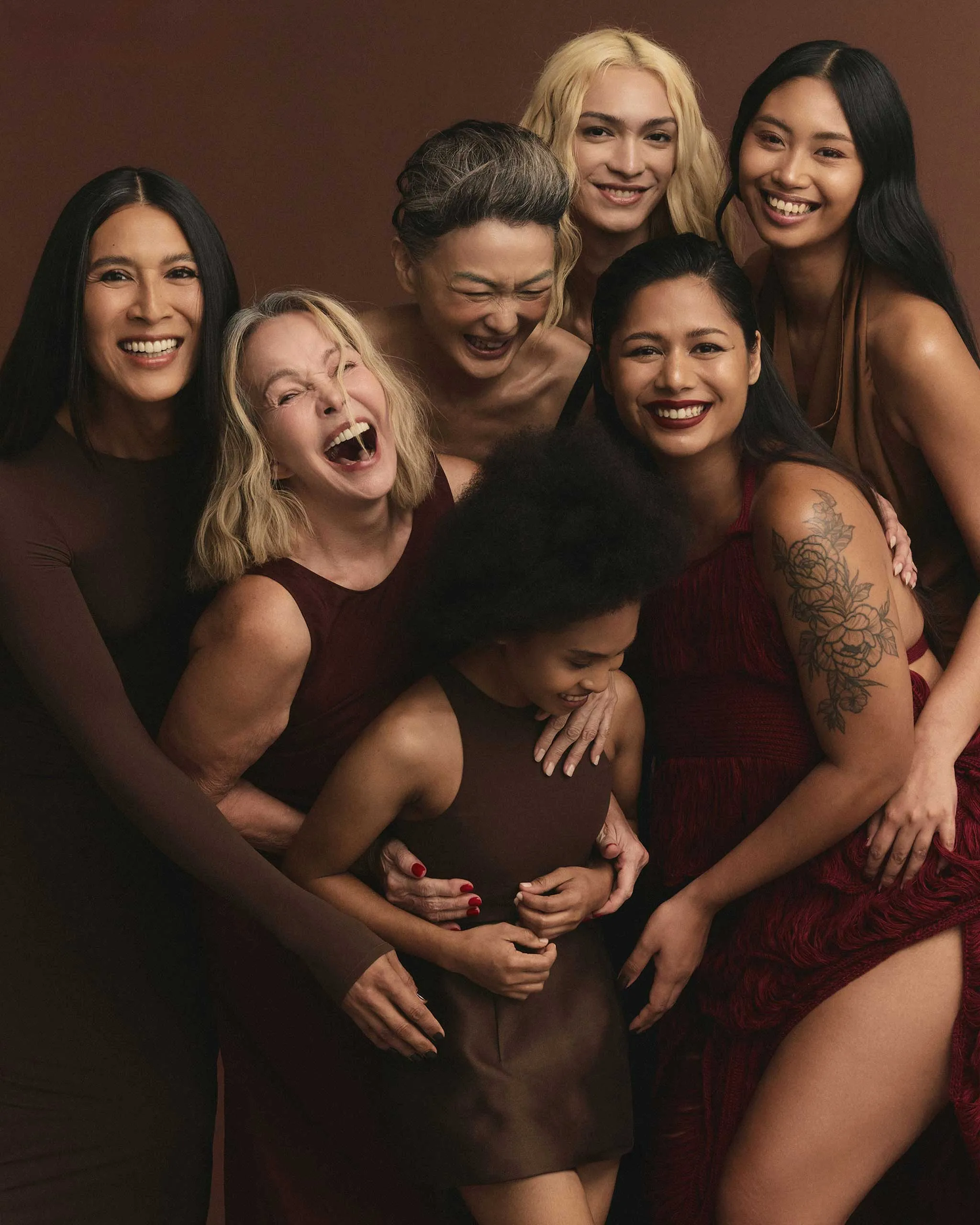
From left: Angie wears a SKIMS dress, Wanda wears a MASSIMO DUTTI dress, Marina wears a SAMSØE SAMSØE dress, Kikay wears a SKIMS bodysuit and MARTIN BAUTISTA mini skirt, Cassandra wears a SKIMS catsuit and COS dress, Teodora wears a JEROME LORICO dress, Queenie wears a vintage dress. Photographed by Renzo Navarro for the September 2025 Issue of Vogue Philippines
From skin tone to body type, gender and age, these voices prove that representation is transformational.
If you’re chronically online, you might’ve noticed a shift happening in social media discourse around health, body image, and beauty standards. A Nat Geo article describing eating disorders on the rise among menopausal women, whose hormonal imbalances can lead to weight gain, triggered a flurry of comments that attributed this trend on the pressures of living through the 1990s and 2000s where being skinny, and then extremely skinny, was idealized in fashion editorials and beaten into us by celebrity tabloids that loudly chastized very normal-looking women like Britney or Jessica should they gain a few off-duty pounds.
The era where Millennials and Gen Xers came of age was extremely messy and incredibly traumatizing for young women especially. On one hand, body shaming was rampant. On the other hand, conversations were starting the demand for more diversity and representation, amplified by the increasing reach of social media and its ability to create communities around movements like body positivity and self-acceptance.
In the Philippines, where Western beauty standards still hold sway, many women are trying to lighten their skin, chasing that kutis mestiza. Pango girlies like myself endured having our noses pinched in the brutal hope that it could reshape what our mamas gave us. These practices haven’t disappeared. It’s difficult to undo decades, if not centuries, of colonial conditioning.
Though we’ve had breakout stars like Anna Bayle who ruled international catwalks in the 1980s, giving us an early glimpse of the power of the morena beauty in a Eurocentric industry, progress hasn’t been swift nor linear. The British photographer Alexi Lubomirski, whose 2013 book Diverse Beauty celebrated women who have been deemed as “too much,” notes that while there are clients and magazines who genuinely embrace change, others are merely performing inclusivity to avoid being called out. “Even though some people go back to doing exactly what they did before, I still believe we’re in a better place. There’s still so much work to do, but we’re going in the right direction. It’s a big ship to turn around.”
“My body changed so much, and I learned to celebrate it throughout all seasons of my life.”
Teodora Cordial
Vogue Philippines beauty editor Joyce Oreña recalls how Wanda Louwallien broke from tradition by championing unconventional beauty. A former top model in the 1970s, Wanda would become one of Manila’s most influential fashion directors. When she began managing her own stable of models, she sought out fresh faces that would define the next decade, including a young Joyce just starting out in the industry in 1989. This raised eyebrows from a late lifestyle editor, who described them as “Wanda’s Uglies.” Says Joyce, “I was fortunate to be among her first models together with Lala Flores and Nol Cueto. Her roster was a diverse mix. The industry wasn’t quite ready for this varied selection, but this didn’t deter her from pushing for models with distinct looks.”
Another veteran, Marina Benipayo, has been in the public eye for nearly four decades, first as a beauty queen, then a fashion model, and later as an actress. She currently stars in the GMA series Sanggang Dikit, where she revealed her naturally graying hair. “I stopped dying my hair late last year, and also cut it very short,” she shares. “I found it liberating, and I’m glad that I was accepted for how I really look.” Not that approval was a huge concern. While some of her followers commented that the change made her look old, others were inspired to stop dying their own hair. “I’m 57 and my life has just been so busy the past 40 years, I don’t have time to worry about what people will think of me. I’ve always made the decisions for myself.” Marina adds that she has never done anything to reverse the aging process, because she wants to be able to look in the mirror and simply see herself, no one else.
Queenie Tao is no stranger to the pages of Vogue Philippines, having appeared in four editorials since the magazine’s debut. The Davao-born model is emerging as the face of the new morena movement. “Right now, everybody is celebrating being Filipino, and that’s so important. People are seeing that brown skin is beautiful,” she says. Of Blaan and Manobo heritage, Queenie hopes her indigenous roots are also being recognized. She recalls her earlier years in the industry when she and other dark-skinned girls struggled to get a booking. “Representing my kababayan in Mindanao when I did the Vogue Mindanao issue last year, that was a breakthrough for me,” she says. “I’m honored to be someone that young girls can look up to.” Queenie believes that there is space for everybody in the industry; you just have to find your niche, and the right people who believe in you and see the beauty in you.
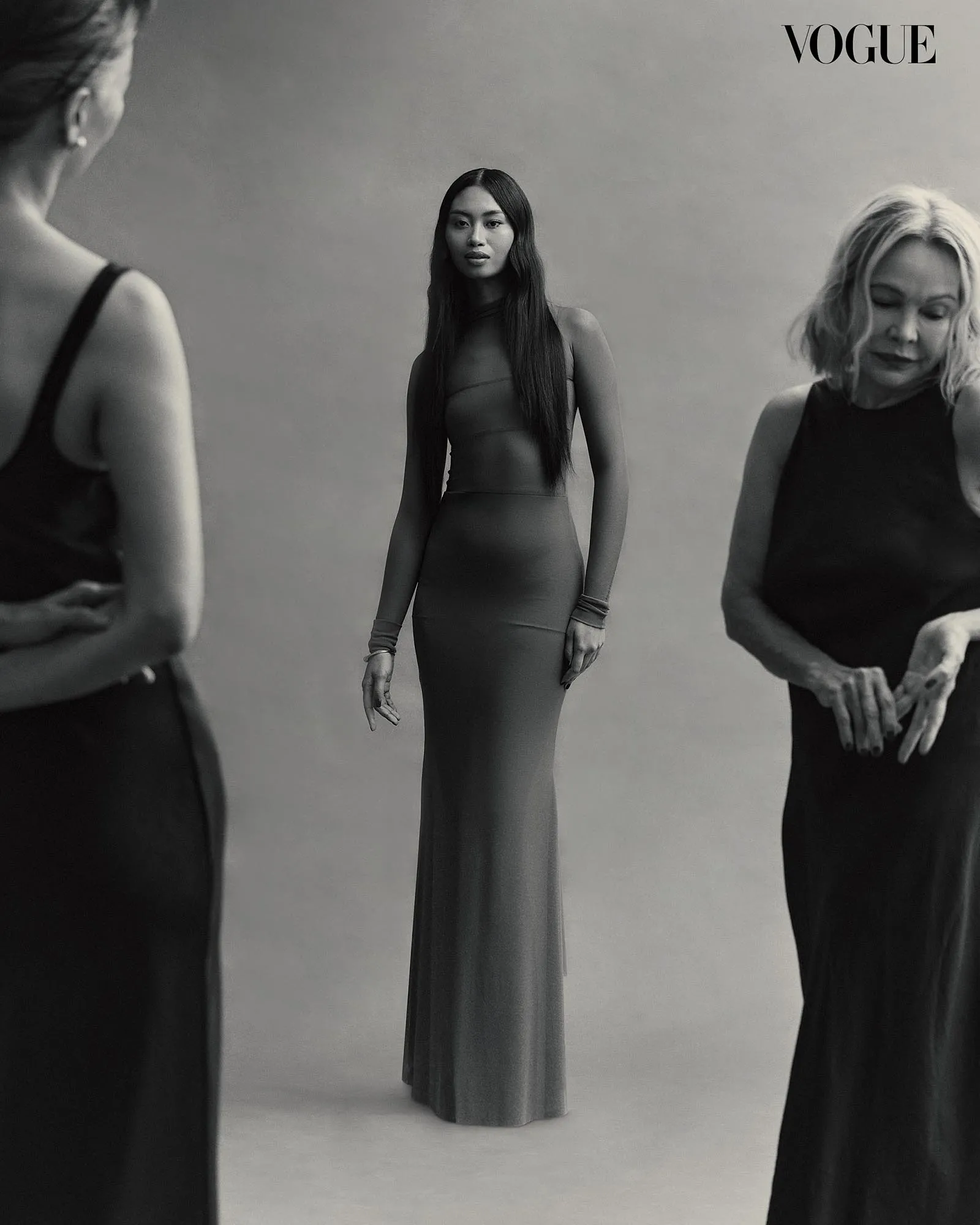
One of those girls trying to find her niche is Risaline Palaban or “Kikay,” a young woman from an underserved Aeta community in Zambales. She came to live in the designer Cheetah Rivera’s house as a kasambahay, but Cheetah and her mom saw much more in her and enrolled her in the Alternative Learning System (ALS) to continue her education. Aetas have long been marginalized and discriminated against in their own land, and when Cheetah saw Kikay using kojic soap to lighten her skin, she knew she had to do something to help Kikay value her own beauty. “Ang ganda ng balat mo, ito ang kulay ng Filipino, ng katutubo [Your skin is beautiful. This is the color of the Filipino, of our indigenous people],” Cheetah told her. She cast Kikay in a photo shoot, dressed in custom-made ternos, claiming her as one of her muses. Gradually, Kikay began to blossom: showing off her skin, letting her hair down and moving with a confidence that hadn’t been there before. “I hope this opens more doors for Kikay,” Cheetah says. Her dream is to become a teacher in her community, and modeling might just be a step toward that future.
Cassandra Lucas landed her first modeling job just two years ago through an open casting call on TikTok for the inclusive makeup brand Colourette. Since then, she has walked runways, appeared in magazines, and is steadily carving out her own space in the scene, blonde hair and all. Still early in her journey, Cass is fueled by excitement, not quite sure of what she’s doing, but knowing that it feels right. “I hope to be in every part of this industry,” she says. “I want to do commercials. I want to see myself on billboards and on buses.” As a child, she was captivated by the sexy confidence of the models who walked the Victoria’s Secret fashion shows. “I didn’t really know what being trans was, I was just a cute little princess baby girl. And I wanted to be like them.” Witnessing the fashion world open up to the LGBTQ+ community has been heartwarming, and Cass understands what it means to be part of the moment: “Representing the dolls, it’s such a powerful thing to be seen. I carry the love that they’ve given me, and I want to make them proud.”
Modeling didn’t seem like an option for Teodora Cordial, who always embraced being curvy, given the near-total lack of plus-size visibility in the Philippines. “Now that I’ve been modeling for four years, I noticed how much we needed that representation, not just for consumers but for the next generation, to show what’s possible. Sometimes we have to be the first person to do so,” she says. Born and raised in Germany, Teo moved to the Philippines seven years ago to connect with her Filipino roots. But when the pandemic interrupted her work as a German teacher, she began reaching out to agencies on her own. She found plenty of jobs modeling swimwear, activewear, shapewear, and lingerie, anything that showed off, rather than camouflaged, her body. Then Teo got pregnant, and she questioned whether she could continue her newfound career. At 32 weeks, however, she was featured in Float Swimwear’s maternity campaign, and just seven weeks postpartum, she was back on set for another swimwear shoot. “My body changed so much,” she reflects, “and I learned to celebrate it throughout all seasons of my life.”
“I don’t want to miss out on being me.”
Angie Mead King
Angie Mead King describes her life as a contrast between fast cars and slow farming. Racing one day, planting organic vegetables and beekeeping the next. There is nothing ordinary about Angie’s story, which exploded into national consciousness in 2016. “I was ready to uproot and move to LA, because the backlash for trans women coming out in Manila was so bad,” Angie recalls. “We were not prepared for the support. [The response] was the opposite of everything we imagined it to be.” What came instead was an unexpected wave of acceptance and a flood of opportunities which put her and her advocacies in the spotlight: “I had never expected to be a celebrity just because I came out.” Angie and her wife Joey have been candid about their struggles, but their unorthodox love story has provided others a vision of how relationships can survive, and evolve, on their own terms. “People told me that I was so brave. Coming out wasn’t about bravery, it was about necessity. When you realize that life is so short and fragile,” Angie says, “I don’t want to miss out on being me.”
The need to reflect the reality of diversity feels all the more urgent in the light of what’s happening in the US, where the dismantling of DEI initiatives can send ripple effects across the globe. In the Philippines, we have the opportunity to push forward and to keep telling our own stories. Keeping the momentum going seems vital, as more often than not, policy lags behind culture. Our own SOGIE Equality bill has been stalled in Congress for 25 years, despite growing awareness and support. It seems that the path to lasting change can take generations.
For influential creatives like Alexi, the responsibility falls on everyone with a voice. He published his own book on diverse beauty at a time when magazines were still reluctant to cast models whom editors considered either “too dark” or “not dark enough to make a statement.” Diverse Beauty set out to prove that anybody can look good in high fashion and that beauty isn’t something defined by labels and checkboxes. “When I had children,” Alexi explains, “I wanted to do everything I could so that one day when I finish this job, I can say to them I was standing on the right side of the fence.”
See more of this story in the Anniversary Issue of Vogue Philippines, available at the link below.
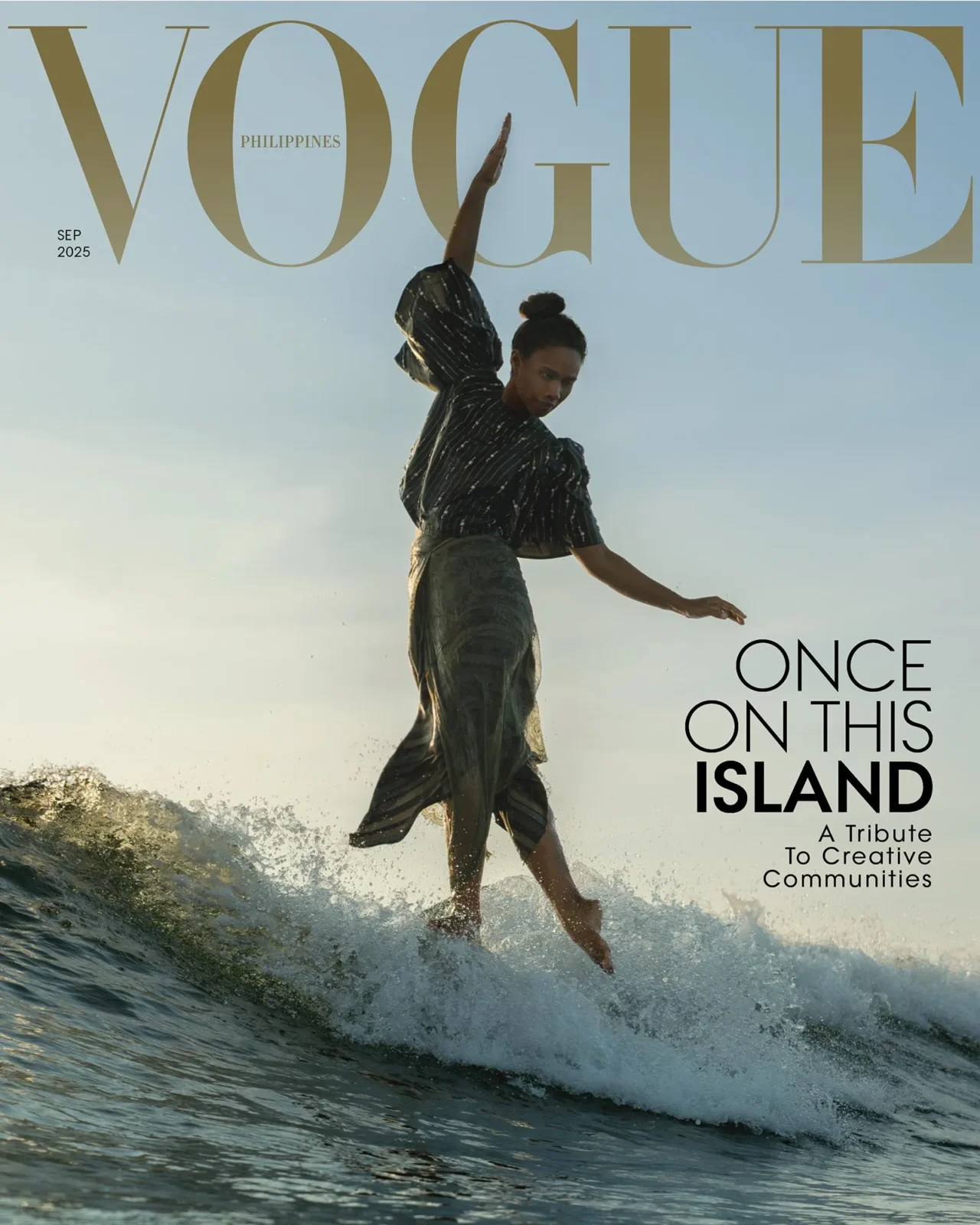
By AUDREY CARPIO. Photographs by RENZO NAVARRO. Beauty Editor JOYCE OREÑA. Fashion Editor DAVID MILAN. Art Director JANN PASCUA. Styling by STEVEN CORALDE of QURATOR. Talents: Angie Mead King, Marina Benipayo, Wanda Louwallien, Cassandra Lucas, Risaline Pabalan (Kikay), Teodora Cordial, and Queenie Tao. Deputy Editor: Pam Quiñones. Beauty Associate and Writer: Bianca Custodio. Producer: Julian Rodriguez. Art Director: Jann Pascua. Multimedia Artist: Mcaine Carlos. Styling: Steven Coralde of Qurator. Makeup: Gery Peñaso, Patricia Acejo, and Carell Garcia. Hair: Gab Villegas and JA Feliciano. Nails: Extraordinail. Photography Team: Joshua Tan and Yel Dela Paz. Additional interviews by Bianca Custodio.


