
Filipino American Actor Martin Martinez Is Finding His Place in Hollywood


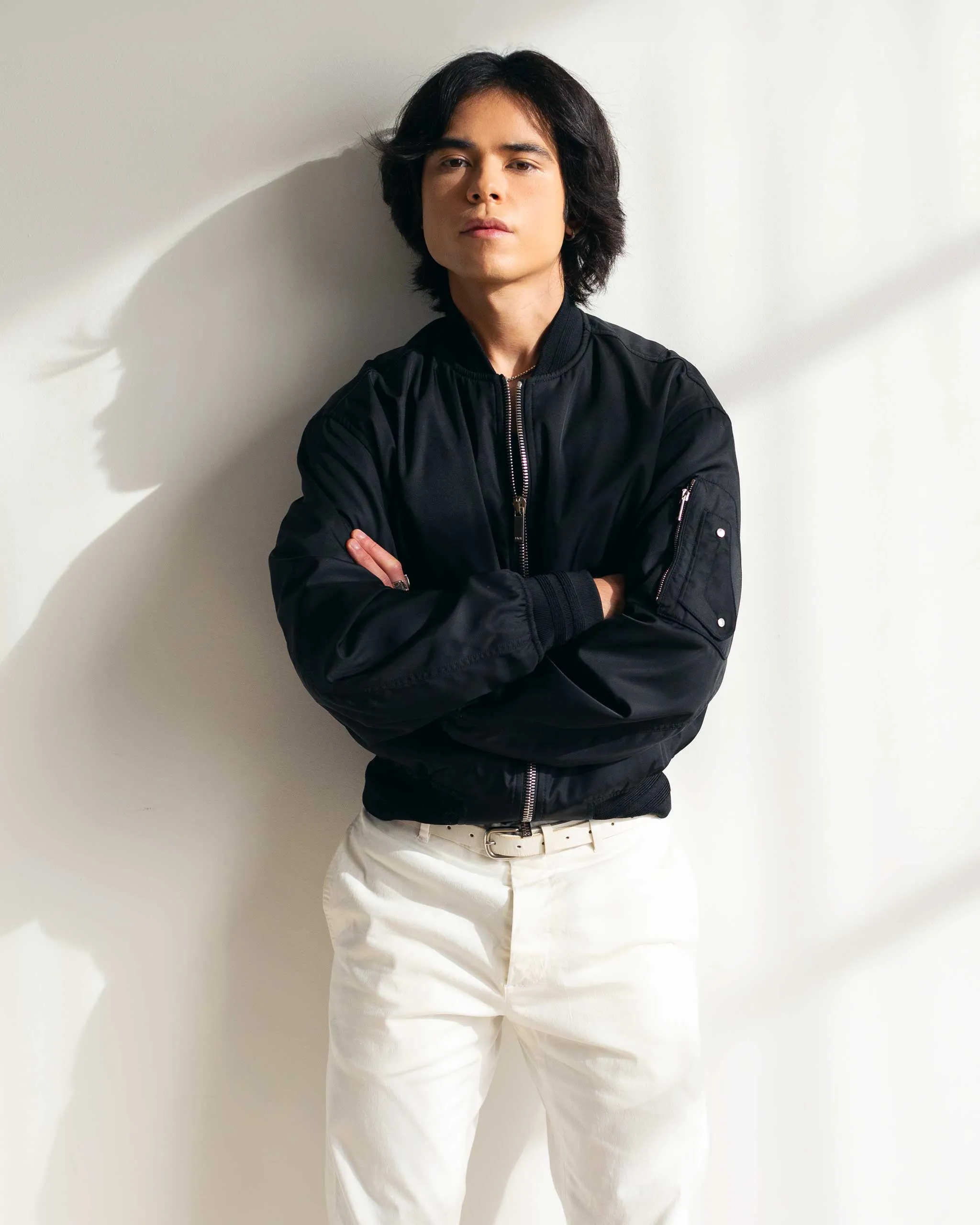
Dior Homme Bomber, Comme des Garçons belt, and Helmut Lang trousers. Photographed by Ryan Barhaug
From The Walking Dead: Daryl Dixon to Pachinko, actor Martin Martinez opens up about discipline, doubt, and building a career on his own terms.
“I’ve always felt like an amalgam of the places I’ve been and the people I’ve crossed paths with,” actor Martin Martinez says. “The things that shaped me rarely looked like lessons at the time. They were just moments of survival, instinct, and curiosity.”
He grew up moving from place to place, often navigating the world on his own. Stability was rare, but observation wasn’t. Martinez learned how to read a room, how people spoke when they felt guarded, how emotion showed up on their faces. Long before he stepped onto a set, this became his earliest acting education.
That attentiveness still defines his work today. Martinez is not an actor who demands attention; he earns it slowly, through interiority and restraint. Yet in an industry that relies on shortcuts and labels, that subtlety once made him hard to place.
“There were moments when I sat in my car after auditions and genuinely wondered if there was room for someone like me,” he says. “Being ethnically ambiguous in an industry that still relies on categories, you feel it.”
He heard the same feedback more than once: We love him, but he’s not quite right. They raised questions about whether the stories he wanted to tell were even available to him, or whether he was simply orbiting the edges of an industry that hadn’t imagined him clearly yet.
For a while, those moments felt like rejection. Then it became something else. “I realized the absence of a blueprint wasn’t a limitation,” he says. “I just had to focus on carving one for me.” Even the roles that once felt small or confining became opportunities. The doubt never fully disappeared, but it transformed into motivation. If his place wasn’t waiting to be found, he would build it himself.

The perspective was shaped early on. Martinez grew up between culturally rich but separate family worlds,” he says. “I didn’t know it then, but existing in that in-between space shaped the way I see people.”
When he began working in Hollywood, the same liminality followed him. There wasn’t a clear box for someone who looked like him. He noticed how rarely he was paired with families on screen, how often his characters existed outside traditional structures. Rather than resisiting it, he leaned in.
“Being pan-ethnic comes with freedom and with challenges,” he says. “But ambiguity became a kind of openness.” It allowed him to approach roles not as fixed definitions, but as possibilities, especially the ones that weren’t written with him in mind.”
Over time, that openness translated into a body of work defined by range. He moved fluidly between roles, appearing in culturally specific coming-of-age stories like Never Have I Ever, global prestige drama in Pachinko, and network television staples such as Magnum P.I. Along the way, he sharpened his instincts through guest roles on shows like Shameless, Chicago P.D., Marvel’s Runaways, and NCIS: Hawai’i.
Still, Martinez is clear-eyed about the realities of the industry. “Talent isn’t enough,” Martinez says plainly. Acting demands discipline, relentlessness, and an almost athletic endurance. You can give everything to a performance and still have no control over how it lands. That surrender, he says, is one of the hardest truths to accept.
Rejection, though inevitable, never becomes easy. “One of the biggest challenges has been learning how to hold onto myself; my confidence, my sense of purpose in the middle of all that unpredictability.”
Early in his career, that uncertainty showed up as pressure to simplify. He was once encouraged to Americanize the pronunciation of his name. He used his middle name for a time because it was “easier.” In audition rooms, he adjusted his energy, his appearance, trying to match what he thought the casting wanted.
“The more I tried to fit into those boxes, the more inauthentic it felt,” he says. The shift came when he stopped trying to be marketable and started trying to be rooted. “The things that I was trying to hide were actually the things that grounded me.”
“The things that I was trying to hide were actually the things that grounded me.”
The grounding became especially important on the set of The Walking Dead: Daryl Dixon, where Martinez plays T.J. The role marked a new level of visibility, but for Martinez, it was less about scale than about alignment; proof that there was room for the kind of interior, human storytelling, he had always been drawn to.
That alignment was tested again more recently when he wrapped a romantic comedy in New York, his first time leading a project as number one on the call sheet. Despite years of preparation couldn’t fully prepare him for the weight of that responsibility. The early days on set were overwhelming. “You’re adjusting to the rhythm of the crew, the pace of the shoot, the energy of other actors,” he says. “There were moments when I wondered if I was really cut out for it.”
What carried him through was commitment. “I had to remind myself I was there for a reason,” he says. “And that if this ended up being the last project I ever did, I was going to give it everything I had.” Growth, he realized, doesn’t always feel triumphant. Sometimes it feels like standing at the edge of something unfamiliar and choosing to step forward anyway.
Despite steadily expanding his presence across television, Martinez feels he is only beginning to show what he’s capable of. He’s drawn to auteur-driven films with strong visual language, to physical and movement-based roles, to elevated sci-fi and psychological thrillers. Stories that linger, that ask more.
What scares him the most isn’t failure or success, but stagnation. “I need to feel like I’m evolving,” he says. “The fear is losing the hunger.”
Ultimately, what Martinez hopes people understand is simple: he loves the work, the craft, and the lifelong pursuit of storytelling. “I’m here for the long run,” he says. “I’m always trying to grow, and I’m committed to the work, wherever it leads.”
In an industry obsessed with arrival, Martin Martinez remains devoted to the pursuit of becoming.
By DAPHNE SAGUN. Photographed and produced by RYAN BARHAUG. Styled by Cassi Crededio. Hair and Makeup: Esther Han. Stylist Assistant: Maximillion Marco. Studio provided by Slate Studios Chicago.
Frequently Asked Questions
Martin Martinez is an actor known for roles in The Walking Dead: Daryl Dixon, Pachinko, Never Have I Ever, and Magnum P.I., along with guest appearances on Shameless, Chicago P.D., Marvel’s Runaways, and NCIS: Hawai’i.
Martinez describes being “ethnically ambiguous” in an industry reliant on categories, recalling being told “we love him, but he’s not quite right” during auditions. He came to see the lack of a clear career blueprint as an opportunity to build his own path.
Martin Martinez plays T.J. in The Walking Dead: Daryl Dixon, a role he describes as marking a new level of visibility and proof that there was room for the interior, human storytelling he has always been drawn to.
Yes. Martinez says he was once encouraged to Americanize the pronunciation of his name and used his middle name for a period because it felt “easier,” before realizing that authenticity, not marketability, was what grounded his work.
Martinez says he’s drawn to auteur-driven films with strong visual language, physical and movement-based roles, and elevated sci-fi and psychological thrillers, expressing that his greatest fear is stagnation rather than failure.