
For Saja Kilani, Palestinian Fashion Was the Only Choice for the Golden Globes


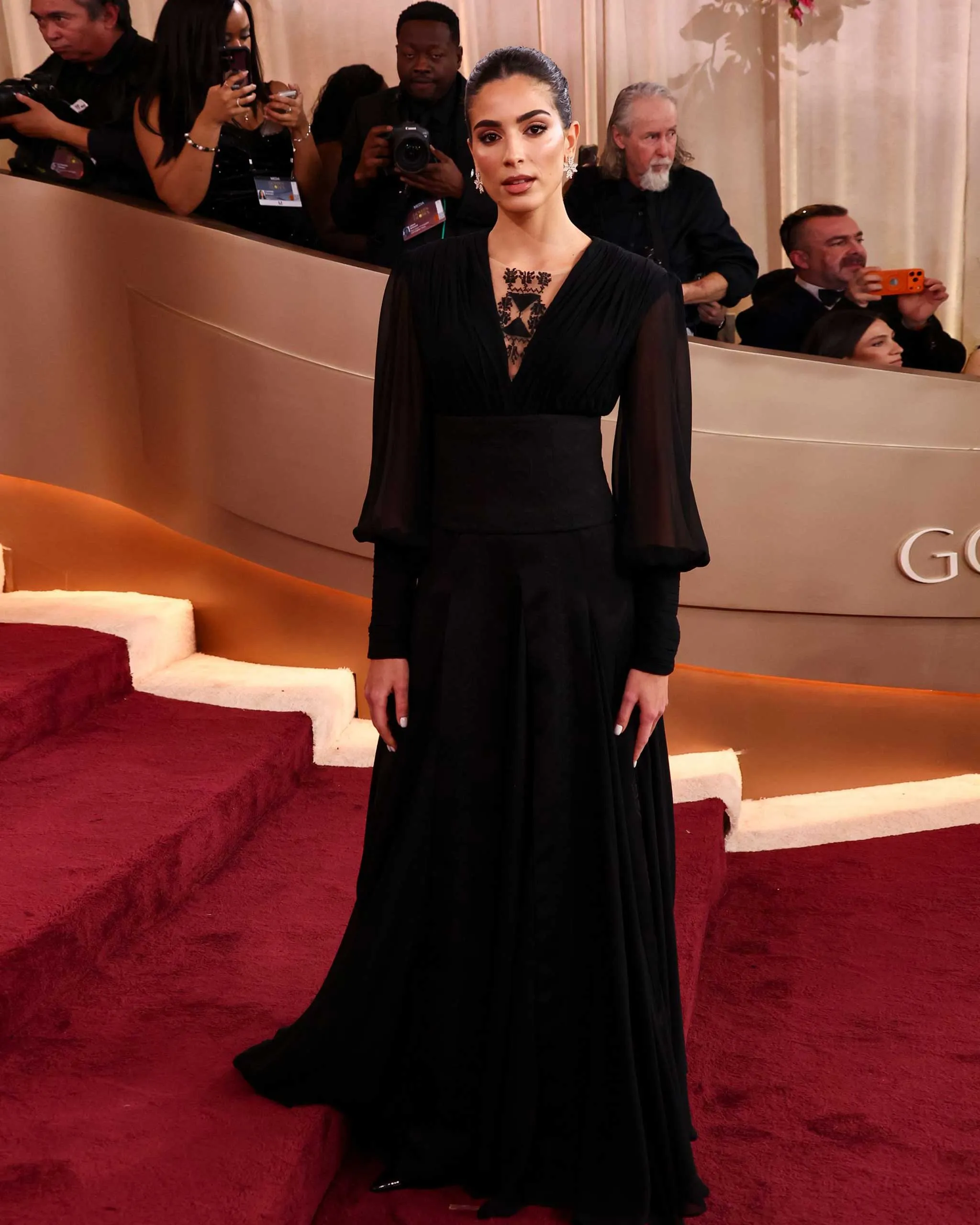
Saja Kilani’s earrings reference traditional Palestinian embroidery, or tatreez, as does the neckline of her custom Reema Dahbour dress. Tommaso Boddi/2026GG/Getty Images
For Saja Kilani, “sometimes fashion says what words cannot.” The Palestinian-Jordanian-Canadian actor, one of the stars of The Voice of Hind Rajab, is referring to the dress she’s wearing for the 2026 Golden Globes – and certainly, anyone would struggle to convey what it means for the cast of Kaouther Ben Hania’s docudrama to be on the red carpet tonight.
Kilani turned to Reema Dahbour – who has previously dressed the likes of supermodel Bella Hadid and Princess Iman of Jordan – for a custom look inspired by a traditional Palestinian thobe. “For the Globes I felt it was important to me to wear something that represented the region, but in a quiet, powerful way,” says the actor. “Reema is a friend of mine, and we created this custom piece together: the goal was to bridge tradition and modernity, in a way.”
To that end, Dahbour added an element of tatreez – an ancient Palestinian embroidery technique – at the neckline. “It sort of looks like a necklace, and it holds a meaning,” Kilani explains. “Traditionally women stitched this amulet as an act of care – to offer spiritual protection.” Thus rooted in tradition, the dress was made modern with a dramatic silhouette: “I wanted to reference strength with the accentuated shoulders, and the structured belt gives it an architectural edge.” The colour is symbolic, too. It represents mourning, Kilani says, “but I also feel like black is a powerful, strong colour. It shows the resilience, as well.”

Clearly, the human story behind The Voice of Hind Rajab – and the ongoing suffering of the Palestinian people – is never far from Kilani’s mind. Made in the midst of Israel’s assault on Gaza following the events of 7 October 2023, Ben Hania’s film tells the true story of five-year-old Hind, whose family attempted to flee north through Gaza City in January 2024. She was travelling in a car with her aunt, uncle and four young cousins when Israeli troops opened fire on their vehicle, killing all but Hind. She died some three-and-a-half hours later, after the ambulance deployed to rescue her was struck by a tank shell, killing the two paramedics inside.
Kilani plays Rana Faqih, the real-life Palestine Red Crescent Society (PRCS) volunteer who spoke to Hind in the final hours of her life as she waited, surrounded by the bodies of her family, for help to come. “I’ve had contradicting feelings about it,” the actor confesses, of the dissonance between the subject matter the film deals with and dressing up to walk the red carpet at festivals and awards ceremonies. “But I want to be proud of the work we’ve done.”
In the end, it was meeting Hind’s mother that gave her a different perspective. “I asked her, ‘How do you feel about us attending awards shows?’ She told me, ‘As Palestinians we love to get dressed, we love to put on make-up – this is who we are.’ She kind of gave me this validation to continue. Sometimes fashion says what words cannot – it’s kind of its own language. And especially in the Palestinian heritage, embroidery plays a very key role in preserving memory.”
This article was originally published on British Vogue.
Frequently Asked Questions
Saja Kilani wore a custom black gown by designer Reema Dahbour, inspired by the traditional Palestinian thobe, featuring tatreez embroidery at the neckline, accentuated shoulders, and a structured belt for an architectural silhouette.
Tatreez is an ancient Palestinian embroidery technique. On Kilani’s gown, it was incorporated at the neckline in a design resembling a necklace, traditionally stitched by women as an act of care believed to offer spiritual protection.
Saja Kilani plays Rana Faqih, a real-life Palestine Red Crescent Society volunteer who spoke with five-year-old Hind Rajab in the final hours of her life, after Israeli troops opened fire on the vehicle carrying Hind and her family in Gaza City in January 2024.
The Voice of Hind Rajab, directed by Kaouther Ben Hania, tells the true story of five-year-old Hind, who died after an ambulance sent to rescue her was struck by a tank shell, killing the two paramedics inside, following an earlier attack on her family’s vehicle.
Kilani chose black to represent mourning while also expressing resilience and strength, saying the color reflects both grief and the endurance of the Palestinian people amid the film’s difficult subject matter.
- The Story Behind Bella Hadid’s Palestinian “Olive Oil” Dress
- Bella Hadid Expresses Her Palestinian Heritage In a Keffiyeh Dress
- 5 Ways to Help Those Suffering in Israel and Gaza
- From Bella Hadid’s Keffiyeh Dress To Cate Blanchett’s “Watermelon” Moment, This Year’s Cannes Red Carpet Has Been Particularly Politically Charged