
The Blu Girls Are Rebuilding the Legacy of Philippine Women’s Softball


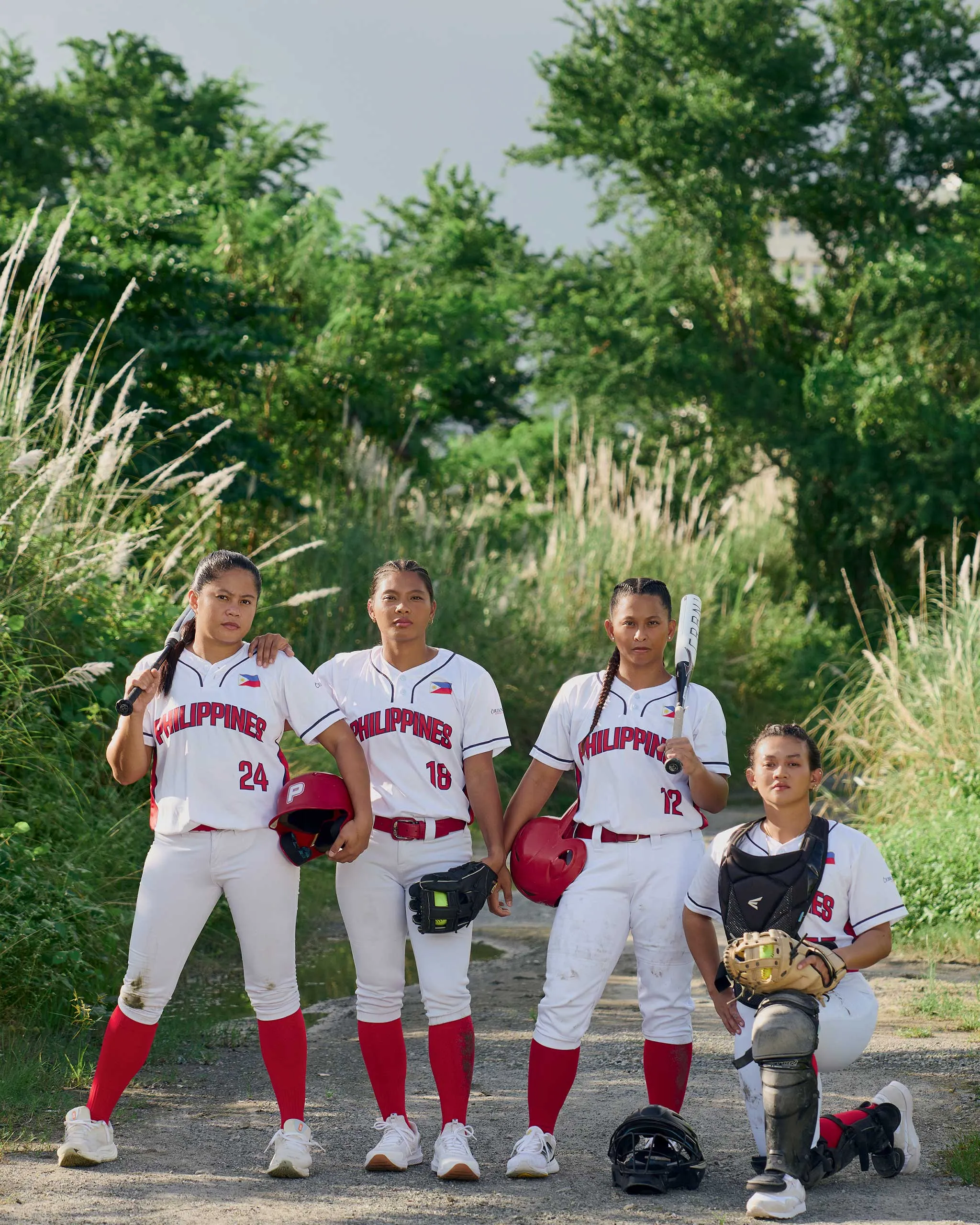
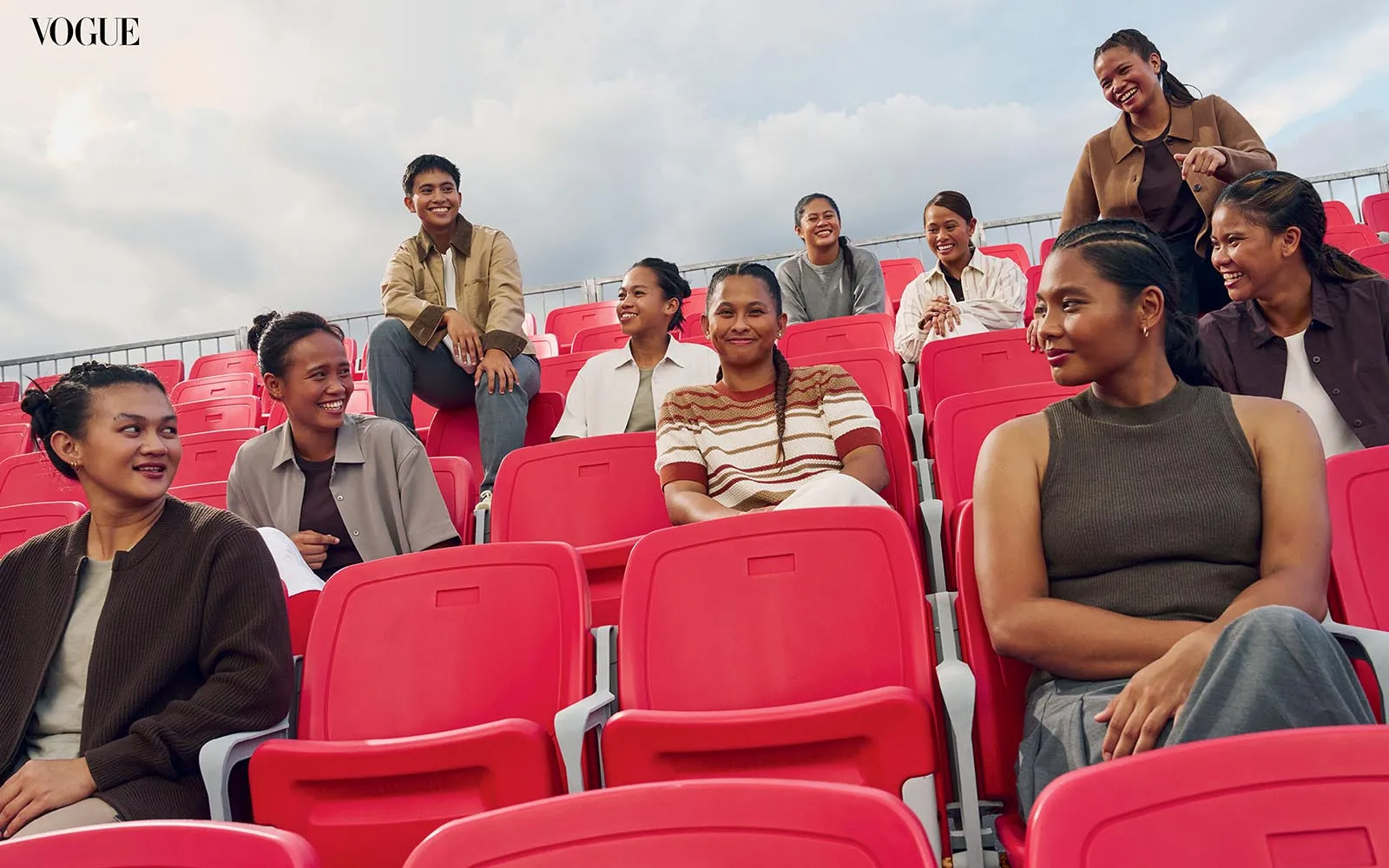
From left: Senior players Alaiza, Reyae, Charlotte, and Angelu wear their national team uniform. Photographed by Sonny Thakur for the December 2025/January 2026 Issue of Vogue Philippines
Once a powerhouse in Asia, the Blu Girls are rebuilding the legacy of Philippine women’s softball with a new generation defined by mental resilience.
Softball is a game of failure.
Cheska Altomonte leans forward, her hands tracing a play in the air. Even through the grain of a video call, her energy is contagious. As former captain of the Philippine women’s national softball team and now secretary general of the Amateur Softball Association of the Philippines (ASAPHIL), she lays out the odds: a player swings ten times and connects with only three. It doesn’t sound like much, but in this high-pressure sport, that’s already considered good. Just getting on base three times out of 10 is a high statistic. “Softball is a game of failure,” she repeats, her smile widening, the thrill of the game clear in her voice. “And you have to be able to handle that. You need to learn how to fail well.”
It’s a statement that seems at odds with their record. Known widely as the Blu Girls, the Philippine women’s national softball team have long been the strongest in Southeast Asia, never finishing with anything less than gold in the region. Since the sport’s inclusion in the Southeast Asian Games, they have held every championship title and once ranked among the world’s top contenders, reaching as high as third at the Women’s Softball World Championship in 1970 and fourth in 1974. Today, this long legacy lives in a new generation of players.
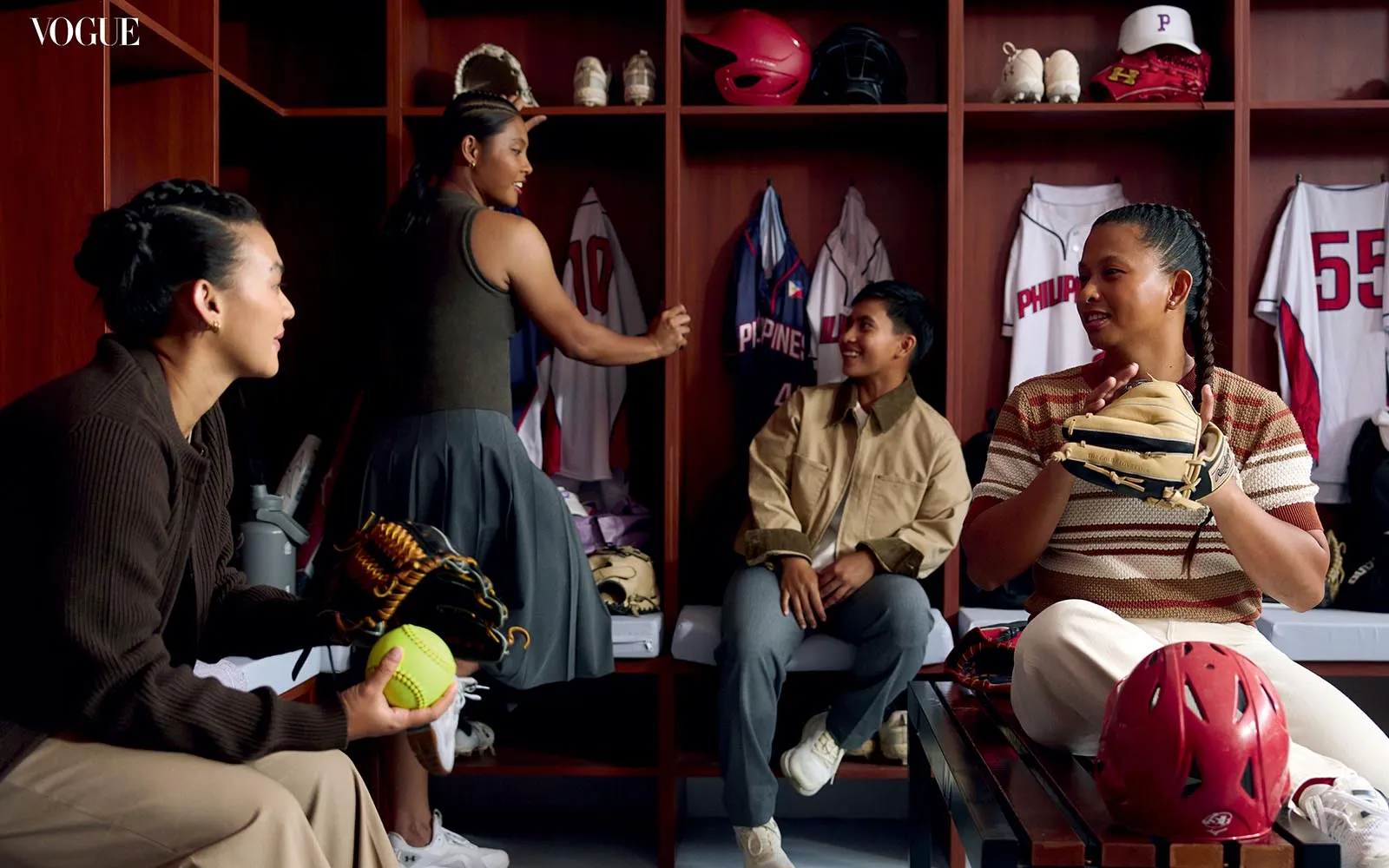
At barely seven in the morning, the sun was already high over the Felino Marcelino Sr. Baseball Stadium in Taguig, washing the field in warm light. Under the shade near the dugout, the Blu Girls sat in small clusters, laughing and talking over one another, their voices carrying across the grass. The team moved with a kind of alert ease, lively and unmistakably at home in their own company.
At the helm was team captain Charlotte Sales, who, even on a day off like today, kept the group in sync. Around her, the team looked like any group of young women their age, save for the athletic builds and faint sun spots that marked hours under the heat of the field. Most of the team’s current 17-player roster are in their early 20s, just at the start of their careers. Some still balance college classes with training, others newly graduated. They come from places scattered across the country, from Bukidnon to Rizal to Cavite, each pulled into the sport for different reasons: influenced by a mother who used to play, a cousin’s suggestion, a teacher’s insistence, or a passing curiosity that deepened into a love for the game.
At its simplest, softball looks like a cousin of baseball: a bat, a ball, and four bases forming a diamond. But the difference is in the speed, and the split-second decisions it demands. The field is smaller, the pitches come underhand but fast and spinning, and the space for error is slim. One misread pitch or wrong throw can shift the rhythm of an entire game.
“You can make a plan, but anything can really happen in a play,” explains Altomonte, who has spent over a decade playing for and managing the national team. “It’s really in the moment: you make a decision when the ball is hit. One missed pitch, it goes inside, and the whole play changes. Coaches can plan for something, but it almost never goes exactly as planned.”
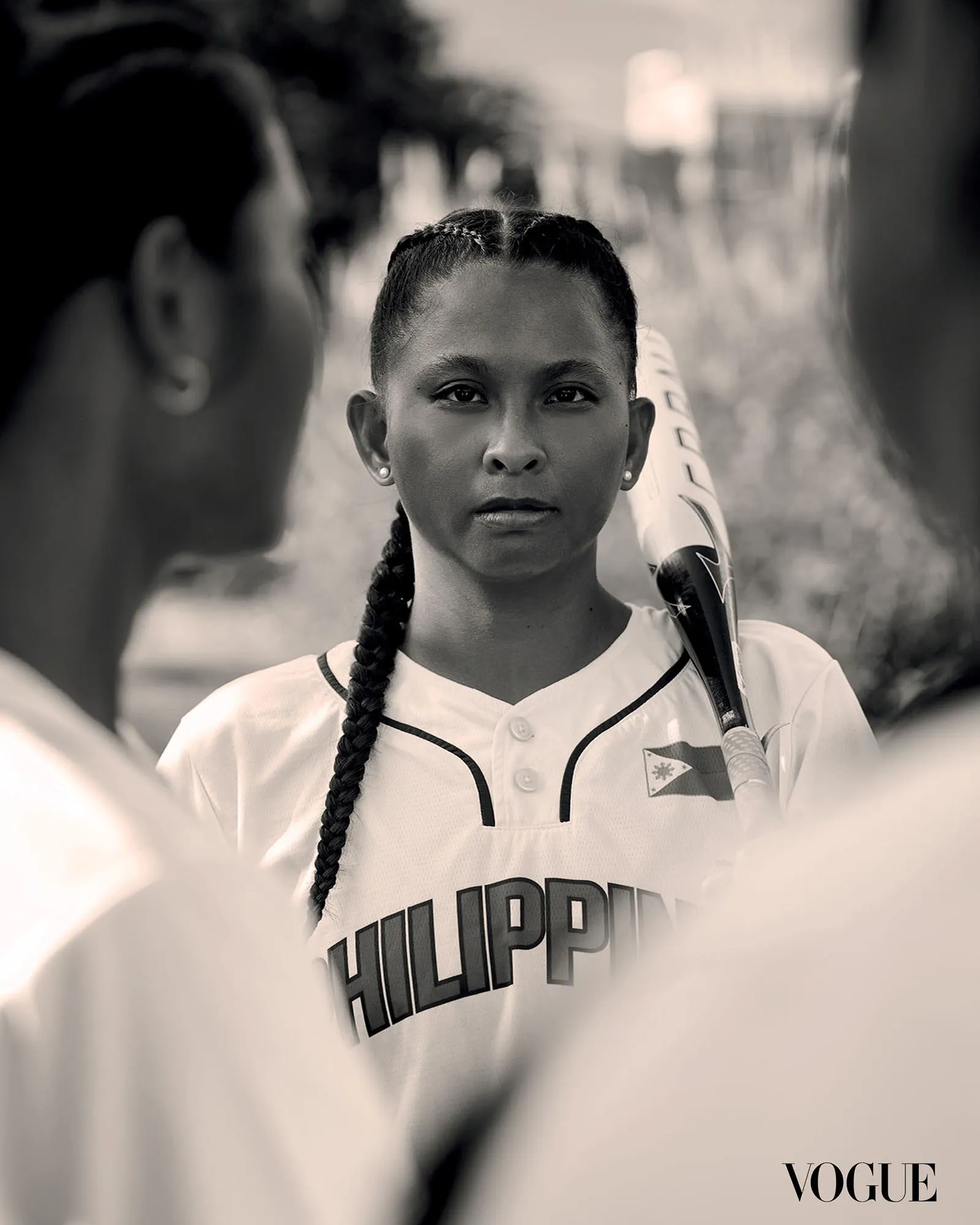
Every position on the field carries weight. The pitcher controls the tempo, the catcher calls the plays (“the eye of everyone,” as rookie Victoria Magbanua describes it), and the infielders and outfielders respond in unison, covering ground and anticipating every move. What makes the sport fascinating isn’t just its physical precision but its mental demand. Players are trained to recover fast, to reset after mistakes, to move on after a bad inning. “When there’s a problem in the field or we make a mistake, we can’t pause and sulk in a corner,” says rookie outfielder Mary Jane Libaton. “Outside softball, it’s the same. You can’t be held back by your problems. You need to fight through it.”
In a game where most attempts end in failure, what ultimately defines a good team is how they respond to it.
At the time of writing, the Blu Girls are coming off a fourth-place finish at the 2025 Women’s Softball Asia Cup, where they delivered strong performances against Asia’s best, including Olympic champion Japan and world top-five teams Chinese Taipei and China. The result marks steady progress for a largely young team still finding its rhythm after years of transition and amid a season of rebuilding. This December, the team is gearing up for the SEA games, where they’re expecting yet another gold. But it has taken years for the program to reach this point. For more than half a century, Philippine women’s softball has learned, time and again, what it means to fall behind and find its way back.
“Way back when, the Philippines was a powerhouse in softball,” shares Altomonte. By the 1990s, however, the country’s dominance began to wane. “Eventually, we started lagging and falling behind other countries. All the other programs started getting better, and we started getting left behind.”
“Softball is a game of failure. You need to learn how to fail well.”
At the 1990 ISF Women’s World Championship in Illinois, the team finished with four wins and five losses, and by 1998, in Japan, they dropped to sixteenth place. Much of this decline was tied to shifting national priorities. When softball was removed from the official calendars of the SEA Games or Asian Games, the national training pool was dissolved, leaving players and coaches to rebuild from scratch each time the sport returned.
“It’s actually a very expensive sport,” Altomonte explains. “Everybody needs equipment: mitts, bats, balls. Bats now cost around USD300 to USD400 a bat, the mitts are about USD100 plus, and a dozen balls cost around PHP14,000. Then there’s the issue of field accessibility. Right now, they shut down Rosario Field in Pasig, and they shut down Marikina Field. Those were the main fields we grew up in. Now, all the teams are training and playing at Rizal Memorial Baseball Stadium.”
It wasn’t until the early 2000s that a slow revival began. Businessman and former national player Raul Saberon secured private support from Jean Henri Lhuillier, who would later head the ASAPHIL. With renewed funding and structure, the program gradually regained footing. The turning point came in 2017, when the Blu Girls finished second to Japan at the Asian Women’s Softball Championship, their best regional result in forty-five years. The podium finish qualified them for both the 2018 Women’s Softball World Championship and the 2018 Asian Games, marking their return to the international stage. By 2019, the Blu Girls had re-established clear momentum, and in the 30th SEA Games, they swept all opponents to claim gold, marking their tenth straight title in women’s softball. And then, the pandemic hit.
“At one point, we were ranked 11th in the world. We were doing really, really well, winning against the top 10 teams in the world. But because of the pandemic, we couldn’t participate in a lot of tournaments, so our ranking went down,” Altomonte recalls. The global crisis forced yet another pause in competition, but by 2023, a younger, mostly homegrown team had begun to take shape.
“There’s excitement again. Of course, they’re a little young when it comes to exposure and handling high-pressure moments, but they’re competitive, and I’m really proud. It’s not just a new team, new athletes, but also a new generation,” shares Altomonte. “Watching them [play in the recent Asia Cup] got me super excited. It made me feel even more like this team is worth fighting for. And they’re great kids, not just as softball players, but as people. They’re just really good kids.”
“Lahat kami galing sa hirap eh. (We all came from humble beginnings,)” team captain Charlotte Sales shares. “Nagsimula kami sa pinakababa din talaga tapos ngayon nandito na kami. Sobrang laking bagay din nito. [We really started from the bottom, and now we’re here. This is a big deal for us.]”
She takes her role seriously: “It’s a team sport, so I have to make sure the team acts as one. If one person makes a mistake, that falls on all of us.” Still, she’s quick to point out that the responsibility doesn’t feel heavy, because her teammates share the weight.
And their unrestrained affection is impossible to miss. On set, Charlotte moved easily among her teammates, straightening a collar here, brushing off dirt there, absently playing with someone’s hair as she watched over the shoot. The others followed suit, wiping each other’s sweat between layouts without hesitation and exchanging endless streams of encouragement that moonlight as playful banter. It’s clear to anyone paying close attention that they’re young women growing together and coming of age in and beyond the field.
“80 percent of winning or losing comes from mental toughness.”
According to second and third baseman Neo Mahinay, the lessons extend beyond drills and game plans. “For our coaches, it’s not just skills and playing that we focus on. It’s not like that with Coach Ana,” she explains. “What she really teaches is inside and outside the field. Through challenges, we get to boost ourselves, to build up strength, to be strong enough to handle all of life’s problems.”
Head coach Ana Santiago has led the Blu Girls on and off since 2007. Her reputation precedes her: part strategist, part mentor, fully invested in the players’ growth. “I’m really a believer in mental toughness,” she says. “In the past, it was always neglected. But for me, 80 percent of winning or losing comes from mental toughness.”
As a coach, she strikes a strict balance between physical discipline and mental training. From Monday to Saturday, practices begin at dawn, alternating between defensive and offensive sessions, conditioning, and scrimmages. But Santiago also makes time for what she calls mental reps: film sessions, one-on-one talks, and reflections meant to strengthen focus and emotional control. Open communication with her players is what she considers to be key to the growth of the team.
“We spend a lot of time together, so I know my players well. I can tell when they’re feeling down or struggling. That’s when I take time to talk to them one-on-one,” she explains. “I schedule those talks, sometimes even while walking together, just simple check-ins to ask how they’re doing and what their emotional state is. It may be simple, but I think it really helps a lot.”
To reinforce the team’s mental conditioning, she also makes it a point to partner with sports psychologists from the Philippine Sports Commission, integrating their sessions into the team’s regular training cycle.
That approach has shaped a culture where openness is as important as grit. “Before, it was very old-school, no feelings, just play,” Altomonte explains. “Now, they talk about what they’re struggling with. You can physically see them snap out of it. They’re learning how to regulate, how to reset.”
To Altomonte, the Philippine national team has the skills to become world champions. Their future simply depends on experience, exposure, and determination. “This sport is something Filipinos can excel in,” she says. “It’s a sport where physicalities don’t really matter. You can be short and still have an advantage, or you can be tall and have an advantage. [Filipinos are] resilient. I think it’s just our nature. It’s who we are. And we’re able to become the best in the world with a lot less resources than other countries.”
She adds, “The Philippines is going to be one of the most competitive teams out there. I truly believe that. It’s not just a dream. It’s something we’re working towards, and it’s going to happen. Everyone on the lineup now is committed. They’re here for the long haul. They see the goal, and they’re working towards it. I have high hopes for this team, for the Asian Games next year, the Olympic qualifiers, and for the program in general.”
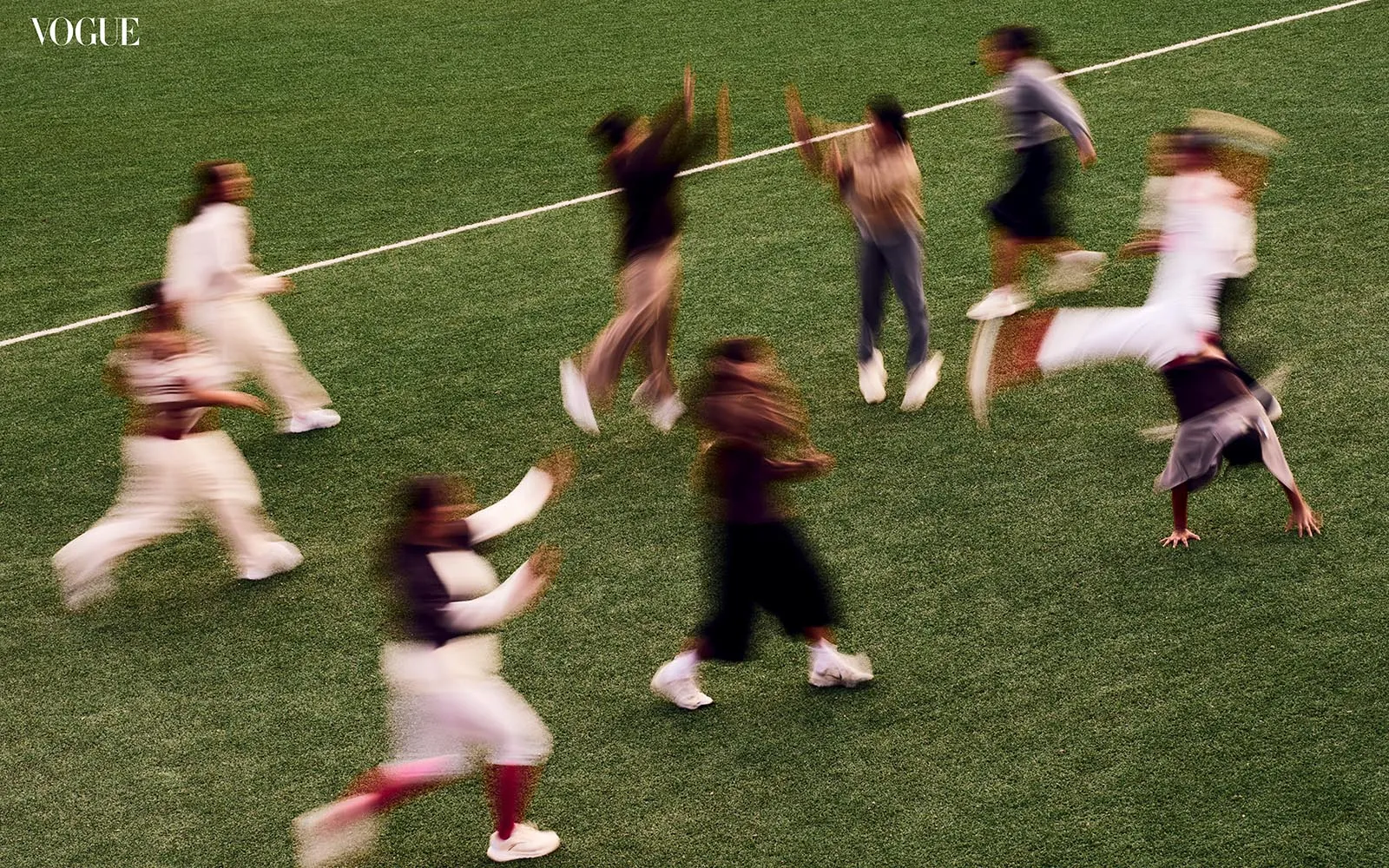
As the day wrapped at the Felino Marcelino Sr. Baseball Stadium, the light turned a pale violet, the kind that softens the edges of the field. The girls lay in the grass, laughing, catching their breath after hours under the sun. Then someone picked up a bat, another called for a ball, and soon they were playing again, an impromptu rally, no score, no pressure. It was pure instinct, pure play.
Watching them, it was easy to understand what keeps this team, and this sport, alive. Beneath every repetition, every early morning, every game plan and mental drill, there is love: love for the game, love for their teammates, and love for the quiet progress that comes from showing up again and again. It’s the same love that threads through Santiago’s voice when she talks about her players, and in Altomonte’s when she describes the team’s future.
In a sport built on learning how to fail well, that love might just be what keeps them standing.
See more exclusive photographs from this story in the December 2025/January 2026 Issue of Vogue Philippines, available at the link below.

By BIANCA CUSTODIO. Photographs by SONNY THAKUR. Beauty Editor JOYCE OREÑA. Fashion Editor DAVID MILAN. Talents: Alaiza M. Talisik, April Mae B. Minanga, Jhaycel B. Roldan, Ma. Angelu Gabriel, Ma. Charlotte Narcs P. Sales, Mary Jane Libaton, Ma. Victoria P. Magbanua, Neo May C. Mahinay, Reyae Mae L. Villamin, and Roma Jane R. Cruz. Art Director: Jann Pascua. Producers: Mavi Sulangi and Julian Rodriguez. Copywriter: Aylli Cortez. DIT: Kyle Espedido. Gaffers: Andrew Cadorna and Raymond Orquia. Videographer: Marko Bonifacio. Makeup: Gery Peñaso, Xeng Zulueta, Vince Leendon, and Christian Ray Arapoc using Dior Beauty. Hair: Glenda Eugenio, Christian Serioza, Tina Alvaran, Renalyn Laoreno, Carol Pauso, and Kristia Marie Angeles of Toni&Guy.
Special thanks to Mayor Lani Cayetano and the City Government of Taguig. Shot on location at the Felino Marcelino Sr. Baseball Stadium.